UK
The Deekay Aircraft Corp. Ltd. was formed in 1937 to build aircraft using a new type of wing construction developed by S.C. Hart-Still. Built the side-by-side two-seat Knight, designed by S. C. Hart-Still at Broxbourne in 1937. One completed; scrapped during war.
Inter-Wars
Dayton-Wright TR-5
Had a single wheel landing-gear.
Dayton-Wright TR- 3
Side-by-side two-seat (last rotary-engined design for U.S. Army)
Dayton-Wright RB Racer
In 1920 Milton C. Baumann designed the revolutionary RB Racer, with solid all-wood wing, totally enclosed cockpit and retractable landing gear linked to rod-operated leading and trailing-edge camber-changing flaps.
Dayton-Wright Messenger
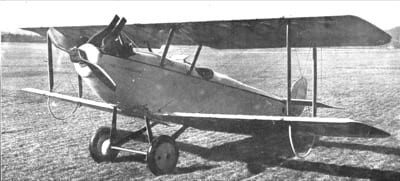
The Dayton-Wright Messenger biplane was designed by Oliver Thomas in 1918. It was powered by a 37-hp DePalma V-4 engine. Dayton-Wright hoped to get an Army contract. Failing that, it was planned to sell on the civil market, but only one was built.
Engine: 37-hp DePalma V-4
Span: 19 ft 3 in
Length: 17 ft 6 in
Empty weight: 476 lb
Loaded weight: 636 lb
Speed: 85 mph
Dayton-Wright Airplane Co
USA.
Formed during First World War at Dayton, Ohio, for quantity aircraft production, with Orville Wright as consulting engineer. Built Liberty-engined DH-4 (the “Liberty plane”) and Standard J-1. In 1919 built a limousine version of DH- 4, single-seat Messenger, and also a three-seater. In 1920 Milton C. Baumann designed the revolutionary RB Racer, with solid all-wood wing, totally enclosed cockpit and retractable landing gear linked to rod-operated leading and trailing-edge camber-changing flaps. Built the USB-1, an Engineering Division redesign of the Bristol Fighter; 1921 twin-engined seaplane; side-by-side two-seat TR- 3 (last rotary-engined design for U.S. Army) and singlewheel landing-gear TR-5. In 1922 built Douglas DF-2. In 1923 the parent company, General Motors, abandoned aviation and dissolved Dayton-Wright; aeronautical work of the company taken over by Consolidated Aeronautics Inc.
The Dayton-Wright Company approached the USAAS to replace their World War 1-era Curtiss JN-4 “Jenny” series of trainers and was in turn asked to deliver three TA-3 models for evaluation. Though the design itself proved promising enough, the TA-3 (designated with an “A” for its air-cooled engine operation) was delivered by request with an uprated Le Rhone engine of 110 horsepower. Still further evaluation models were ordered, this time with the requested Wright-Hispano I V-8, 150 horsepower engine of increased power (designated TW-3 with the “W” standing for its water-cooled engine process) finally culminating in an official order by the USAAS.
Production rights for the trainer were secured by the newly-created Consolidated Aircraft Company (established by Reuben Fleet of the Gallaudet firm) as General Motors was reviewing their commitment to aircraft production in a post-war world and would eventually shut down operations at Dayton-Wright altogether. The TW-3 was delivered by 1923 and became the first notable variant of the “Trusty” production line.
Dayton Grant / O-765
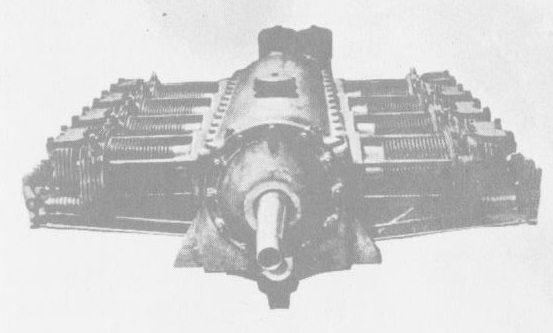
The 1929 Dayton Grant featured steel cylinders with detachable aluminium heads, with bronze valve seats shrunk in the heads. There is a special tulip valve design of special steel, one exhaust valve and one intake valve per cylinder.
The aluminium alloy pistons have full floating hollow piston pins. The crankshaft is one piece, with five bearings.
Equipment was an instruction book, tool kit, and exhaust flanges.
Available at extra cost were C-5 fuel pump, hub for a wooden or steel propeller, and starter.
Type: 8 cylinder horizontal opposed
Military Rating: 225 hp at 1800 rpm
Commercial Rating: 240 hp at 2000 rpm
Displacement: 764 cu.in
Compression ratio: 5.3-1
Bore: 4 1/2 in
Stroke: 6 in
Length: 56 in
Width: 44 in
Height: 20 in
Weight: 500 lb
Fuel consumption: not more than 1.05 lb/hp/hr
Oil consumption: not more than .025 lb/hp/hr
Lubrication: Force feed
Ignition: Dual spark magneto or generator for battery ignition
Carburation: 2 Zenith or Stromberg
Spark plugs: 2 B.G. per cylinder 1 XA
Dayton Bear
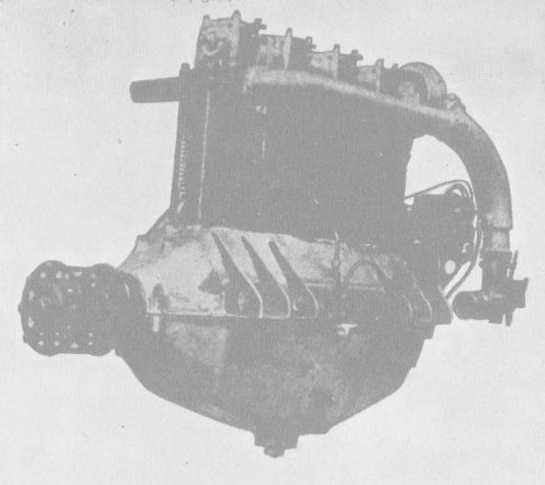
The 1928 Dayton Bear was a modified Hall-Scott A-7 engine. Equipment included a hub for a wooden propeller, exhaust flanges. Instruction book, and tool kit.
Accessories available at extra cost were a fuel pump drive, C-5 fuel pump, starter, and hub for a steel propeller.
Type: 4 cylinder inline, air cooled
Approved Type Certificate No.11
Military Rating: 110 hp at 1500 rpm
Rating: 120 hp at 1850 rpm
Displacement: 445 cu.in
Compression ratio: 5.1-1
Bore: 4 1/2 in
Stroke: 7 in
Length: 50 3/32 in
Width: 18 1/4 in
Height: 38 27/32 in
Weight: 375 lb
Fuel consumption: not more than .525 lb/hp/hr
Oil consumption: not more than .0125 lb/hp/hr
Lubrication: Force feed
Ignition: 2 Dual Bosch magnetos
Carburation: Zenith L-8
Spark plugs: 2 per cylinder B.G. 1 XA.
Price: $1450
Dayton Airplane Engine Co
Circa 1920s engine builder
Dayton
Ohio
USA
Day Model A Special
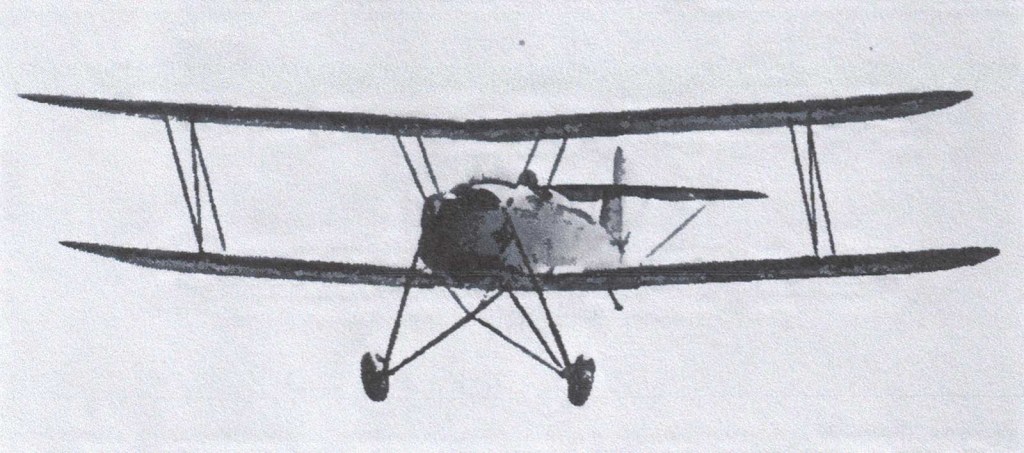
The Day Model A Special was planned originally for pilots with limited experience by offering them a safe, easy to fly aircraft. An early light plane around-the-world-flight was successfully achieved by Charles Healy Day with his wife Gladys in 1931. They completed a 24,000 mile global tour in an open cockpit, side by side biplane he designed.
Day was a highly respected aeronautic engineer. He designed the Standard J-1 in 1914 which was used to teach World War I cadets to fly. It was also a favorite of barnstormers during the 1920’s. He also designed the later five-place New Standard GD-24 and D-25.
The 34 foot span airplane was powered with a 120 hp Martin D-333 engine. Their seven month tour included flights over 20 countries with visits to 74 cities and covered 16,000 miles flown over land and 8,000 miles with their aircraft loaded aboard ship for crossing the Atlantic and Pacific oceans.
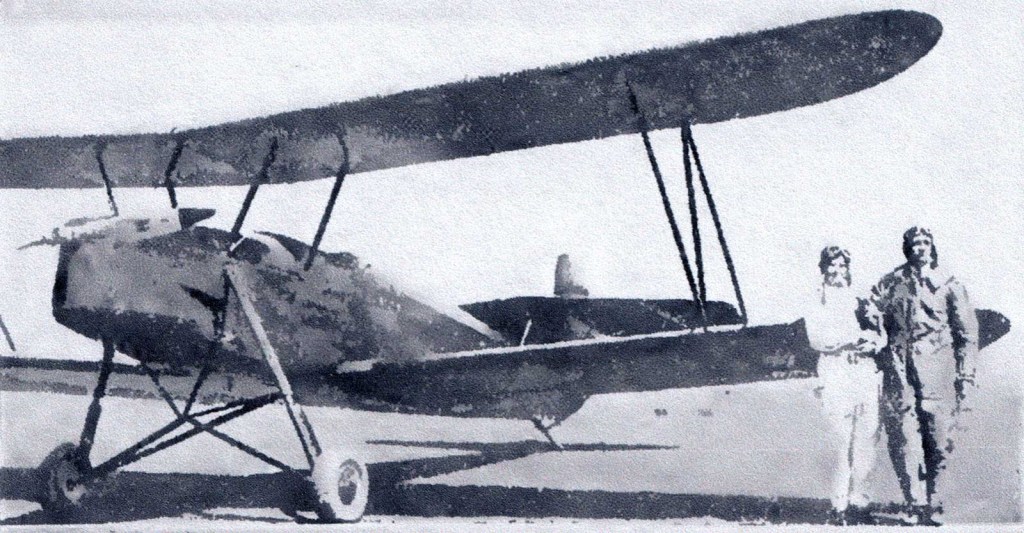
The only damage this aircraft suffered throughout the world tour was a bent tail skid mount caused by ground-looping across a ditch in Foo-Chow, China.
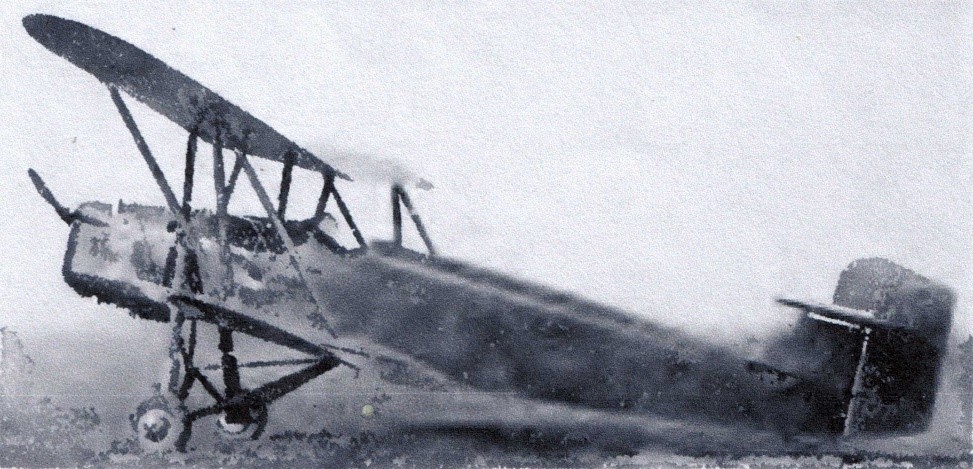
Fuel capacity was only 24 gallons. An additional 24 gallon tank was installed for the world flight. This extended range for over land flights but 48 gallons was insufficient for flying over the oceans.

