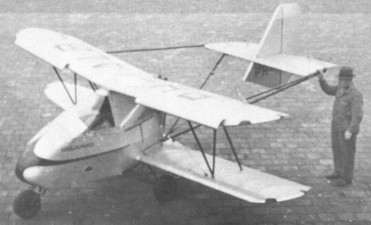
The Scheldemusch, a single seat sports aircraft with a six metre wing span and an empty weight of 185kg. Its price was Dfl. 2,500, and its operating costs, including depreciation, maintenance etc., amounted to Dfl. 9per hour. This small aircraft was designed in 1935 by the former Pander designer, Mr Slot, for the Royal Company De Schelde. The Scheldemusch was the first production light aircraft with a steerable nosewheel.
The aircraft department of a dockyard, opened in 1935, employing technicians from Pander. Built S.12 four-seat cabin monoplane, Scheldmusche light single-seat pusher biplane; best known for Scheldmeeuw single-seat flyingboat, which was built in all-metal and composite versions. It took over the designs of Pander and Zonen when that company went out of business in 1934. Schelde had taken over the aircraft construction department of the Pander furniture factory in The Hague at the end 1934. From 1939 made wings for Dornier Do 24 flying-boats, Aviolanda building the hulls. After 1945 began glider construction and Dakota conversion. In 1951 acquired license for production of Saab Safir. The aircraft construction department of the Royal Company De Schelde, joined Fokker on May lst, 1954.
France A propeller designer from the Societe Anonyme des Etablissements Lumiere who designed and built a single-seat racer in 1921. In 1924 built a “scale model” of a Bumellitype flying wing, with two 40 hp engines. Also built the Koolhoven F.K.31 under license. In 1924 he joined Buscaylet et Cie, giving up independent design.
The 1920 de Marcay Sport-Farman was a two-seater biplane with a span of 23 ft and weighing 450 lb. The landing speed was 16 mph and top speed 87 mph. It could take-off in 30 yds with two POB, and 10 yds with one.
The De Marcey ‘Sport Biplane’ was powered with a 60 hp Le Rhone and wingspan of 18 ft. The motor was neatly cowled and the propeller was fitted with a large spinner and a streamlined monocoque fuselage, Top speed was 118 mph with a landing speed of 28 mph.
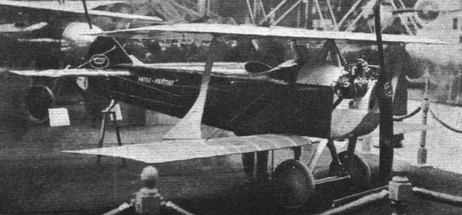
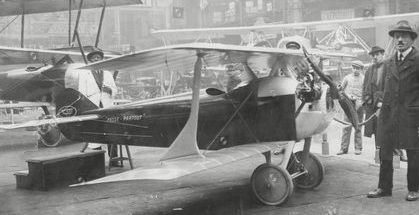
The de Marçay Passe-Partout (lit. '”de Marçay Master-Key”‘) was a small, low-powered single-seat sport and touring aircraft built by SAECA Edmond de Marçay (Société Anonyme d’Etudes et de Construction Aéronautique Edmond de Marçay) in France just after World War I.
The Passe-Partout was the smallest and lightest de Marçay aircraft of the three on display at the Paris Aero Salon of 1919. It had a very low power engine, the same 10 hp (7.5 kW) ABC 8 hp adapted flat-twin motorcycle engine that powered the English Electric Wren. Flight magazine doubted its practicality with this engine.
It was a single bay biplane with a single interplane strut on each side defining a bay braced with a single flying wire and a single landing wire. Both wings were two spar structures; there was marked forward stagger but no dihedral The interplane struts were slender at the top but smoothly widened towards their feet, linking the upper rear spar to both lower wing spars. The narrow upper joint provided a fixed point about which control wires could warp the trailing edge. Short cabane struts from the fuselage supported the centre of the upper wing.
The Passe-Partout had a monocoque fuselage of rounded rectangular cross-section. Its engine was mounted, with cylinders exposed, in the upper nose. The pilot’s open cockpit placed him just aft of the upper trailing edge but over the lower wing because of the stagger. At the rear a plywood covered tailplane was mounted high on the fuselage and fitted with fabric covered elevators. Both the fin and rounded rudder were also ply covered. Its fixed landing gear was of the conventional tailskid type with mainwheels on a single axle rubber rubber sprung from a frame consisting of two V-form struts from the lower fuselage with a single cross-member.
The Passe-Partout hadn’t yet flown when it appeared at the Paris Salon in December 1919 but it had flown by the following May. Marçay continued to advertise it until at least October 1920 but Flight’s doubts about its practicality seem to have been justified for in May 1928, when the de Marçay company ceased to exist, Les Ailes noted that the Passe-Partout had undertaken only a few, inconclusive trials and further, that de Marçay himself saw it more of a curiosity than a practical aircraft.
Powerplant: 1 × ABC 8 hp, 7.5 kW (10 hp) Propeller: 2-blade Wingspan: 4.04 m (13 ft 3 in) Wing area: 8.50 m2 (91.5 sq ft) Length: 3.797 m (12 ft 5.5 in) Height: 1.37 m (4 ft 6 in) Empty weight: 104 kg (230 lb) Gross weight: 189 kg (417 lb) Endurance: 2 hr Maximum speed: 109 km/h (68 mph, 59 kn) Service ceiling: 1,000 m (3,300 ft) Crew: one
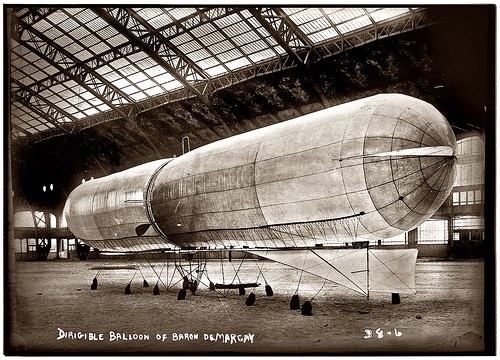
The “Dirigeable” was an unmanned proof-of-concept airship financed by Baron Edmond de Marçay together and designed by Dutchman Johan Kluytmans. It had its propeller positioned amidships and around the circumference of the two-part envelope, driven by an engine that was slung below the envelope. It was tested held by ropes, but was no success. Both de Marçay and Kluytmans went on to design more conventional aircraft.
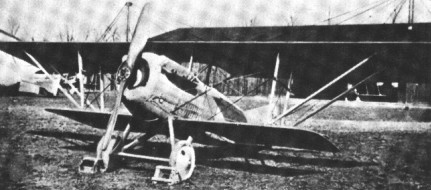
An experimental single-seat scout, the de Marcay Type C utilised a SPAD 13 fuselage, built in 1919.
The initial design was based on the use of an eight-cylinder Liberty engine, but the difficulties experienced with this engine led to revision of the design to take a 300 hp Hispano-Suiza 8Fb eight-cylinder water-cooled engine as the de Marcay 2 Cl. An unequal-span staggered single-seat biplane with horn-balanced ailerons on the upper wing only and an armament of two synchronised 7,7-mm Vickers machine guns.
The Type C achieved 157 mph at Villacoublay flown by Lt. Lebeau. Although the fastest fighter participating in the 1919 Service Aéronautique contest held at Villacoublay, no production order was placed for the de Marcay 2 Cl and only one prototype was completed.
Engine: 300 hp Hispano-Suiza 8Fb eight-cylinder Max speed, 156 mph (252 km/h) at sea level, 144 mph (232 km/h) at 9,840 ft (3000 m). Time to 16,405 ft (5000 m), 16.27 min. Span, 30 ft 4 1/8 in (9,25 m). Length 21 ft 8.6 in (6,62 m). Wing area, 269.1 sq ft (25,00 sq.m).
The Deleray Aircraft Works D-5 Sport Plane of 1920 was a single-seat open cockpit biplane powered with a 15hp motorcycle engine. The lower wing slightly shorter. It could be practically any motorcycle motor of 12 hp or more. The slab-sided early ultralight was advertised as “complete set of 18 large plans” for $6.00.
Wingspan: 17 ft Max speed: 65 mph Stall: 35 mph Seats: 1