Dewoitine D.8    

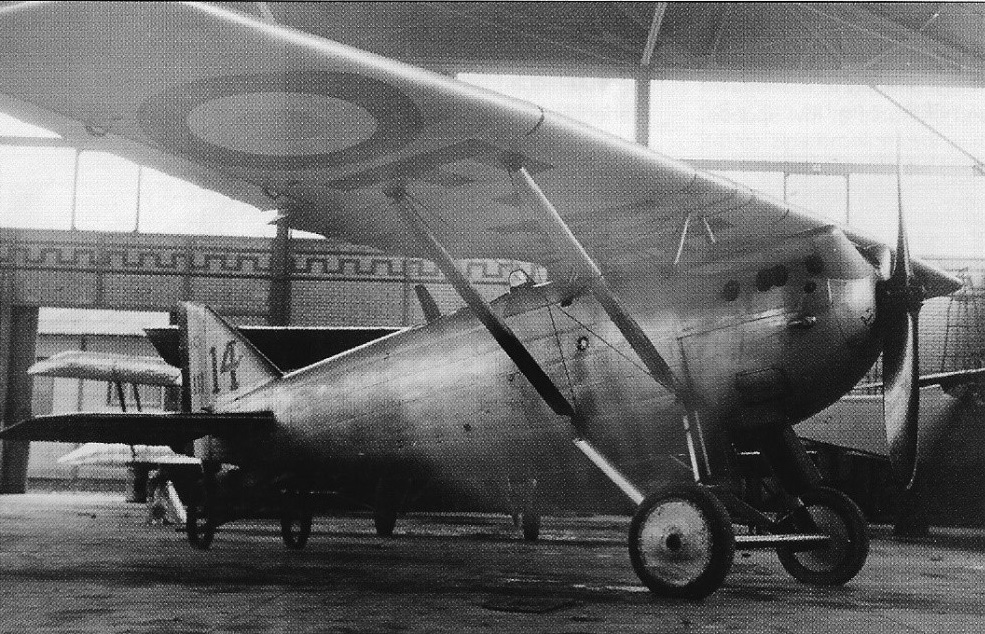
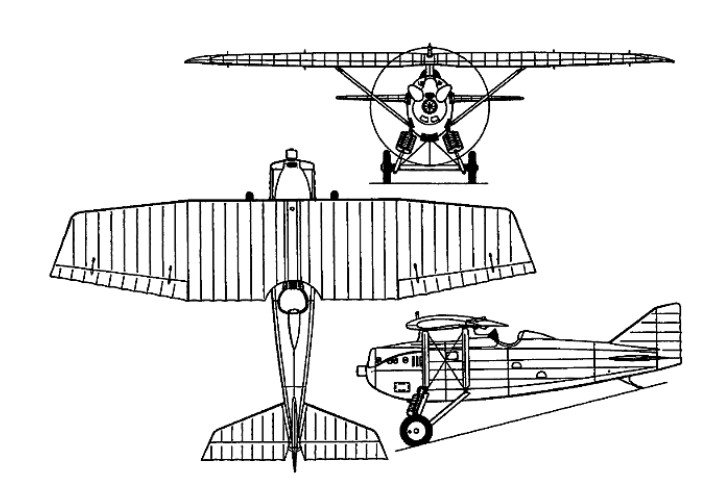
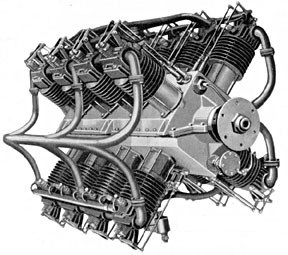
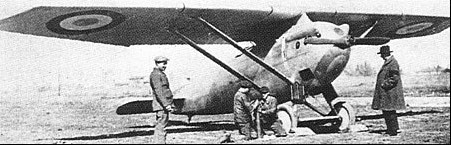
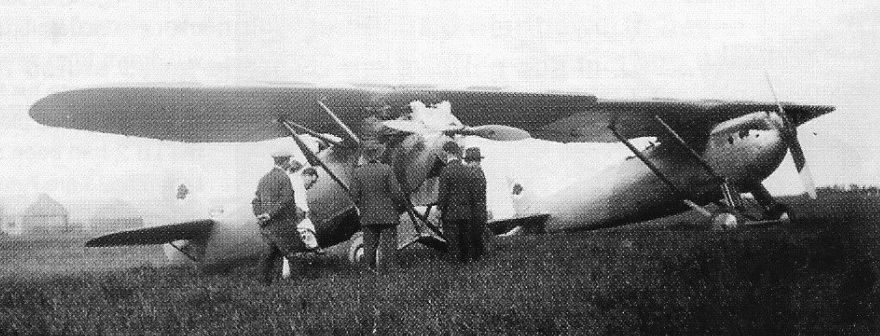
In the autumn of 1922, Dewoitine submitted to the CEDANA (Commission d’Examen des Appareils Nouveaux pour l’Aeronautique) a high-altitude version of the D 1 (which had then still to fly) designated D 8. One category of fighter in the 1921 C1 programme called for a speed of 240km/h at 7000m and a practical ceiling of at least 8500m. After discarding the proposal to equip the D 8 with a Rateau turbo-compressor, Dewoitine adopted the higher compression Hispano-Suiza 8Fe engine of 360hp. A larger wing of wood rather than metal construction was introduced and the prototype was rolled out in the late summer of 1923.
At Francazal, the D 8 attained an altitude of 2000m in 4.25 min, 3000m in 6.83 min, 4000m in 10.5 min and 5000m in 15.1 min. For publicity purposes this performance was attributed to the D 1 fighter. The C1 requirement for a high-altitude fighter having been abandoned, and, in June 1924, the D 8 was modified for an attempt on the world air speed record, fitted with a lightened version of the D 1 wing. On 23 December 1924, the D 8 established 100-, 200- and 500-km closed-circuit records while being flown by Marcel Doret, and, on 12 December, set a 1000km closed-circuit record of 221,775km/h.

Max take-off weight: 1100 kg / 2425 lb
Empty weight: 780 kg / 1720 lb
Wingspan: 12.80 m / 41 ft 12 in
Length: 7.50 m / 24 ft 7 in
Height: 2.75 m / 9 ft 0 in
Wing area: 25.00 sq.m / 269.10 sq ft
Max. speed: 245 km/h / 152 mph
Dewoitine D 1 / Ansaldo AC 2

C.1bis

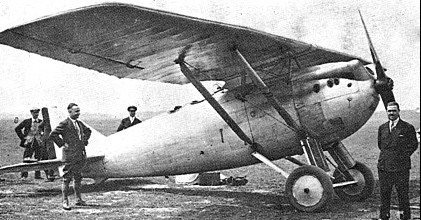
Designed by Emile Dewoitine to compete in the French C1 single ¬seat fighter competition of 1921, the prototype D 1 flew for the first time on November 18 1922.
A high-wing monoplane with fabric-covered metal wings and an oval-section metal fuselage covered by duralumin sheet. Armament was two 7.7mm synchronised Vickers guns and power was provided by a 300hp Hispano-Suiza 8Fb (HS 42) eight-cylinder water-cooled engine.
The principal criticism being the poor forward visibility. A 120mm pylon was therefore inserted between wing and fuselage, the fighter, now referred to as the D.1bis, becoming a parasol monoplane. This modification was completed in August 1923, by which time the first three (of 10) pre-series aircraft had been supplied for official evaluation in the initial configuration. Two of these were lost in accidents and the third was modified to D.1bis parasol form.
After prolonged evaluation of all the 1921 contenders, the Dewoitine D 1 and Spad 80 each received a contract in 1924 for 80 aircraft, the two types being intended to replace Spad XIIIs and XXs in Aviation Militaire squadrons. A further 29 D 1 s were ordered subsequently f or the Aeronavale.
Dewoitine’s chief test pilot, Marcel Doret, set speed records (with and without payload) of 233.10 km/h (144.84 mph) on December 23, 1924, and the D 1 could climb to 5000 m (16404 ft) in 15.1 minutes.

Union des Pilotes Civils festival, Orly, Paris 18 May 1930
Dewoitine D1ter No.3 F-AHAZ of Marcel Doret

The next five pre-series. aircraft (the fourth, fifth and sixth having been ordered by Czechoslovakia, Japan and Italy respectively, and the seventh and eighth by Switzerland) were all completed to D 1bis standard, but continuing criticism of forward view led to replacement of the shallow pylon between wing and fuselage by a cabane of inverted-vee struts on the prototype which thus became the D 1ter. The two pre-series aircraft for Switzerland were modified to this standard prior to delivery, the two lost during official trials) were completed as D 1ter fighters, the cabane struts being standardised for production D 1s. A contract had been placed in November 1923 on behalf of the Aeronautique Navale for 44 D 1s, with the government providing guarantees for 150 aircraft.
The production contract was placed with the SECM (Societe d’Emboutissage et de Constructions Mecaniques) which flew its first series D 1 on 18 January 1925. The production aircraft required several successive structural reinforcements, and did not gain acceptance by the Aviation Militaire until 1929. The D 1 was of mixed construction, with an open cockpit and two 7.5 mm (0.295 in) machine guns in the engine upper decking. The final version, the D 1 ter, had a more conventional strut type centre section cabane.

Dewoitine D1C1 300hp Hispano

Most Aviation Militaire D ls were soon transferred to the Aeronavale units, including 3C2, 4C1, 7C1 and 7C3; by mid 1931 these units had re equipped with the Nieuport-¬Delage 62. The Aeronautique Navale took delivery of its D 1s from early 1925, and in the previous year an order for 20 had been placed on behalf of the Forces Aeriennes Terrestres, although these were never to equip a service unit.
Dewoitine D ls were exported to Japan (one), Switzerland (two) and Yugo¬slavia (79), and a further 126 were built (with modifications) by Ansaldo at Turin for the Regia Aeronautica, with the designation AC 2.

Engine: 300hp Hispano-Suiza 8Fb (HS 42)
Max take-off weight: 1240 kg / 2734 lb
Empty weight: 820 kg / 1808 lb
Wingspan: 11.50 m / 37 ft 8.75 in
Length: 7.50 m / 24 ft 7 in
Height: 2.75 m / 9 ft 0 in
Wing area: 20.00 sq.m / 215.28 sq ft
Max. speed: 247 km/h / 153 mph
Range: 400 km / 249 miles
Armament: two 7.7 mm (0.30 in) Vickers machine gun

Dewoitine

Societe Aeronautique Dewoitine

Founded at Toulouse in 1922 by Emile Dewoitine to build all-metal aircraft. His first fighter, the D.1, appeared that year and his ultralight D.7 of 1923 was demonstrated in the USA. Designed and built a number of fighters, of which the D.21 of 1927 was built in Switzerland and France, and in 1929 in the Argentine. As no French orders were forthcoming, Dewoitine went to Switzerland in 1927 and formed the Societe Aeronautique Dewoitine. Returned to France 1930, establishing a manufacturing agreement with Liore et Olivier, which was entrusted with the redesign of his D.531 to become the D.37 for the Armee de I’Air. He produced two long-range aircraft, both lost on record attempts, and airliners for Air France, but in the main developed a successful family of fighters, the last of which, the D.520 of 1938-1940, was known as the “French Spitfire.”

Dewoitine fighters were eventually responsibility of SNCAM. Meanwhile, D.37 series of parasol-wing monoplane fighters was developed by Liore et Olivier, though name Dewoitine was sustained in fighter field primarily by the low-wing D.500 series, many of which were built by Liore et Olivier. Societe Aeronautique Frangaise gained greatest publicity with record-breaking D.332 Emeraude, first flown 1933, and with D.338 as used extensively by Air France in late 1930s. This latter aircraft was, perhaps, the finest 3-engined airliner in service before Second World War, and continued in use after fall of France.

In France, the Socialist Government of the so called Popular Front brought all the companies building military aircraft, aero engines and armament under its control in 1936. The im¬mediate result was the socialized oblivion of such established companies as Marcel Bloch, Bleriot, Nieuport, Potez, Dewoitine, Hanriot and Farman within half a dozen nationalized groups or Societies Nationales, named according to their geographical location (Nord, Ouest, Centre, Midi and so on).
During the war the Group formed the Societe Industrielle pour I’Aviation with the organization that represented General Motors in France, building the Arado Ar 196 and Ar 199 and developing the Ar 296.

Deutsche Flugzeubu-Werke GmbH / DFW / Allegemeine Transportanlagen Gesellschaft Maschinenbau (ATG)

Deutsche Flugzeubu-Werke GmbH / DFW was formed by Bernard Meyer at Lindenthal, Leipzig, in 1910, it built Maurice Farman biplanes under license and produced its own Mars biplane and a copy of the Jeannin Taube and Etrich Stahl-taube in 1914. During the war the DFW B series (unarmed) and C (armed) two-seaters were well known, the C V in particular being license-built also by Aviatik and Halberstadt. In 1916 DFW produced the R.I. and R.ll giant bombers, very clean designs with engines in the fuselage. Planned civil development of these after the war had to be abandoned and they were scrapped, but civil conversions of C types were built. The company built no aircraft after 1920, amalgamating with Allegemeine Transportanlagen Gesellschaft Maschinenbau (ATG).
ATG joined Siebel in 1945 to become Siebel ATG (SIAT).

Detroit Aircraft Corp Gull G1

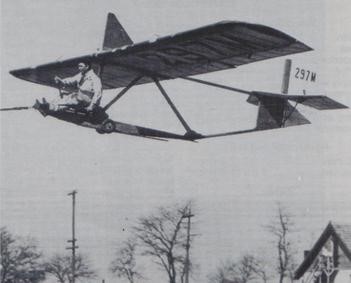
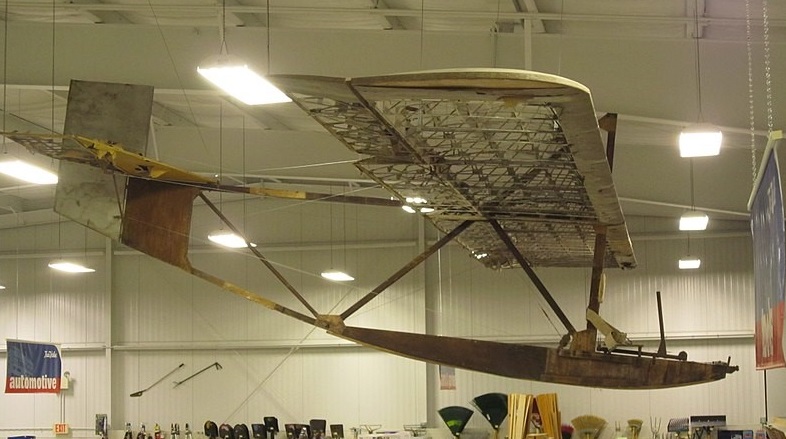
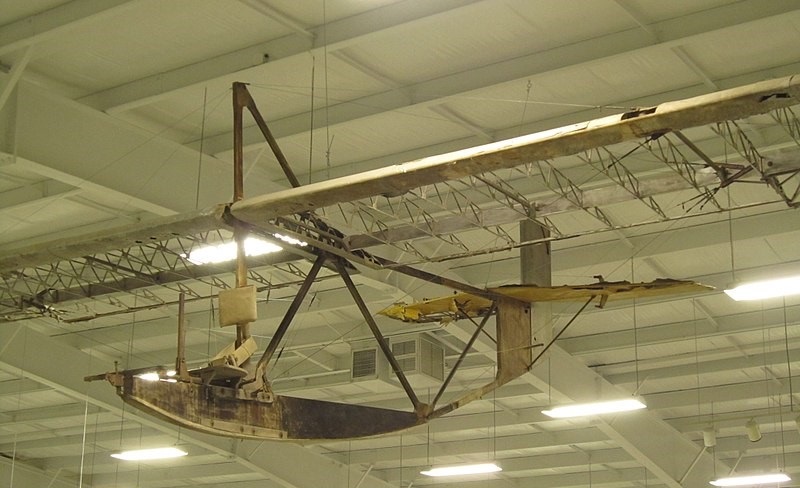
The Gull G1 was developed by Detroit Aircraft as an inexpensive aircraft for the Depression. The Gull is a high wing, cable-braced primary glider.

The Gull is built from wood, with the tail and wing surfaces covered in doped aircraft fabric. The wing is cable braced from a kingpost. The fuselage consists of a simple structure to which the seat is attached. The pilot sits on the completely open seat, with no windshield. Controls are conventional three-axis. The landing gear consists of the bottom of the fuselage shaped into a long wooden skid. Sometimes two small wheels were attached.

On June 20, 1930, the Aeronautics Branch certificated its first glider, the Detroit Gull, Model G-1. The aircraft’s correct designation is not clear. Soaring Magazine calls it the Detroit Gull G1 Primary, while the two Federal Aviation Administration registered aircraft are simply Detroit Gulls. Henley’s ABC of Gliding and Sailflying also calls it the Detroit Gull.

Detroit Aircraft later sold the rights to Stone Aircraft, who sold plans for the aircraft for amateur construction.

One Gull was started before the Second World War by Peter Eyrud of Walla Walla, Washington, but not completed. This aircraft was purchased by Peter M. Bowers who completed and flew it. Bowers documented the aircraft project in an article in the March/April 1957 edition of Soaring Magazine entitled Don’t Build a Primary.

In 1983 two other Gulls were reported to be in storage awaiting restoration.

In May 2011 there were two G1 Gulls registered with the Federal Aviation Administration in the USA. One was in the Kansas Aviation Museum and the other was still registered to Peter M. Bowers, even though he died in April 2003. Soaring Magazine reports that this aircraft too is actually in an unnamed aviation museum.

In August, 2013 one was put on display at the W.L Zimmerman’s Hardware Store, Intercourse, Pennsylvania. This glider has been preserved in original condition from 1931.

G1
Wingspan: 34.5 ft (10.5 m)
Wing area: 170 sq ft (16 sq.m)
Length: 17.5 ft (5.3 m)
Height: 7.0 ft (2.1 m)
Aspect ratio: 7:1
Airfoil: USA 35
Empty weight: 200 lb (91 kg)
Gross weight: 400 lb (181 kg)
Never exceed speed: 103 mph (166 km/h, 90 kn)
Maximum glide ratio: 8:1 at 30 mph (48 km/h)
Wing loading: 2.36 lb/sq ft (11.5 kg/sq.m)
Crew: one

Detroit Aircraft Corp

Formed in 1929 as a parent corporation to take control of several firms hit by the Depression: Lockheed Aircraft Company, Ryan Aircraft Corporation, Eastman Aircraft Corporation, Blackburn Aircraft Corporation, Aircraft Development Corporation, Marine Aircraft Corporation, Parks Airlines Ltd., and the Winton Engine Corporation. The consortium itself failed shortly afterwards.

In 1929 Lockheed merged with the Detroit but After the Great Crash Detroit Aircraft Corporation went bankrupt in 1931 and with it Lockheed.
In 1932, Boston banker Robert Gross led a syndicate that bought and resurrected the company with $50,000. The Electra was a success and the company prospered.