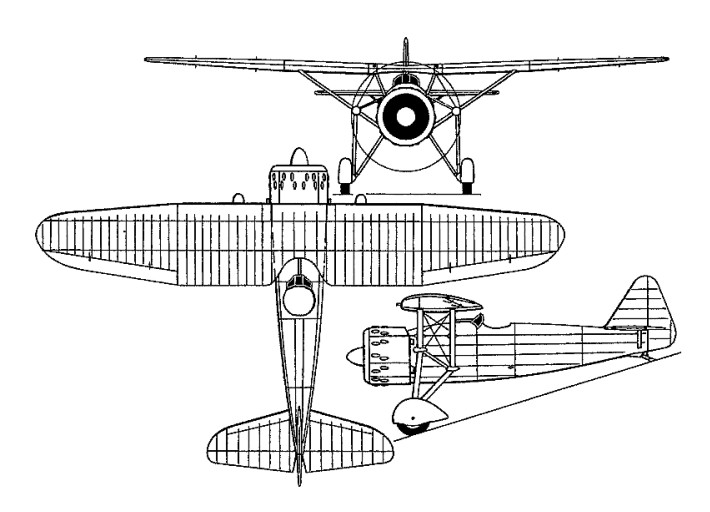
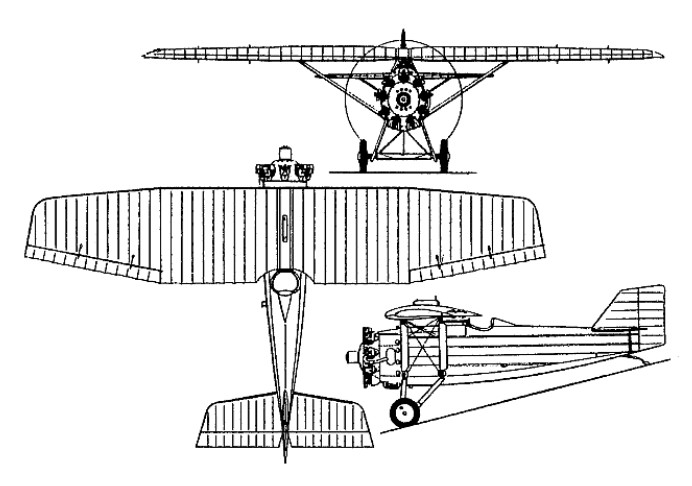
Dewoitine D.53 / D.530 / D.531 / D.532 / D.534 / D.535 / D.536

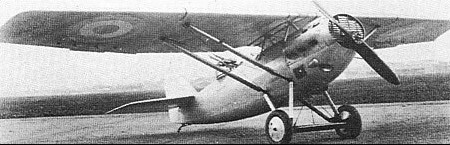
Following the loss, at the end of July 1930, of the first pre-series D 27 as a result of a wing structural failure, a substantially reinforced wing structure was designed to meet new requirements imposed by France’s Service Technique. Emile Dewoitine had, at this time, been assured by the Ministere de l’Air of an order for 90 D 27 fighters with reinforced wings, although this was not, in the event, to be confirmed.

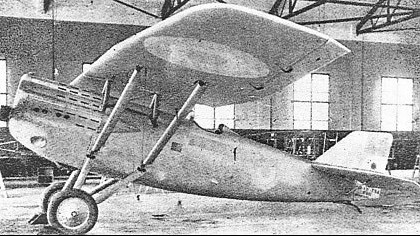
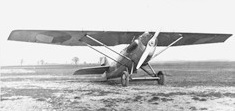
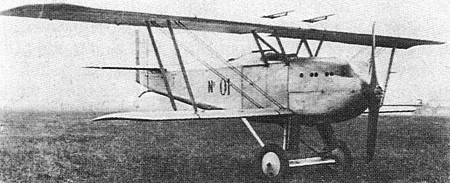
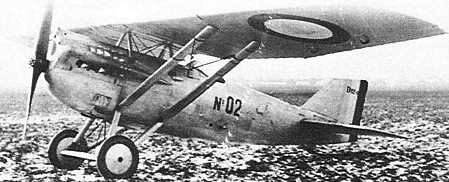
The structural changes were accompanied by a change in designation from D 27 to D 53, the first reinforced wing being completed on 27 February 1931, and this being applied by Liore-et-Olivier to D 27 No 14 to produce the D 530 which flew at the end of the following March. The D 530 was powered by an Hispano-Suiza 12Md, a lightened version of the HS 12Mb (HS 57) engine of 500hp. The HS 12Md was not acceptable to the STAe, the second, third and fifth D 53 series fighters then being fitted with the HS 12Mb as D 531s for official evaluation. Weighing 1420kg, these recorded maximum speeds of 269km/h at sea level and 258km/h at 5000m during trials at Villacoublay.

In August 1931, the Turkish government expressed interest in the D 53 and was offered versions with either the compressor-equipped Skoda Lr engine of 580hp or the Curtiss V-1570 Conqueror of 600hp. The fourth D 53 series fighter prototype flown in the autumn of 1931 was the D 532 with a compressor-equipped Rolls-Royce Kestrel engine. This attained 313km/h at 4000m, climbing to that altitude in 6.9 min, but excessive oscillation of the tail led to discontinuation of flight testing and re-engining with an HS 12Mb engine as the D 534 LP.

Flown in April 1932, the D 535 was equipped with a 500hp HS 12Xbrs engine, this becoming the D 536 when fitted with a Farman compressor which raised the output of the HS 12Xbrs engine to 570hp at 5800m.

In July 1933, a twin-float fighter version of the D 535 was offered to Peru, which, in the event, procured Nieuport- Delage 123s.

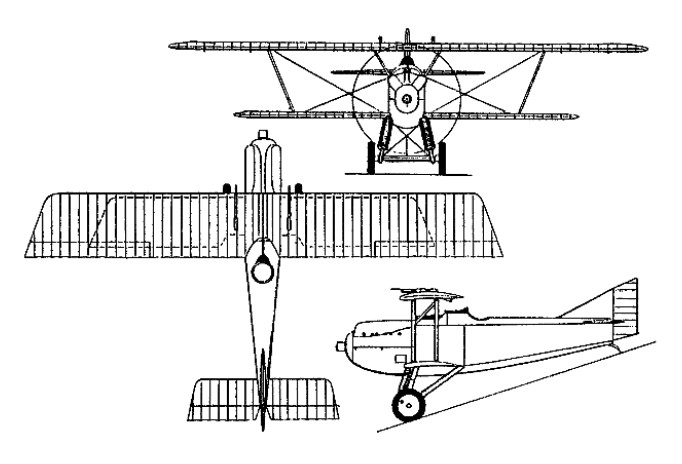
Only seven D 53 series aircraft were flown of which two D 531s allegedly found their way to Republican Spain during the Civil War, becoming known as Dewoitinillos or Dewoitine pequenos (little Dewoitines) to distinguish them from D 371s. The dimensions of the D 53 series were similar to those of the D 27.

The five D.27 prototypes and two of a strengthened model, the D 53, were flown experimentally for a time on board the aircraft carrier Bearn.

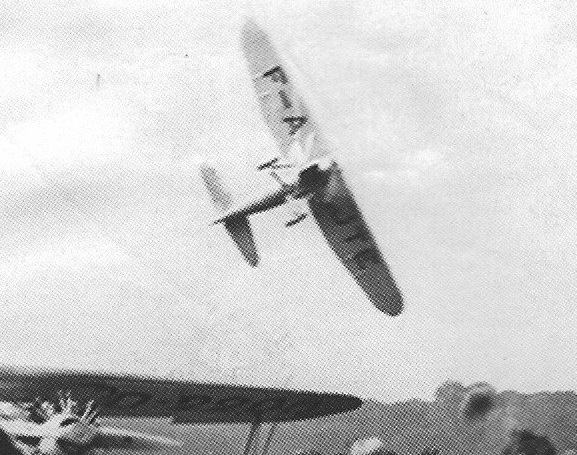
In 1937, Dewoitine and Marcel Doret approached the nationalise SNCASE (which had absorbed the Dewoitine company) for a new aerobatic craft. The result was a new D.530 (No.6), built from D.530 F-ANAX. Using his old registration F-AJTE, Doret first flew his new craft in April 1937. F-AJTE lasted the war and German occupation and flew until 1955, whem Marcel Doret died. F-AJTE logged over 575 hours and in November 1936 was presented to the Muse de L’Air.

D.530 F-AJTE

Gallery

D 530
Engine: Hispano-Suiza 12Md, 500hp

D.530 F-AJTE
Engine: Hispano-Suiza 12Md, 500 hp
Wingspan: 33.98 ft
Length: 21.65 ft
Height: 9.51 ft
Empty weight: 2361 lb
Gross weight: 3076 lb
Max speed: 233 mph
Stall: 59 mph

D 531
Engine: HS 12Mb
Weight: 1420kg
Max speed: 269km/h at sea level / 258km/h at 5000m

D 532
Engine: Rolls-Royce Kestrel
Max speed 313km/h at 4000m
Climb to 4000m: 6.9 min

D 534 LP
Engine: HS 12Mb

D 535
Engine: 500hp HS 12Xbrs

D 536
Engine; HS 12Xbrs, 570hp at 5800m
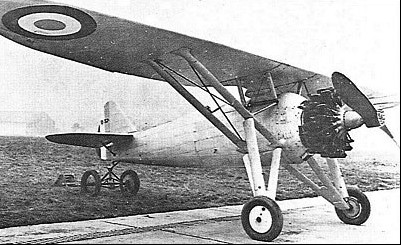
Dewoitine D.31 / D.37 / D.370 / D.371 / D.372 / D.373 / D.376

D.370

Transferred by the SAF-Avions Dewoitine to the Liore-et-Olivier (LeO) concern owing to the workload imposed on the parent company by the D 50bis (future D 500), the D 37 (later D 370) was a private venture contender in the 1930 C1 programme.
Evolved in 1931 in parallel with the D 500, the D 37 was devel¬oped via the D 53 (strengthened D 27) and first flown on 1 October 1932 with a 700 hp Gnome Rhone 14 Kbrs Mistral Major 14-cylinder two-row radial engine driving a four blade propeller. The prototype was built at Argenteuil by Liore et Olivier and was entered for the 1932 French fighter competi¬tion by the Societe Aeronautique Frangaise, a new company formed by Emile Dewoitine following his return from Switzerland.
It was subsequently subjected to an extensive series of modifications: a G-R 14Kbs engine gave place, in turn, to a G-R 14Kds affording 800hp for take-off and 740hp at 4500m; the engine cowling was changed; the undercarriage was redesigned, and the wing introduced dihedral and reduced chord.
Yet more redesign was embodied by a second prototype, the D 371, which appeared late February 1934. Twenty-eight D 371s were ordered for the Armee de l’Air with the G-R 14Kf s engine of 930hp for take-off and 880hp at 3250m, and an armament of four underwing 7.5mm MAC 34 machine guns.
Fourteen were ordered by Lithuania, and these, having two synchronised 7.7mm Browning guns in the fuselage and two Darne guns of similar calibre in the wings, were designated D 372s. Republican forces in Spain received the 14 D 372s (930 hp Gnome Rhone 14 Kfs) ordered by Lithuania. The Lithuanian government relinquished its D 372s in favour of D 501s, the former being sold to the Spanish Republican government and ferried to Spain during August 1936, where they were later joined by 10 of the 28 Armee de l’Air D 371s.
In March 1036, Escadrilles 7C 1 and 7C2 of the Aeronavale at Hyeres began to replace their Wibault 74s with 20 examples of the D 373, similar to the 372 except for wing flaps and deck landing gear. These had flotation gear, a 30cm reduction in wing span and an armament of four Darne guns within the wing.
These were followed by 25 D 376s with wing folding.
The last D 371 left the factory at the end of December 1935, the Armee de l’Air fighters following the Navy’s D 373s. The remaining D 371s equipped an escadrille at Bizerte, Tunis, until 1939, but were little flown owing to constant problems with their engines.
Standard armament of the D 37 was four underwing 7.5 mm (0.295 in) MAC 1934 or Darne machine guns, but the D 371 prototype was a testbed for two long barrelled 20 mm (0.79 in) Oerlikon S cannon mounted in the wing centre section, and some D 373/376s were fitted with 13.2 mm (0.520 in) Hotchkiss machine guns. Performance of the D 371 included a climb to 4500 m (14 764 ft) in 5.18 minutes and to 10000 m (32810 ft) in 21.85 minutes.

The French Government declared on 25 July 1936 that it would not send arms to Spain, but its Air Minister, Pierre Cot, secretly permitted a consignment of aircraft to be dispatched. At the end of July, about 70 aircraft were sent across the border to Barcelona, including Potez 54 bombers and Dewoitine 371 fighters.
This version’s service effectiveness was limited, due to extensive grounding brought about by frequent engine troubles, and those still serving with ERC 574 in Tunisia were replaced by Morane Saulnier 406s in November 1940. The D 373/376s, 27 of which constituted the entire Aeronavale fighter strength upon the outbreak of war, were similarly replaced by Potez 63 fighters in January 1940.

D 31
Engine: 800¬hp Gnome Rhone 14 Kd

D.37
Armament: 4 x 7.5 mm (0.295 in) MAC 1934 or Darne machine guns

D.371
Span: 11.80 m (38 ft 8.5in)
Length: 7.44 m (24 ft 5 in)
Height: 3.40 m / 11 ft 2 in
Wing area: 17.45 sq.m / 187.83 sq ft
Take-off weight: 1884 kg / 4154 lb
Empty weight: 1320 kg / 2910 lb
Maximum speed: 380 km/h (236 mph)
Armament: 2 x 20 mm (0.79 in) Oerlikon S cannon
Climb to 4500 m (14 764 ft): 5.18 minutes
Climb to 10000 m (32810 ft): 21.85 minutes
Range: 900 km / 559 miles

D 372
Engine: 930 hp Gnome Rhone 14 Kf

D.373
Engine: 930 hp Gnome Rhone 14 Kf

D.376

Dewoitine D 371

Dewoitine D.27 / D.272 / D.275

D.27

The D 27 was evolved to meet the requirements of the STAe 1926 C1 leger programme for lightweight fighters.
Incorporating a split-axle (with independently articulated wheels) rather than cross-axle undercarriage, the D 27 was powered by the SLM Saurer built 500hp Hispano-Suiza 12Mb (HS 57) 12-cylinder Vee engine and had an armament of two synchronised 7.7mm guns. The fuel was carried in a tank which formed the underside of the centre fuselage. In emergency this tank could be jettisoned.

The liquidation of the Construction Aeronautique E Dewoitine in January 1927 resulted in the transfer of development of the D 27 to the EKW in Switzerland, where a prototype flew on 3 June 1928.

By the end of 1929, three had been ordered by Romania, one by Argentina and three by Yugoslavia (of which two were to be assembled by Zmaj at Zemun), and the prototype was undergoing evaluation by the Swiss Fliegertruppe in competition with Alfred Comte’s AC-1.

The five prototypes and two of a strengthened model, the D 53, were flown experimentally for a time on board the aircraft carrier Bearn.
In the autumn of 1928, the EKW initiated a pre-series of 12 D 27 fighters, these adopting a redesigned tail and a revised wing of 0.45sq.m less area, modifications first tested in the Laboratoire Eiffel wind tunnel. Meanwhile, in March 1928, Emile Dewoitine had reestablished himself in France, forming the Societe Aeronautique Francaise-Avions Dewoitine.

The second and third pre-series D 27s were delivered to France in April 1929, the former being re-engined with the 400hp HS 12Jb as the D 272 F-AJTE for Marcel Dorset for aerobatic demonstrations. After 267 flight hours it was accidently destroyed in 1936.

The latter undergoing STAe evaluation at Villacoublay from 28 May equipped with two 7.7mm Darne guns. On 29 November 1929, a contract was issued by France’s DGT (Direction Generale Technique) of the Ministere de l’Air for the second and third pre-series aircraft plus three (later increased to four) additional fighters to be assembled by Liore-et-Olivier.

The D 27 was offered to the Forces Aeriennes Terrestres as the D 271 with the 500hp HS 12Hb engine and as the D 273 with a Gnome-Rhone Jupiter VII with a compressor enabling 425hp to be delivered at 4000m, but neither model was adopted.

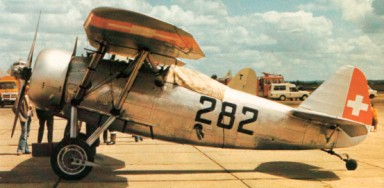
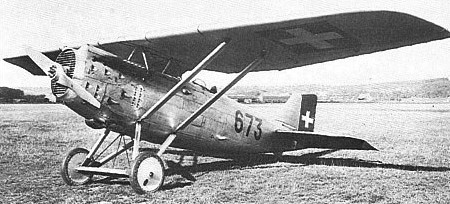
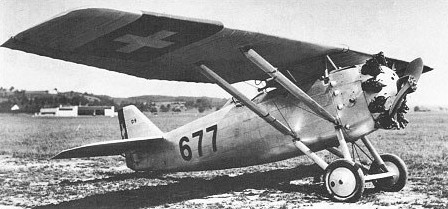
At the end of 1929, however, the decision was taken in principle to re-equip the fighter element of the Swiss Fliegertruppe with the D 27, a pre-series of five being ordered from the EKW as D 27 IIIs, with deliveries commencing in 1931. A pre-production batch of 15 followed, additional contracts being placed for 45 D 27 IIIs to bring deliveries to the Fliegertruppe to 66 (including the prototype). Sixty six were delivered from 1930 to the Swiss Fliegertruppe, which also received 11 examples of the D 26, a version fitted with a 250 hp Wright Cyclone radial engine. Fifty six of the Swiss D 27s were still in first line fighter squadron service when war broke out in 1939. During the following year, they were withdrawn to training units, from which they did not disappear completely for another decade.

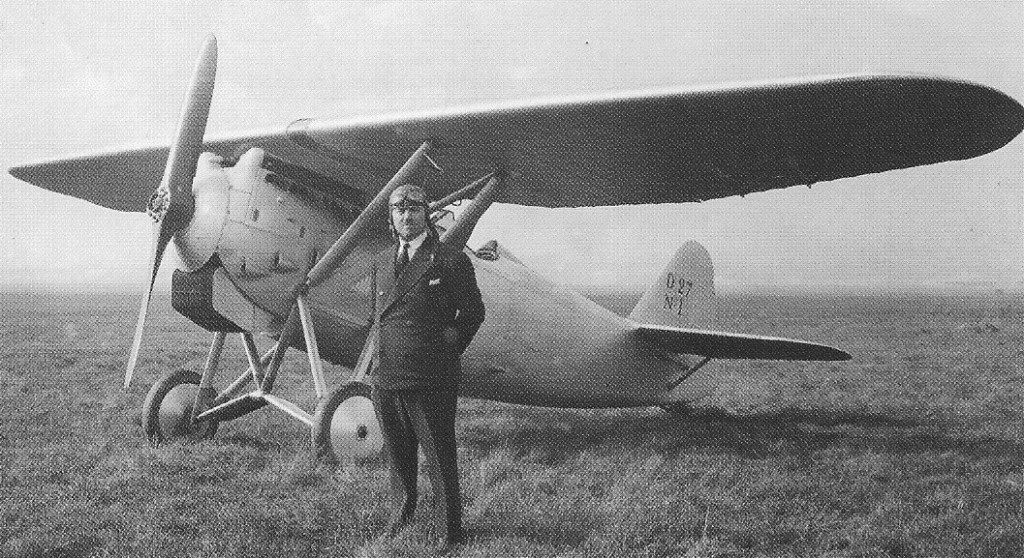
On November 30, 1930, Dewoitine chief test pilot Doret broke the world 1000 km (621 mile) closed circuit speed record flying a Dewoitine D 27 at an average of 286.227 km/h (177.854 mph).

Marcel Doret and his D.27

Swiss D 27 III
Take-off weight: 1415 kg / 3120 lb
Empty weight: 1038 kg / 2288 lb
Wingspan: 10.30 m / 33 ft 10 in
Length: 6.56 m / 21 ft 6 in
Height: 2.78 m / 9 ft 1 in
Wing area: 17.55 sq.m / 188.91 sq ft
Max. speed: 298 km/h / 185 mph
Range: 425 km / 264 miles
Armament: 2 x 7.5 mm (0.295 in) machine guns
Service ceiling: 8300 m / 27231 ft
Climb to service ceiling: 11 minutes

Dewoitine D.26

The Dewoitine D 27 was designed in Switzerland and built there by the EKW state aircraft factory at Thun. It first flew in 1929, with an SLM Saurer built Hispano Suiza 12 Mc engine of 600 hp, and a total of 85 were built at Thun between 1929 33. Sixty six of these were delivered from 1930 to the Swiss Fliegertruppe, which also received 11 examples of the D 26, a version fitted with a 250 hp Wright Cyclone radial engine.

Dewoitine D.26 Article

Most of the D 26s were used as advanced trainers, but after World War II a number survived doing duty as tugs for sailplanes.

Dewoitine D.25

The D 25 tandem two-seat day and night fighter was developed in response to the 1925 C2 (two-seat fighter) programme. Based on the single-seat D 21, but with local reinforcement of the aft fuselage to permit installation of an open turret for a gunner. The D 25 was powered by a 450hp Lorraine-Dietrich 12Eb water-cooled W-type engine, the D 25 entered flight test in 1926, but the C2 programme for which it was intended was abandoned and the type was offered for export.
Four were ordered by Argentina in 1928, and these, fitted with an armament of two 7.9mm synchronised Madsen guns and two similar weapons on a ring mount in the rear cockpit, were built under subcontract by the Hanriot company (which also built the last 10 D 21 single-seaters for Turkey).

Engine: 450hp Lorraine-Dietrich 12Eb
Take-off weight: 1750 kg / 3858 lb
Empty weight: 1182 kg / 2606 lb
Wingspan: 12.80 m / 41 ft 12 in
Length: 7.64 m / 25 ft 1 in
Height: 3.00 m / 9 ft 10 in
Wing area: 24.80 sq.m / 266.94 sq ft
Max. speed: 222 km/h / 138 mph

Dewoitine D.21 / Skoda D-1

At the end of 1925, the second prototype D 12 single-seat fighter was re-engined with a 500hp Hispano- Suiza 12Gb (HS 50) 12-cylinder W-type water-cooled engine and redesignated D 21. The D 21 had the four 7.5 mm (0.295 in) Darne machine¬guns.
Intended for export, the D 21 was first demonstrated in January 1926 at Bruxelles-Evere, the first export order from Turkey, for two D 21s for evaluation. Czechoslovakia ordered three and Argentina 18, plus the prototype. Of these, the three Czech aircraft and seven of the Argentine aircraft were assembled by the EKW in Switzerland.

A manufacturing licence was obtained by Czechoslovakia, Skoda building 26 D 21s during 1928-29 (as Skoda D 1s) with Skoda L engines (derived from the HS 12G) of 562hp. Out dated by the late 20s, they were discharged by the Czechoslovak Army and used by the Police Air Patrol.

Skoda D-1

Argentina also procured a manufacturing licence and the Fabrica Militar de Aviones (FMA) built 58 examples during 1930-31, but with Madsen machine guns and the licence-built Lorraine-Dietrich 12Eb W-type engine. They became effectively D 12s, although the designation D 21 was retained.

One French built D 21 was sold to Switzerland, where in late 1926 Emile Dewoitine had taken up residence, his French company having been bankrupted by the lack of domestic orders for any type since the D 1, and where, in 1928, there appeared the final development of the D 1 formula, the D 27.

In the autumn of 1927, Turkey placed a follow-on order for 10 D 21s, these being delivered during 1928-29.

Max take-off weight: 1580 kg / 3483 lb
Empty weight: 1090 kg / 2403 lb
Wingspan: 12.80 m / 42 ft 0 in
Length: 7.93 m / 26 ft 0 in
Height: 3.00 m / 9 ft 10 in
Wing area: 24.80 sq.m / 266.94 sq ft
Max. speed: 267 km/h / 166 mph

Skoda D-1
Engine: Skoda L, 500 hp
Span 12.24 m
Length 7.64 m
Top speed 270 kph
Rate of climb: 10m/s
Service ceiling: 9000 m
Endurance: 1hr 30min
Armament: two synchronized machine guns

Dewoitine D.19

The D 19 appeared in the summer of 1925 with a 400hp Hispano-Suiza 12Jb 12-cylinder water-cooled Vee-type engine. By comparison with the D 1, the D 19 had longer span, narrower chord ailerons and a wing spanning 12.50m with an area of 24.00sq.m. Demonstrated in Switzerland in August 1925, three examples of a modified version of the D 19 were ordered by the Swiss government. Specified armament was two fuselage-mounted 7.7mm guns, the paired Lamblin radiators mounted on the undercarriage legs replaced by a Chausson frontal radiator and a wing similar to that of the D 1 was adopted.
A second D 19 prototype was completed with these modifications, this being sold in 1928 to Belgium, and the first Swiss aircraft was ferried to the EKW (Eidg. Konstruktions-Werkstatte) in March 1926. The two other Swiss aircraft were transported to Switzerland in February 1927 for assembly by the EKW state aircraft factory at Thun, subsequently entering service with the Fliegertruppe.

The D 19 received a new wing of 25.00 sq.m similar to that of the D 9 and D 12 before CEPA testing, in which performance proved mediocre owing to mismatching of the propeller.

The three D 19s participated in the 1927 Zurich-Diibendorf international aviation meeting, one being winner of the closed-circuit race for fighters with a speed of 250km/h. Used primarily for combat training by the Fliegertruppe, one D 19 was lost in 1930, and the remaining two continued in service until 1940.

D 19
Max take-off weight: 1390 kg / 3064 lb
Empty weight: 980 kg / 2161 lb
Wingspan: 10.80 m / 35 ft 5 in
Length: 7.87 m / 25 ft 10 in
Height: 3.50 m / 11 ft 6 in
Wing area: 20.00 sq.m / 215.28 sq ft
Max. speed: 268 km/h / 167 mph
Range: 400 km / 249 miles

Dewoitine D.15

The only single-seat biplane configuration fighter built by Emile Dewoitine, the D 15 was proposed as a simpler and more economic (from the structural viewpoint) fighter than the D 9, D 12 and D 19 monoplanes. Powered by a 450hp Hispano-Suiza 12Ha (HS 51) 12-cylinder liquid-cooled Vee engine, the D 15 had fabric-covered metal wings with ailerons on the upper wing only. The metal fuselage with steel longeron and duralumin tube cross-member construction with fabric-covered sides and light metal upper and lower decking. Armament was two fuselage mounted 7.7mm Vickers guns and two 7.5mm Darne guns mounted on the upper wing centre section.
Flown on 13 August 1924, the D 15 displayed inadequate longitudinal and lateral stability, and, after modification, proved to possess inferior performance to the lower-powered D 19 monoplane during CEPA (Commission des Essais Pratiques de l’Aviation) testing at Villacoublay during the autumn of 1924. It was not submitted for STAe evaluation of 1923 C1 programme contenders held in 1925-26.

Take-off weight: 1535 kg / 3384 lb
Empty weight: 1040 kg / 2293 lb
Wingspan: 12.00 m / 39 ft 4 in
Length: 7.40 m / 24 ft 3 in
Height: 3.54 m / 11 ft 7 in
Wing area: 30.00 sq.m / 322.92 sq ft

Dewoitine D.12

Evolved in parallel with the D 9 as a contender in the 1923 C1 programme, the larger, sin¬gle seat parasol D 12 fighter was powered by a 450hp Lorraine- Dietrich 12EW 12-cylinder W-type water-cooled engine and armed with two 7.7mm Vickers guns.
With a basically similar fuselage to that of the D 1, the D 12 first flown in June 1924.
In September 1924, the D 12 was fitted with a higher compression 450 hp Lor¬raine 12 Eb and a pair of 7.5mm Darne model 19 guns on the wing centre section.
The paired Lamblin radiators on the undercarriage legs was replaced by a frontal radiator and a wing similar to that finally adopted on the D 9 was fitted. On 5 February 1926, the D 12 was written off in an accident at Cazaux. A second prototype had meanwhile entered flight test, having flown at the end of 1925, this having a W-type Hispano-Suiza 12Gb engine, but further development was discontinued.
It was eventually to take third place in the 1923 C1 programme after the Nieuport-Delage 42 and the Gourdou- Leseurre 32.

Max take-off weight: 1636 kg / 3607 lb
Empty weight: 1070 kg / 2359 lb
Wingspan: 12.80 m / 41 ft 12 in
Length: 7.60 m / 24 ft 11 in
Height: 3.00 m / 9 ft 10 in
Wing area: 25.00 sq.m / 269.10 sq ft
Max. speed: 239 km/h / 149 mph

Dewoitine D.9 / Ansaldo AC 3

First flown in 1924, the Dewoitine D 9 was essentially a scaled¬ down development of the earlier D 1 single ¬seat parasol monoplane fighter, from which it differed mainly in being powered by a 420 hp Gnome Rhone 9 Ac radial engine, a licence-¬built version of the 9 cylinder Bristol Jupiter.
Developed for participation in the 1923 C1 programme, two prototypes were completed. The Aviation Militaire purchased one for evaluation, but despite the extra available power the performance was not significantly improved, the D 9 took only 9 seconds less than the D 1 to reach 5000 m (16404 ft), and no French production contracts resulted.
Early in the flight test programme, the standard D 1 wing was replaced with a new wing of 2.5 sq.m greater area. A six-month delay in the commencement of evaluation of the contenders in the C1 programme provided Dewoitine with the opportunity to increase wing area by yet a further 2.5sq.m.
Armament consisted of two fuselage-mounted 7.7mm Vickers guns and two Darne model 19 guns of 7.5mm calibre mounted on the wing centre section outside the area of the propeller disc.
The D 9, placed sixth among the contenders, was destroyed on 15 October 1925.
Apart from the prototypes, only 13 were manufactured by Dewoitine, two for Belgium in 1925, Switzerland acquired the sec¬ond prototype and assembled three others in 1928 from French built components, and Yugoslavia (eight). The components of three were delivered in 1927 to the EKW (Eidg. Konstruktions-Werkstatte) in Switzerland for assembly, with delivery to the Fliegertruppe in 1928.
The largest production was undertaken by Ansaldo in Italy, which built 147 for the Regia Aeronautica with the designation AC 3.

Max take-off weight: 1333 kg / 2939 lb
Empty weight: 945 kg / 2083 lb
Wingspan: 12.80 m / 41 ft 12 in
Length: 7.30 m / 23 ft 11 in
Height: 2.93 m / 9 ft 7 in
Wing area: 25.00 sq.m / 269.10 sq ft
Max. speed: 244 km/h / 152 mph
Range: 400 km / 249 miles