The first glider designed by Hans Jacob.
Landing speed: 35 mph
Inter-Wars
DFS Crane
A glider circa 1935
DFS / Deutsche Forschungsinstitut Für Segelflug / German Research Institute for Gliding / Rhon-Rossiten-Gesellschaft
Established as the Rhon-Rossiten-Gesellschaft at Wasserkuppe in 1925.
Became DFS on moving to Darmstadt in 1933 and undertook glider research. Designed and built the successful DFS 230 assault glider in the Second World War, and the DFS 228, an air-launched rocket aircraft used as a research vehicle for the DFS 346, a swept-wing reconnaissance project expected to reach 1,650mph (2,655kmh) at 66,000 ft (20,120 m). Also undertook development of Me 163 and Mistel composite bomber. Experimented with delta designs by Dr. Alexander Lippisch and evolved piloted V-1. In 1946 the DFS 346 project and its engineering design staff were taken by the Soviets to Podberczhye, where the project was said to have been completed.
Dewoitine C-38
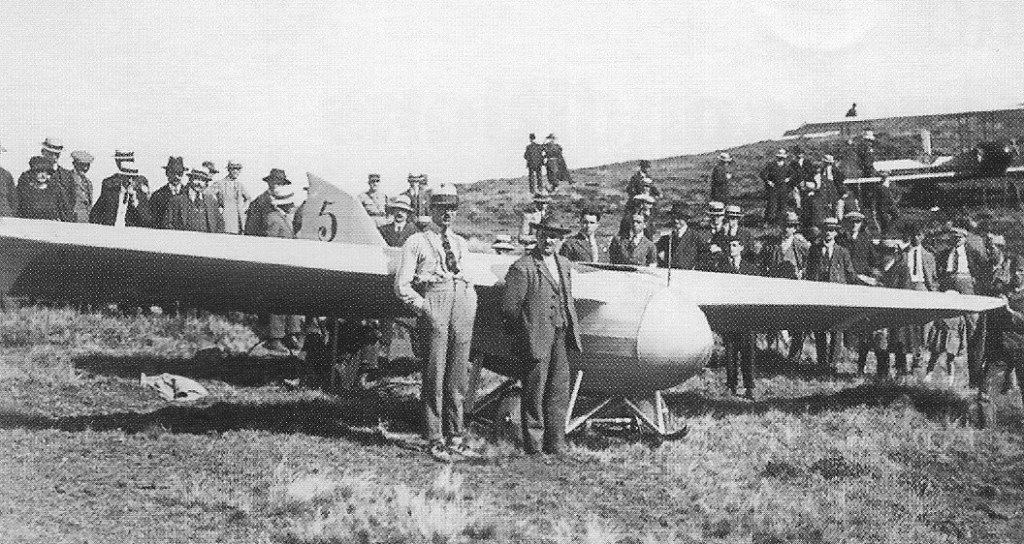
The Dewoitine monoplane had already been flown in the first French soaring contest at Clermont Ferrand in 1922. It was able under Georges Barbot, in the autumn of 1922, to make a gliding flight of 20 minutes from the plateau of Super-Bagderes (Pyrenees) with an altitude difference of 1200 meters. In 1923, it was flown by Barbot 8 hours, 36 minutes and 56 seconds in Biskra, Africa.
The Dewoitine monoplane has flexible wings without external brace-wires. For transportation, the wings can be folded back against the fuselage, without being entirely disconnected. Each wing has a hollow main spar and tapers outward.
It is steered by warping the ends of the wings, the rear two-thirds being flexible and the front third rigid.
The fuselage has a streamline form made by oval ribs- connected by light spars. On the glider, the front end of the fuselage consisted of a spherical cap of plywood, the latter was replaced by an engine on the low-powered airplane.
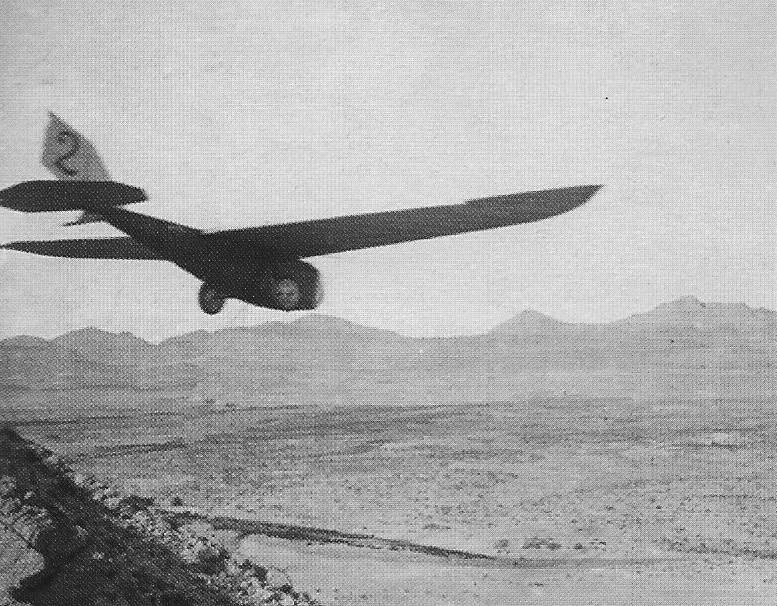
The 7 to 10 HP Anzani engine was originally designed for motorcycles. It had two opposite cylinders and was air-cooled. The brake horse-powers were;
7 HP at 1250 R.P.M.
8 HP at 1350 R.P.M.
9 HP at 1450 R.P.M.
11.75 HP at 1800 R.P.M.
12.75 HP at 2200 R.P.M.
With wide-open throttle, the revolution speed was about 1350 R.P.M., hence 8 HP.
The weight of the supporting structure is 35 kg (77.2 lb) or 4.375 kg (9.65 lb) per HP. The weight of the fuel is about 20 kg (44.1 lb) and the power plant 80 kg (176.4 lb). With a total weight of 250 kg (551.2 lb) the total load per HP is 31.25 kg (68.9 lb).
The engine is located in the front end of the fuselage and drives a two-bladed propeller. The fuselage is supported by an ordinary landing gear with rubber-tired wheels. The fuselage and wings are covered with fabric.
The flight performances are said to have been satisfactory. Barbot reached an altitude of 500 m (1640 ft) in a 25-minute flight from Francavat to Toulouse. The start was made from a level field.
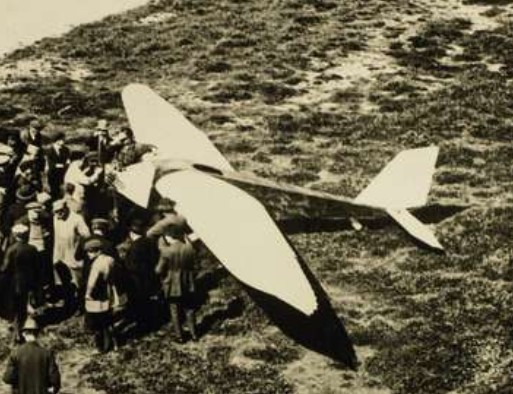
Barbot made another flight from St. Inglevert (France) across the English Channel to Lympne (England) and back. The time going was 50 minutes; returning, 43. minutes. The consumption for both flights was 4.5 liters (1.2 gallons) gasoline and 0.7 kg (1.54 lb) oil. At 1500 R.P.M. near the ground, the speed was 90 km/hr (56 mi/hr). At 1200 R.P.M it was 75 km/hr (47 mi/hr). The theoretical ceiling was 2000 m (6562 ft).
Span: 11.3 m (37.07 ft)
Wing area: 11.5 sq.m (123.78 sq ft)
Aspect ratio: 10
Length 4.9 m (16.08 ft)
Weight empty 115.0 kg (253.5 lb)
Total weight 250.0 kg (551.2 lb)
Dewoitine D.570
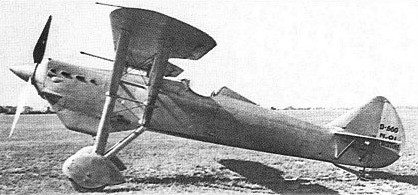
At the end of March 1933, criticism of the gulled wing of the D 560 led Emile Dewoitine to replace this with a wing of parasol form and of reduced span and area. Re-designated D 570, the modified prototype entered flight test on 27 November 1933, transferring from Francazal to the Centre d’Essais at Villacoublay early in December. It flew back to Francazal for minor modifications, and, on 21 December, while returning to Villacoublay, suffered an aileron failure and was destroyed.
Engine: HS 12Xbrs, 600 hp
Max take-off weight: 1709 kg / 3768 lb
Empty weight: 1284 kg / 2831 lb
Wingspan: 11.58 m / 37 ft 12 in
Length: 8.53 m / 27 ft 12 in
Height: 3.42 m / 11 ft 3 in
Wing area: 17.00 sq.m / 182.99 sq ft
Max. speed: 338 km/h / 210 mph
Dewoitine D.560
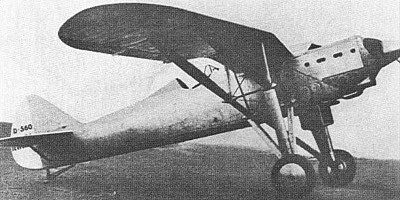
Aware of some prejudice against the low-wing monoplane configuration for single-seat fighters, Emile Dewoitine evolved almost simultaneously with the low-wing D 500 a fighter of shoulder-mounted gull wing configuration. This used the same 660 take-off horsepower HS 12Xbrs engine, the same fuselage and essentially similar tail surfaces. Designated D 560, this fighter flew for the first time on 5 October 1932, proving to be slower at rated altitude than the equivalent low-wing monoplane when flown at the Centre d’Essais at Villacoublay during the following month. The ventral radiator bath was extended forward similar to that of the D 500, and to rectify a stability problem the vertical tail was enlarged. The manoeuvrability of the D 560 proved outstanding, but evaluation pilots participating in the 1930 C1 programme universally condemned the gulled wing (which was also featured by other contenders – the Loire 43, the Gourdou-Leseurre 482 and the Mureaux 170). As a consequence, the D 560 was rebuilt as a classic parasol monoplane, the designation being changed to D 570.
Engine: HS 12Xbrs, 600 hp
Max take-off weight: 1698 kg / 3743 lb
Empty weight: 1270 kg / 2800 lb
Wingspan: 12.47 m / 40 ft 11 in
Length: 8.48 m / 27 ft 10 in
Height: 3.42 m / 11 ft 3 in
Wing area: 17.30 sq.m / 186.22 sq ft
Max. speed: 375 km/h / 233 mph
Dewoitine D.513 / D.514 LP

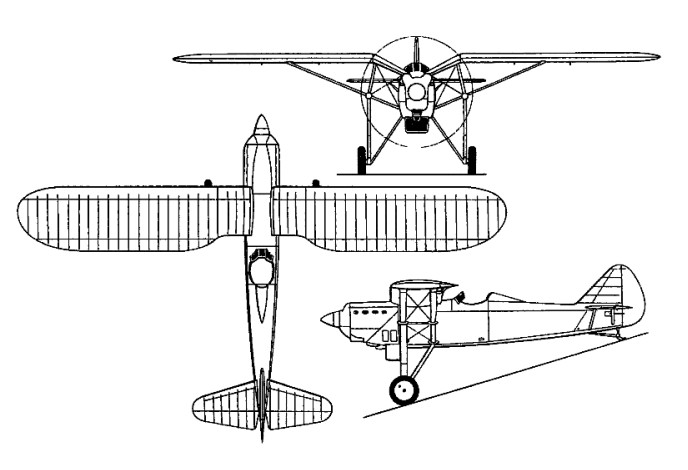
The company’s first monoplane fighter with retractable landing gear, two prototypes of a new fighter, the D 513, were ordered in 1935 as part of the 1934 C1 programme, the first of these being flown on 6 January 1936. Featuring semi-elliptical horizontal and vertical surfaces, with a wing of relatively high aspect ratio, an Hispano-Suiza 12Ycrsl engine with a frontal radiator similar to that of the D 503, and an inward-retracting main undercarriage, the D 513 proved disappointing during initial trials. It suffered serious instability and attained a maximum speed of only 425km/h at 4600m. Radical redesign followed, the wing and tailplane being mated to an entirely new fuselage, vertical tail surfaces, elevators and undercarriage, the frontal radiator giving place to a deep radiator bath beneath the nose. In this definitive form, the D 513 still proved incapable of meeting specified performance, a shortcoming which, compounded by continuing instability and difficulties with both engine cooling and undercarriage retraction, led to the discontinuation of development. The second prototype was fitted with an HS 12Ydrs2 engine rated at 930hp at 990m, and undercarriage and radiator like the D 503, and was employed for high-speed parachute launching trials as the D 514 LP.
D 513 (final form)
Take-off weight: 2446 kg / 5393 lb
Wingspan: 12.06 m / 39 ft 7 in
Length: 7.45 m / 24 ft 5 in
Wing area: 18.32 sq.m / 197.19 sq ft
Max. speed: 445 km/h / 277 mph
Dewoitine D.503
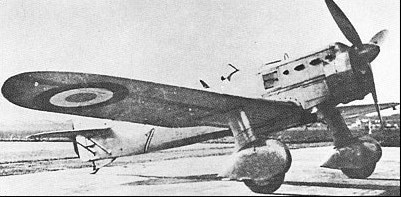
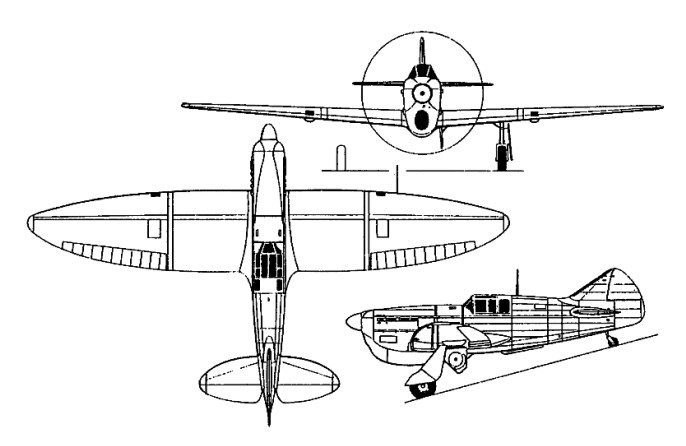
First flown on 15 April 1935, the D 503 was, in fact, a modification of the D 511 prototype, which, although exhibited in the Salon de l’Aeronautique in Paris in November 1934, was not flown. The D 511 had consisted of the fuselage and tail assembly of the D 500 mated to a wing of marginally smaller span and area, cantilever main undercarriage members and an Hispano-Suiza 12Ycrs engine. Calculations indicated that the D 511 would not offer a sufficient advance in performance (despite the fact that the first production order for the D 510 was not to be placed until May 1935) and it was therefore re-engined with a 690hp HS 12Xcrs engine with a circular frontal radiator, armament comprising a 20mm engine-mounted cannon and two wing-mounted 7.5mm Dame machine guns. Flight testing revealed a climb rate inferior to that of the standard D 500 and, after serving as the personal aircraft of Col Rene Fonck in the escadrille ministerielle, the prototype was assigned to the flying school at Etampes.
Engine: 690hp HS 12Xcrs engine
Take-off weight: 1823 kg / 4019 lb
Empty weight: 1378 kg / 3038 lb
Wingspan: 11.48 m / 37 ft 8 in
Length: 7.56 m / 24 ft 10 in
Height: 2.70 m / 8 ft 10 in
Wing area: 15.00 sq.m / 161.46 sq ft
Max. speed: 375 km/h / 233 mph
Range: 840 km / 522 miles
Armament: 1 x20mm cannon, 2 x 7.5mm Dame machine guns
Dewoitine D.500 / D.501 / D.510
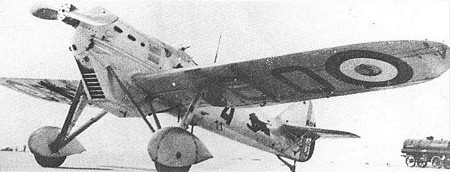
The D 500 was designed by Emile Dewoitine to a 1930 requirement for the Aviation Militaire. It was of all metal monoplane construction, with neat cantilever low wings, a fixed, spatted landing gear, and open cockpit. Intended to meet the demands of the 1930 C1 programme and eventually selected as winning contender, the D 500 was powered by a 12-cylinder Vee Hispano-Suiza 12Xbrs (HS 72) engine rated at 660hp for take-off and 690hp at 4000m. Armament comprised two 7.7mm Vickers guns in the fuselage, these later being supplanted by 7.5mm Darne guns with provision for two similar wing-mounted weapons.
The prototype was first flown on June 18, 1932, and at the end of November 1933, orders were placed for 60 D 500s of which 45 were to be built by Liore-et-Olivier and 15 by SAF-Avions Dewoitine. Of the former, 40 were to be powered by the HS 12Xbrs engine and the remaining five by the HS 12Xcrs (HS 76) with provision for a 20mm Hispano-Suiza S7 (Oerlikon) cannon mounted between the cylinder banks. With this installation and twin wing-mounted machine guns the fighter was designated D 501.
The SAF-Avions Dewoitine order was eventually to comprise eight D 500s, five D 501s and two D 510s. The first production D 500 was flown on 29 November 1934, contracts having meanwhile been placed for a further 50 D 500s and 80 D 501s to be built by Liore-et-Olivier and 60 D 501s by Ateliers et Chantiers de la Loire, deliveries to the Armee de l’Air commencing May-June 1935. Three D 500s were ordered by Venezuela at the beginning of 1934 and delivered in July 1935, and in the following year 14 D 501s were supplied to Lithuania. The Armee de l’Air received 100 D 500s and 133 D 501s, 30 of the latter type also being supplied to shore-based elements of France’s Aeronautique Navale. Small numbers of D 500s and D 501s equipped Escadrilles Regionale de Chasse in the early months of World War II, but had been relegated to tuitional tasks by 1940.
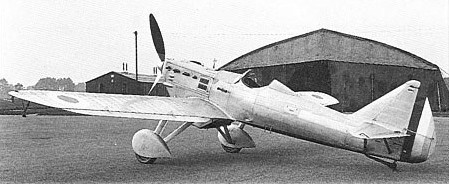
A further improved model, the D 510, first flew on August 14, 1934. It had a larger area rudder and a revised engine mounting to accommodate the 860 hp HS 12 Ycrs power¬plant.
Two of the 15 D 500 series aircraft (the second and tenth) comprising the initial production contract for the new low-wing fighter monoplane placed with SAF-Avions Dewoitine were fitted with the Hispano-Suiza 12Ycrs (HS 77) engine as prototypes for the D 510. Heavier and longer than the HS 12Xcrs (HS 76) of the standard D 501 fighter, the HS 12Ycrs similarly catered for a 20mm cannon between its cylinder banks, and was rated at 775hp at sea level and 860hp at 4000m. The first of the D 510 prototypes flew (without the cannon fitted) on 14 August 1934, the second (with cannon) following on 10 December. Apart from engine, the D 510 was fundamentally similar to the D 501, the cannon being complemented by a pair of 7.5mm wing guns. In May 1935, the Ministere de l’Air placed an initial contract for 35 (later reduced to 25) D 510s, these being delivered from 9 October 1936. Seven more D 510s were then built for the Armee de l’Air as agreed replacements for a similar number of D 501s taken from the service’s deliveries as part of the Lithuanian order. Follow-on contracts then called for a total of 80 more aircraft from which a contract for 24 D 510s from the Chinese Central Government was to be fulfilled. Other export D 510s were single examples to the UK and the Soviet Union, and two to Japan for evaluation purposes, and two, unofficially, to Republican Spain. These last had been the first two of a cancelled contract for Turkey and were ostensibly sold to the Hedjaz (Saudi Arabia). When it was revealed that the two D 510s had arrived in Spain, the French government insisted that their engines be returned to France. Eventually, both aircraft were fitted with M-100 (licence-built HS 12Ybrs) engines from a Tupolev SB bomber and allegedly saw some combat. Three Groupes de Chasse were still flying with the D 510 at the beginning of World War II, but re-equipped during the first months of the conflict. Two Escadrilles Regionale de Chasse in North Africa converted to D 510s in September-October 1939, flying them until mid-1940, and two escadrilles of the Aeronautique Navale formed on D 510s in December 1939 and May 1940.
One hundred and twenty were built, 90 going to the Armee de l’Air, for whom the D 510 was the first fighter capable of a level speed exceeding 400 km/h (248 mph).
Before the Second World War, most D 510s served in metropolitan France or Tunisia but on the outbreak of war, Groupes de Chasse GC 1/ 1, 11/ 1 and 118 were equipped with this model, and some D 501s were still in service in France with ERC (Escadrilles Regionales de Chasse) 561 and 562. Some D 501s were also still in service in North Africa when France capitulated in May 1940.
Prior to the outbreak of war, Dewoitine had export orders from China (24 D 510C), the Hejaz (two D 510), Japan (two D 510J), Lithuania (14 D 510L), Britain (one D 510A), the USSR (one D 510R) and Venezuela (three D 500V). There is some doubt whether those destined for Venezuela were ever received, and it is probable that some or all of the Lithuanian batch and the two for the Hejaz went instead to the Republican forces in Spain during the Civil War.
D 501
Take-off weight: 1787 kg / 3940 lb
Empty weight: 1287 kg / 2837 lb
Wingspan: 12.09 m / 39 ft 8 in
Length: 7.56 m / 24 ft 10 in
Height: 2.70 m / 8 ft 10 in
Wing area: 16.50 sq.m / 177.60 sq ft
Max. speed: 367 km/h / 228 mph
Range: 870 km / 541 miles
D.510
Engine: Hispano-Suiza 12Ycrs (HS 77), 775hp at sea level, 860hp at 4000m
Take-off weight: 1929 kg / 4253 lb
Empty weight: 1496 kg / 3298 lb
Span: 12.092 m (39 ft 8 in)
Length: 7.94 m / 26 ft 1 in
Height: 2.42 m / 7 ft 11 in
Wing area: 16.50 sq.m / 177.60 sq ft
Maximum speed: 393 km/h (244 mph)
Range: 700 km / 435 miles
Armament: 1 x 20mm cannon, 2 x 7.5mm wing guns
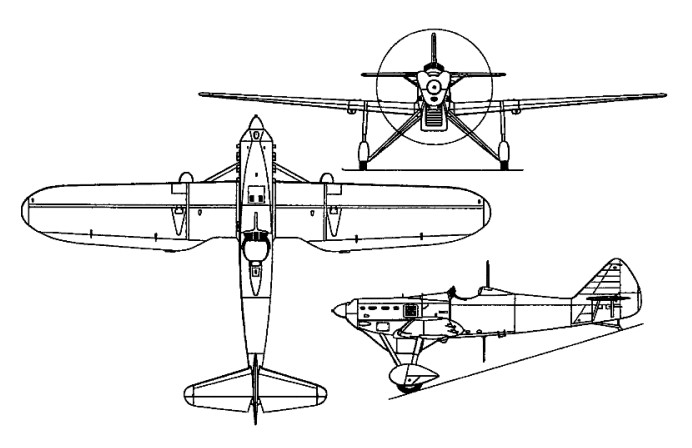
Dewoitine D.332 / D.333/ D.338 / D.342 / D.620

An all-metal single-spar cantilever low-wing monoplane; it was intended for service with Air Orient on its Paris-Saigon route. Power was provided by three 428.5kW Wright Cyclone radial engines and the aircraft had a trousered fixed landing gear. The single D.332 Emeraude was first flown on 11 July 1933 by test pilot Marcel Doret.
Several speed-with-load-over-distance world records fell to the D.332 in 1933 and it made many spectacular European flights. However it crashed on the final return stage of the inaugural Paris-Saigon service on 15 January 1935.
Three D.333s followed, each powered by 428.5kW Hispano-Suiza radial engines and accommodating ten passengers. One was lost in October 1937 while flying the Toulouse-Dakar service with Air France. The others flew in South America on the Buenos Aires-Natal route.
In 1936 the prototype of a new version appeared as the D.338, a fast 22-passenger Air France liner. It was followed by 30 production examples for Air France. These had retractable landing gears, were powered by 484.5kW Hispano-Suiza V16/17 engines, and each accommodated up to 22 passengers. They were operated on the Paris-Cannes-Damascus-Hanoi and Paris-Dakar routes. Many continued to fly during World War II on government liaison and VIP duties and eight were used for a short time after the war.

During the war, the Free French airline known as Lignes Aériennes Militaires flew the D.338 on scheduled service to Beirut and Brazzaville, French Congo.
Lufthansa, the German airline, made use of seven D.338s which they confiscated from Air France.
Nine of the aircraft survived the war and were put into service for a few months.
The D.342 was a one-off development of the D.338, as was the D.620.
D.333
Engine: 3 x HS 9 Vd, 425kW
Take-off weight: 11100 kg / 24471 lb
Empty weight: 6960 kg / 15344 lb
Wingspan: 29.4 m / 96 ft 5 in
Length: 22.1 m / 72 ft 6 in
Wing area: 99.0 sq.m / 1065.63 sq ft
Max. Speed: 300 km/h / 186 mph
Cruise speed: 260 km/h / 162 mph
Ceiling: 5000 m / 16400 ft
Range w/max.fuel: 2000 km / 1243 miles
Range w/max.payload: 850 km / 528 miles
Crew: 4
Passengers: 22


