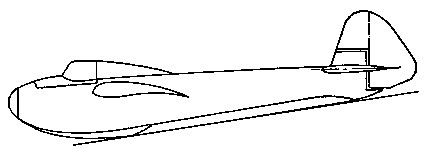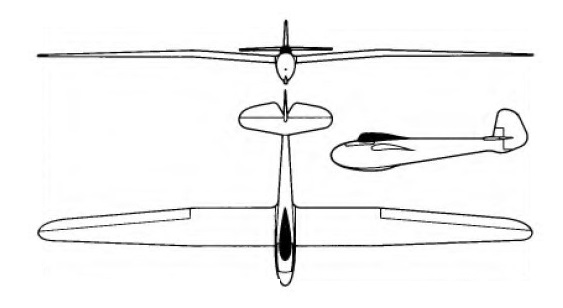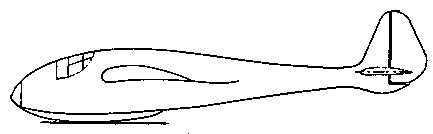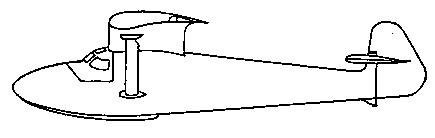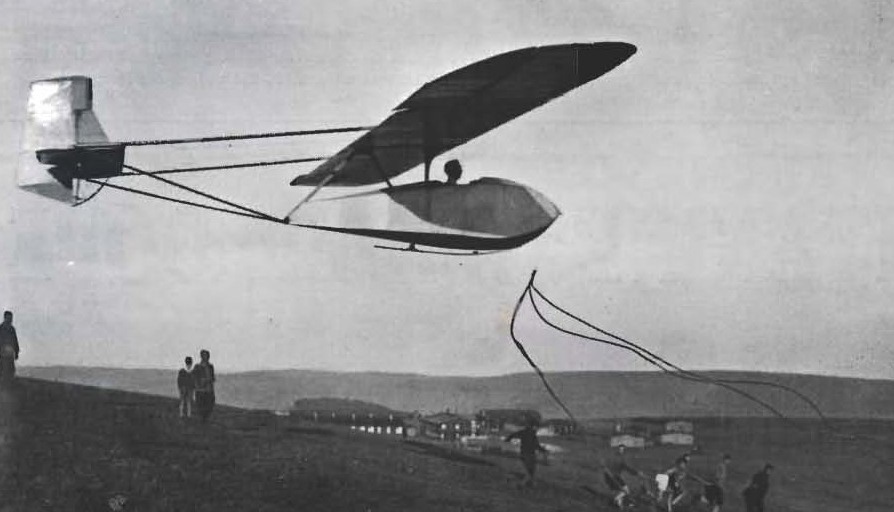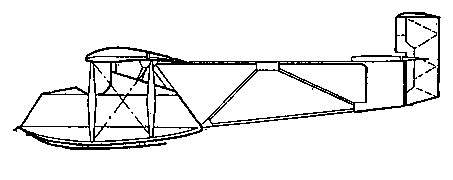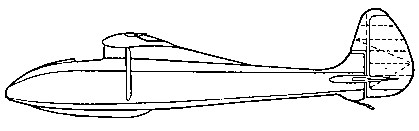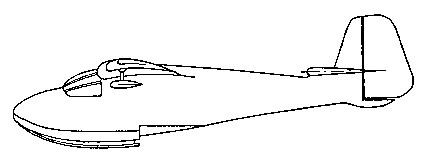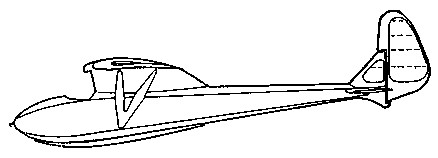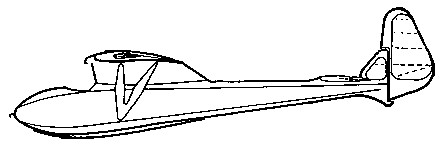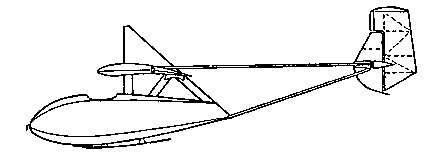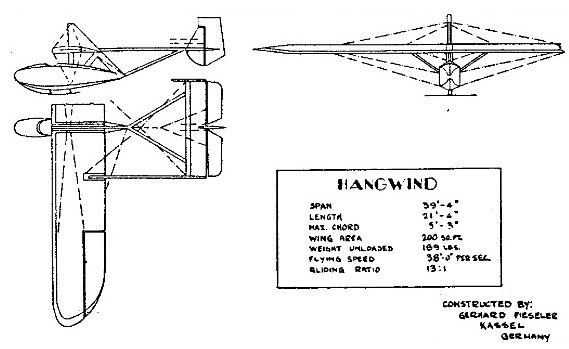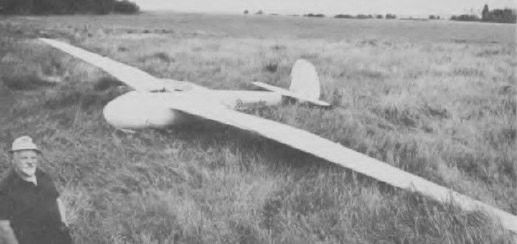
The Rhonsperber (or Rhon Sparrowhawk) was the second high perfromance single-seater designed by Hans Jacobs, and made use of the growing experience being gained in soaring in thermals at the Rhon competitions of 1932, when the Rhonadler had first appeared, and 1934. Developed from the Rhonbussard, and owing something to the earlier Rhonadler, the Rhonsperber differed from these types by having the cantilever gull wing lowered to the mid-set position, and slightly increased in span over the Rhonbussard’s. For the first time in a sailplane, spoilers were fitted into the wing upper surfaces, and these were later developed by Hans Jacobs into the DFS air brakes which were to be fitted to many other sailplane designs. Lowering the wing made possible a larger cockpit with better visibility above and behind, in which the instrument panel could be placed further from the pilot so as to enable him to see the whole panel at a glance; the pilot also had the benefit of an adjustable seat and rudder pedals for greater comfort on long soaring flights. Landing gear consists of a long wooden skid under the forward fuselage and a tail bumper fairing.
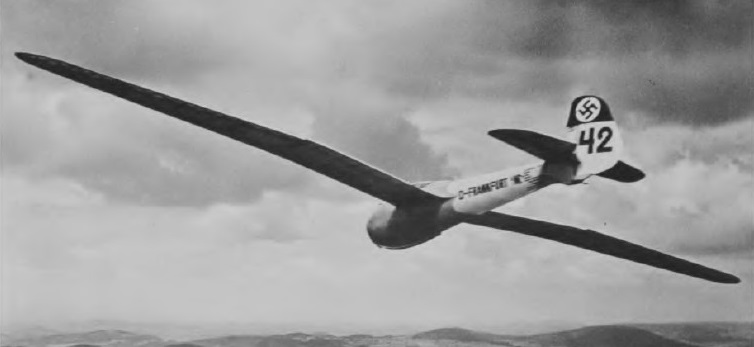
Of conventional wood and fabric construction, the Rhonsperber was put into production by the firm of Schweyer at Ludwigshafen, where about 100 were built; the prototype had first flown in 1935 and for the next two or three years the type was regarded as the leading German high performance sailplane.
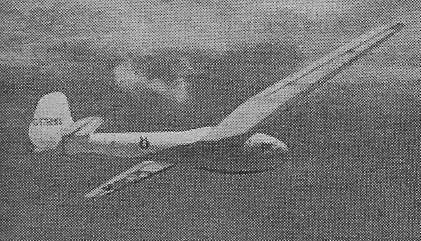
It had many competition successes and made some notable long distance and record flights, including the first sailplane crossing of the Alps into Italy, made by Heini Dittmar in 1936, and a new world altitude record of 18,898ft set up in 1937 by Paul Steinig.
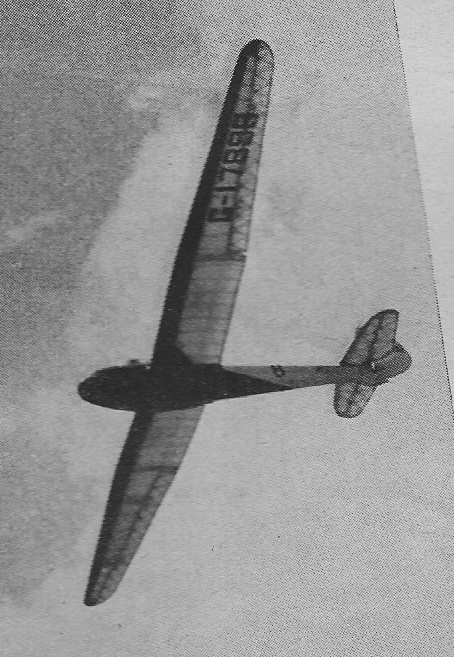
Span: 50 ft 2.5 in / 15.2 m
Length: 19 ft 10.25 in / 6.05 m
Wing area: 162.6 sqft
Aspect ratio: 15.3
Empty weight: 357 lb
Max weight: 562 lb
Max speed: 124 mph
Min sinking speed: 2.4 ft/sec
Best glide ratio: 20:1
Crew: 1
Schweyer Rhonsperber
Wing span: 15.3 m (50 ft 2 1/2 in)
Length: 6.05 m (19 ft 10.25 in)
Wing area: 15.1 sq.m (162.6 sq ft)
Wing section: Gottingen 535
Aspect ratio: 15.3
Empty weight: 162 kg (357 lb)
Max weight: 255 kg (562 lb)
Water ballast: None
Max wing loading: 16.9 kg/sq.m (3.46 lb/sq ft)
Max speed: 108 kt (200 km/h)
Stalling speed: 32.5 kt (60 km/h)
Min sinking speed: 0.72 m/sec (2.4 ft/sec)
Best glide ratio: 20