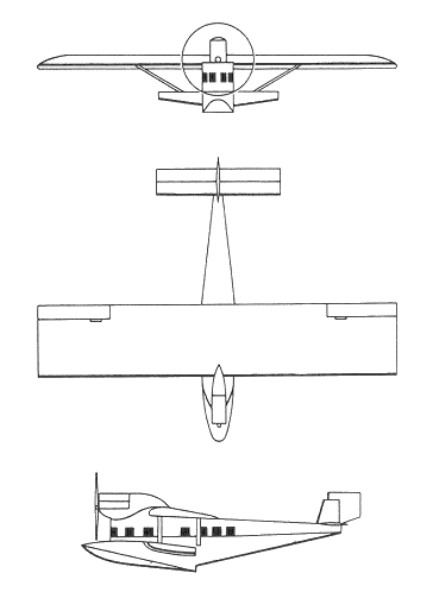
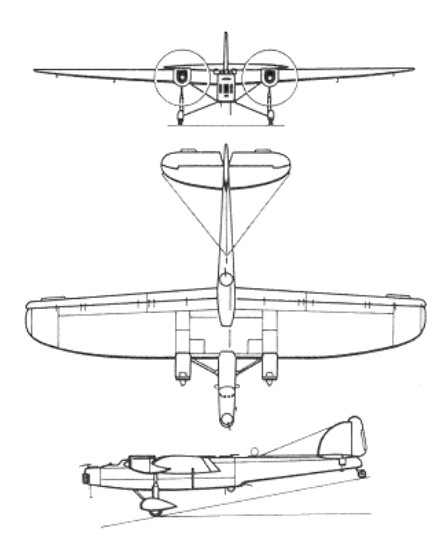
The Do Y medium bomber had a high-set wing and and three engines, two on the wing leading edge and the third on struts above the wing. The Do Y was built in Switzerland in 1931 and possibly 4 were built. The first 2 models (Werke No 232 and 233) were powered by Bristol Jupiter VI engines with 2 bladed wooden props were ordered and delivered to the Yugoslavian government in October 1932. They were later captured by invading German forces in 1941.
The next two models again ordered by the Yugoslav goverment were powered by Gnome Rhone Jupiter 9 Kers engines with 3 bladed metal props offering a better all round performance.
Inter-Wars
Dornier Do.14
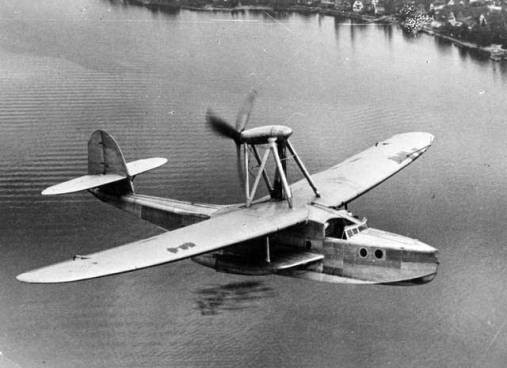
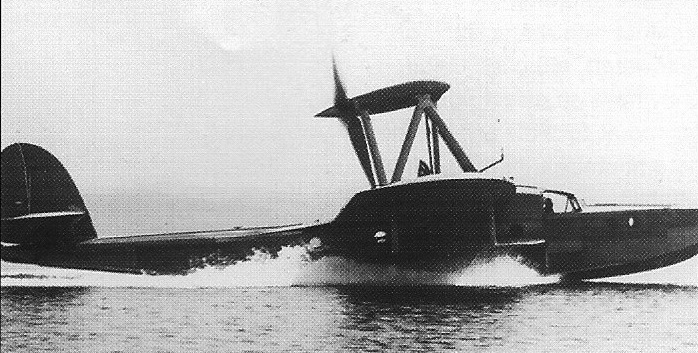
With the Do.14, Dornier used basic the formula of their successful “Wal” series to build a “cleaner” and more modern seaplane in 1936. Apart of its more aerodynamic shape the main characteristic of the Do.14 was its engine installation. Instead of the twin engined tandem layout above its wing, Dornier placed the two engines inside the fuselage. Those engines were situated facing each other and connected to a gearbox that drove the pusher propeller through a vertical shaft. The aircraft flew without any serious problems, yet only one was built, Technology advances had made this engine formula obsolete.
Dornier Delphin
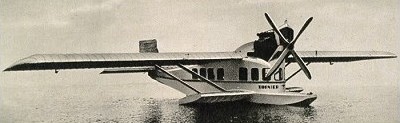
In 1920 Dornier produced the first Delphin commercial flying-boat. It was based upon substantially the same design as the Libelle. The first versions, the L.1 and L.1a, were each produced with a high open pilot’s cockpit aft of the 138kW BMW IlIa or 134kW BMW III engine, but the later L.2 and L.3 versions had seating for two in front of the passenger cabin, separated by a bulkhead. Power for these versions was provided by a 186.3kW BMW IV or 194kW Rolls-Royce Falcon III and a 447kW BMW VI engine respectively. The Delphin L.2 accommodated up to seven passengers (one next to pilot). The L.3 could carry up to 13 and was built in Switzerland by the Aktiengesellschaft fur Dornier-Flugzeuge at Altenrhein for over inland water and coastal services.
Engine: 1 x BMW IIIa, 136kW
Max take-off weight: 2200 kg / 4850 lb
Empty weight: 600 kg / 1323 lb
Wingspan: 17.0 m / 55 ft 9 in
Length: 11.5 m / 37 ft 9 in
Height: 3.1 m / 10 ft 2 in
Wing area: 50.0 sq.m / 538.20 sq ft
Max. speed: 150 km/h / 93 mph
Cruise speed: 125 km/h / 78 mph
Ceiling: 4000 m / 13100 ft
Range w/max.fuel: 380 km / 236 miles
Crew: 1
Passengers: 5
Dornier Spatz
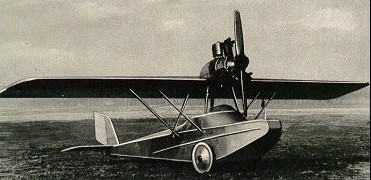
Virtually a landplane version of the Dornier Libelle without the hull sponsons but with fixed tailskid landing gear. The 1924 Spatz had a 60kW Siemens-Halske engine was standard, but a 75kW engine and an open cockpit or enclosed cabin were optional.
Engine: 1 x Siemens-Halske Sh-7, 59kW
Take-off weight: 800 kg / 1764 lb
Empty weight: 490 kg / 1080 lb
Wingspan: 9.8 m / 32 ft 2 in
Length: 6.9 m / 22 ft 8 in
Height: 2.8 m / 9 ft 2 in
Wing area: 15.5 sq.m / 166.84 sq ft
Max. speed: 141 km/h / 88 mph
Cruise speed: 120 km/h / 75 mph
Ceiling: 3500 m / 11500 ft
Crew: 1
Passengers: 2
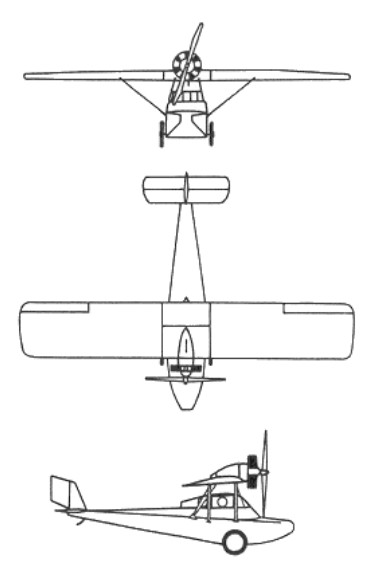
Dornier Do-12 Libelle
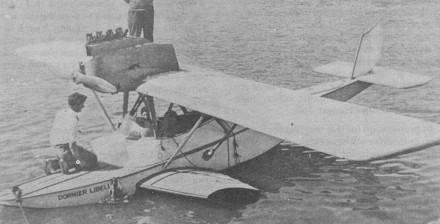
The Libelle is a small flying boat of 1922. They were sold in Brazil, New Zealand, Australia, Japan and the Fiji.
Dornier Libelle II
Length : 24.606 ft / 7.5 m
Height : 7.874 ft / 2.4 m
Wingspan : 32.152 ft / 9.8 m
Max. speed : 78 kts / 145 km/h
Service ceiling : 6562 ft / 2000 m
Engine : Cirrus III 4-Cyl, 79 hp
Crew : 1+2
Dornier Do. F / Do-11 / Do-13
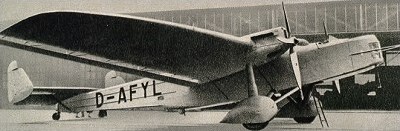
During the late 1920s the German Dornier Metallbauten set up a subsidiary at Altenrhein in Switzerland to build heavy aircraft expressly forbidden under the terms of the Versailles Treaty. The Do P had four engines, the Do Y three, and the Do F was a large twin. All were described as freighters, but their suitability as bombers was obvious. In late 1932 it was boldly decided to put the F into production at the German factory at Friedrichshafen, the designation being changed to Do 11. The Do F, built at Dornier’s Altenrhein factory in Switzerland, and which first flew in May 1932, powered by two 550 hp Siemens built Bristol Jupiter radials and having a retractable main landing gear.
The Do 11 had a slim light-alloy fuselage, high-mounted metal wing with fabric covering carrying two 484.4kW Siemens Sh 22B engines (derived from the Bristol Jupiter), and a quaint retractable landing gear whose vertical main legs were laboriously cranked inwards along the inner wing until the large wheels lay flat inside the nacelles. There was obvious provision for a bomb bay and three gun positions.
In 1933, well before the official establishment of the Luftwaffe, an official order was placed for a production version of the Do F with two 650 hp Siemens Sh 22B 2 nine-cylinder radials, driving three blade wooden propellers. They were delivered from late 1933 as Do 11Cs to the German State Railways which under the cover of a freight service actually enabled the embryo Luftwaffe to begin training future bomber crews. Although they were so used for freight, gun installations, bomb racks and other military items were delivered separately and secretly. Thus they could be converted quickly into bombers and were openly in service as such in early 1934 with the Befeffiskampfgeschwader (auxiliary bomber wing) of the Luftwaffe.
The Do 11C was a twin engined, high wing monoplane, with an all metal fuselage and a glazed observation section in the nose. The crew consisted of a pilot, wireless operator and two gunners, the latter sharing the three single 7.9 mm (0.311 in) MG 15 machine-guns, one each in dorsal and ventral positions and one on a ring mounting forward of the front cockpit.
The Do 11C was a contemporary of the Ju 52/3m in the initial formation of Luftwaffe bomber squadrons.
It had been planned to deliver 372 Do 11 in 1934 but delays, plus grossly unpleasant handling and structural qualities, led to the development of the Do 11D with modified, shorter span wings, and the Do 11Cs in service were also converted to this standard. This was further developed into the Do 13, by fitting non retractable landing gear and doing away with the glazed nose and the small auxiliary horizontal stabilizers fitted under the Do 11’s tailplane.
At least 77 Do 11D were delivered, some later being passed on to another clandestine air force, that of Bulgaria.
The Do 13 was first flown on February 13, 1933, with the same powerplant as its predecessor. Substitution of Junkers type ‘double wing’ trailing edge flaps, similar to those of the Ju 52/3m, gave it improved landing characteristics, and when the Sh 22 engines were replaced by a pair of 750 hp 12¬cylinder liquid cooled BMW VIUs, driving four blade propellers, the bomber was redesignated Do 13C.
The Do 13 with fixed (often spatted) landing gear was wholly unacceptable, but in September 1934 testing began of a completely redesigned machine called Do 13e with stronger airframe, Junkers double-wing flaps and ailerons and many other changes. To erase the reputation of its forbear this was redesignated Do 23 and in March 1935 production restarted of Do 23F bombers.
No attempt was made to disguise the function of the bomber: the fuselage having a glazed nose for visual aiming of the 1,000kg bomb load housed in vertical cells in the fuselage, and nose, mid-upper and rear ventral positions each being provided with a 7.92mm MG 15 machine-gun. After building a small number the Dornier plant switched to the Do 23G with the BMW VIU engine cooled by ethylene-glycol. By late 1935 more than 200 had been delivered and these equipped the first five named Fliegergruppen – although about two-thirds of their strength comprised the distinctly preferable Ju 52/3m. Although it played a major part in the formation of the Luftwaffe and continued to the end of World War II to serve in training, trials and research roles, the Dornier Do 23 was not much better than its disappointing predecessors.
Do 11D
Span: 26.30 m (86 ft 3.5 in)
Length 18.80 m (61 ft 8.25 in)
Gross weight 8200 kg (18078 lb)
Maximum speed: 260 km/h (161 mph).
Do-13
Engine: 2 x BMW VIU, 540kW
Take-off weight: 8750-9200 kg / 19291 – 20283 lb
Empty weight: 3150 kg / 6945 lb
Wingspan: 25.6 m / 83 ft 12 in
Length: 18.8 m / 61 ft 8 in
Height: 5.4 m / 17 ft 9 in
Wing area: 108.0 sq.m / 1162.50 sq ft
Max. Speed: 260 km/h / 162 mph
Cruise speed: 210 km/h / 130 mph
Ceiling: 4000 m / 13100 ft
Range w/max.fuel: 1200 km / 746 miles
Armament: 3 machine-guns, 1000kg of bombs
Crew: 4
Dornier C4 / Do-10
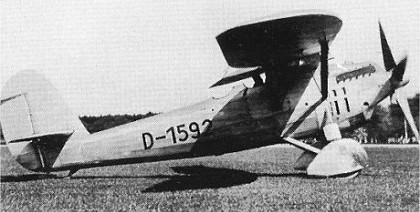
The Do C4, later renamed Do 10, was a two-seat parasol monoplane fighter. It was unsuccessful, and used as testbed for a tilting engine installation.
Dornier Do-X
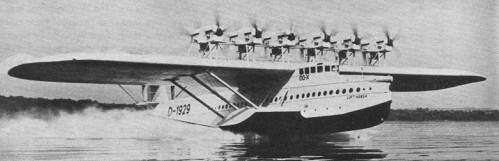
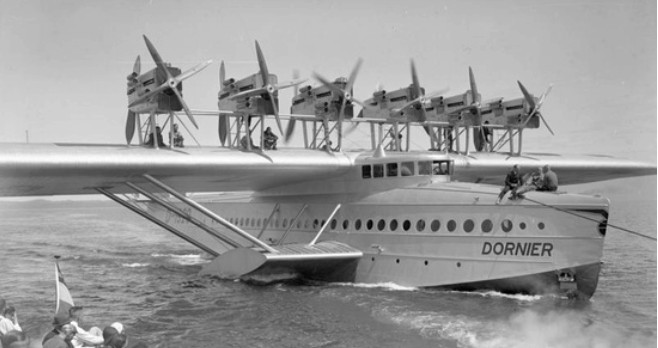
First conceived by Dr. Claudius Dornier in 1924, planning started in late 1925 and after over 240,000 work hours it was completed in June 1929. The Dornier Do X weighed 62 tonnes (61 tons) loaded, spanned 48 m (157 ft), had three decks, carry 100 passengers, and was powered by 12 Siemens built Bristol Jupiter radial engines of 550 hp mounted in tandem pairs atop a forest of struts above its wing. The three decks included a lounge, smoking room, bathroom, kitchen and dining room as well as individual sleeping cabins. Fully loaded, the maximum speed was only 160km/h.
The luxurious passenger accommodation approached the standards of transatlantic liners. On the main deck was a smoking room with its own wet bar, a dining salon, and seating for the 66 passengers which could also be converted to sleeping berths for night flights. Aft of the passenger spaces was an all-electric galley, lavatories, and cargo hold. The cockpit, navigational office, engine control and radio rooms were on the upper deck. The lower deck held fuel tanks and nine watertight compartments, only seven of which were needed to provide full flotation.
The Do X was financed by the German Transport Ministry and built in a specially designed plant at Altenrhein on the Swiss portion of Lake Constance. This, in order to circumvent the Treaty of Versailles which forbade any aircraft exceeding set speed and range limits to be built in Germany after World War I. The Dornier Do X was the largest, heaviest, and most powerful flying boat in the world when it was produced in 1929.
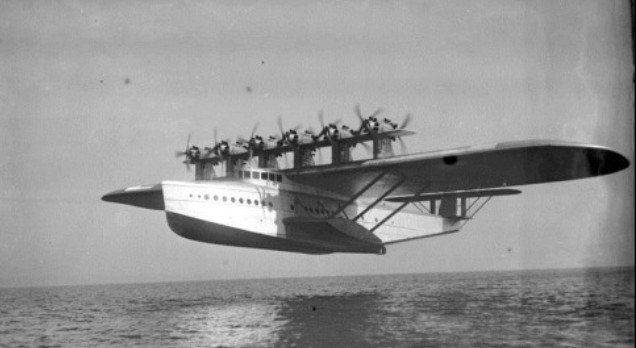
The Do X was built in Switzerland by Aktiengesellschaft fur Dornier-Flugzeuge at Altenrhein, was launched on 12 July 1929, and first flew off the Bodensee on 25 July 1929 with a crew of 14. The Do X is a semi-cantilever monoplane, an all-duralumin hull, with wings composed of a steel-reinforced duralumin framework covered in heavy linen fabric, covered with aluminum paint.
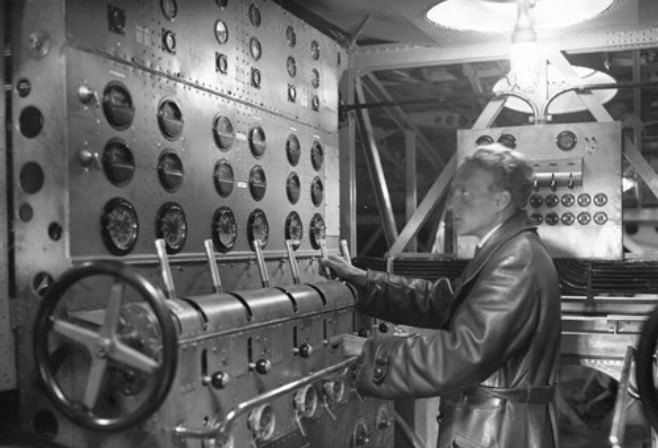
It was initially powered by twelve 391 kW (524 hp) Siemens-built Bristol Jupiter radial engines (six tractor propellers and six pushers), mounted in six tower nacelles on the wing. The nacelles are joined by an auxiliary wing whose purpose was to stabilize the mountings. The air-cooled Jupiter engines were prone to overheating and proved to only be able to lift the Do X to an altitude of 425 m (1,400 ft). The engines were supervised by an engineer, who also controlled the throttle. The pilot would ask the engineer to adjust the power, in a manner similar to that used on maritime vessels.
On its 70th test flight on 21 October 1929 there were 169 souls on board; 150 passengers (mostly production workers and their families, and a few journalists), 10 aircrew and 9 “stowaways”, who did not hold tickets. The flight broke the then world record for the number of persons carried on a single flight, a record that was not broken for another 20 years. After a takeoff run of 50 seconds the Do X slowly climbed to an altitude of only 200 m (650 ft). As a result of the ship’s size, passengers were asked to crowd together on one side or the other to help make turns. It flew for 40 minutes (Flug Revue claims it was the 42nd flight and lasted 53 minutes, and historical film shows “fliegt mit 170 personen”) at a maximum speed of 170 km/h (105 mph) before finally landing on Lake Constance.
But the Dornier was barely able to climb above 400 m (1312 ft) because of the poor cooling of the rear-mounted sextet of Jupiters, which sharply reduced their power output.
After completing 103 flights in 1930, the Do X was refitted with 455 kW (610 hp) Curtiss Conqueror water-cooled 12-cylinder inline engines. Only then was it able to reach the altitude of 490 m (1,610 ft) necessary to cross the Atlantic. Dr. Dornier designed the flying boat to carry 66 passengers long distance or 100 on shorter flights.
During a visit to England in 1930 it was piloted for 10 minutes by the Prince of Wales.
To introduce the airliner to the potential United States market the Do X took off from Friedrichshafen, Germany on 3 November 1930, under the command of Friedrich Christiansen for a transatlantic test flight to New York. The route took the Do X to the Netherlands, England, France, Spain, and Portugal. The journey was interrupted at Lisbon on 29 November, when a tarpaulin made contact with a hot exhaust pipe and started a fire that consumed most of the port side wing.
After sitting in Lisbon harbor for six weeks while new parts were fabricated and the damage repaired, the flying boat continued along the Western coast of Africa and by 5 June 1931 had reached the Capverdian Islands. Taking off from Las Palmas in the Canary Islands in high seas the hull took such a beating that another three months were wasted for repairs. Eventually it reached Natal, Brazil after crossing the Atlantic at an altitude of 6 m (20 ft) and with half her crew of 19 and much of her cargo of mail left be¬hind to save weight.
The new engines, while giving more power than the radials, burned fuel at the rate of 1820 litres (400 Imperial gallons) per hour, which meant that every non essential item had to be sacrificed. At length, on 27 August 1931, the Do X came to New York’s Battery to a ticker tape welcome, ten months after setting out from Germany.
The Do X and crew spent the next nine months there as its engines were overhauled, and thousands of sightseers made the trip to Glenn Curtiss Airport (now LaGuardia Airport) to tour the leviathan of the air. The economic effects of the Great Depression dashed Dornier’s marketing plans for the Do X, however, and it departed from New York on May 21, 1932 via Newfoundland and the Azores to Müggelsee, Berlin where it arrived on 24 May and was met by a cheering crowd of 200,000.
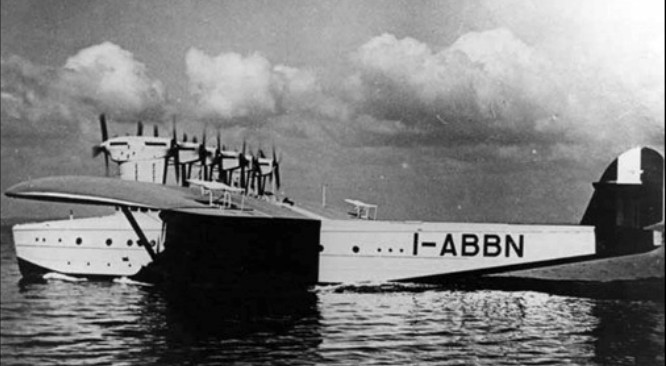
Two further Do Xs, the Umberto Maddalena and Alessandro Guidoni, were built for the Italian air force.
Germany’s original Do X was turned over to Deutsche Luft Hansa, the national airline at that time, after the financially strapped Dornier Company could no longer operate it. After a successful 1932 tour of German coastal cities, Luft Hansa planned a Do X flight to Vienna, Budapest, and Istanbul for 1933. The voyage ended after nine days when the flying boat’s tail section tore off during a botched, over-steep landing on a reservoir lake near the city of Passau. While the fiasco was successfully covered up and the Do X was repaired, it was then flown to Berlin, where it became the centerpiece of Germany’s new aviation museum Deutsche Luftfahrt-Sammlung at Lehrter Bahnhof, opened in 1936.
The Do X remained an exhibit until it was destroyed in an RAF air raid during World War II on the night of 23-24 November 1943, by 383 aircraft – 365 Lancasters, 10 Halifaxes, and 8 Mosquitos. Fragments of the torn off tail section are on display at the Dornier Museum in Friedrichshafen. While never a commercial success, the Dornier Do X was the largest heavier-than-air aircraft of its time, a pioneer in demonstrating the potential of an international passenger air service. A successor, the Do-XX, was envisioned by Dornier, but never advanced beyond the design study stage.
Do XIa
Data from Flight 1930
Length: 40.1 m (131 ft 4 in)
Wingspan: 48 m (157 ft 5 in)
Height: 10.25 m (33 ft 7 in)
Wing area: 450 m² (4,844 ft²)
Empty weight: 28,250 kg (62,280 lb)
Max. takeoff weight: 56,000 kg (123,460 lb)
Engines: 12 × Curtiss Conqueror, 455 kW (610 hp)
Maximum speed: 211 km/h (131 mph)
Cruise speed: 175 km/h (109 mph)
Range w/max.fuel: 3600 km / 2237 miles
Range w/max.payload: 1100 km / 684 miles
Ceiling: 420 m / 1400 ft
Wing loading: 19.3 lb/sq ft (at 46 tons weight)
Crew: 10-14
Capacity: 66-100 passengers
Dornier Do.R Super Wal
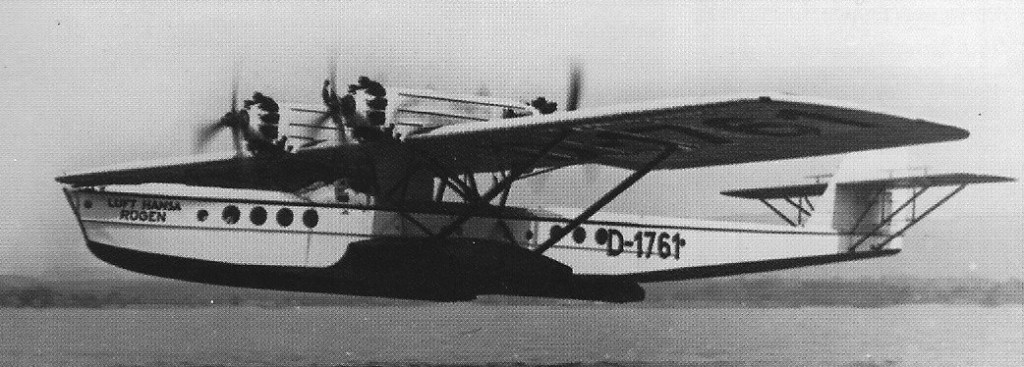
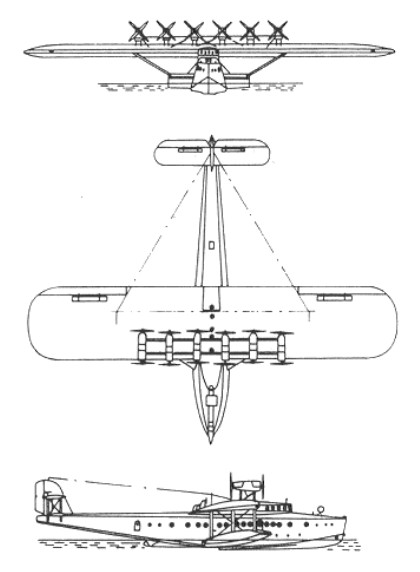
In 1926 Dornier located his main centre of activities across Lake Constance at Altenrhein, Switzerland, and began the development of the Superwal, the four engine DoR with two passenger cabins for 20 passengers, and then the gigantic 12 engine DoX, intended for transatlantic travel.
Dornier Do.Q
A 1925 Japanese collection of official papers, which was sent to Kawasaki, mentions a Do. Q aircraft as a submarine-carried aircraft.
The first paragraph reads, roughly:
“To their request, regarding the work progress of the Do. Q – (machine with Siemens motor), [would] like to share with them [Kawasaki?] that we will be expecting such a motor from the delivery company and then try to make it [Do. Q]. We assume that with this engine, a better performance of the Do. Q will be achieved.”
The second paragraph:
“[As far as] flying the Do. Q, built [using the] Le Rhone engine is concerned, it was executed some time before another flight with the maximum payload. The engine of the [Do. Q] started effortlessly in 20 seconds, however, the speed [was] very low, which was detected by [comparison to the Dragonfly (Do. A)] and it found that the rate [speed?] of the Do. Q was [inferior] to the Dragonfly. Also on the water, the rotating mass of the motor [required] that the turn down the Le Rhone engine [to] only 800 [Touren?] and the pilot is forced to temporarily turn off the ignition to the engine. The consequences of this is that the boat [was] pretty jerky and restless and rolls up after turning the ignition [on]. The flight tests were, therefore, with the Do. Q [using the] Le Rhone.”
Third paragraph:
“So we must ask them [Kawasaki?] to be patient in this affair, until we try our exports [engines] with [the] built-in Siemens motor [as we regret that opposition to ] the Le Rhone engine [has] stiffened. It will be understandable to them that the Do. Q [will] only achieve good results and for this reason [we must]refrain from [using] the Le Rhone engine.
Your faithfully,
Dornier-Metallbauten G.m.b.H.”

