The Dunstable Dart by A.R. Weyl originated from an idea to make a powered version of the Slingsby Falcon 3.
Inter-Wars
Dunstable Kestrel
In January 1935 W.L.Manuel joined the Dunstable Sailplane Co and built a developed version of the Willow Wren which was named the Dunstable Kestrel.
The Dunstable Kestrel was manufactured by the company from designs by W.L. Manuel in 1935; production was limited to one sailplane with a British Gliding Association id of G221. Records comment that G221 was purchased by a trainee pilot who was still in his early stages of training with a primary glider. This Dunstable Kestrel passed to the Norfolk & Norwich Aero Club and crashed in 1938, however W.L. Manuel drew up plans for home builders which were offered for sale at the cost of £6. 6s. W.E. Godson purchased a set of plans and built a second British Kestrel whilst three more Kestrels were built in Australia by R. New, R. Basillie and the last by P. Pratt. Whilst no remains exist of the British built aircraft all three Australian-built ones are in museums.
Wingspan: 12.19 m / 40 ft 0 in
Length: 6.10 m / 20 ft 0 in
Wing area: 13.93 sq.m / 150 sq.ft
Aspect ratio: 11
Empty weight: 111.13 kg / 245 lb
AUW: 188.24 kg / 415 lb
Wing loading: 13.52 kg/sq.m / 2.77 lb/sq.ft
Max L/D: 18
Stall: 45 kph / 28 mph
Min sink: 0.95 m/sec / 2.9 ft/sec
Dunstable Sailplane Company
The Dunstable Sailplane Company was established in 1934 by W.L. Manuel and C.H. Latimer-Needham to design, manufacture and repair gliders from its workshop at Barton-Le-Clay Airfield in Bedfordshire, UK.
The Dunstable Kestrel was manufactured by the company from designs by W.L. Manuel in 1935; production was limited to one sailplane with a British Gliding Association id of G221.
W.L. Manuel drew up plans for home builders which were offered for sale at the cost of £6. 6s.
W. L. Manuel was born William Lancelot Manuel in 1903; parish records list his birthplace as Malling, Kent. Manuel spent his early life working at RAF Hawkinge Kent with 25 Fighter Squadron, He was a key member in the establishment of the Channel Gliding Club (1930), and built an estimated 14 aircraft over his 84-year life. William Manuel retired in 1965 from the AC Cars company of Thames Ditton; it is thought he was the company’s chief planning engineer on retirement.
Dunning 1934 sailplane
The basic design of the Cloudcraft Dickson Primary was modified and built by a Mr Dunning, of the Southdown Gliding Club, in 1933-34.
It was first flown from Lancing, UK, on 10 March 1934 only to be written off there on 20 May 1934.
Only one was built and no Certificate of Airworthiness was issued.
Dewoitine D.480 / D.482
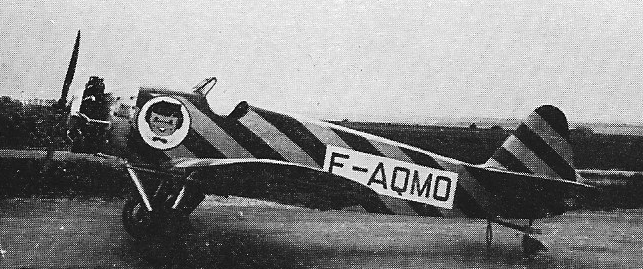
The D.482 side-by-side two-seat trainer was produced in 1932 as a higher-powered development of the D.480, the 95hp Salmson 7 Ac radial of the D.480 being replaced by a 135hp Salmson 9 Nc.
A number were produced by the Societe Aeronautique Francaise in the early 1930s.
D.480
Engine: 95hp Salmson 7 Ac
D.482
Engine: 135hp Salmson 9 Nc
Wingspan: 41 ft 8 in
Length: 24 ft 3.25 in
Height: 9 ft 3 in
Wing area: 204.5 sq.ft
Empty weight: 1424 lb
Loaded weight: 2005 lb
Max speed: 87 mph
Service ceiling: 14,673 ft
Range: 373 mi
Druine
Roger Druine built his first aircraft in 1938 at the age of 17, and built a single-seat cabin monoplane, the Aigle, in 1948. His 1950 single-seat D.31 Turbulent was produced in small number by Rollason Aircraft & Engines and Stark Flugzeugbau, and remains available in plans form for home construction. Rollason also built the 1954 two-seat D.60 Condor (plans available). Also remaining available in plans form is D.5 Turbi two-seater, first flown 1951, as a development of Turbulent.
Driggs Skylark
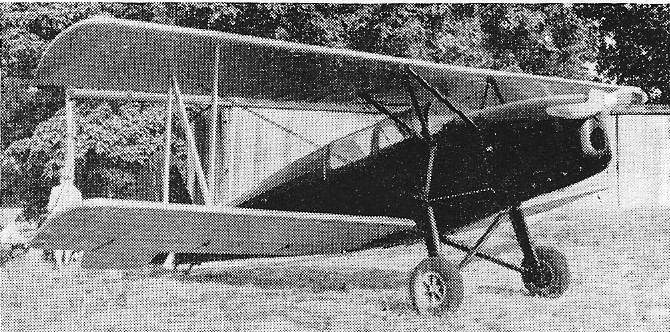
The unique Driggs Skylark N11301 c.n 3016 was built in May 1931.
An enclosed tandem two-seater powered by a 95 hp Cirrus engine, modifications to the tail and canopy addition were carried out in May 1942.
In 1956 it was owned by Morey Cheever of Demotte, Indiana, USA.
Driggs Dart
The 1926 Driggs Dart I was tested by the Army as 26-205.
A variation of the Driggs Dart I was built as the McRae Super Dart.
Driggs-Johnson DJ-1 Bumblebee
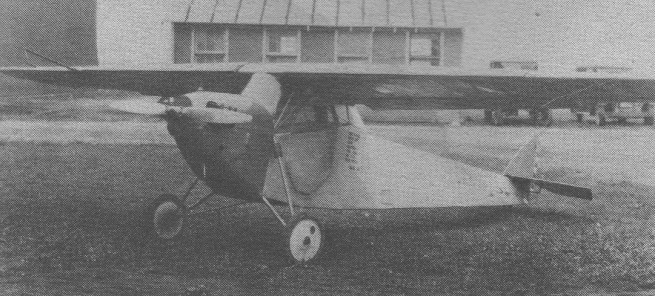
The original Driggs-Johnson DJ-1 of 1925 was powered with a 28-hp converted Henderson motorcycle engine. The few production Darts used slightly more power. This is one that the Army bought to test variable-camber wings; low cost and simple construction made it easy to try different arrangements.
Driggs Aircraft Corp
USA
Founded at Lansing, Michigan in 1927 by Ivan H. Driggs, who designed and built his first aircraft in 1915. Later worked as engineer for Dayton-Wright. In 1924, in conjunction with Johnson Airplane and Supply Company, built two Driggs-Johnson DJ-1 Bumblebee racers, followed by a second version in 1925. Developed Dart Model 1 for Air Corps research on high-lift wings in 1926. Driggs products included Dart II and Skylark III. Driggs left to work for Luscombe on the 1934 Phantom I, and Driggs design rights went to Phillips Aviation in 1938.

