Gipsy Major powered primary trainer designed by Lt Col A. M. Muniz.
Inter-Wars
Fabrica Brasileira de Avioes
Brazil
Assumed responsibility from Companhia Nacional de Navegagao Costiera / CNNA for continued production of M-7 Gipsy Major powered primary trainer and M- 9 advanced trainer with Gipsy Six engine, designed by Lt Col A. M. Muniz. Acquired license to build Fairchild PT-19 in 1942.
Druine D.5 Turbi
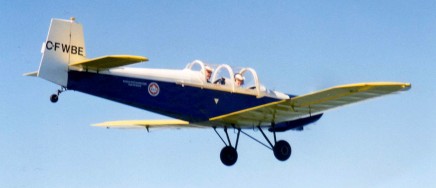
After designed the Turbulent, Roger Druine created the two-seat version, the D.5 Turbi. The prototype first flying in the late 1940s, powered by a Beaussier Bo2.
The Turbi tandem two-seater follows the same lines as the Turbulent and the construction is very similar. The rear turtle-decking on early models was fabric covered, but later models are plywood covered. Dual controls are fitted. The fuselage is of rectangular slab-sided construction with four spruce longerons and frames. The fin is built integral with the fuselage. The tailplane is non-adjustable and like the fin is plywood covered. The wings employ fixed slots, a box type main spar, drag spar, rear spar, lattice type ribs and plywood cover¬ing forward of the main spar. The remainder including the ailerons are fabric covered. The main undercarriage is of divided type and has coil springs for shock absorption. A variety of engines may be installed from 45 to 85 h.p.
Falconar plans show open cockpit with dual controls that can be flown solo from either the front or back seat, the original design was a dual windshield open cockpit. Early Turbi’s built in England were powered with the DH Gipsy Minor. The 4 cylinder 65hp Czech Walter LOM II AE has a dry weight of only 132 lbs – which is a similar configuration to the Gipsy Minor. Other popular engines can be a Continental or Lycoming 65 to 115 HP.
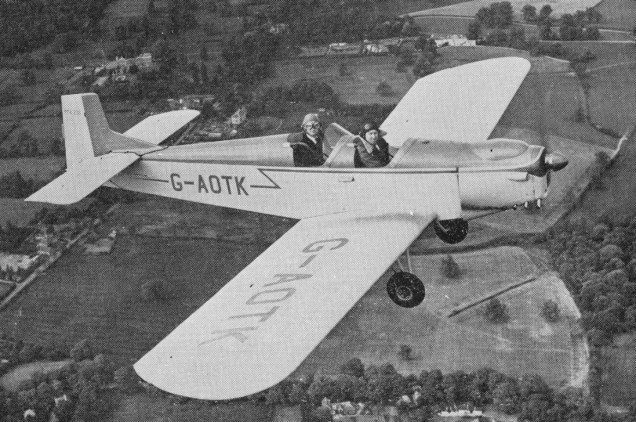
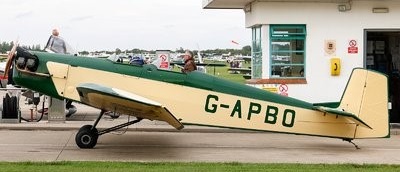
Falconar updated plans & kits for this light 2-seater tandem sportplane, in the LSA catergory.
Options include enclosed cockpit either with single curvature windows or vacuum formed bubble canopy.
Vne (never exceed speed): 108 mph
Cruise speed: 81 mph
Range: 400 miles
Stall: 34 mph
Length: 25 ft 9 in
Wing span: 28 ft 6 in
Wing area: 142 sq.ft
Plans 2010: $305
Engine: Mikron 11, 60 h.p.
Span: 28’6”.
Length: 22’ 6”.
Wing Area: 139 sq. ft.
Empty Weight: 684 lb.
Loaded Weight: 1200 lb.
Wing Loading: 8.6 lb/sq. ft.
Max. Speed: 100 mph.
Cruise Speed: 85 mph.
Stall Speed: 45 mph.
Initial Climb: 550 fpm.
Range: 320 miles.
Falconar Avia Turbi D5
Cruise: 90 mph
Stall: 34 mph
Range: 460 sm
Rate of climb: 700 fpm
Takeoff dist: 600 ft
Landing dist: 400 ft
Engine: Continental C-65, 65 hp
HP range: 65-115 hp
Fuel capacity: 16 USG
Empty weight: 600 lb
Gross weight: 1067 lb
Length: 25.8 ft
Wing span: 28.5 ft
Wing area: 142 sq.ft
Seats: 2
Cockpit width: 24 in
Landing gear: tailwheel
Etheridge 1933 Glider
A single-seat glide designed by W.H. Etheridge, a schoolmaster at Pirton School, Hertfordshire, UK, and built by three scholars attending evening classes, S. Day, C. Etheridge and P. Etheridge, in 1933.
The glider had a fuselage similar to an Abbott-Baynes Scud, and was fitted with ‘Primary Type’ wings parasol mounted.
Espenlaub 5-seater
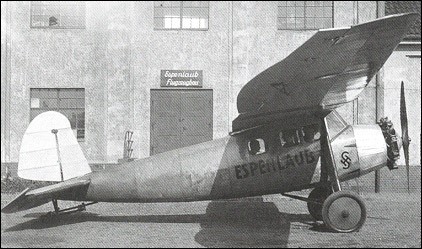
Espenlaub Flugzeubau
Germany
Gottlieb Espenlaub achieved an international reputation in the 1920s building and flying gliders. Company formed at Dusseldorf early in the 1930s to build light aeroplanes as well as gliders. Types included a tailless monoplane, a two-seat high-wing monoplane and a five-seat high-wing cabin monoplane with engine of about 125 hp. During Second World War a Riga subsidiary did stress calculations for Bf 109G wooden tailplane.
Erla 5
A single-seat monoplane with an engine of 20 hp.
ERLA-Maschinenwerk GmbH
Germany
Though established in 1934, the real beginnings were in 1933 as Nestler und Breitfeld of Erla. Type Erla 5 was a single-seat monoplane with an engine of 20 hp. From 1934 undertook quantity production of Arado Ar 65 and Ar 68, He 51 and Bf 109 (including early “C” sub-type from 1937, as well as numerous later variants). Also produced assemblies for other military types.
ERCO (Engineering Research Corp.)
USA
Established 1930, Henry Berliner was the founder of Berliner Aircraft Company, and founder of Engineering Research Corporation, Riverdale, Maryland- producer of the Ercoupe.
After making important components for other aircraft, designed and built the novel Ercoupe monoplane, developed from the original Weick “easy-to-fly” type and first flown in October 1937. Fred E. Weick was the company’s chief engineer. The type was notable for its control system, which eliminated rudder pedals, and was first marketed in 1940. Production ceased on U.S. entry into Second World War, when company was fully engaged in defense contracts. Difficulty of obtaining duralumin led to redesigned Ercoupe of composite construction in 1941. In August 1941 one was used to demonstrate benefits of jet-assisted take-off (JATO) compared with conventionally- powered aircraft. Two examples were bought by U.S. Army as experimental radio-controlled targets. After the war civil Ercoupe production was resumed.
Entler-Werke
Germany
Based at Wilhelmshaven. Built in 1922, in conjunction with Prof. Junkers, a small two-seater cantilever biplane which had corrugated sheet-metal covering. Development was intended, and in summer 1922 an English selling price of £222 was mentioned. By 1925 the firm had ceased to exist.

