The 8VI, a water-cooled 90° V-8 and companion of the 12WI displacing 16.032 l (978.3 in³), was rated 350 hp at 2,500 rpm and delivered 418 hp at 2,700 rpm. It weighed 704 lb, was 57.13″ long, 37.43″ wide and 32.5″ high.
Inter-Wars
Farman 12WI
The 12WI was a water-cooled 60° V-12 with a 2:1 reduction gear ratio. With a 135 mm (5.315″) bore, 140 mm (5.512″) stroke, 24.047 l (1,467.4 in³) displacement and 5.5:1 (later 5.9:1) compression ratio, it was rated 540 hp at 2,260 rpm and could produce 603 hp at 2,700 rpm. It was 59.1″ long, 43.34″ wide and 35.46″ high. Cylinder construction was similar to the 18WI. A Zenith carburetor supplied the mixture, and Ducellier magnetos the ignition. Bare dry weight was 902 lb, and complete weight was 1010 lb. Fuel consumption was 0.539 lb/hp/hr and oil consumption was 0.026 lb/hp/hr. A Farman two-stage supercharger maintained rated output up to 2,000 m (6,562 ft) with the first stage, and up to 5,100 m (16,732 ft) with the second stage.
Farman 18WI W-18
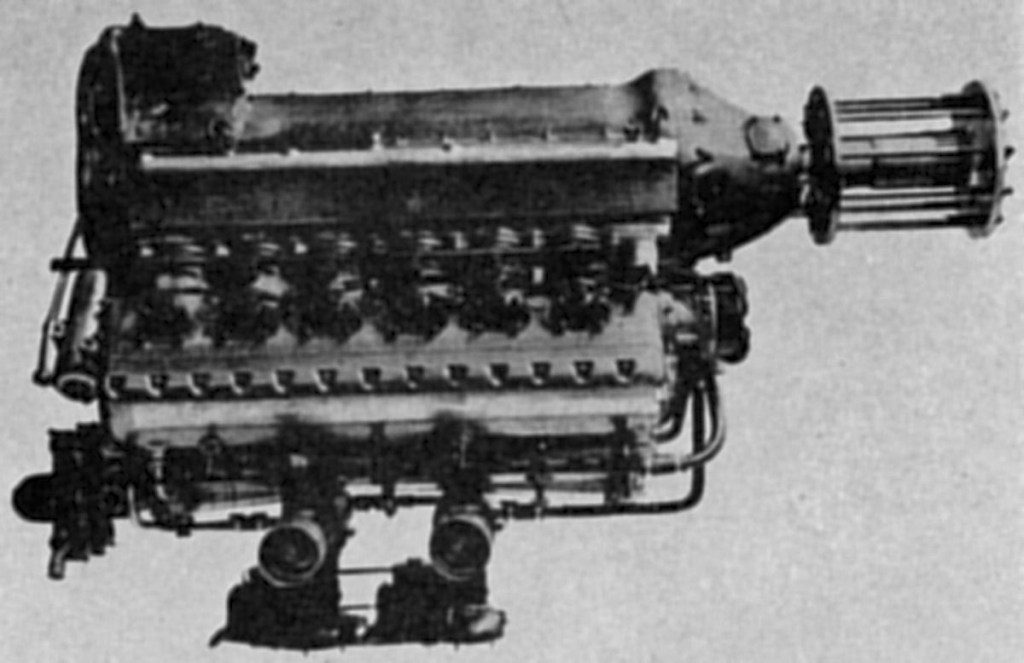
The 18WI, introduced in 1926, had a different construction than former Framan water-cooled W-18s. It was also adaptable to inverted installation. Its bore was 110 mm (4.331″), its stroke 125 mm (4.921″), its displacement 21.382 l (1,304.8 in³) and its compression 5.7:1. It was rated 550 hp at 2,600 rpm but could produce 730 hp at 3,400 rpm.
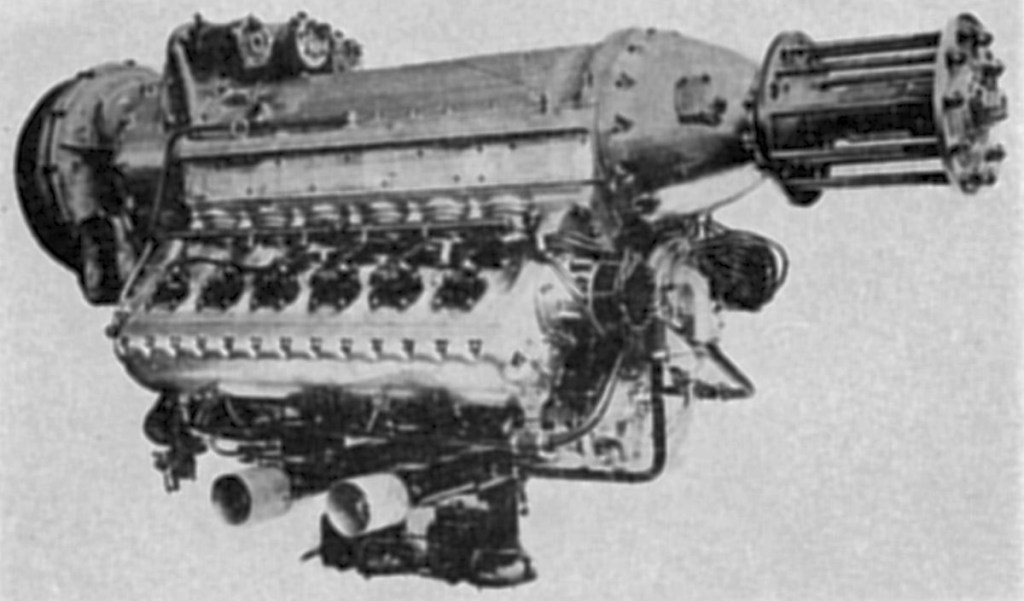
Its bare weight was 701 lb, but with a 2.46:1 propeller reduction gear, starter and propeller hub it weighed 930 lb. It was 67.69″ long without supercharger, 80.29″ long with supercharger, 30.7″ wide and 42.67″ high. Each six-cylinder row, including cylinder heads and valve ports, was cast en-bloc of Alpax, a ductile silicon-aluminum alloy. Steel liners were pressed into these castings from inside. The three blocks were mounted on an aluminum crankcase at a 40° included angle. The valves seated upon inserts and were operated via rocker arms and overhead camshafts enclosed in aluminum housings that were bolted to the cylinder blocks. The crankcase was divided horizontally along the crankshaft centerline and was closed at the front by the reduction gear casing. The six-throw, seven-main-bearing crankshaft used articulated rods with H-section link rod shanks. Light alloy cast aluminum pistons were fitted with full-floating pins. Spur gear trains at the engine front drove the camshafts. Intermediate gears in the outer block camshaft gear trains drove two 18-cylinder ignition distributors and a water pump on the center block. The dry-sump lubrication system furnished pressurized oil to all bearings. Two Zenith carburetors were suspended below the cylinders; one fed the aft nine cylinders and the other the nine forward cylinders. When fitted with a Rateau supercharger, the engine could maintain 600 hp up to 5,684 m (18,000 ft).
Farman W-18
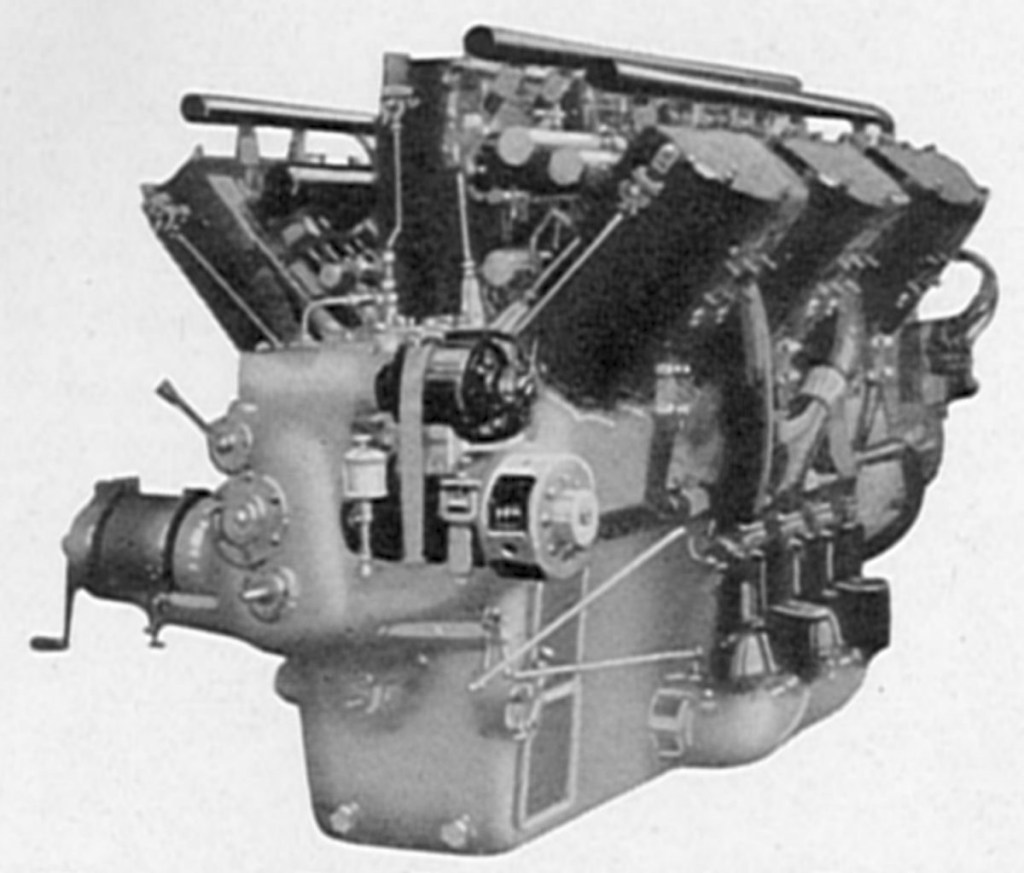
A W-18 engine using similar construction to the 12WE was next introduced. With a 130 mm (5.118″) bore, 180 mm (7.087″) stroke, 43.005 l (2,624.3 in³) displacement it was rated 600 hp at 1,860 rpm and weighed 1,848 lb. As with the 12WE the cylinders, built up in pairs, each had four interchangeable overhead valves operated by rocker arms and push rods from camshafts in the Vees. Articulated connecting rods were used and the link rods had tubular shanks. These engines were either direct-drive or used Farman bevel-planetary reduction gears with standard 2:1, 1.83:1, 1.67:1 and 1.5:1 ratios. Six carburetors, three on each side, fed three cylinders each.
The 18WD, a more refined version of the earlier W-18, was rated 700 hp at 1,850 rpm and produced 820 hp at 2,100 rpm. It weighed 1,716 lb and consumed 0.495 lb/hp/hr. It was equipped with magneto and battery ignition.
Farman 12WE
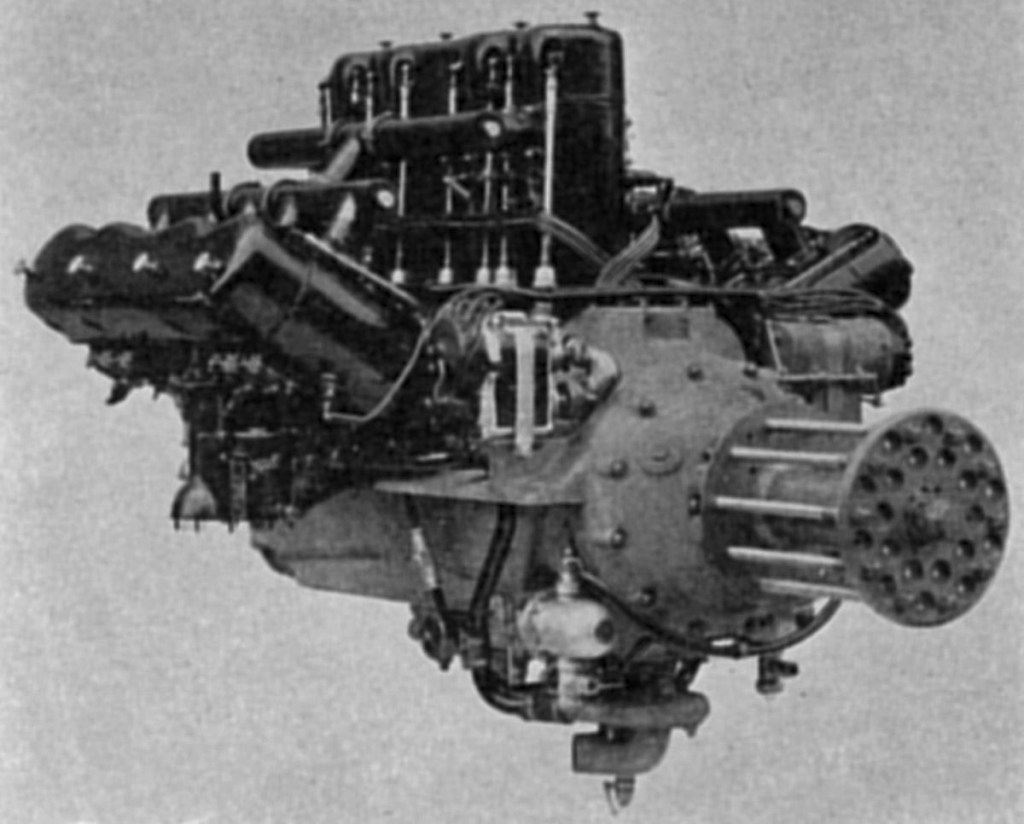
The 12WE, a more refined water-cooled W-12 with the same bore, stroke and displacement was introduced in 1924. With a 5.3:1 compression ratio, it was rated 500 hp at 2,150 rpm and could produce 550 hp at 2,200 rpm.
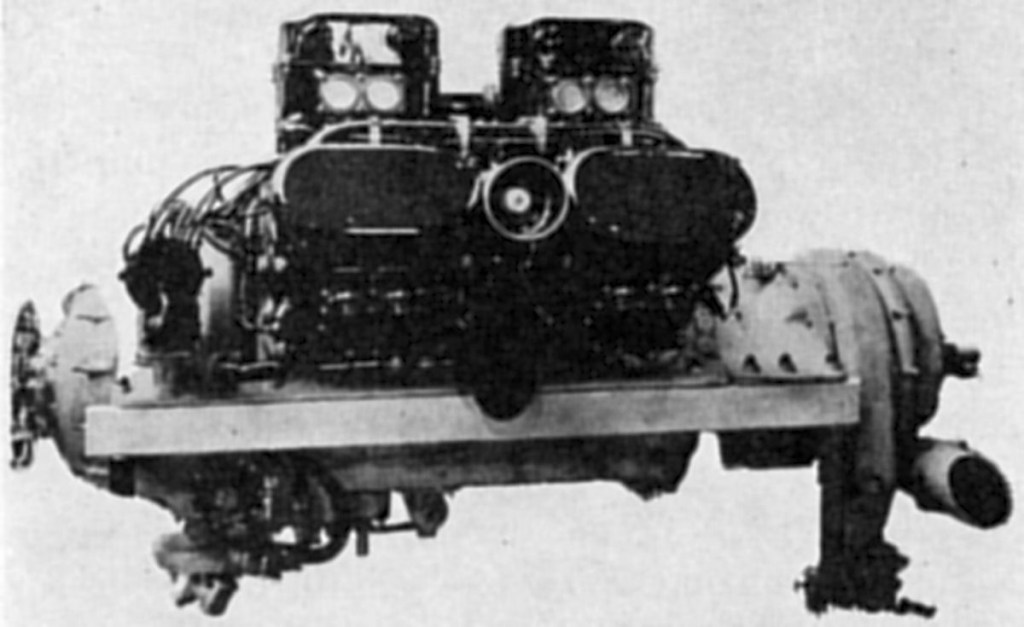
The direct-drive engine weighed 1,034 lb; with Farman propeller reduction gears, the engine weighed 1,122 lb. Steel cylinders with a common welded-on sheet-metal water jacket were arranged in pairs. The overhead valves were operated by push rods from camshafts located at each Vee’s center and driven through a gear train from the crankshaft propeller end. Pistons and crankcase were aluminum-alloy castings. The crankshaft was supported on white-metal-lined plain bearings. A disc with driving dogs at the crankshaft front accommodated either a bolted-on propeller shaft or reduction gear drive. The crankshaft gear driving the cam gear train also meshed with a pinion at the crankcase bottom that drove oil, water, and fuel pumps. A front-mounted cross shaft driven from a camshaft drove two magnetos or two distributors. The dry-sump lubrication system used gear-type pumps to draw oil from both crankcase ends and force it through cooler, from which it was flowed to all bearings through a filter that could be bypassed and withdrawn for cleaning while the engine was running. Cooling water was circulated by a centrifugal pump fitted with a throttling device to regulate the water flow rate and thereby maintain correct water temperature. The carburetors were situated outside the outer cylinder rows and the induction pipes had water jackets. Some 12WE engines were fitted with centrifugal superchargers. Propeller reduction gears were available with 2:1 and 1.35:1 ratios.
Farman 200 hp V-8

The first Farman engine was a water-cooled V-8 rated at 200 hp. It weighed 700 lb, or 3.5 lb/hp. The built-up, welded-steel cylinders were made in pairs. Push rods and rockers operated the valves, were enclosed by aluminum covers and fed directly with oil. The oil supply was carried in the crankcase base chamber.
Magnetos provided dual ignition and a Ragonet electric starter and an impulse magneto were fitted. The propeller was driven through bevel planetary gears of the well-known Farman design, which included one fixed crown bevel, a differential spider with four satellites, and a crown bevel wheel. A water-cooled V-12 of similar design was rated at 400 hp.
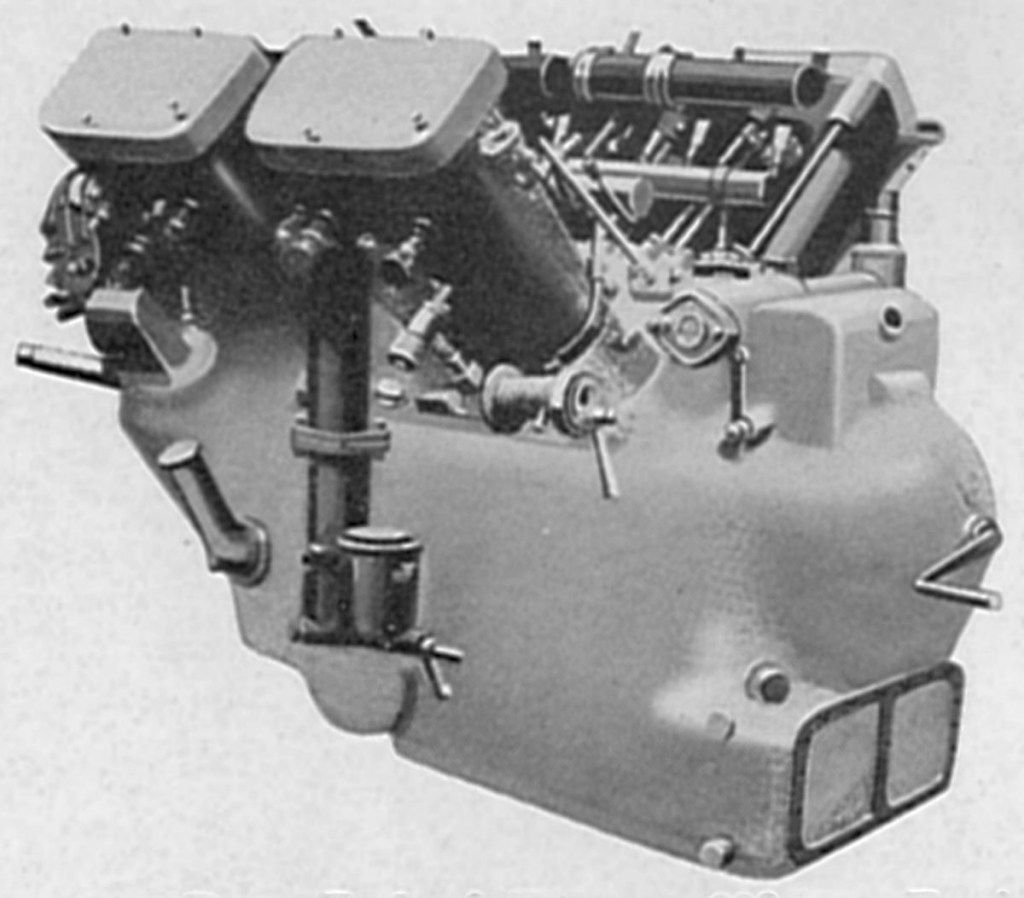
This engine soon was supplanted by a water-cooled W-12 with a 130 mm (5.118″) bore, 160 mm (6.299″) stroke, 28.485 l (1,555.2 in³) displacement and 5.5:1 compression ratio was rated 400 hp at 1,880 rpm and weighed 1,100 lb. Fuel consumption was 0.484 lb/hp/hr and oil consumption was 0.022 lb/hp/hr.
Farman David / Sport

The Farman David was a light sport biplane introduced to the aviation world via the 1919 Paris Salon. Power was provided by a 37 kw (50 hp) Gnome rotary engine and the type was quite successful. Although publicised as a single-seater, it had accommodation for a pilot and passenger in cramped conditions. It was placed in production by Farman and soon became known as the Farman Sport, the name by which it was usually known. The 1920 model became available with a 45 kw (60 hp) Gnome engine, but eventually the Anzani engine seems to have become the norm.
A number were exported to Australia. The first of the type was imported by Shaw-Ross Engineering & Aviation Company Ltd of Port Melbourne, VIC. This aircraft G-AUBV (c/n 8 – later VH-UBV) arrived on 4 March 1921 and was registered from June 1921 but was destroyed by a fire at Essendon, VIC on 7 August 1931, the same fire which destroyed VH-UDL (c/n 24).

A further aircraft VH-UFX (c/n 7085) was registered to Industrial Indent Pty Ltd of Melbourne on 29 June 1927. It was damaged when it undershot landing at Essendon on 24 November 1930.
Another aircraft VH-UDC (c/n 25) was registered on 28 June 1921, also to Shaw-Ross Engineering & Aviation Company Ltd of Port Melbourne. It was destroyed in a crash at Cowes, VIC on 9 February 1923.
VH-UDL (c/n 24) was registered to Shaw-Ross Engineering & Aviation Company, also on 28 June 1921. Ownership was transferred to Shaw Aviation on 27 June 1930. It was destroyed in a fire at Essendon, VIC on 7 August 1931.
Two Farman Sports were obtained by Airgold Ltd in Papua New Guinea, G-AUHL (c/n 30) and G-AUHM (c/n 31). In May 1928 the two Farmans arrived in Port Moresby in crates. The intention was to assemble and then fly them to Lae to be operated in the freight role. However, on examination of the aircraft they were found to be too frail for the conditions prevalent in Papua New Guinea.
VH-UHL, named ‘Butterfly’, was assembled at Lae and flown to Wau. Fitted with a 34 kw (45 hp) Anzani radial engine, although Department of Civil Aviation (DCA) records indicated it, and VH-UHM, were fitted with the 60 kw (80 hp) Anzani 6A engine, the Farman Sport VH-UHL swung on landing on its first flight and a wheel collapsed. A further flight to Wau was made nine days later and on this occasion the undercarriage collapsed on landing. As well, many problems were experienced with the engine and VH-UHL was re-crated and shipped south for disposal. The second Farman Sport aircraft VH-UHM was never assembled and flown in Papua New Guinea and was also shipped back to Australia.
After returning from New Guinea VH-UHL had a number of owners, including L Mitchell of Wycheproof, VIC in May 1929, H Sweeney of East St Kilda, VIC in July 1930, C H Frazer of St Kilda, A H Wilkins of Blackwood, SA in November 1934, and R J Weston of North Adelaide, SA in October 1938. It was struck off the register in December 1947.
Farman Sport VH-UHM eventually ended up with Mr G N Wikner of Brisbane, QLD who loaned it to the Aero Club of NSW at Mascot for a period in 1929. He eventually rebuilt it, making various improvements to the airframe, the aircraft eventually being written off in an accident on 20 March 1930 at Dayboro in Queensland. Later a wing was used in the construction of a glider known as the Golden Arrow.
A catastrophic fire wiped out three of the Australian registered Farman Sport aircraft on 7 August 1931 when it broke out in the Shaw Aviation Company hangar at Port Melbourne, four aircraft, including three Farman Sports (VH-UBV, VH-UDL and VH-UFX) and a de Havilland DH.6 (VH-UBW) being destroyed.
Engine: Anzani 52 kw (70 hp)
Wingspan: 7.11 m (23 ft 4 in)
Wing area: 26 m² (279.87 sq ft)
Length: 6.13 m (20 ft 1¼ in)
Empty weight: 200 kg (441 lb)
Loaded weight: 400 kg (882 lb)
Max speed: 140 km/h (87 mph)
Service ceiling: 2,000 m (6,560 ft)
Endurance: 4 hrs 20 mins
Seats: 2
Farman F.1020

The Farman F.1020 was built to test a novel wing design, the study of which had begun in 1926. Its plan was essentially semicircular, with the straight edge leading. The chord was thus broad and the aspect ratio very low. Such a wing has high induced drag but was thought to offer good transverse stability and low speed behaviour. It has such features in common with some tailless and delta designs.
The wing of the F.1020 had a near circular trailing edge which squared off into straight tips. The leading edge was a little further forward than the diameter of the idealised semicircle would have been and was slightly swept; it was also extended beyond the rest of the wing, carrying conventional ailerons. The maximum chord, at the wing root, was 5 m, compared with a span of 7.2 m; the aspect ratio was 2.1. The trailing edge carried deep chord control surfaces, two per side: the outer pair were used differentially like ailerons and the inner ones as flaps.
This wing was mounted on the fuselage of a Farman F.402, retaining the empennage, undercarriage and the 110 hp (82 kW) Lorraine 5-cylinder radial engine. As on the F.402, the wing was placed on top of the cabin with two square windows in the roof for upward visibility. The control system enabled the pilot to switch between conventional (aileron, elevator, rudder) control and that provided by the trailing edge surfaces.
The first flight of the F.1020, nicknamed the Pelle-bêche (en:Digging-shovel or Spade) and registered as F-AMOG, was in December 1933, piloted by Lucien Coupet. Thereafter it was only flown by Henry Farman who found it almost impossible to spin, but without any other particular merits. A design study was made for a variant with a shorter, 4 m, chord, designated F.1021, but this was not built.
Powerplant: 1 × Lorraine 5 Pb, 82 kW (110 hp)
Wingspan: 7.50 m (24 ft 7 in)
Wing area: 27 m2 (290 sq ft)
Aspect ratio: 2.1
Length: 8.27 m (27 ft 2 in)
Height: 2.22 m (7 ft 3 in)
Maximum speed: 200 km/h (120 mph, 110 kn)
Crew: 2
Farman F.480 Alizé
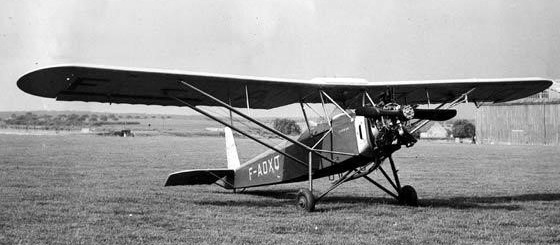
Farman Moustique / Aviette
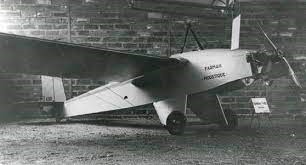
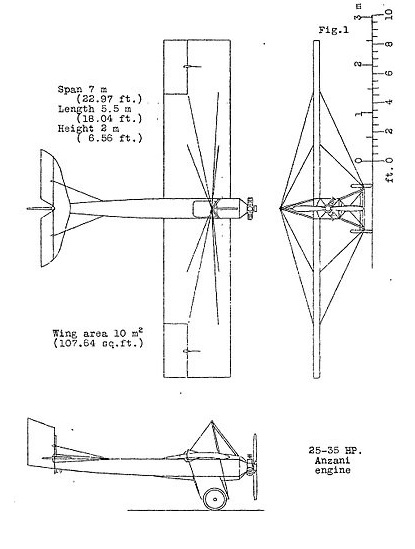
Shortly after the end of World War I, Farman introduced a low powered single seat monoplane for sport and tourism. It flew for the first time in May 1919 and was named the Moustique (in English, Mosquito). A little later, aircraft of this kind became known in the United Kingdom as motor gliders, the subjects of the first Lympne Trials of 1923. In 1922 one Aviette, without its engine, had already won prizes at a national glider competition. Three months before the Lympne Trials several Aviettes competed in an equivalent French meeting for moto-aviettes at Buc. The design was revived, over 17 years after its first appearance, as the F 450 Moustique and was one of the aircraft purchased by the French government as part of l’Aviation Populaire programme.
The original Moustique, later known as the Moustique I, was a shoulder wing monoplane. The wing was rectangular in plan, fabric covered and was wired braced from above and below. The upper wires were attached to a king post protruding from the raised, curved decking ahead of the cockpit and lower wires went to the undercarriage structure. The wings carried full span ailerons.
Behind the cockpit the fuselage, which reached up only to the pilot’s waist, was slender. It was square sectioned and covered with thin plywood. The parallel chord horizontal tail had separate elevators with the deep rudder moving between them. These surfaces were fabric covered and the rudder was round topped; there was no fixed fin. The undercarriage consisted of two parallel spruce panels mounted on the fuselage, bearing two mainwheels on a single axle. This first aircraft was powered by a 30 hp (22 kW) flat twin ABC Scorpion engine.
The first Moustique flew in May 1919, but by the following year its span had been reduced from 7.65 m to 5.0 m (from 25 ft 1 in to 16 ft 5 in), saving a little weight, and was known as the HF 206 or the HF206 Moustique I. No other Moustique had so short a span.
In 1922 a glider version called the Aviette had flown. This had an extended span of 10.50 m (34 ft 5 in) and an unladen weight of only 43 kg. It also had a deeper fuselage, allowing the pilot to sit with his head just clear of the upper surface, and a new upper wing bracing system with the bracing wires attached to the top of a tall, three post pylon, just in front of the pilot. It also had a reshaped rudder with a linear, rising top. It was the only Moustique type glider, but the fuselage, wing bracing and rudder modifications were carried forward into all later variants.
In 1923 three powered Aviettes were entered for the competition at Buc, Yvelines. All had an 18 hp (13 kW) engines but one aircraft had a 3-cylinder radial Salmson 3 Ad and the other two, 4-cylinder inline Sergant As.
The Moustique II or F 21 of 1924 was powered by a 35 hp (26 kW) 3-cylinder Anzani 3 A2 radial and had a wing with a span of 8.20 m (26 ft 11 in), fitted with short span ailerons. Two took part in the 1924 Tour de France.
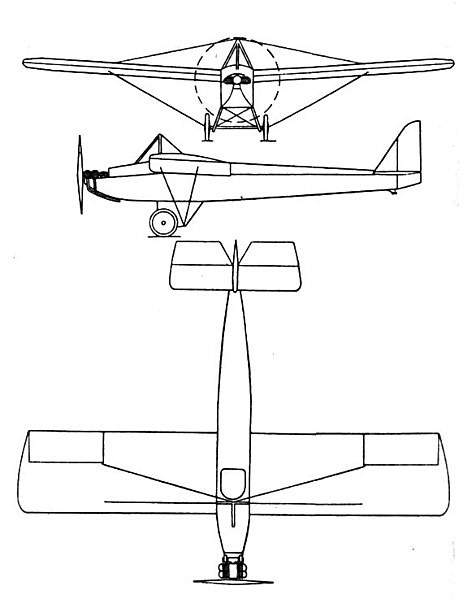
In the mid-1930s there was a government-driven revival of interest in low cost flying with the introduction of the Aviation Populaire programme. In response, Farman relaunched the Moustique with a slightly shorter span of 8.07 m (26 ft 6 in) and a longer fuselage. It first flew in December 1935. The first five prototypes were designated F 450 Moustique. The first was initially powered by a 35 hp (26 kW) Poinsard 2 Ca flat twin engine; later it, like the others had Mengin engines of the same type and power. A visual difference between this and earlier Moustiques was the presence of a normal fin, carrying a round-topped rudder. The production version, the F 451 Moustique, had a 25 hp (19 kW) AVA 4A-00 flat-four two-stroke. This variant was produced in much greater numbers (46) than any other Moustique.
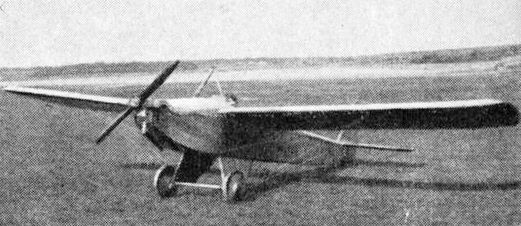
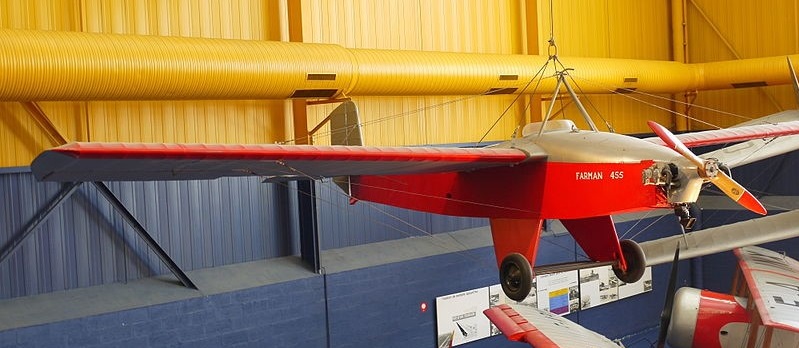
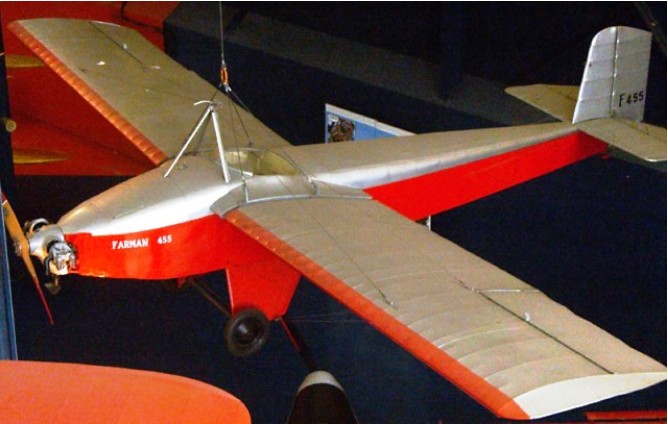
The last Moustique development was the two seat F 455 Super Moustique, initially called the Moustique III, which first flew in 1936. Its span was increased by 1.65 m (5 ft 5 in) and it had a more powerful 35 hp (26 kW) Mengin 2 A-01 engine. Only one was built; its performance in the climb was poor. The light aircraft section of the Farman works was shut down when the company was nationalised in March 1937.
During the early 1920s Farman entered Moustiques into several competitions. In August 1922 the first national French glider meeting, the Congrės expérimental d’aviation sans moteur, organised by the Association of French Flyers (AFF) and partly government-funded, was held in Combegrasse, Puy-de-Dôme. Farman entered two aircraft, the Aviette glider and a biplane (a de-motorised Farman FF 65); overall there were 17 contestants. The Aviette, piloted by Lois Bossoutrot, won several prizes in the competition between catapult-launched gliders, achieving the lowest sinking speed, the greatest altitude (80 m or 262 ft) and longest over-launch site duration of 3 min 30 s. The Aviette was placed second in the distance-covered contest, flying 5.28 km (3.28 mi). Over the fortnight-long event, the Aviette was in the air for 48 min 25 s.
In July 1923, three powered Aviettes competed at Buc, Yvelines for the Grand Prix de Motoaviette against eighteen other entrants. The competition was open to all aircraft with a maximum takeoff weight of less than 250 kg (551 pounds). There was a 125,000 FF prize for the fastest flight of 30 laps around a 10-kilometer (6.21-mile) course. The winner was Lucien Coupet in the Salmson-powered Aviette, covering 310 kilometers (192.5 miles) in 4 hours 37 minutes 19 seconds. No other aircraft could overcome the wind and rain.
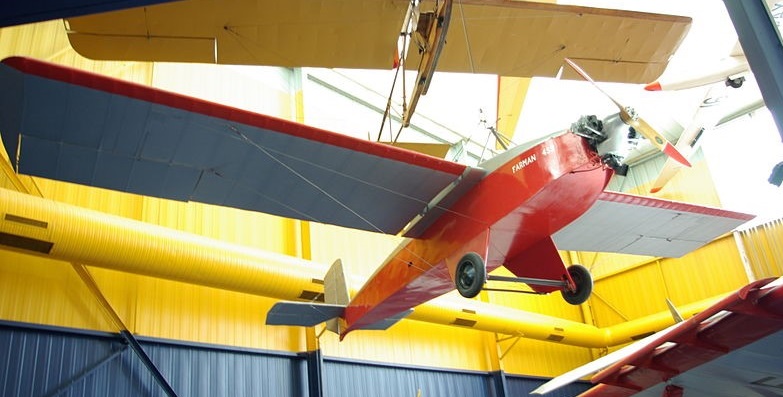
A year later, Farman entered two MF 21 Moustique IIs into the Tour de France, an eight-stage contest organised by the AFF. Initial elimination trials in bad weather reduced the 15 entrants to a starting group of three for the Tour proper. The MF 21 flown by Maurice Drouhin was the only survivor by the end of the second stage, and he was declared the winner, having covered 1,807 km (1,123 mi) in 20 hr 40 min 27 s. Drouhin also won the Prix Solex, worth 50,000 FF in April 1925, flying the Salmson-powered Aviette. This required a flight from Paris to Rouen (about 120 kilometres or 75 miles) using less than 3 kg (6.6 lb) of petrol and oil.
In 1938 the first F 450 was used to test-fly a device called a gouvernes autoptères, invented by Marcel Granoli. Its purpose was to provide automatic lateral and longitudinal stability in the event of a momentary sideslip. The test showed only limited success.
Thirty-six of the 46 production F 451 Moustiques were bought by the state under their Aviation Populaire programme, intended to bring people from all walks of life into aviation and make pilots of them. Other F 451s were bought by individuals, partly attracted by the low costs: the aircraft sold at just under 20,000 FF. To make the Moustique attractive to the hunting fraternity, Farman advertised an optional rear locker “for the transport of a dog.”
Variants:
Moustique
Later Moustique I, one only.
Engine: Anzani, 25-30 hp
Wingspan: 7.65 m / 25 ft 1 in
Wing area: 10 sq.m / 107.64 sq.ft
Length: 5.5 m / 18.04 ft
Height: 2 m / 6.56 ft
HF 206
The original Moustique with wings cropped to a 5.0 m (16 ft 5 in) span.
Aviette
4 built with Salmson or Sergant engines. 10.50 m (34 ft 5 in) span. One converted to glider for Combegrasse competition. 3 entered for the competition at Buc
F 21 Moustique II
2 built with Anzani engines. 8.20 m (26 ft 11 in) span. Entered into Tour de France.
F 450 Moustique
1936 revival. 5 built with Poinsard or Mengin engines. 8.07 m (26 ft 6 in) span.
F 451 Moustique
Production version of F 450; 46 built
Engine: 1 × Ava 4A-00, 19 kW (25 hp)
Propeller: 2-bladed wooden Merville Srs.639
Wingspan: 8.07 m (26 ft 6 in)
Wing area: 10.50 m2 (113.0 sq ft)
Length: 6.40 m (21 ft 0 in)
Height: 1.90 m (6 ft 3 in)
Empty weight: 151 kg (333 lb)
Gross weight: 285 kg (628 lb)
Maximum speed: 130 km/h (81 mph, 70 kn)
Range: 350 km (220 mi, 190 nmi)
Capacity: 1
F 455 Super Moustique
Initially known as the Moustique III. Two side-by-side seat, dual control version. 1 built with Mengin engine. 9.72 m (31 ft 11 in) span.