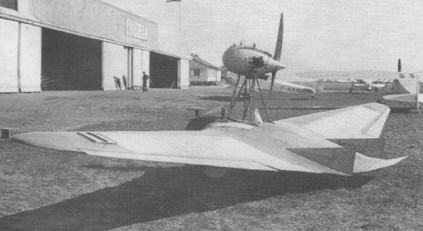
Charles Fauvel modified an Abrial airfoil section for his projects (the Abrial / STAé 230-231, thickened to 17%) and Georges Abrial helped him for the development of his AV-2. The Abrial reflex airfoils were very efficient and the various tests at the St Cyr wind tunnel gave enough data to use them successfully for tailless aircraft. Charles Fauvel decided, after having obtained a patent on his formula for the flying wing, to put into work a prototype incorporating his theories. The designation was AV-2 (“AV” for Aile Volante, French for Flying Wing), the AV-1 having been intended only as the model to study the formula in laboratory studies. The construction of the AV-2 started about the year 1932, and the work was performed at the Guerchais factory. Equipped with a self-stabilizing airfoil designed and drawn by Georges Abrial, this aircraft was aimed at amateur pilots of motorized flight as well the glider pilot. The engine, mounted on a pylon on top of the back of the fuselage, could be disassembled from the craft in a few minutes to transform the plane into a pure glider. With the unexpected bankruptcy of the Guerchais enterprise and the end of financial support from the main investor, the Makhonine company, the development of the AV-2 stopped and was ultimately never finished. In a parallel effort, Charles Fauvel designed another prototype, a pure glider designated the AV-3.
Wing span: 12.85 m Length: 3.6 m Wing area: 20 sq.m Airfoil: Fauvel Aspect ratio: 8.3 Empty weight: 243 kg Max speed (Vno): 160 km/h
Charles Fauvel decided, after having obtained a patent on his formula for the flying wing, to put into work a prototype incorporating his theories. The AV-1 was intended only as the model to study the formula in laboratory studies.
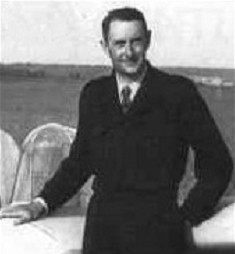
Born 31 December 1904 at Angers, Charles Fauvel was attracted to aviation from an early age. From 1913 on, he built models, and Garros and Audemar’s acrobatic competition at Angers in 1914 permanently sealed his passion for aviation. He passed his latin-science-philosophy baccalaureat, then obtained a military flight training scholarship in 1923; he then entered the French Air Force Academy. In 1925 he witnessed his first soaring competition at Vauville, during which Alfred Auger officially beat the glider altitude record using the Peyret-Abrial “Vautour” with more than 700 meters. The same year, during his military service at Chateauroux, he made the acquaintance of Pierre Massenet, with whom he later participated in the foundation of the Club Aéronautique Universitaire (University Aero Club), one of the most renowned soaring clubs of the pre-1940 period. It was also in 1928 that Fauvel, watching the new Summer soaring competition at Vauville, formed his first flying wing concepts. Observing certain gliders with long, thin wings (Peyret-Abrial “Rapace”, Wolf Hirth…), he considered that to reduce parasitic losses to a minimum, one cannot indefinitely increase the aspect ratio of the wings. Reducing the size of the fuselage and the interaction with the horizontal empennage thus led to the “flying wing” formula, for which Fauvel registered a patent in 1929. Unlike the projects conceived at about the same time in Germany by the Horten brothers and by Lippisch, the work of Charles Fauvel, based on studies and experiments of Georges Abrial and René Arnoux, involved the use of a “stable” airfoil section providing both lift and stabilization, without recourse to a swept and twisted wing as on the German gliders. Still in 1928, toward the end of the year, Charles Fauvel put the finishing touches of a small light single-seater, the Peyret-Mauboussin PM-10, equipped with a 34 hp Scorpion ABC engine, whose best glide ratio was nearly 16 without engine fairing or wheel pants. It was with this machine that he beat, in September 1929, several international records in the under-400 kg category, including the international altitude record (5,193 meters) and the duration record (12 hours). In 1929, Fauvel participated in the creation of AVIA with Massenet, Auger and a few friends; this was a committee founded to promote the development of soaring. He then left the air force to join AVIA as sport director, while remaining chief pilot of the CAU. He prospected and discovered the airfields of Beynes (near Paris) and of la Banne d’Ordanche (in Auvergne). In the same period he received and perfected the single-seat AVIA 10 A designed by Jarlaud at the Béchereau works. In 1931, he had to leave AVIA, which was suffering financial difficulties, and re-enter the Air Force as a test pilot at the Villacoublay flight test center, until 1933. While on leave, he participated in the Vauville competition in 1931 in the AVIA 32 E, and managed the best French distance of the competition. In 1932, he passed his C license (no. 19) at la Banne d’Ordanche, on the AVIA 15 A. He then threw himself into the design of his first machine, the AV-1, followed by the AV-2, then by the first pure glider, AV-3, which appeared in 1933. In 1935 he flew the AV-10, a light two-seater touring craft with a Pobjoy engine. In 1940, Germany invaded France. Charles Fauvel was reassigned to Morocco a deputy group commander. Returning to France after the armistice, he passed in 1941 his instructor’s license at the Montagne Noire center, and was appointed chief of the military soaring center at Avignon. After the invasion of the free zone, he retired from the Air Force with the rank of lieutenant colonel. In May 1945, he was working at the air sports studies technical establishment at Castelnaudary. In 1954, Charles Fauvel started his own enterprise, the SURVOL company, at Cannes, whose purpose was to promote and facilitate the commercialization of his flying wings. In 1971, Charles Fauvel decided to stop commercial production of his gliders, but continued to distribute stacks of drawings to amateur builders. The Survol company offered the AV-361, the AV-451, as well as touring craft such as the AV-60. From 1972 on he was president of the Fayence soaring center and also participated in the OSTIV (Organisation Scientifique et Technique du Vol à Voile) congresses, notably in 1978 at Chateauroux, where he presented his report on the flying wing design formula. He died on 10 September 1979 at the controls of his airplane, a Gardan “Super Cab”, which struck the Alps at 735 meters altitude north of Genoa, in Italy. Recipient of the Croix de Guerre 40-45, Officer of the Legion of Honor, Médaille d’Outre-mer (Overseas Medal) 1926-1927, Aeronautical Medal, Grand Silver Medal of the Aéro-club de France, Grand Gold Medal of the FFVV, Charles Fauvel flew more than 200 different types of airplane and 50 types of glider.
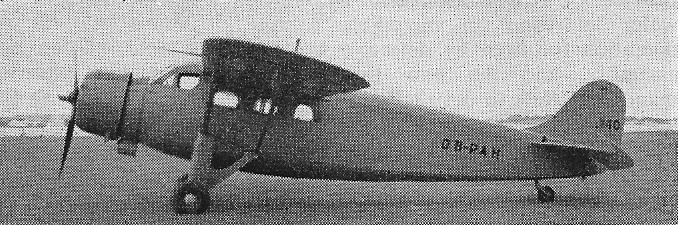
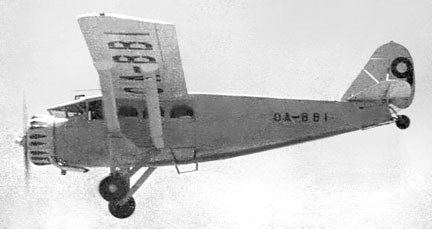
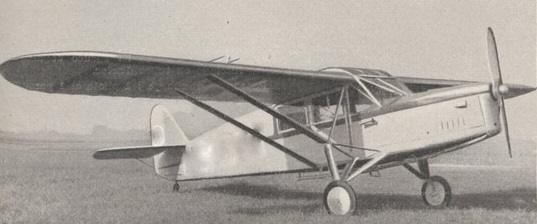
The Faucett F-19 was a larger and stronger version of the Stinson SM-6B built in Lima, Perú, by Elmer J “Slim” Faucett’s Compania de Avación Faucett.
Built with a 600hp P&W Wasp S1H1-G, using a supplied pattern aircraft, NX219W, from Stinson.
The eight-passenger cabin monoplane was built in small numbers immediately after WW2, used for internal routes by the Faucett airline. Some were refitted with an 875hp P&W Hornet S1E3-G engine.
Stinson-Faucett F-19 Perú OB-BBI
Thirty were built between 1934-46, of which three were reportedly still active in the late 1990s.
They were also available as a twin-float seaplane.
Aircraft operator, founded by Elmer Faucett, owning airport at Santa Cruz, Lima. Developed aircraft in 1930s for its own airline use and for Huff-Daland Dusters Inc., which it managed. Designs, based on Stinson, included F.19 eight-passenger cabin monoplane. Production discontinued 1947.
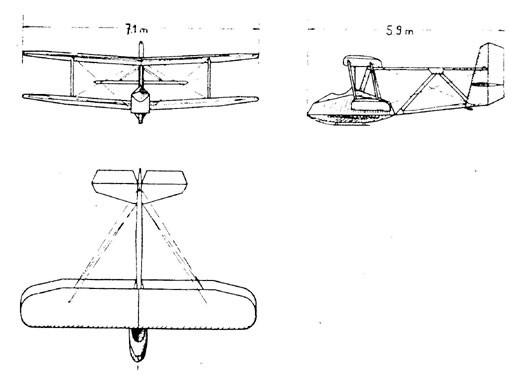
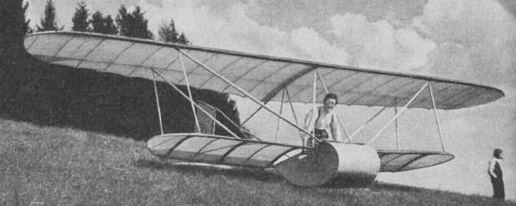
The 1927 Aecherli Pfau 7 wood and canvas biplane training glider was designed by Hermann Aecherli and Willy Farner with the upper wing with semi-Warren truss bracing, and ‘bathtub’ cockpit.
The prime constructor was Aecherli Hermann of Fällanden. Only the one was built.
Wingspan: 8.20 m Length: 4.6 m Wing area: 15.2 sq.m Empty weight: 50 kg Max weight: 120 kg Wing loading: 8 kg/sq.m Best glide: 7.5 Seats: 1
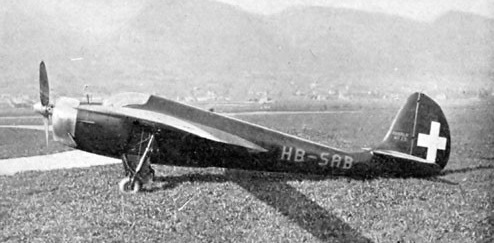
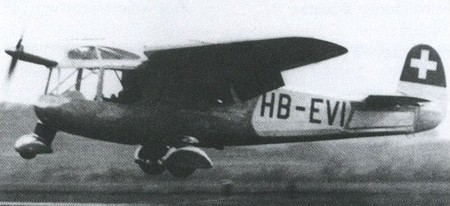
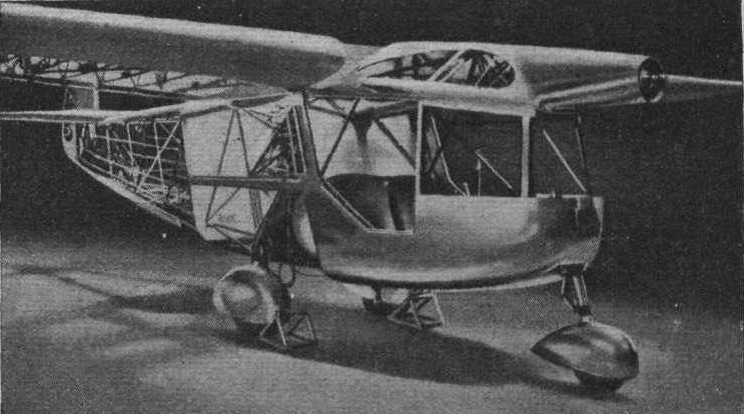
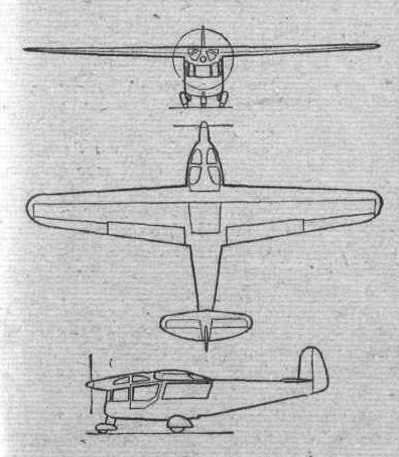
The W.F.12 two-seater trainer and touring aircraft is a high-wing monoplane with a fixed and faired undercarriage and a nose wheel landing gear. The cabin has side-by-side seating accommodation with dual controls.
In the prototype WF.12 built 1943, the Blackburn Cirrus-Minor 4-cylinder air-cooled in-line engine of 90 h.p. for take-off and of 82 h.p. cruising power at 2,300 r.p.m. is mounted in the fuselage aft of the cabin. The airscrew extension shaft comprises two parts linked together and connected with the airscrew shaft by means of universal joints; it runs over the top of the cabin and is supported forward in a structure projecting ahead of the top of the fuselage nose section. In this manner the airscrew axis lies in a plane with the wing and the view forward and downward is unimpaired.
Engine: Blackburn Cirrus-Minor, 90 hp Span: 36.1 ft / 11.00 m Length: 24.4 ft Height: 8.5 ft Wing area: 172 sq.ft Empty weight: 1,235 lb Gross weight: 1,765 lb Wing loading: 10.24 lb./sq.ft Power loading: 19.6 lb/hp Maximum speed: 109 mph Landing speed (with flaps): 46.6 mph