A two-seat light aircraft designed by J.B.Fenton in 1930. Construction was started at Stanmor, UK, in 1931, registered G-ABHZ c/n F.Mk.1, it was not finished.
Inter-Wars
Felixstowe F.5
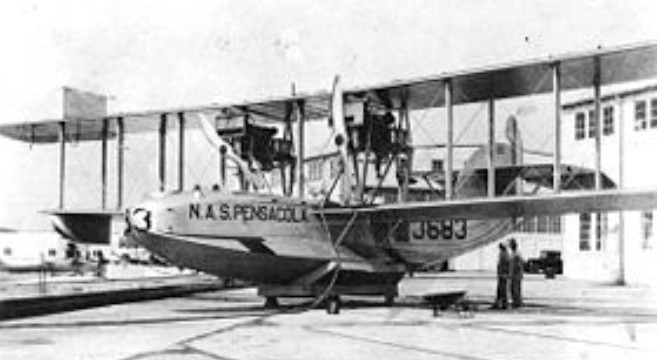
The Felixstowe F.5 is a four-seater seaplane of British maritime reconnaissance aircraft developed at the end of the First World War. Designed to combine the same payload and the operating range of the Felixstowe F.3 with qualities of handiness and the performances of the Felixstowe F.2a.
The last aircraft designed by John C. Door, the prototype, N90, first flew in May 1918, the aircraft met expectations, the hull supporting maritime conditions of the North Sea, and production was launched.
To accelerate production and for economic reasons, The F.5 adopted many elements already built for the F.3. Preserving practically only the hull of the prototype, with the aerofoil and the engines of the F.3, the craft had performances lower than the prototype, the F.2a, and even than the F.3.
53 Felixstowe F.5 were built:
Seaplane Experimental Station, Felixstowe: 1 prototype
Shorts Bros 23.
Dick, Kerr & Co: 2.
Phoenix Dynamo Manufacturing Company: 17.
Gosport Aviation: 10.
F.5 entered service only after the First World War ended, and replaced in the RAF the Felixstowe F.2a, F.3 and Curtiss H-16 . It became the standard aircraft of the RAF until the commissioning of the Supermarine Southampton in 1925. Nine squadrons were in the RAF equipped with the F.5.
The U.S. Navy was interested in Felixstowe F.5 but wished that the craft be produced in the United States and tailored to their needs. Parts were delivered to Naval Aircraft Factory, Philadelphia, in March 1918, and work began immediately. The Rolls-Royce Eagle were replaced by Liberty. The F5L the prototype made its first flight July 15, 1918. Often wrongly called Curtiss F.5L, 227 were built:
Naval Aircraft Factory, Philadelphia: 137 [A3559/3692].
Curtiss Airplanes & Motors , Buffalo 60 [A4281/4340].
Canadian Aeroplanes Ltd., Toronto: 30 [A3333/3362].
The F.5L remained in service in the U.S. Navy until replaced in 1928 by the PN-12, used for coastal patrols or missions of coastal artillery adjustment.
Between 1920 and 1921, the Aeromarine Plane and Motor Company subsidiary Aeromarine Airways, used 8 F.5L surplus from the U.S. Navy. Equipped for the transport of 10 passengers, these were sometimes called Navy Cruiser and were used in November 1920, between Key West , Florida and Havana , Cuba . One of these seaplanes, from the 1st November 1920, flew the first international air mail service on behalf of the U.S. Post Office. Aeromarine Airways also flew the seasonal services Miami – Bimini – Nassau , New York City – Atlantic City and Cleveland – Detroit from July 14, 1922. These were named Santa Maria / Wolverine, Pinta, Niña, Columbus, Balboa, Ponce de Leon, Buckeye and Mendoza. The latter is famous for having flown over New York with 27 people on board in May 1922.
In 1920, Shorts Bros. export some F.5 to Japan, which then bought a license. The arsenal of Yokosuka to build 10, Aichi 40 and arsenal Hiro 10 before developing in 1927 from F.5 Hiro Type 15 (Hiro H1H).
In 1919, NAF built two F.5L [A4036/4037] with a significantly larger surface modified empennage. This tail will be adopted retroactively on F.5L in service.
In March 1919 Naval Aircraft Factory dispatched to New York City a F.5L specially designed for display. An aeronautical exhibition was organized by the Association of Manufacturers and the cell Aeronefs exposure would allow the public to understand how construtction device. So it was a cutaway that should not fly, but he was still a seral number [A-3882]. Transferred to the Smithsonian Institution in 1920, he became well cumbersome when it was decided ten years later to renovate the building that housed. The Smithsonian therefore proposed to return to the U.S. Navy, and this proposal was accepted, but the Smithsonian finally kept the hull, a wing float, a propeller and a bomb. The U.S. Navy had shelled the rest is all that remains today of the family seaplane designed by John C. Door , with the front part of an unidentified aircraft maintained by the Norfolk and Suffolk Aviation Museum of Flixton, in Great Britain .
Felixstowe F.5
Engines: 2 x Rolls-Royce Eagle VIII, 345 hp
Wingspan: 31.6 m
Length: 15.0 m
Height: 5.7 m
Wing area: 131 sq.m
Empty weight: 4136 kg
Loaded weight: 5765 kg
Maximum Speed: 142 km / h
Ceiling: 2070 m
Range: 840 km
Armament: 4 Lewis 7.7 mm
Bombload: 418 kg
Crew: 4
F-5-L
Engines: Two 400-horsepower Liberty 12A
Wingspan: 31.6 m (103 ft 9 in)
Length: 15 m (49 ft 4 in)
Height: 5.7 m (18 ft 9 in)
Weight: Empty, 3,955 kg (8,720 lb)
Gross, 6,169 kg (13,600 lb)
Felixstowe F.3
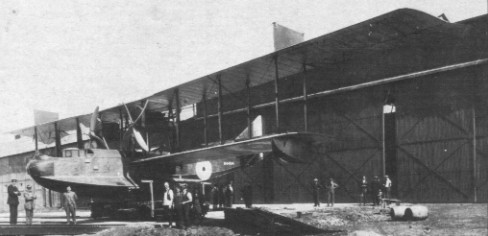
Porte designed the F.3, a slightly enlarged variant of the F.2, which was put into production. The F.3 soon proved to be inferior in many respects to the F.2, but by the time this was realized full scale production was well under way and could not be halted. This accent on F.3 production inadvertently prevented full importance being given to Porte’s final biplane flying boat design, the F.5.
Span: 31 m (102 ft) (upper), 22.6 m (74 ft 2 in) (lower)
Length: 15 m (49 ft 3in)
Height: 5.7 m (18 ft 8 in)
Maximum speed: 150 km/h (93 mph) at 609.5 m (2000 ft).
Feigl & Rotter Feiro
Louis Rotter designed light aircraft in the 1920s, the 110 hp Le Rhone-engined Feiro I all-wood four-seater being the first post-First World War civil aircraft to be built in Hungary. Produced subsequently the improved Feiro Daru and the lightweight Feiro Dongo side-by-side two-seater.
Feigl & Rotter
Louis Rotter designed light aircraft in the 1920s, the 110 hp Le Rhone-engined Feiro I all-wood four-seater being the first post-First World War civil aircraft to be built in Hungary. Produced subsequently the improved Feiro Daru and the lightweight Feiro Dongo side-by-side two-seater.
Federal Aircraft CM-1 Lone Eagle
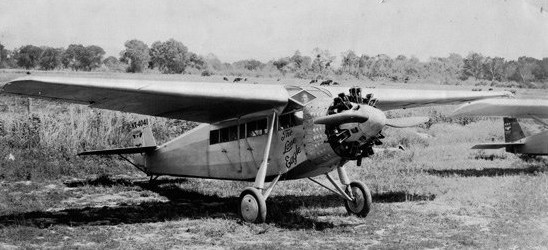
A four-passenger cabin monoplane powered by Wright Whirlwind radial engine.
Federal Aircraft Co / Ryan Mechanics Monoplane Company
USA
Incorporated 1928 by some workers who had helped build the Ryan monoplane for Charles Lindbergh. Known originally as Ryan Mechanics Monoplane Company. CM-1 Lone Eagle was a four-passenger cabin monoplane powered by Wright Whirlwind radial engine.
Fauvel AV.10
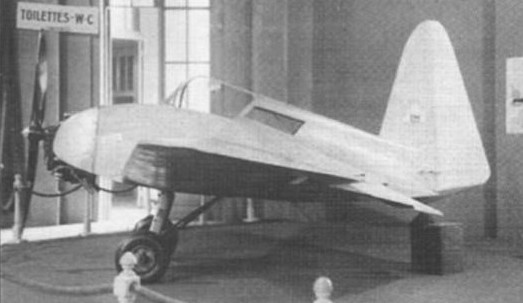
In 1935 Fauvel flew the AV-10, a light two-seater touring craft with a Pobjoy engine. Concentrating his efforts on this machine, Fauvel improved its performance, and in 1937 the AV-10 took the world altitude record in its category, while becoming the first flying wing to receive a Certificate of Navigability.
The AV-10 was the first airplane-only design of Fauvel to be flown. Designed as a two-seater side-by-side and equipped with a Pobjoy engine of 75 Horsepower, it first flew in 1935. It was exhibited at the 25th Salon de L’Aéronautique at the Grand-Palais of Paris, on the 13th to the 29th of November, 1936, along with other light planes of the era : the Salmson Cricri, the Potez 60, the Leopoldoff Colibri and the Peyret Taupin. In 1937, the AV-10 set a new altitude record for it’s category when it reached 5791 meters, and became the first government-certified flying wing. The AV-10 remained a unique prototype, allowing Charles Fauvel to expand his knowledge and expertise in designing flying wings. The AV-10 disappeared in 1940, when it was taken by German troops.
Fauvel AV.7
Glider
Wing span: 17.6 m
Length: 7.2 m
Wing area: 54.7 sq.m
Empty weight: 1840 kg
Max. gross weight: 3650 kg
Max. speed: 220 km/h
Cruise speed: 190 km/h
Max. altitude: 3800 m
Fauvel AV.3
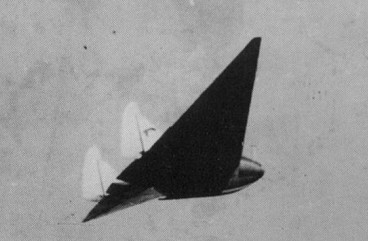
With the unexpected bankruptcy of the Guerchais enterprise and the end of financial support from the main investor, the Makhonine company, the development of the AV-2 stopped and was ultimately never finished. In a parallel effort, Charles Fauvel designed another prototype, a pure glider designated the AV-3. Thanks to the financial support of friends (former squadron friends), he was able to construct and test the AV-3, making the first flights in 1933 from the La Banne d’Ordanches airfield. He also allowed a famous glider pilot, Eric Nessler, to fly the glider, who confessed that he was very much impressed by Fauvel’s flying wing formula. The AV-3 was destroyed in 1936, when the aircraft hangar where it had been stored for the winter was virtually destroyed by a storm that took off the roof. This allowed rain to fall in torrents on the glider for more than a week and the water caused too much damage to consider repair. The AV-3 was the last pre-war glider of Charles Fauvel.
Wing span: 12.9 m
Length: 3.62 m
Wing area: 20 sq.m
Airfoil: Fauvel
Aspect ratio: 8.3
Empty weight: 107 kg
Max speed (Vno): 250 km/h
Glide ratio: 19:1
Sink rate: 0.8 m/sec

