Two aircraft, designated V. 40, with Wright Hispano engines and two Browning machine guns, were supplied to the US Army Air Service in 1922. These aircraft had no type designations. One of the V.40s, A.S.64231, crashed due to flutter on March 13th, 1922.
Inter-Wars
Fokker F.V
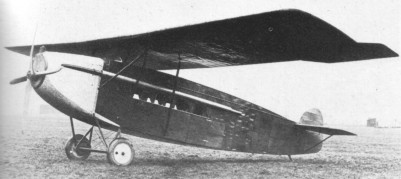
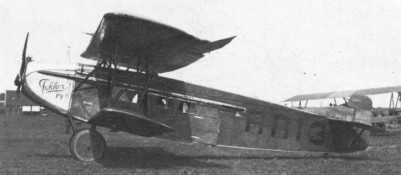
The Fokker F.V was designed to meet the demand for increased capacity. The F.III was increasingly unable to cope with growing air traffic, and the F.IV was too large. The F.V accommodated eight passengers and two pilots. More attention was paid to passenger comfort, and a separate space was provided for luggage. Another great improvement was the provision of a toilet. The aircraft could be used as a monoplane or as a biplane; as a monoplane the F.V, with an all up weight of 2.655 kg, could reach a speed of 192 kph, while as a biplane the speed was 180 kph with a total weight of 3,134 kg. The prototype was tested by the German-Russian Aviation Company, Deruluft, but was not satisfactory, and spent its life in the service of a small Austrian company.
Fokker T.III
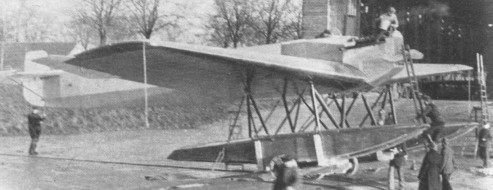
The T.IIIW bomber for the Portuguese Navy was built at Veere. It was a larger version of the T II and had a 360 h.p. Rolls Royce Eagle or Napier Lion engine. Five T.IIIWs were produced.
The T.III had an inter¬changeable undercarriage, with floats, becoming the T.IIIW.
Fokker T.II
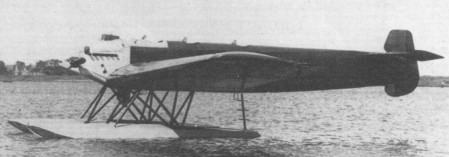
With a crew of three and a 400 h.p Liberty engine the speed was 152 kph and the range 650km. Three T.IIs on wooden floats were delivered to the US Navy.
Fokker F.IV / T-2 / A-2
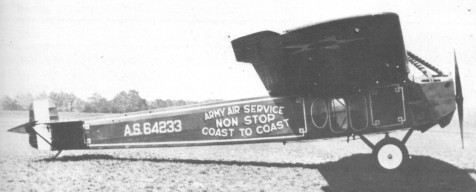
Manufactured as a Fokker F-IV, the aircraft was purchased by the U.S. Army Air Service in June 1922 and re-designated the Air Service Transport 2, or T-2. One US Army Air Service ¬ T 2was modified to an Ambu¬lance aircraft, with the designation A 2.
Under the auspices of the U.S. Army Air Service, the Fokker T-2 made the first nonstop U.S. transcontinental flight in 1923. Required modifications for the transcontinental flight, such as increasing the fuel capacity, making structural reinforcements, and adding a second set of controls, were carried out at McCook Field, Dayton, Ohio. Two failed attempts at a west-to-east crossing were followed by a successful east-to-west flight when Air Service Lieutenants Oakley Kelly and John Macready took off from Long Island, New York, on May 2 and landed at Rockwell Field, San Diego, California, on May 3, slightly more than 26 hours and 50 minutes later.
On October 5, 1922, Lieutenants John A. Macready and Oakley G. Kelly flew a Fokker T-2 over San Diego, California, for 35 hours, 18 minutes, and 30 seconds, setting a then unprecedented endurance record. It would have lasted much longer if the plane hadn’t run low on fuel.
Engine: Liberty V-12, 420 horsepower Wingspan: 24.5 m (80 ft 5 in)
Length: 15.2 m (49 ft 10 in)
Height: 3.7 m (12 ft 2 in)
Weight: Gross, 4,932 kg (10,850 lb) at takeoff for coast-to-coast flight
Fokker F.W.3
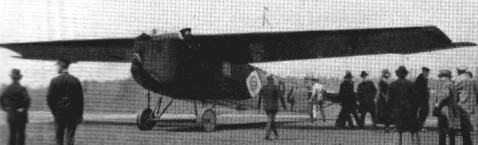
An airliner built in Holland circa 1922-23.
Fokker F.III
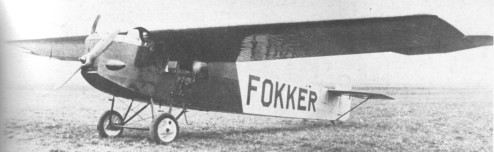
Developed from the F.ll, the Fokker F.lll had a fuselage of reduced length and increased width, with a cabin accommodating five passengers in upholstered comfort. The pilot was seated in an open cockpit offset to starboard, recessed into the wing leading edge. The thick-section monoplane wing was cantilevered, the fixed cross-axle landing gear had single-wheel units and compared to the F.ll, the rudder was of increased height.
The prototype, powered by a 138kW BMW IIIa engine, was flown at Schwerin at the beginning of April 1921 and on 14 April inaugurated KLM flights for the year. The F.III was exhibited at the 1921 Paris Salon de I’Aeronautique where it met with a mixed reception as a result of Fokker’s association with the German cause during World War I.
Of 31 F.IIIs built by Fokker, 12 were supplied to KLM and these were powered by the 179kW Armstrong Siddeley Puma engine. They were used from 1921 linking Amsterdam, Rotterdam and Croydon, and also on the route from the Netherlands to Bremen and Hamburg. Other customers were the German Deutsche Luftreederei, which used a Danzig-registered machine with a BMW IIa engine; and the Hungarian MALERT company which operated four F.IIIs with BMW IIIas and two with 172kW Hiero engines, these being used from Budapest to Vienna and Graz. One F.III was demonstrated in North America, but only two aircraft were sold there.
Later Fokker-built F.IIIs, powered by 268kW Rolls-Royce Eagle engines, had the pilot’s cockpit offset to port and some were completed as strut-braced parasol-wing monoplanes. The Deruluft airline, owned jointly by the USSR and Germany, acquired 10 of these Eagle-powered F.IIIs, and two were taken into service by KLM in 1922. The latter were re-engined with 298kW Gnome-Rhone Jupiter VI radial engines in 1925 and used on the Amsterdam-Paris route. In 1926 five surviving F.IIIs were sold to the Swiss Balair company and made a formation delivery flight to Basle on 28 April.
In 1923 production of the F.III began in Germany, at the Staaken works, the Deutsche Aero Lloyd airline acquiring at least 20 of these so-called Fokker-Grulich F.III aircraft. Some were powered by 186kW BMW IV engines, while others had Armstrong Siddeley Pumas. Several were re-engined subsequently with 239kW BMW Va engines, leading to the revised designation F.IIIc.
When Deutsche Lufthansa was formed in 1926 it took over 16 F.IIIs then operating services between Hamburg and Amsterdam, and transferred them to short routes linking north German coastal resorts; they were later used on internal freight services.
Two F.IIIs were sold to British Air Lines Ltd in 1929, a company then based at Croydon Airport.
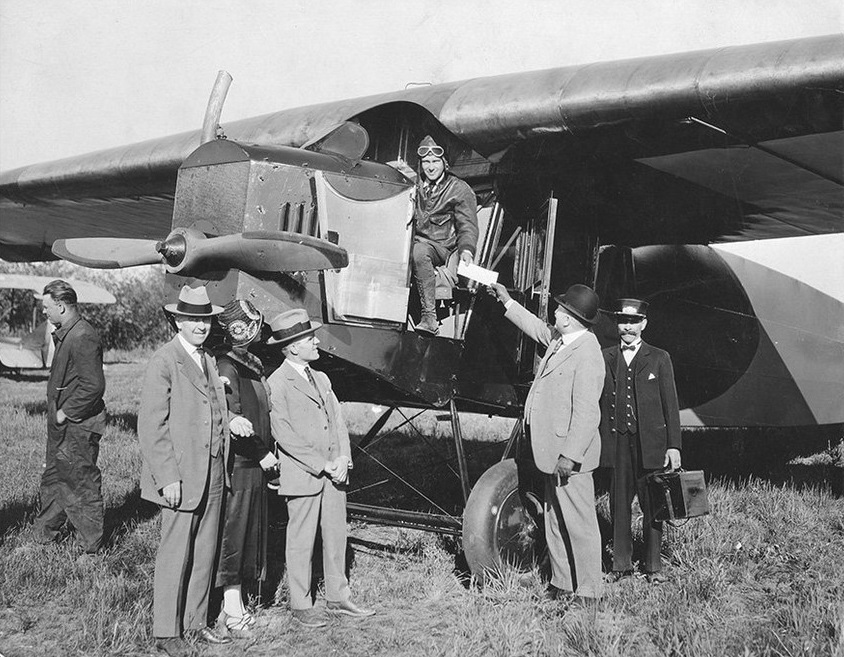
In Feb. 1925, Noel Wien purchased a Fokker F.III from Atlantic Aircraft in New Jersey and had it shipped to Rodebaugh’s newly formed Fairbanks Airplane Company. On June 5, 1925, former barnstormer Wien made the first commercial flight between Fairbanks and Nome, covering the 560 miles in seven hours and 40 minutes in a Fokker F.III monoplane. Here Fairbanks mayor, Dr. F. Dela Vernge (in derby), hands Wien a letter for personal delivery in the Bering Sea city. The cost of the charter flight: $1,500.
F.3
Engine: 1 x Armstrong Siddeley “Puma”, 179kW
Wingspan: 17.62 m / 57 ft 10 in
Length: 11.07 m / 36 ft 4 in
Height: 3.66 m / 12 ft 0 in
Wing area: 39.1 sq.m / 420.87 sq ft
Max take-off weight: 2000 kg / 4409 lb
Empty weight: 1200 kg / 2646 lb
Max. speed: 150 km/h / 93 mph
Cruise speed: 135 km/h / 84 mph
Range: 650 km / 404 miles
Crew: 1
Passengers: 5
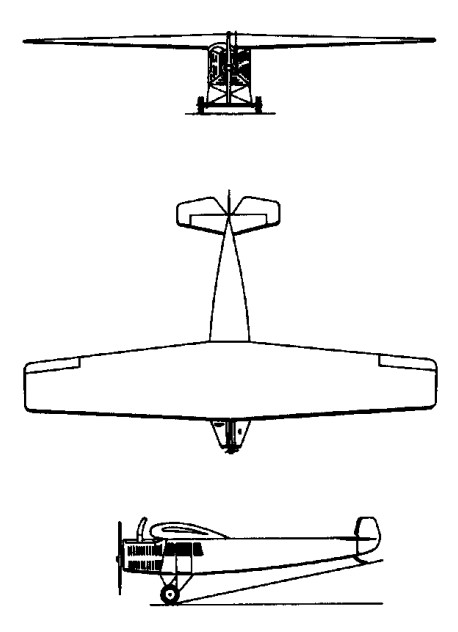
Fokker V.45 / F.II
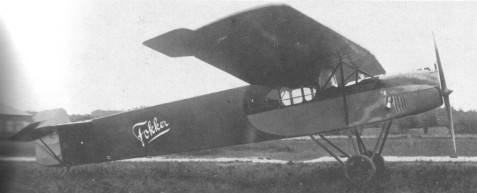
Realising the need for better passenger accommodation, Reinhold Platz, in charge of the factory at Schwerin now that Fokker was in Holland, abandoned development of the F.I and designed instead the F.II prototype. A parasol monoplane with open cockpits for pilot and passengers, like the F.I (V 44), the F.II (V 45) was built at the Fokker works at Schwerin in Germany, making its first flight in October 1919 and receiving the German civil registration D-57. The decision having been made by Fokker to transfer his activities to the Netherlands, the F.ll prototype was flown out of Germany illegally by Bernard de Waal on 20 March 1920.
The thick-section cantilever wooden wing, intended originally for the F.I, was bolted to the top of the F.II’s fuselage, which was of rectangular section and tapered in width to the strut-braced horizontal tailplane. There was no fixed fin and the rudder was of relatively small dimensions. Four passengers were accommodated in a cabin beneath the wing, while the pilot and a fifth passenger were located in an open cockpit immediately forward of the cabin. The landing gear of the F.II was of cross-axle type with rubber-cord shock absorbers.
The F.ll proved to be one of the first practical passenger transport aircraft in the world and some 30 were built, most being constructed under licence by Grulich in Germany, but several being produced at Netherlands Aircraft Factories in north Amsterdam and at Fokker’s new Veere factory. It is believed also that three series machines were completed at Schwerin.
The Fokker-Grulich F.II, of which at least 19 were built, had an improved cockpit layout, redesigned cabin windows and strengthened landing gear. Ing Karl Grulich was technical manager of Deutsche Aero Lloyd (D.A.L.) and his version of the F.II was flown by that airline. The wings of the Grulich F.II were built by Albatros and the fuselages by D.A.L., who also carried out final assembly work.
Veere- and Schwerin-built F.IIs had BMW IIIa engines, but the Grulich versions had 186kW BMW IVs. Most of the Grulich aircraft were re-engined subsequently with the 239kW BMW Va and given the new designation F.IIb.
The three Schwerin-built F.II series aircraft were registered in the Free City of Danzig and used by the Deutsche Luftreederei airline. Dutch-built F.IIs flew from 1920 to 1927 with the national airline KLM and two were sold to the Belgian airline SABENA for a service between Brussels and Antwerp. One Dutch-built F.II had a 179kW Armstrong Siddeley Puma engine and one was flown briefly with a BMW IV.
Longest-lived were the Fokker-Grulich F.IIbs. Taken over with some F.IIs by the newly-formed Deutsche Lufthansa in 1926, 10 still remained in service on feeder routes linking Cologne with Aachen, Essen, Krefeld and Mulheim in the Ruhr in 1934.
F.2
Engine: 1 x BMW IIIa, 138kW
Wingspan: 16.1 m / 52 ft 10 in
Length: 11.65 m / 38 ft 3 in
Height: 3.2 m / 10 ft 6 in
Wing area: 38.20 sq.m / 411.18 sq ft
Max take-off weight: 1900 kg / 4189 lb
Empty weight: 1200 kg / 2646 lb
Max. speed: 150 km/h / 93 mph
Cruise speed: 120 km/h / 75 mph
Range: 1200 km / 746 miles
Crew: 1-2
Passengers: 4
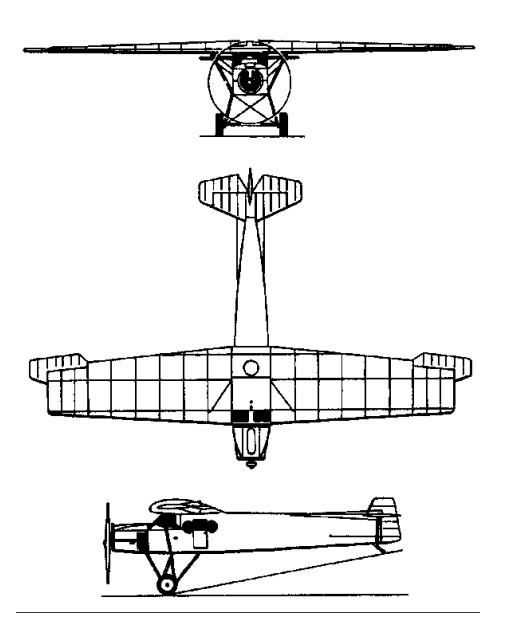
Fokker V.44 / F.1
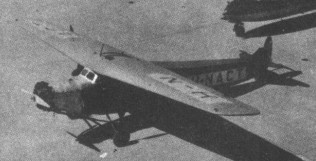
Fokker C.II America
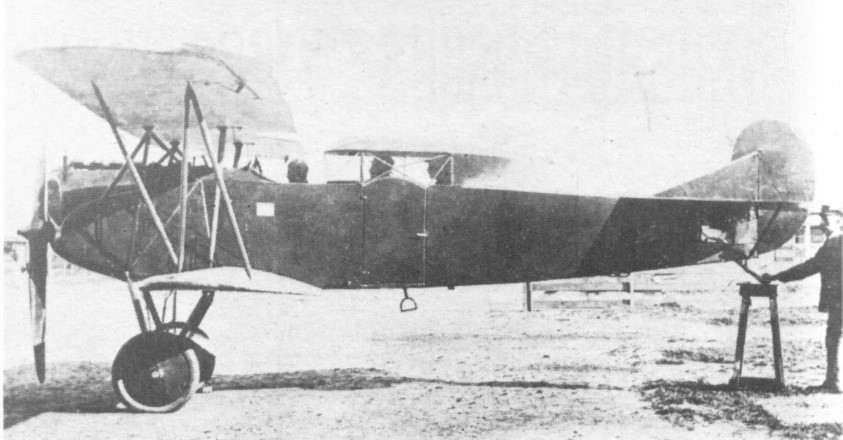
The C.II “passenger” version of the C.I had a two seat cabin. 1920
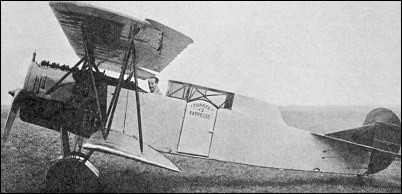
Engine: 1 x 138kW BMW inline
Wingspan: 10.61 m / 34 ft 10 in
Length: 7.44 m / 24 ft 5 in
Height: 2.86 m / 9 ft 5 in
Max take-off weight: 1170 kg / 2579 lb
Max. speed: 150 km/h / 93 mph
Crew: 1
Passengers: 2

