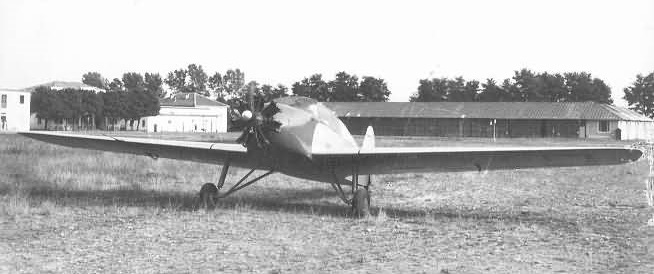
Based on the Kinner Sportster, the 202 Mantis of 1956 was a single place open cockpit low wing monoplane agricultural sprayer. First flown on 30 May 1956, only one was built, registered N13701.
Poland Brothers Paweł and Jan Gabriel from Bydgoszcz began building gliders already before World War One. In 1921 they built diminutive plane P.V (wingspan: 5 m, length: 4 m) inspired by Fokker E.V, first flown in 1921. Encouraged by its good quality designed several larger aircraft, largely inspired by Fokker D.VII. Of these only one, P.VI was actually built and flown in 1924. Although very good plane, it unfortunately didn’t get any orders, leading brother to lose interest in aviation.
The first plane or Funk model ‘A’ was powered by and inverted and converted flat head four cylinder ingine.
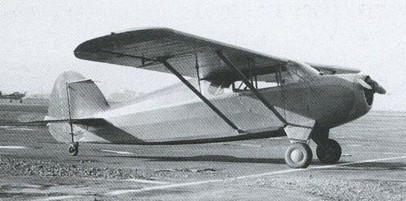
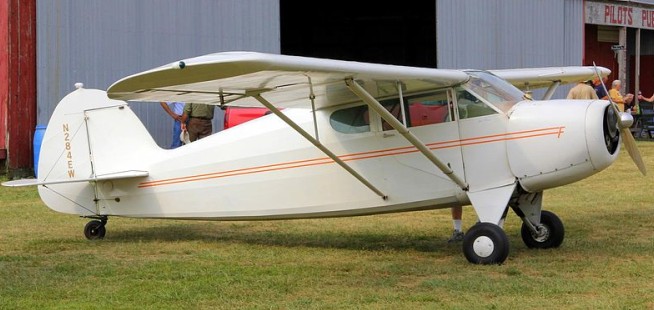
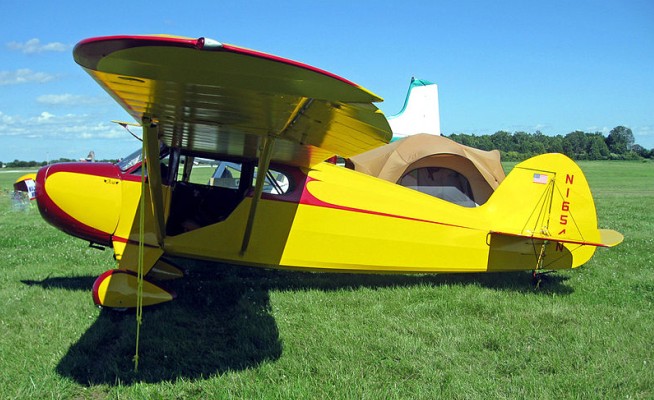
The Funk Model B was a 1930s American two-seat cabin monoplane designed by Howard and Joe Funk. Originally built by the Akron Aircraft Company later renamed Funk Aircraft Company.
The Model B was the first powered aircraft designed by brothers Howard and Joe Funk, whose previous experience was in homebuilt gliders and sailplanes. Similar in appearance to a Piper Cub, their Model B was a strut-braced high-wing monoplane with a conventional tail unit and fixed tailwheel landing gear. The design uses mixed construction with fabric covered wooden wings and a welded steel-tube fuselage. The aircraft was powered by the brothers’ own Model E engine developed from a Ford “B” motor-car engine. The prototype first flew in late 1933.
When the test flights proved to be successful the brothers formed the Akron Aircraft Company in 1939 to build the Funk B. After production began, the engine was changed to a 75hp (56 kW) Lycoming GO-145-C2 horizontally-opposed four-cylinder engine and was re-designated the Model B-75-L.
Funk B75L
In 1941 the company moved from Akron to Kansas and the company was renamed the Funk Aircraft Company. Production was stopped during the Second World War and one aircraft was impressed into service in 1942 with the United States Army Air Corps as the UC-92.
After the war in 1946 production was resumed using a Continental C85-12 engine and the aircraft was redesignated the Model B-85-C and named the Bee. It did not sell well and production was halted in 1948. 380 aircraft of all variants had been built.
Funk B85C
Variants: Model B Prototype and initial production aircraft with Funk E engine.
Model B-75-L Pre-war production aircraft with a 75hp (56 kW) Lycoming GO-145-C2 piston engine.
Model B-85-C Bee Post-war production aircraft with a Continental C85-12 engine.
UC-92 Army designation for one impressed Model B-75-L (s/n 42-79548).
Specifications: B-85-C Engine: 1 × Continental C85-12, 85 hp (63 kW) Propeller: 2-bladed Lewis fixed pitch Wingspan: 35 ft 0 in (10.67 m) Length: 20 ft 1 in (6.12 m) Height: 6 ft 1 in (1.85 m) Wing area: 169 sq ft (15.7 sq.m) Airfoil: NACA 4412 Empty weight: 890 lb (404 kg) Gross weight: 1,350 lb (612 kg) Fuel capacity: 20 US gal (76 l; 17 imp gal) Maximum speed: 115 mph (185 km/h; 100 kn) at sea level Cruise speed: 100 mph (87 kn; 161 km/h) Range: 350 mi (304 nmi; 563 km) with 30 minutes reserve Service ceiling: 15,000 ft (4,572 m) Rate of climb: 800 ft/min (4.1 m/s) Take-off run: 348 ft (107 m) Crew: 2
Formed 1941 at Coffeyville, Kansas, successor to Akron Aircraft Inc., to market Funk Bros. Model B two-seat monoplane. Production resumed after Second World War, aircraft redesignated B-85-C Bee, with Continental C-85 engine. Manufacturing rights acquired in 1962 by Thomas H. McLish of Sharon, Pennsylvania.
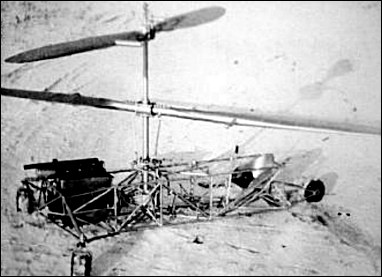
Canada’s first helicopter was built by the Froebe brothers of Manitoba in the early 1930s. It is preserved in Western Canada Aviation Museum in Winnipeg.
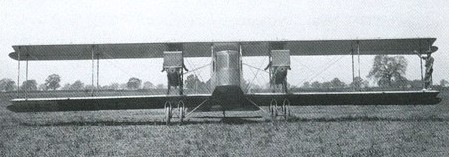
USA Friesley Aircraft Corp., Gridley, CA, built single Falcon, large transport biplane, 12 passengers, 2 x 400hp Liberty, finished mid-1920, not flown until 1921.