After takeover by Keystone, Loening set up the Grover-Loening Aircraft Company at Garden City, New York, as consultant, and built small amphibian flying-boat XS2L for U.S. Navy in 1931. Delivered XSL-2 experimental submarine-borne version in 1933.
Inter-Wars
Groppius
USSR
Two-seat commercial biplane designed by E. E. Groppius and built in late 1924 by a State factory in Moscow. Powered by 300 hp Hispano-Suiza engine.
Grokhovsky G-61 / PG-61
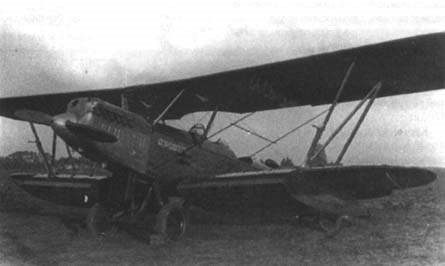
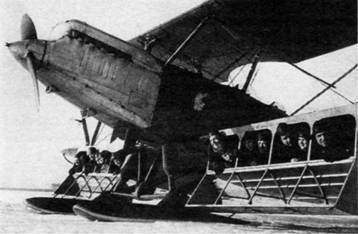
Starting in 1931, Grokhovsky worked on systems for air landing. One of the systems, the Grokhovsky G-61 (Russian: Гроховский Г-61), was to take advantage of all the payload capacity of the aircraft models without affecting their structure. It allowed a stock Polikarpov R-5 reconnaissance biplane to lift 16 people.
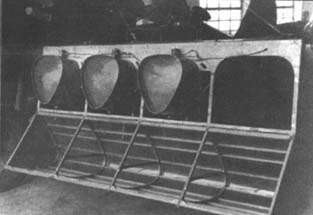
Grokhovsky decided to save resources in construction of specialized aircraft by installing two specially designed cassettes under the underwing of a stock R-5. Each had several compartments designed to carry one soldier.
The first model of the G-61 container had capacity for two paratroopers and could be opened downwards to allow jumping.
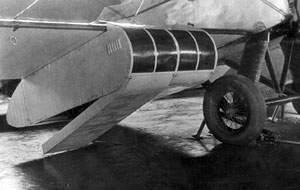
To reduce aerodynamic resistance, the cassettes were designed as a thick wing profile and by protruding from the wing plane in the front and rear area, they increased the wing area by about 7 sq.m. According to the opinion of the institute’s specialists, this should constitute an increase in the lift force and therefore increase the payload capacity of the model. The new leading edge was formed by transparent curved surfaces of Plexiglas, covering the entire width of the cassette and reinforced with a plywood structure.
In addition to transporting soldiers, these cassettes could be used to evacuate the wounded, transport supplies and cargo. Outside the military sphere, the cassettes were used to transport expeditions to remote places, carry out rescue missions, among others.
Cassettes with different capacities were designed, depending on the mission. One of the first versions of the G-61 had only 4 compartments, each calculated to transport a person weighing about 80 kg. The bottom of the compartments could be opened in flight. In this way the pilot could release loads with a parachute or launch the paratroopers into the air.
By 1935 this G-61 system passed factory tests and was delivered to state tests, but Grokhovsky kept working on higher capacity versions.
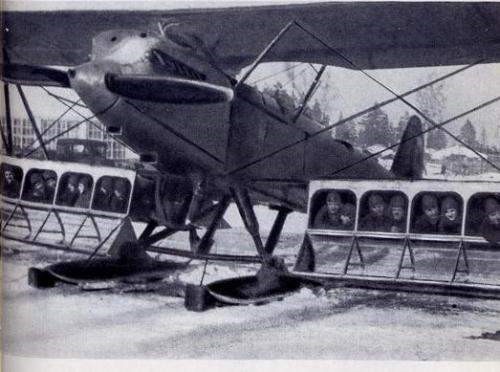
In 1936 a new version was designed. Each cassette held 7 soldiers, bringing the R-5 ‘s capacity to 15 soldiers (including one in the aircraft’s second seat). The construction turned out to be quite light, only about 200 kg. The entire structure of the R-5 was reinforced.
Yakov Alksnis and NN Polikarpov openly expressed their skepticism about the success of the new version. However, by that time Grojovski had a well-earned reputation, so he was given permission to fly his creation. The most difficult thing was finding a test pilot who wanted to test it. Three would refuse, so Grojovski finally decided to take the risk.
On December 8, 1936 at the NKTP Central Airfield in Podlipki an R-5 plane took off with the two new cassettes. The flight had been planned with sandbags until the expected takeoff weight was achieved. These sacks were jokingly known as “Iván Peskov” because this surname means “Son of the Sand”. When Alksnis and Polikarpov arrived to supervise the flight, the plane had already been loaded and the cassettes closed.
The plane with its ski undercarriage traveled around the runway for about 350 meters and took off. At the controls was Pavel Grojovski. The plane made a low-altitude circle flight and took to the runway. The surprise was tremendous when the cassettes were opened and it was found that instead of bags there were 14 Grojovski collaborators. The “official” explanation was that the Iván Peshkov sacks had not arrived on time for the tests and the collaborators had volunteered to take on the weight. In reality, this fact constitutes a sign of the confidence that the workers of the institute had in their boss.
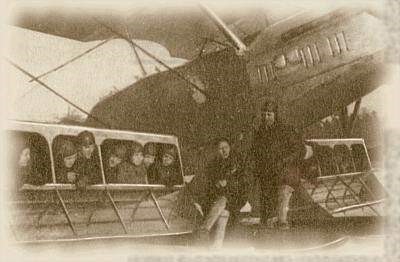
The take-off weight on this flight, including the pilot, a passenger and an auxiliary 250-liter fuel tank, reached 1,650 kg (tests were carried out with weights up to 2,000 kg). Top speed was set at 180 km/h and cruising at about 160 km/h.
Despite Grokhovsky ‘s successes at that time, he began to move away from issues related to the landing to concentrate on aeronautical production. In 1937 the institute would be reorganized and all these works abandoned.
On 12 August 1937, during an attempted flight to the United States via the North Pole, the crew of the Bolkhovitinov DB-A (“Н-209”) would go missing with the crew led by polar pilot SA Levanevski.
On August 25, 1937 Grokhovsky wrote a letter to Stalin in which he reaffirmed that the capacity of the R-5 with the G-61 could be raised from 1,650 to 2000 kg. This would make it possible to locate auxiliary fuel tanks with a pump transfer system to the main tanks and increase the range of the P-5 (civilian version of the R-5) to 3,000 km. In 7 – 10 days Grokhovsky promised to have the cassettes ready. In addition to fuel, these capacities could take food for several months, a tent, an inflatable boat, and all the necessary instruments for a prolonged search.
Grokhovsky further enunciated the advantages of the R-5 for the task due to its ability to land and take off on relatively short runways, the presence of dual flight control, and the possibility of transporting the entire return crew in a single aircraft. The letter ended with a request to allow to equip a P-5 with cassettes and allow it to participate in the search for the crew of “Н-209”.
Grojovski ‘s request was approved. Two P-5 airliners were loaned from the GVF’s northern direction. The first, with factory number 8458, had been delivered in 1934, receiving registration СССР-Л1565 in August. The second example, with factory number 9627, would enter service in June 1935 with registration СССР-Л1937. Both examples received the designation PG-61.
The cassettes were installed in Factories No.89 and 241. The engineers Gubanov (Factory No.241), Mladkovski (GVF Main Directorate), Vorozhtsov (NII GVF) and instrumentalist Lomtiev played a vital role in the modifications.
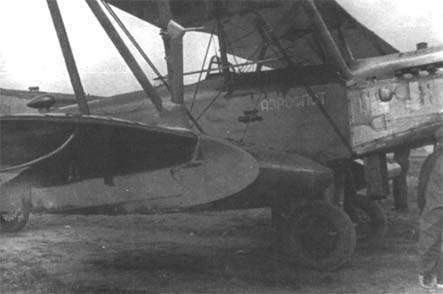
The modifications made made it possible to increase the takeoff weight of the P-5 to 4050 kg. The cassettes were designed in such a way that all the weight was concentrated near the center of gravity of the model.
On September 12, 1937, the aircraft, registered СССР-Л1565, took off from Moscow to Arkhangelsk with the pilot of the experimental institute Boris Bitski. In two days it reached its destination, where the plane was disassembled for transport aboard the steamer “Roshal”, which was traveling to Rudolf Island in the Franz Josef Land archipelago .
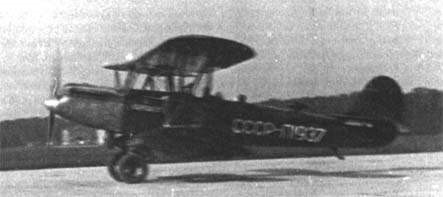
The second example СССР-Л1937 was kept in Moscow for a set of tests. Auxiliary fuel tanks with a total capacity of 840 liters were installed in six of the 8 cassette compartments. The takeoff weight with fuel rose to 3350 kg. In the rest of the compartments there was a reserve radio station, food for two months, weapons, sleeping bags, and additional parts for minor repairs to the plane. The takeoff weight grew to 3780 kg. Instruments for blind flights, a radio-compass and powerful radio equipment were installed in the piloting cabins.
On September 16, 1937, pilot IS Kotov and the radio operator Degtiev began the tests of the aircraft at the Bykovsky airfield. Only four flights were carried out in which it was possible to determine that the aircraft behaved quite well in flight and could be controlled without difficulty, despite its great weight. Takeoffs and landings and horizontal flight of maximum and minimum speeds were tested. The plane behaved well and not unlike the normal P-5.
During the takeoff run, no tendency to deviate to one side was recorded. Takeoff occurred at a speed of 90-95 km/h and the run lasted about 18 seconds.
Horizontal flight was tested at speeds between 135 and 185 km/h. Gliding was tested at speeds of 135 – 140 km/h, demonstrating good stability.
The landing was not unlike normal P-5 aircraft. The auxiliary tank system also passed the tests.
After the culmination of the tests, the СССР-Л1937 plane flew to Moscow, from where it departed for Arkhangelsk, taking on board the same crew that participated in the tests. In Arkhangelsk the plane was disarmed and its crew joined that of the other plane, which had not yet boarded.
The Roshal steamer arrived in Arkhangelsk on October 1. The loading of the ship took 5 days. At the end of October, it would arrive at the island of Rudolf, where a group of Tupolev G-2 planes (civilian transport version of the Tupolev TB-3 bomber) were already present. Despite the number of aircraft and crews, constant weather problems did not allow the pilots of these aircraft to conduct an active search for Levanevski’s aircraft.
Unlike these large aircraft, which arrived flying under their own power, the P-5s, after unloading, had to be fuelled and transferred to the improvised runway. During final preparation on December 2, the ice under Bitski’s aircraft gave way and the СССР-Л1565 aircraft plunged about a meter, damaging its propeller. Next to the plane, Chuxnovski, who was helping in the preparation, fell into the water.
On December 8 both planes were prepared for flights. Both pilots calculated that the weather would improve and in about four days they could take off. In one of the planes the navigator LM Rubinshtein would travel. Inclement weather thwarted this plan.
The weather situation improved only on the 20th and the P-5s, together with Chuxnovski’s G-2, were ready. Bitski and Kotov tried twice to take off, but a broken tail skid prevented them from taking off. It is unknown if the PG-61 took part in the rescue flights or not.
It is known that СССР-Л1937 survived this adventure and was still flying at the beginning of 1941. The fate of the P-5 СССР-1565 is unknown.
Grokhovsky G-61
Powerplant: One M-17B, 680 hp takeoff / 500 hp rated power
Wingspan:15.5/12.6 m
Wing area: 50.2 m²
Length:10.56m
Loaded weight: 3800kg
Wing loading: :75.7 kg/sq.m
Power load: 7.6 kg/hp
Payload capacity: 15 soldiers
Cargo volume :4.3 cu.m
Top speed: 201km/h
Cruising speed: 130 km/h
Take-off run max load: 400 m (30 sec)
Ceiling: 2800m
Accommodation: 1-2
Grokhovsky G-52
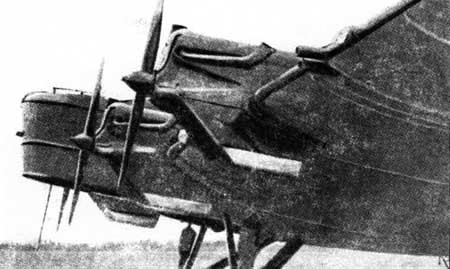
In 1934 Grojovski began experiments installing conventional weapons used by ground units on bombers. Initially as part of the experiments, he fitted a Tupolev TB-3 bomber with a 76mm regimental gun. The gun was installed under the fuselage, in a structure 600 mm from the bottom of the fuselage. The tests were carried out between December 15 and 18, 1934, first with shots from the ground and then during the flight. As a result of these tests, it was declared that firing with 76mm regimental guns from aircraft is possible.
After these results Grojovski began the development of a version with more powerful weapons, again on a TB-3 bomber. This version was called “Letayuchaya Baterieya” or “Flying Drums” and received the designation G-52 (Russian: Гроховский Г-52 “Летающая Батарея”) in the institute’s consecutive year.
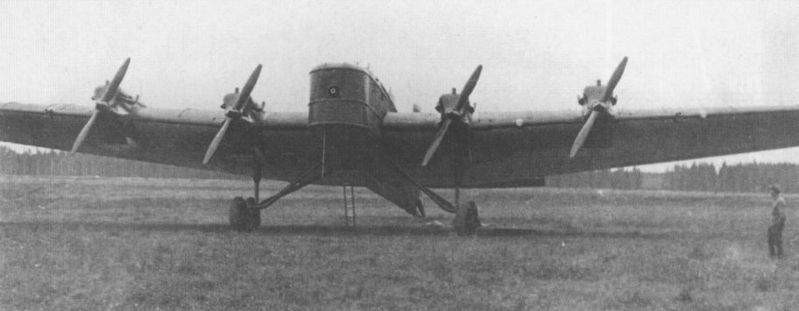
The G-52 “Letayuchaya Baterieya” heavy attack aircraft was submitted for state tests in December 1935. It was a Tupolev TB-3 bomber with M-17 engines and armed with cannons.
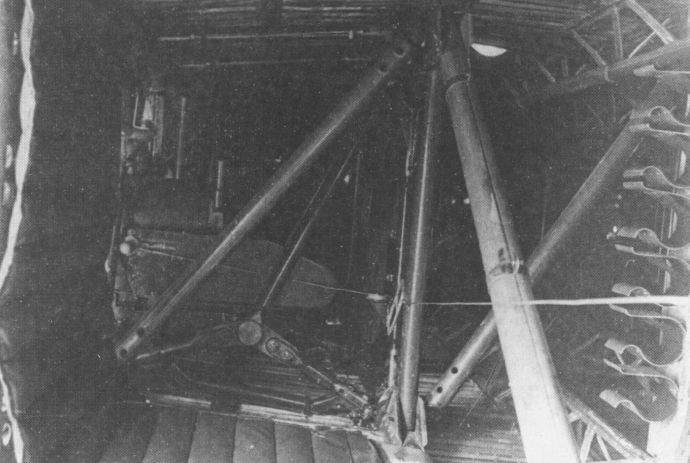
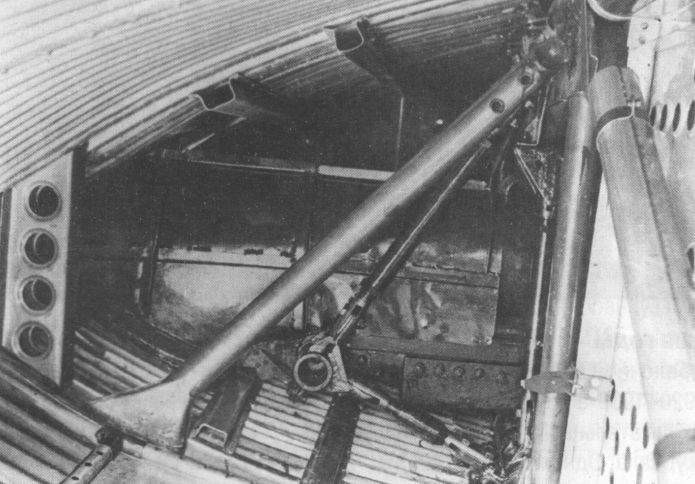
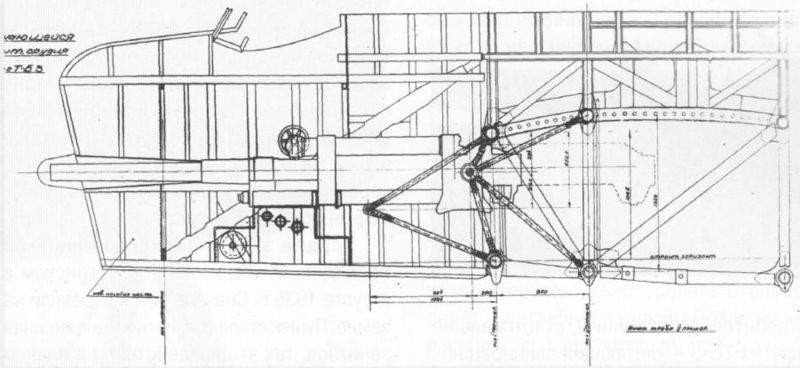
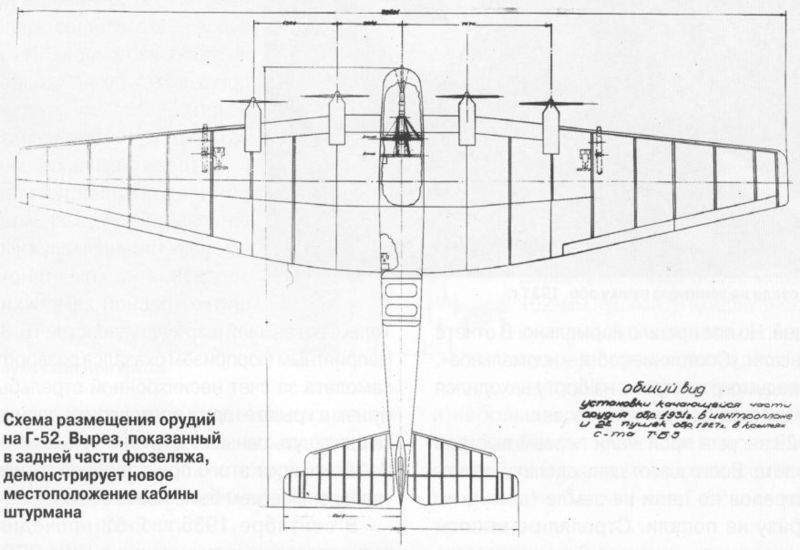
After reviewing several installation variants, it was agreed to install a 76 mm anti-aircraft gun (1931 model in the nose.). The developers were forced to shorten the nose, which forced the elimination of the navigator’s position in the bow. The long tube of the gun was located between the pilots’ stations, protruding by about 250 mm at the bow of the aircraft. The body of the cannon was fixed to the upper and lower partitions of the spars of the center plane, by means of a system of adjustable rods. From the nose and up to the pilots’ position, the barrel was covered with a tube to prevent the entry of gunpowder gases into the cockpit. The reloading of this cannon for firing was done manually. To achieve this, the gun server position was located in the fuselage, with a small seat and some shelves for the projectiles.
In the wing consoles two 76 mm field guns (1927 model). To install the guns on the TB-3 bomber , the gun carriage with the wheels was eliminated, maintaining the recoil compensation system. The server for each gun sat during the flight on a mattress attached to the wing structure.
The main task for which the G-52 was conceived was fire support to landing troops. The range of the artillery salvoes was 18 km and the location of the target was done during the turn. To achieve some aim, a standard collimator was located in front of the ship’s commander’s post. Each shell had a weight of 6.5 kg.
According to the assertions of its builders, the three cannons of the “Letayuchaya Baterieya” could fire up to 27 shots per minute. This really does not seem credible due to the lack of automatic recharging systems at the time.
The order to fire was obtained by means of light indicators. The ship’s commander had a control board with switches and indicator lamps.
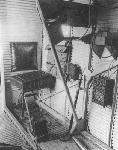
When the commander connected the switch, the piece received the instruction to prepare to fire. When loading the projectile, the server of the piece pressed his switch to indicate that he was ready. After taking the plane to the target, the commander pressed a button and a red light illuminated in the room, indicating the order to fire. In case of need, the wing guns could be fired using a remote control system. For this purpose, cables were located from the cockpit to the wing locations.
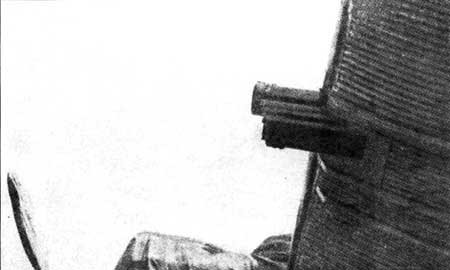
The navigator, originally located in the bow of the bomber, in this version came to occupy a position on the left side of the rear part of the fuselage, just above the wing trailing edge area.
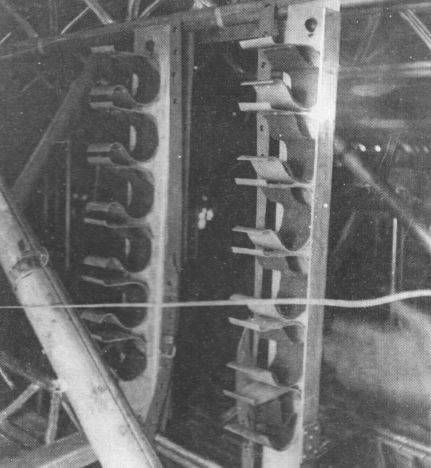
This system in general must have turned out to be not very functional, first of all due to the need to approach the target without an aid system for the pilots, maintaining the course during the entire approach despite the interference caused by the enemy fighters and the anti-aircraft systems. On the other hand, the lack of aiming systems guaranteed a very low level of success. During the tests it was also found that the smoke from the cannon shot leaves the pilots practically without visibility.
Grojovski’s experiments in this direction were simply abandoned.

Grokhovsky G-39 Cockroach
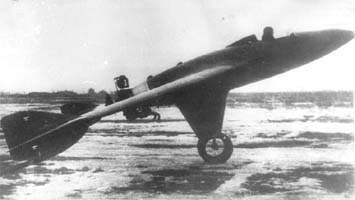
Practical work on the development of a “tailless” aircraft began at the Oskonbyuró (Bureau for Special Constructions of the VVS RKKA) in Moscow at the beginning of 1933. The group led by Grojovski had previously tried to venture into this type of apparatus, but the large number of “gaps” did not allow it to seriously engage in the development of such a complex task. In particular, the issues related to the achievement of the necessary stability in flight became more complex.
Grojovski also clearly understood the need to start with experimental models. Only phased development would allow the necessary experience to be obtained, but this principle was foreign to the bureau’s way of working. Since its creation, all the works conceived by the group under the direction of Grojovski had a practical nature, designed so that once the tests were completed, they could go directly into service.
In those years attention began to be paid to a new type of aerial combat: the demolition of the enemy plane by ramming. In Russia this method was popularized by the pilot Nesterov and received the name “Taran”. Generally the “Tarán” was carried out placing the own plane at 6 o’clock from the enemy and cutting its tail planes or wing tips with the propeller. In the best of cases, the attacking aircraft landed with a damaged propeller, in many others it ended up destroyed along with its opponent. The “Taran” method was promoted during the first stage of the Great Patriotic War, when German aviation had air superiority. Many Soviet pilots rammed their planes into the enemy in those unequal combats.
Grojovski decided to study the possibility of building a plane specialized in ramming. It was a matter of designing a model capable of inflicting great damage on the enemy plane without great damage to its own. The result of this work was an aircraft without analogues for the time that received the name G-39 from the institute and the nickname “Cockroach” (Russian: Гроховский Г-39 “Кукарача”).
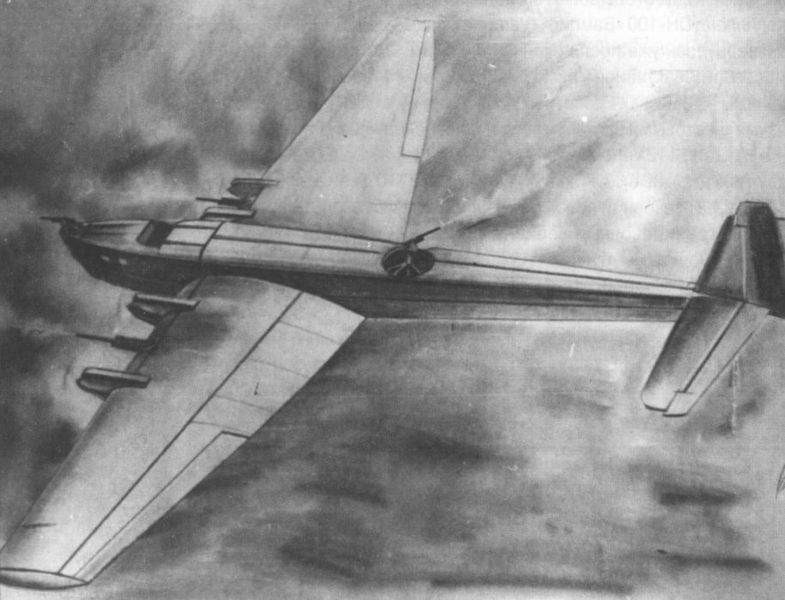
As a basis for Grojovski ‘s thought, an example without tail planes was designed. Along the entire leading edge of the wing, a “knife” was installed, a thin, sharp sheet of high-strength steel. In the bow, the installation of a long bar with sharp edges was foreseen, which was to protect a pneumatic cannon. Between this bar and the wing consoles a fine steel cable was installed. It was thought that at the moment of impact, either with the cable or with the edge of the leading edge, the enemy’s tail would be destroyed.
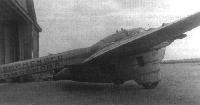
In general, the G-39 repeated Cheranovski ‘s flying wing schemes. The short, cigar-shaped fuselage featured an enclosed bubble-like cockpit forward. In front of the windshield was an armored plate.
The wing had a 38º leading edge camber and ended in vertical surfaces inserted into the trailing edge. The tips of the wings inclined downwards.
At the rear of the fuselage, within a semicircular indentation in the wing, the propeller was located in a drive configuration. The engine was installed at the rear of the fuselage using a special system that allowed it to rotate the engine from its horizontal to vertical position. In this way, the variable pitch propeller was converted from a driver to a tractor and generated the necessary lift to allow vertical takeoff.
The landing gear of the G-39 featured four wheels. The main units featured long landing gear covered by a thin fairing and attached to the wing root, at the point of junction with the fuselage. The other two wheels were located in the lower part of the wingtip vertical surfaces.
From the drawing stage of the new model and by virtue of its appearance, the designers named it “Cockroach”.
Among the novelties incorporated in the development of the model was the introduction of vertical takeoff capability. The idea of such a possibility had been presented by Grojovski in his work “Installation of a power unit in the middle zone of the fuselage”. With this decision the technical task was to develop a tailless ramming aircraft capable of vertical takeoff and landing. The general conception of the new plane was patented by Grojovski on February 25, 1935.
Despite its technological novelty, the new model was based on a body of documented discoveries, calculations, patents, and innovations. On the other hand, there was the trust of the group in the intuition of their boss. Even without the necessary technical preparation and unable to explain how and why, Grojovski always ended up being right, even in those cases in which “science” suggested that his ideas were theoretically incorrect. For this reason, the new task did not raise doubts as to its success, neither in the bureau workers, nor in the invited specialists, and soon the new G-39 model began to take shape on the drawing sheets.
The task was presented with its specifications, but the bureau group lacked knowledge and experience for its development. A group of specialists, VF Bolkhovitinov, SG Kozlov and A. Ye Kaminov were contracted for the conception of the project.
The development and construction of the “Cockroach” was carried out in difficult conditions. The invited specialists could dedicate only their free time to the design, mainly at night. The model was not registered in any development plan, so it had no allocation of material resources.
The construction was carried out in the workshops of the TsAGI. Getting a new engine was impossible, so they had to be content with the underpowered 100-hp M-11, removed from another aircraft. To build the fuselage they had to use leftover materials from other productions. The shortage of qualified personnel was constantly felt. The lack of specialized equipment in the TsAGI workshops made it necessary to simplify the project.
The closed cockpit was replaced by an open one with a windshield. The semicircular slit in the wing, in the position of the propeller, was replaced by a rectangular one. As a result of this modification, the triangular wing ended up becoming a swept wing and its trailing edge a large horizontal stabilizer with a large area and span.
The prototype lacked the ramming equipment, neither the wing knives, nor the installation of the nose system with pneumatic cannon could be installed in the conditions of the workshop.
Another feature that seems to disappear in this prototype was the possibility of vertical takeoff. At least no evidence is collected to show that it was ever tried by the participants in the tests.
The TsAGI workshops were commonly visited by Valeri Pavlovich Chkalov. He had been entrusted with the task of testing the plane and for this reason he considered it mandatory to know the apparatus at the assembly stage. Under his advice, the cabin was set up and the equipment and instruments were placed in the correct position.
At the end of the spring of 1935 the “Cockroach” left the workshops for the development of the tests. Seeing him on the track, Chkalov commented:
- “Oh! It actually looks like a cockroach. I’ll try it.”
However, flying the “Cockroach” proved impossible. The G-39 ran down the runway increasing its speed but in no case did it get up on the runway. Chkalov, not giving up, raced the plane up and down the runway failing to get it airborne until the fuel ran out.
Irritated and addressing the plane’s designers, he blurted out:
- “A real Cockroach and Cockroaches don’t fly! Somewhere you miscalculated or overthought, distinguished!”
The failure of the G-39 can be explained by a series of causes:
The low motor power;
The position of the propeller in relation to the fuselage, the wing and the fairings of the main landers contributed to diminish the effect of the propeller;
The low quality of the construction of the plane;
With all these problems against, the “Cockroach” was unable to take flight.
But Grojovski did not give up his efforts and, not without the help of some important people in the VVS, managed to have the “Cockroach” project included in the official plan of the NKTP Experimental Institute. For this he had to abandon the idea of the vertical takeoff. Work on such a “progressive” model would not have received support.
The contract with the invited specialists was not renewed. Grojovski put his replacement VD Urlapov in charge of development, taking into account that the project already existed and the experience had been accumulated to take on the job. Three months later in the Soviet press would appear:
“The experimental institute of the Narkomtyazhprom in Leningrad begins the development of a model of a flying wing with a 100-hp engine. This plane can carry four passengers and fly at a speed of 220 km/h. In a period of two and a half months the plane should be ready to participate in the all-Soviet race organized by the newspaper “Pravda”, the Central Committee of the Komsomol and the Council of OSOVIAJIM . “
From this moment the development of the G-39 disappeared without a trace. All information about its development has disappeared. Neither was it clear about his fate in contacts with the institute’s workers during that time. Possibly all this is linked to the process that followed the dissolution of the institute and the repression linked to the arrest of MN Tukhachevaski.
G-39
Powerplant: 1 × 100 hp M-11
Wingspan: 6.80 m
Wing area: 14.20 m²
Length: 8.84m
Height: 3.16m
Empty weight: 520 kg
Maximum takeoff weight: 698 kg
Accommodation: 1
Grokhovsky G-38 / LK-2
Work on the multifunctional aircraft Grokhovsky G-38 (Russian: Гроховский Г-38) began in the summer of 1934 at the request of the VVS leadership. The collective of the experimental institute headed by Grojovski took up the task.
The new model, also known as “Light Cruiser – 2” or LK-2 was developed under the direct supervision of the head of the VVS Ya. I. Alksnis and the deputy commissioner MN Tukhachevsky.
The general conception of the model was assigned to VF Rentel, who designed a monoplane aircraft with a double tail cone configuration and mixed wood and metal construction, retractable gear, 28-meter wingspan and capacity for three crew members. The results of the calculations with the selected engines showed that the model would not be able to compete even with contemporary fighters. Its speed barely reached 300 km/h. The armament, composed only of 7.62 mm machine guns, was also considered poor.
PA Ivensen, a 25-year-old engineer, who had previously worked for was recruited to lead the project group. After familiarizing himself with the results of Rentel’s work, Ivensen confirmed that for the selected design 300 km/h was a limit, but a solution could be found capable of raising this value to 500 km/h.
After three intense days of redesign, the project group made a significant group of modifications. The wingspan was reduced by 1/3 of the original, being fixed at just over 14 meters, increasing the wing loading and with it the speed. This introduced a new problem by increasing the landing speed to 125 km/h. instead of the 90 km/h demanded in the requirements.
Notwithstanding, the opinion of Valeri Pavlovich Chkalov played a decisive role in defining that “…the greatest advantages must be obtained in the air and not at one’s own aerodrome. You need advantages in speed and maneuver to win. There will be little need to land if they knock you down easily, but if you succeed you will land at any speed…”.
Apart from Ivensen, specialists were invited to work on the G-38
MV Orlov – Head of the resistance department of the SNII (Samoliotni NII) of the GVF
AK Martynov – TsAGI Professor of Aerodynamics
VN Belyaev – Professor at TsAGI specialized in resistance of materials and loads
VI Korovin – Aeronautical Designer
AF Epishev – Specialist in strength calculation and static tests
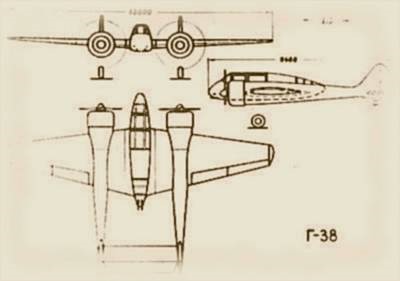
The G-38 was designed as a double-fuselage aircraft, of mixed construction, with great use of wood. Only the central gondola, intended for the crew, was made of metal. Control surfaces were fabric covered.
The wing was strengthened, allowing it to withstand heavy loads and even considering the possibility of hanging bombs, rockets and auxiliary fuel tanks on it. It was built in wood with a honeycomb structure and plywood covering.
The 800 hp Gnôme – Rhône 14Krsd engines were located in the wing centerplane and were continued in the oval section tail cones, tapering towards the tail end, built on a wooden structure and covered in plywood.
The landing gear was of the conventional type with a tail skid. The main units retracted backwards, being stored inside the motor nacelles.
The central gondola housed a crew of three, with the navigator located in the bow and pilot and radio operator seated back to back.
The G-38 was designed with an armament of two ShVAK cannons and two ShKAS machine guns firing forwards, another two ShKAS machine guns operated by the navigator in the nose cabin and a last pair operated by the radio operator, defending the rear. There were also two AG-TB 40.8 mm grenade launchers. Under the central gondola bombs could be located on external supports.
A scale model of the G-38 was built, which was blown in the TsAGI wind tunnel, showing the possibility of reaching a top speed of 550 km/h. The carpenters who worked on this model took such pains to polish it that the model was commonly called “the piano.”
In December 1934 the conceptual project of the “Light Cruiser” was finished. The new model surpassed in all its characteristics the similar models of AN Tupolev Mi-3 (ANT-21) , Mi-3D (ANT-21bis) and DIP (ANT-29).
MN Tukhachevsky, after getting acquainted with this project, declared the G-38 the “main object of aviation technique in the rearmament of the RKKA”. He especially demanded to increase the acceleration of development, stressing the state importance of the creation of this aircraft and promised, in case of successful flight tests, to recommend its creators to receive state awards and decorations. In two and a half months, a life-size model was finished, which was exhibited in a hangar at the Moscow Central Airfield, located in the Jodymka field. This mock-up was visited and analyzed by the commissar of heavy industry GK Ordzhonikidze, the head of the VVS Already. I. Alksnis , MN Tukhachevski and a significant number of senior Red Army officers.
Among the visitors was the test pilot Valeri Pavlovich Chkalov. After carefully reviewing the plane, he ended by saying to Grojovski:
- “Excellent machine. Prepare it soon. The first flight is mine.”
The plans were quickly sent to the Leningrad Factory No.47, which operated under the Grokhovsky Institute. The G-38 prototype was nearly complete by the end of 1936. With the restructuring of the experimental institute and its change of subordination all the works were cancelled.
In 1937, after the firing squad of Marshal MN Tujachevski, a GUAP commission that visited the institute made the decision that the aeronautical construction at the Grojovski institute was not objective and aimed to destroy the aircraft under development, considered to have little prospect. In front of the workers of the institute, both the G-26 and the G-38 were transferred to one end of the factory airfield, doused with gasoline and burned.
G-38
Engines: 2 Gnôme-Rhône 14 krsd, 800 hp
Wingspan: 13.4m
Wing area: 32.0 m²
Length: 8.8m
Height: 2.9m
Loaded weight: 4500 kg
Wing loading: 160 kg/m²
Power load: 2.8 kg/hp
Speed at sea level: 550 km/h
Landing speed: 125 km/h
Armament: Two ShVAK cannons and six ShKAS machine guns
Bomb load: 500 kg
Accommodation: 3
Grokhovsky G-37
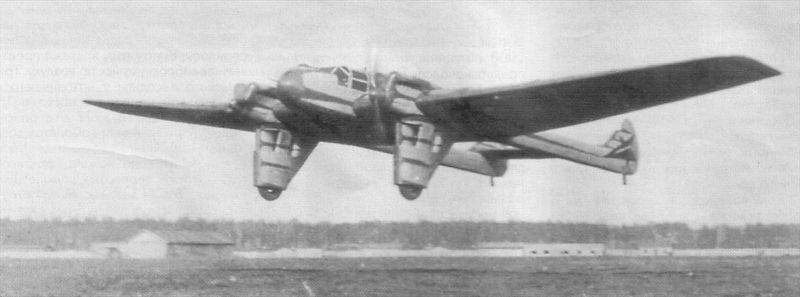
The G-37 troop transport aircraft was obtained as a development of Grojovski’s ideas regarding means of air landing. On this occasion, the transporter plane could be used in different functions, including transporting troops using a special container that was fixed to the bottom of the center plane with capacity for 10-12 soldiers.
The project, originally known as ULK, acronym for Universalnoye Letayuche Krylo or Universal Flying Wing, was [Grojovski|PI Grojovski]] himself, but its design and projection were entrusted to the head of the Leningrad branch of Oskonbyuró IV Titov, production preparation was led by VF Rentel and execution by RM Kalinin.
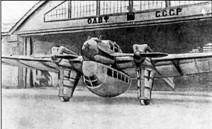
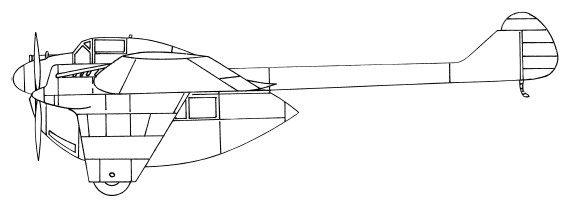
The Grojovski G-37 (Russian: Гроховский Г-37) was designed as a twin-engined, low-wing monoplane with a double tail cone. The structure was metal and the entire covering of the plane was made with corrugated metal.
The G-37’s wing came from a crashed Tupolev ANT-9. This wing was totally metal with a 4-spar structure and was made up of a centerplane and two consoles. Virtually the entire wingspan of the trailing edge of the consoles was taken up by the ailerons. After removing the ailerons, this wing presented an area of 80.97 m². A central gondola with the cockpit and flat bottom was fixed on the centerplane with a constant chord to allow the fixing of the detachable ventral cargo container.
In order to accommodate the ventral container, the G-37 featured a fixed landing gear with a long length of the landing gear faired in “trousers” with tunnel-type inlets for the oil and water radiators. The wheels were simple and there were no brakes. The suspension of the main landers was by rubber. In winter conditions, the replacement of the wheels with skis was foreseen.
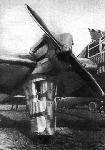
Two M-17 liquid-cooled engines with a power of 680 takeoff hp and 500 nominal hp were selected as power plant, moving 3.15 m diameter fixed-pitch wooden propellers, also inherited from the Túpolev ANT-9. The motor mounts were fixed to the centerplane structure. The bonnets continued in the form of two parallel tail cones, ending in two medium-sized empennages. The empennages were metallic and were integrated into the structure of the cone. The rudders had aerodynamic compensators on the upper part and servo rudders or trimmers on the trailing edge.
The two tail cones were metal, with an oval section that tapered towards the tail and were located on the wing. In the lower rear part, the non-steerable landing skids were fixed and with suspensión was spring steel. Both empennages were joined by a constant chord stabilizer to which the elevator was attached. This stabilizer had a three-beam structure and was fixed to the empennages by means of 4 points in such a way that its angle of incidence could be modified on the ground. Originally the surface of this stabilizer was 10.5 m², but during the tests it was increased by 20%.
The fuel system consisted of tanks in the center of the plane with a capacity for 1000 kg of fuel.
The cockpit with capacity for 1-3 crew members was located in the central gondola, depending on the type of mission. In the bow was located the open cockpit of the gunner with the possibility of installing a pair of Degtiariov light machine guns on a swivel mount. Behind it was the closed cabin for two crew members located side by side. Behind this cabin was a small cargo or baggage compartment in which an additional fuel tank could be installed. The G-37 featured dual flight controls using cables and wires.
The fixing supports of the cabin in the center plane could be used to fix other types of containers or loads, and even to carry up to a ton of bombs.
Engineers VA Ryvkin, GS Avdieyev and spouses PS and AF Epishev also participated in the preparation of the landing cabin or container. All from OSOVIAJIM.
Already prior to the construction of the G-37, Grojovski and his collective had worked on the development of a cabin for 12 soldiers, individual containers for paratroopers, tested in a Tupolev TB-1 bomber, and a larger cabin for 17 soldiers, officially named KPS. -17 and known as “buffet”, which was tested on a TB-3.
The project planned various types of cabins depending on the aircraft’s mission, but only one was built, which was completed in Poplidki and attached to the aircraft in Moscow. This cabin was calculated to transport 10 passengers or 12 equipped soldiers or 10 wounded or four stretchers with a nurse.
Its construction was totally metal with corrugated metal covering and side windows. The length of the cabin was about 7 meters with the front hinged, forming an access opening to the right side. The soldiers or passengers were located on both sides on wooden benches, intertwining their legs due to the narrowness of the cabin.
This cabin featured a hatch in the forward part of the floor, which could be used to drop propaganda over enemy territory. This container could be dropped in flight, either due to an aircraft emergency or in the performance of a landing task over an area where it was impossible to land. The cabin descended with the help of a parachute 40 meters in diameter.
The G-37 was built in the winter of 1933-1934 at the Leningrad Factory No.47, which was subordinate to Grokhovsky ‘s OKB.
The pilot Valeri Pavlovich Chkalov was unable to fly due to the punishment imposed for destroying an airplane. For almost six months he had been forbidden to take flight and for him that had become a true torture. On May 7th he was at the civilian fleet airfield in Leningrad (formerly a hippodrome) and in an open hangar he saw the strange G-37 on the skin of which read “In the name of the Leningrad Komsomol”.
The G-37 was to be tested by AB Yumashiev on May 7, 1934, who had not arrived at the airfield at that time.
Chkalov requested permission to run the G-37 around the runway. Knowing the punishment, they initially declined his request, but at his insistence they decided to authorize it, but warning him that he should only taxi.
Runway runs were run from end to end and Yumashiev was still missing, so Chkalov was cleared to make the first flight.
After takeoff the plane began to oscillate slowly, moving the tail up and down. This movement was increasing and it seemed that the flight would end in disaster, but Chkalov managed to land the plane almost at the end of the runway. After correcting the problem (a bad installation of the tail control cable) the factory tests developed quickly and without complications until June 1, 1934.
On June 12, 1934 Chkalov flew from Leningrad to Moscow, landing at Frunze Central Airfield (formerly Trotsky airfield located on the Khodimka field), where he received designation for further testing. There Grojovski and a group of Oskonbyuró workers were waiting for him. The aircraft was presented to GK Ordzhonikidze, MN Tukhachevski and Ya. I. Alksnis, making a positive impression. Above all, the visitors valued the high flight speed, much higher than that of the Tupolev R-6 that had begun to be produced in series.
During the transfer of the G-37, Chkalov without trying, managed to set an unofficial speed record for twin-engine aircraft. Covering the distance between Leningrad and Moscow in 2 hours and 15 minutes, the plane reached an average speed of 310 km/h. According to Chkalov, the plane could develop a higher speed after adjusting the engines correctly and replacing the old wooden propellers with new ones (these propellers, taken from ANT-9 planes, were exposed to the elements for more than three years, for which they lost between 15 and 20% its effectiveness.
Flight tests were supervised by PA Khrustalev.
Development testing of the G-37 took place during the winter of 1935. The aircraft showed excellent stability and response to controls. The centering and static moments of the tail units were maintained during the tests similar to those of the Túpolev ANT-9 and no vibrations or anomalies were observed in any of the flight regimes. Both the propulsion and fuel systems worked flawlessly throughout the testing period.
The flight characteristics of the G-37 with the cockpit hung under the fuselage deteriorated considerably. Top speed at sea level dropped to 235 km/h, while cruising speed at 2,500 meters was 250 km/h.
At the beginning of 1935 and at the request of the head of the VVS, Yakov Alksnis, new M-17 engines were installed in the G-37, with which performance improved significantly, reaching a maximum speed (without the container) of 375 km/h. These results opened up new prospects for the use of the G-37 as a postal or military reconnaissance aircraft.
In the spring of 1935 the tests of use of the transport cabin were continued with drops of paratroopers through the lower hatch. Among the enthusiasts who took the plunge were Grojovski himself and several members of his collective.
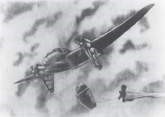
Flight tests of the G-37 continued until November 1936 when the institute led by Grojovski was reorganized.
During testing it became clear that the idea had prospects for practical use, but the capacity of the ULK needed to be increased. Grojovski ‘s task force developed calculations for a version powered by modern M-34N engines and using a thinner, smooth-coated wing instead of the corrugated ANT-9. A model of this version, known as the G-37A, was tested in the VVA Zhukovski wind tunnel, yielding a possible top speed of over 400 km/h.
Unfortunately, these works could not be carried out due to the liquidation of the institute.
Despite the cancellation of the work on the G-37, the investigations carried out by Grojovski and his colleagues were not lost.
Between 1939 and 1940, in the OKB of SV Ilyushin, the conversion of the operational units of the DB-3 bomber would begin into a long-distance landing troop transport plane by adapting a D-20 metal cockpit created by AI Privalov under the fuselage. and designed to transport 10 skydivers.
DK-12 cabins for 12 soldiers were widely used during the Great Patriotic War attached to Il-4 (DB-3F) aircraft.
G-37
Powerplant: 2 × М-17, 680 hp at takeoff and 500 nominal hp
Wingspan: 23.70 m
Wing area: 84.00 m²
Length: 15.20 m
Height: 4.52 m
Empty weight: 3075 kg
Normal flight weight: 5950 kg
Maximum takeoff weight: 6250 kg
Fuel capacity: 650 kg
Maximum speed at sea level: 240 km/h
Maximum speed at altitude: 285 km/h
Landing speed with maximum load: 90 km/h.
Practical range: 1700 km
ROC: 335 m/min
Time to 1000 m: 3 min
Time to 6000 m: 18 min
Practical ceiling: 8050 m
Accommodation: 1 – 3
Payload: 10 passengers, 12 soldiers or 1000 kg of cargo
Grokhovsky G-31 / G-63
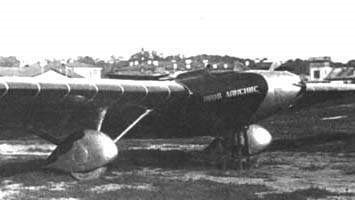
Since 1931 pilot and aeronautical constructor Pavel Grokhovsky began the development of means for landing troops. This new task received special support from the substitute of the People’s Commissar for Naval and Military Affairs and the chief of armaments of the RKKA, Mikhail Tukhachevsky.
After unsafe attempts to transport the paratroopers in underwing containers, Grokhovsky decided to try under his direction, Boris D. Urlapov designing a landing glider with a capacity for 16 paratroopers.
Urlapov had some experience working with gliders, for in 1925, in Saratov, he helped OK Antonov build the OKA-2 glider and later built a training model of his own design.
The task assigned by Grokhovsky envisioned the creation of a towed glider capable of carrying 1,700 kg of cargo or 17 paratroopers.
The glider was given the internal designation G-63 and was characterized by its unusual distribution of soldiers lying within the thick wing centerplane.
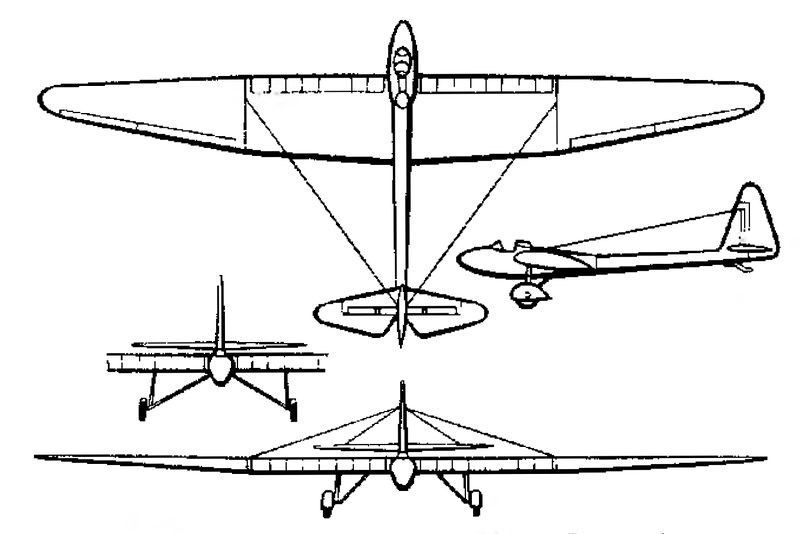
The G-63 glider was designed as a mid-cantilever wing monoplane with a wingspan of 28 metres. The front of the glider was designed as a projecting cockpit for the pilot.
The thick wing featured a thick rectangular midplane with a large chord and trapezoidal wing consoles with rounded ends. This wing was built using profiles TsAGI-677, 678 and 679. The 16 soldiers were located prone in the midplane, in cells measuring 2100 x 660 x 550 mm separated by frames, which at the same time served as wing ribs. The leading edge of this centerplane was made up of a transparent cover that could be opened, pivoting upwards, for the loading and unloading operation of the soldiers.
All construction was made of wood. The fuselage had a monocoque structure with a plywood covering. Following the wing, the fuselage tapered to become a slim oval section tail bar, to which the tail unit was attached. Bracing cables to the wing were used to secure the tail cone.
The tail unit, of the monoplane type, featured stabilizers braced to the keel.
The original landing gear was designed with a conventional structure with a tail skid and was of the fixed type. The main landers, with large simple wheels, were fixed to the centerplane structure in the wing and by means of long studs to the fuselage frames in their lower region. In the G-31 version, the landing gears were reinforced and drop-shaped aerodynamic fairings were placed on the wheels.
The original version placed the pilot in an open cockpit with a windshield, located forward of the wing leading edge. The improved version G-31 included a double cabin with double control.
The G-63 (Russian: Гроховский Г-31 (Г-63)) glider was built in Leningrad Factory No.47. In October 1932 construction was finished and testing began. The first flights were made by Grokhovsky himself. Later the tests were continued with the participation of test pilot VA Stepanchonok. The towing was done with the help of a Polikarpov R-5.
In 1932, during one of the test flights, the G-63 crashed, receiving serious damage.
The glider repairs took until August 1933. During this time, construction changes were made, which included increasing the surface of the rudders, modifying the operating angles of the rudders and ailerons, adding a position for a second pilot, among others. The rebuilt glider received the new designation G-31.
A year later the construction of a second prototype was finished, which was named “Yakov Alksnis” after the head of the VVS. This example featured cut-out landing gear and reinforced landing gear. The rudder control cables were concealed within the tail cone structure.
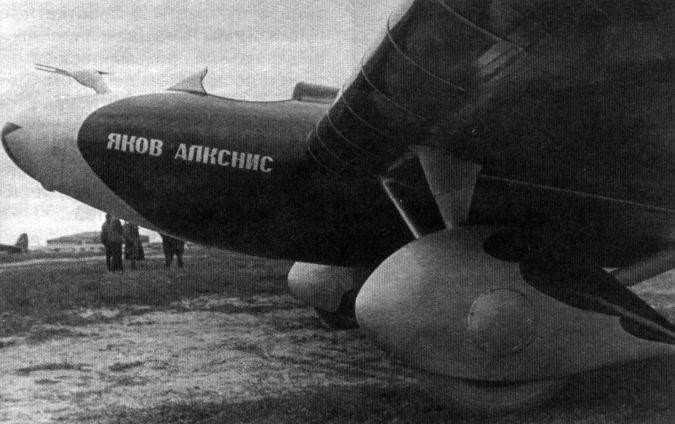
It was thought of giving the glider some capacity for autonomy. With this objective in 1935, the first G-31 prototype was equipped with a 100 hp M-11 engine, turning it into an experimental motorized glider or “planerlet” as it was called in the USSR at that time. The fuel capacity allowed the “planerlet” to stay in the air for about 20 hours.
During the tests, this example with a maximum load of 1,400 kg achieved a speed of 120 km/h with a cruise of 101 km/h and a ceiling of 5,000 m. Flights were made with a range of 2,000 km, but staying for 20 hours in a cramped compartment with hardly any movement capacity was extremely uncomfortable, especially considering that after landing the soldiers would have to go into combat.
With the aim of increasing speed, the installation of a more powerful engine was planned, which transformed the G-31 from a motor glider into a transport aircraft. This is how the G-31 version with the 700 hp Shvetsov M-25 engine would appear.
The little practical application of the idea and the lack of definition by the VVS of the technical specifications for a landing glider, resulted in its abandonment.
Despite the fact that in the early 1930s the USSR was at the forefront of landing glider development with the construction of the Grokhovsky G-31 and the Groshiev GNo.4, work in this direction did not receive enough attention and ended up being abandoned.
The Grokhovsky G-31 landing glider was unveiled to the public over Moscow Central Airfield in 1934 and according to historians was the origin in the development of the German DFS-230 landing glider.
Versions:
G-63 – Original version of the 1932 glider. It was damaged during testing.
G-31 – Improved 1933 model obtained as a result of the modifications introduced to the G-63 prototype after its accident.
G-31 “Yakov Alksnis” – Second example built in 1934 and named after the head of the VVS. It featured minor design improvements.
G-31A or MP – Modification of the first prototype with a 100 hp M-11 engine.
G-31/M-25 – Repowered version of the G-31MP with a 700 hp Shvetsov M-25 engine made in 1935 with the aim of improving performance.
G-63
Wingspan: 28 m
Wing area: 67.6 sq.m
Length: 12.37 m
Height: 3.3 m
Horizontal plane surface: 9.3 sq.m
Vertical plane surface: 3.6 sq.m
Aileron area: 8.1 sq.m
Wing aspect ratio: 11.6
Empty weight: 1290 kg
Wing loading: 44.4 kg/sq.m
Best glide ratio: 28.6
Crew: 1
G-31A
Powerplant: 1 × 700 hp M-25
Wingspan: 28.00 m
Wing area: 70.00 m²
Length: 18.60m
Empty equipped weight: 1400 kg
Maximum takeoff weight: 3200 kg
Wing loading: 46 kg/m²
Power load: 4.6 kg/hp
Payload: 16 equipped soldiers
Top speed: 135km/h
Crew: 2
Grokhovsky Inflatable Gliders
As part of the landing systems studies, the Bureau of Experimental Constructions headed by Grokhovsky proposed various configurations of inflatable gliders.
Systems on board aircraft and gliders were tested. Soon this working group would propose a highly original solution: the use of inflatable gliders, Grokhovsky inflatable gliders (Гроховский надувные планеры). Work in this direction was started by Grokhovsky in 1934. According to their design, these rubber gliders could be used by mountaineers and for disembarkation in places of difficult access. After landing, the plane could be collected and stored in a bag, and could easily be returned to be used again.
Experiments in the development of the inflatable model began with the creation of an inflatable wing. The works were carried out at the Leningrad factory “Krasni Triugolnik” (Red Triangle), one of the oldest industries in Saint Petersburg, specialized in the production of rubber products. The wing built, officially called the “Pneumatic Wing”, had the structural elements and spars also made of rubber and was tested by the glider pilot V. Petushkov, who was tied to it by means of belts.
Petushkov stood on the bed of a truck firmly tied to the wing. The truck picked up speed and soon the wing took off, taking its “pilot” into the air. After flying a certain distance, he was able to land gently on his legs.
This first flight was followed by others from the bed of the truck. Later it was decided to try tying the pilot to the car using a long rope. As the truck began to move, the pilot with wings was towed through the air. This flight could go on for several minutes, until the truck stopped. Initially the flights were not very “elegant”, but little by little Petushkov was learning to master the wing. During one of the flights, when landing the “pilot” did not touch the ground correctly and the glider landed on the wing. In other circumstances, the pilot would have been injured, but the inflated wing totally cushioned the blow.
As a second step, a simple inflatable glider was created with minimal control elements. According to Grojovski : – “this inflatable glider in a mountainous region will be able to absorb impacts of considerable force and its low weight will allow it to rise above the air flows”.
The glider was designed in a short time and its construction was commissioned to the Leningrad factory “Promtexnika”. The new glider was notable for its simplicity. It lacked ailerons and rudders as the control would be done by twisting.
In a straight line the glider flew smoothly and could be easily towed by a U-1 or U-2 biplane. This glider was tested in flight by Grokhovsky himself and several members of his collective. A film is preserved in the Krasnogorski archives where it is shown how the inflation and the towed unloading of this glider was carried out.
The problems arose in the turns. The lateral twists deformed the glider and the forces applied to the controls as well. The elastic fuselage absorbed all the pressures applied on the controls, making the flight uncontrollable. It was clear that the fuselage structure had to be combined in order to guarantee the necessary structural strength.
In 1935 the glider was shown to the country during the flypast in Tushino. Soviet newspapers promoted success and soon references to the Russian inflatable glider were found in the Western press.
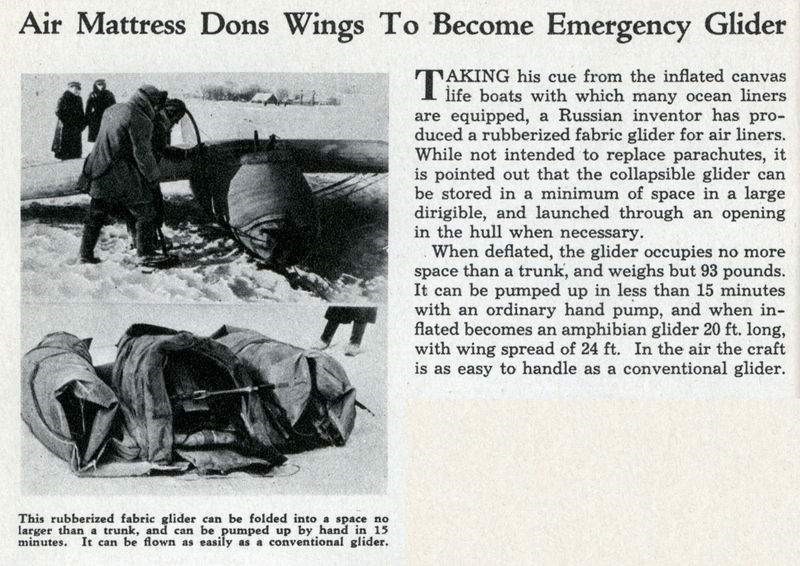
Given the lack of financing to continue the project, the glider was transferred to the Moscow Aviation Institute (MAI) as a possible way for its development. Grokhovsky was hopeful that the young engineers would be interested in the development of this technology. Once in the MAI, the glider was deposited in a warehouse and remained there until it was decommissioned.
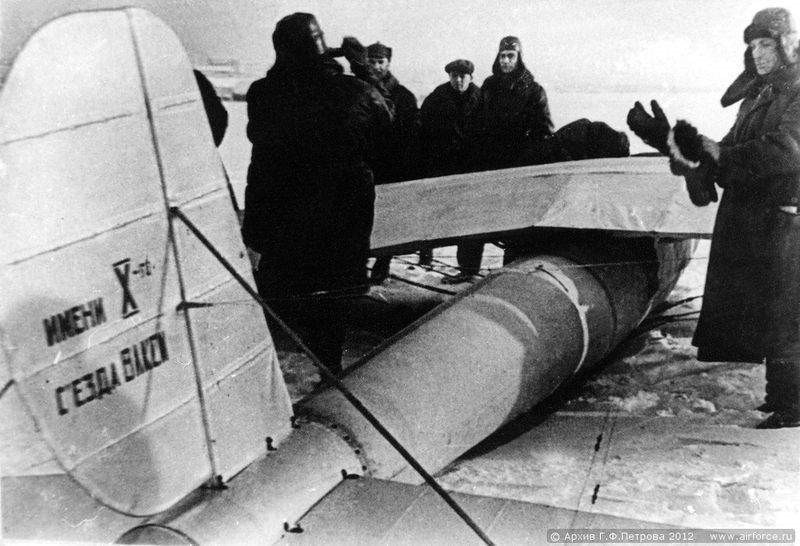
At the Grokhovsky Institute these works were continued. Under the direction of Ivan Titov, Grokhovsky’s replacement, the most developed of these gliders was created, the amphibious “X Congress of the VLKSM”.
It was a single-seater glider with a high-wing monoplane configuration. The fuselage at its rear was made up of a rigid tube to which the tail and landing pad were attached. Wooden controls were located in the cockpit.
The pilot sat on an inflated “pillow”. This version incorporated not only rubber, but wood and metal to the construction. Despite this, a high level of portability was achieved. The glider weighed only 77 kg and could be stored in a 1 x 1 x 0.5 meter bag
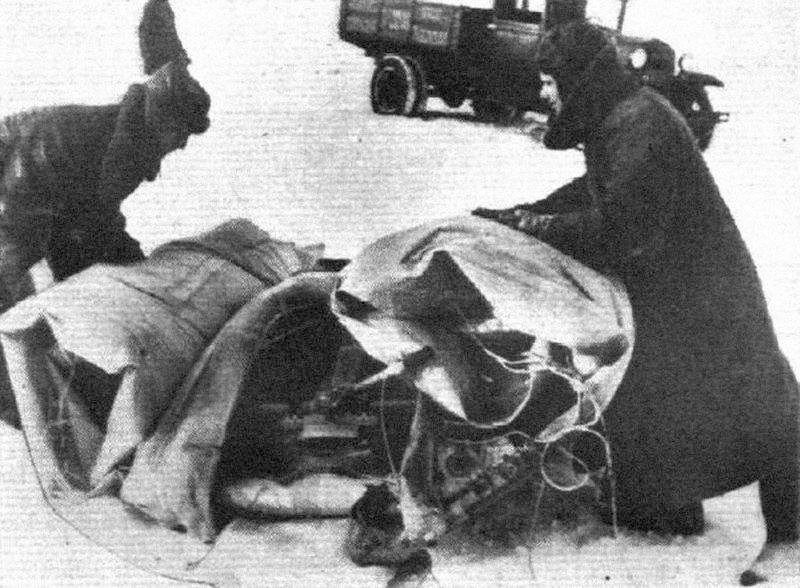
Preparation for the flight took about 20 minutes using a manually operated filling pump.
The construction was carried out in the factory “Krasni Triugolnik”, being ready for 1935. The “fuselage” was prepared to allow the glider to land both on land and on the water.
The first flight on this glider Grokhovsky wanted to carry out personally. The Leningradenses were able to observe how on a summer afternoon a motor boat advanced over the waters of the Neva River towing a glider that floated touching the water with its wings. As speed increased the wings began to rise and soon the glider rose slightly above the water. Bridges over the river prevented the flight from being long, but the objective had been achieved.
The tests were continued by Factory No.47 pilot Georgi Shmith. During the tests, carried out at the Leningrad Flying Club, the glider was towed by a Polikarpov U-2 aircraft at a height of 60 – 100 meters. After being released, it remained in flight, traveling about 1 kilometer before landing. Other successful tests were carried out.
With these results Grojovsky began to think about the possibility of making an inflatable plane.
Grokhovsky, Pavel Ignatievich
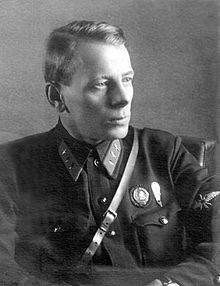
Pavel Ignatievich Grokhovski (in Russian: Павел Игнатьевич Гроховский) was born in March 6, 1899 in Viasma, Smolensk.
His childhood was spent in Tver, where he completed the first four grades of primary education, later entering the Royal College of this city. At the age of 15 Grokhovsky left his studies and his home, traveling to Moscow, where he worked as a messenger for a pharmacy. In those years he frequently visited the Jodynka airfield where Russian aviation pioneers Dokuchayev, Gaber-Vlynski, Lerche held exhibitions, falling in love with aviation.
In 1917 he voluntarily joined a group of revolutionary sailors in Revel (Tallinn), participating in the October uprising. He participated in the Civil War as a sailor on the battle ship “Petropavlovsk”, in the Baltic Fleet. He participated in ground operations under the leadership of IKKoshinov and PEDybenko. Later he fought against the Germans in Ukraine; against Kolchak, Denikin and the White Forces and against the English intervening forces.
In 1919 he joined the Communist Party of the USSR and two years later he was appointed Commissioner of the Black and Azov Seas.
In 1922 he entered flight courses. He studied initially at the Yegorevsk Theoretical School and then at the Borisoglevsk Flight School. In 1925 he finished the Kacha Military Aviation School, becoming a pilot.
His first inventions related to aviation were developed by Grokhovsky in 1927, when he served as a military pilot in the 44th squadron at Novocherkass. In those years bomber training was done with concrete bombs.
Grokhovsky proposed to replace them with clay bombs filled with chalk of different colors. This not only made the teaching process cheaper, but it was very easy to analyze the results of the training since each crew was assigned a color that was scattered at the site of the fall of the artifact.
From 1929 he began to work as a test pilot at the VVS Scientific-Research Institute (NII VVS). In those years, the idea of parachute landing was beginning to develop.
In 1929 Grokhovsky made his first parachute jump.
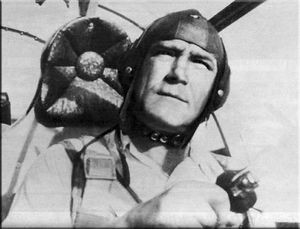
The first Soviet parachutists used the American Irvin system. Each parachute cost about 1,000 gold rubles. Grokhovsky proposed to sew the domes using cheap calico. To demonstrate the possibility of use, Grokhovsky himself and his collaborators performed demonstration jumps.
To study the possibilities of the new idea, the Oskonbyuró (Special Construction Bureau) of the VVS RKKA was created in 1932, dedicated to the development of skydiving and air landing techniques. Grokhovsky was appointed chief and chief builder.
Grokhovsky dreamed of a plane specialized in the transport of paratroopers. His conception would be embodied in the G-37, an aircraft built in the form of a structure with a high fixed landing gear to which a ventral container with landing troops could be attached. This cockpit could be released in flight and fell to the ground with a large parachute 40 meters in diameter.
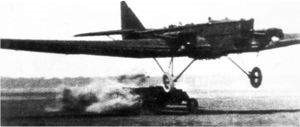
One of Grokhovsky’s novel inventions was his “Aviabus”, a system for launching charges and people from the air without using a parachute. The “Aviabus” was in the form of a flat container in the shape of a short, thick wing, which featured a two-wheel train with rubber cushioning on its bow and a skid on the tail. After launching from a height of 12 – 15 meters above the ground, the “Aviabus” performed a slight glide and when it touched the ground it kept rolling until it lost inertia. With this invention, Grokhovsky was able to considerably reduce the length of stay of the transporter aircraft in the landing area and the problems associated with take-off.
“Aviabus” projects were designed with different capacities and with wheel or ski landing gear. “Aviabus” were developed for land and water landings and even more innovative projects such as a motorized sled, which once launched from the mother plane could start its engine and fulfill its military task as an artillery troop transport. One of the variants was also the “avio-tanqueta”, an armored “Aviabus” with a train of mats and its own engine.
In 1932 the G-63 glider made its appearance. For the first time a glider of such dimensions was built, capable of lifting and transporting 16 soldiers, who travelled lying inside the thick wing. There was also a capacity to transport 500 kg of cargo.
When his organization became an Institute, Grokhovsky had the opportunity to expand his work to the design and construction of airplanes. Between 1934 and 1936, the institute designed and built 5 experimental aircraft models. Grokhovsky generally designed the schematic of the new plane and its development was entrusted to one of his subordinates.
PI Grokhovsky was transferred to a bureaucratic assignment at the Central Council of the Union of Defense Assistance Societies and Aviation-Chemical Construction of the USSR (OSOVIAJIM). The 5 of November 1942 was finally arrested by infundades accusations and ended up dying in prison. The “official” records this death on 2 October 1946 due to tuberculosis.
In 1957, Grokhovsky’s case was presented to the court of the Moscow military region, which completely cleared him due to the lack of evidence that showed involvement in the accusations.
Pavel Ignatievich Grokhovsky was responsible for more than 100 innovations and experimental creations, generally very advanced for his time. He proposed dive bombing long before they began to be used in a massive way, refuelling in the air, the use of the swept wing, the ekranoplanes. Many of these ideas were widely disseminated in later years. Grokhovsky was an exceptional man. His meager education was supplemented by a rare innate instuction. His acquaintances valued him as reckless and audacious, and at times he was irresponsible. Piloting a plane, he performed the acrobatic figures almost at ground level, he always drove the vehicles at high speed, personally tested his most dangerous creations.
Order of Lenin (1933)
Master of the Sport of Skydiving (1934)
Productions related to aeronautics
G-26
Experimental interceptor fighter developed between 1935 and 1936. It was unleashed by the use of a bicycle-type undercarriage with skids under the wings. The prototype was destroyed before its completion.
G-31
Glider from 1933 with capacity for 16 equipped soldiers obtained as an improvement of the previous G-63. Two were produced which were also tested in a motorized version with different powerplants.
G-37
Troop transport plane conceived in 1934 and characterized by its double fuselage and a large light from the ground to be able to transport a launchable container with landing troops under the belly. The container was launched from the air, descending with the help of a parachute.
G-38
Multifunctional combat aircraft known as “Light Cruiser” or LK-2. Developed in parallel with the G-26, the prototype would also be destroyed, when its construction had not yet been completed.
G-39 “Cucaracha”
1939 experimental fighter with arrow wings and tailless configuration.
G-52
“Flying battery” conceived on the basis of a heavily armed Túpolev TB-3 bomber with 76 mm field guns.
G-61
Modification of a Polikarpov R-5 reconnaissance aircraft with cassettes for landing troops located under the wings. Several prototypes were developed, which were successfully tested in 1936. In 1937 two of the civilian version Polikarpov P-5 would be used in an attempt to save Levanevski’s crew
G-63
Initial prototype of the G-31 landing glider. It was destroyed during testing.
Inflatable gliders
The Grokhovsky Institute developed three models of inflatable gliders that were successfully tested between 1934 and 1935.

