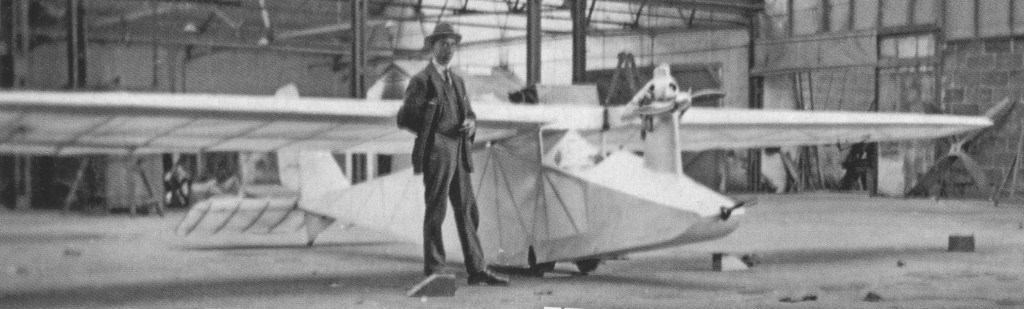
In 1923, the HP.22/23 motor glider was designed by W.H.Sayers, three were entered for the Lympne light aeroplane competitions of that year. The first, No.23, was initially powered by a pylon mounted air cooled 397cc ABC flat twin. It failed to fly, even when repowered with a 500 cc Douglas. Attempted catapult launches by four men pulling a rubber cord also failed and No.23 was scratched from the competition.
In 1921 the United States Navy drew up a specification for a single-seat fighter aircraft capable of operating either as a landplane from its aircraft carriers or from the water as a seaplane, seeking designs from both American and European companies. The British aircraft manufacturer Handley Page, which had recently developed the leading edge slot, realised use of slots and flaps could allow a high-speed monoplane to fly at the low speeds needed for carrier operations with a much higher wing loading than a normal biplane, and decided to develop an aircraft to meet this requirement.
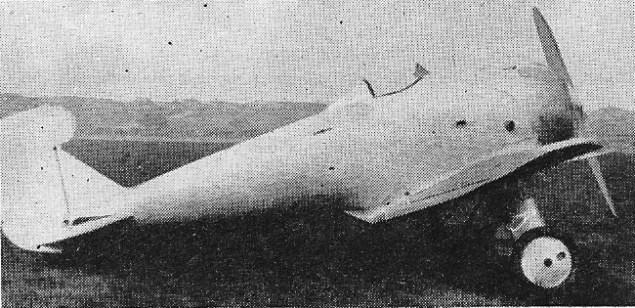
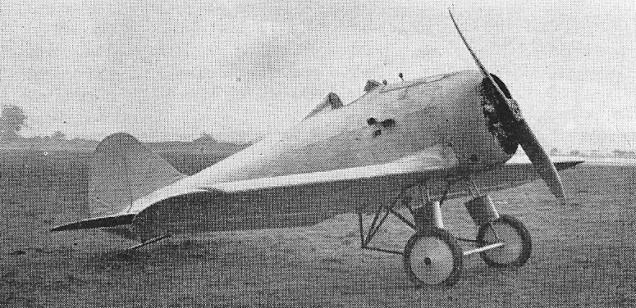
The resulting design, given the Handley Page designation Type S (and later retrospectively known as the H.P.21) was a small, low-wing cantilever monoplane, with full-span leading edge slots and full-span slotted flaps. The airframe was a plywood monocoque, with the fuselage capable of being broken into two sections for storage on board ship. It had a tailwheel undercarriage that could be replaced by two floats. Although designed to use engines of up to 400 hp (298 kW), the prototypes were fitted with a much less powerful surplus Bentley BR2 rotary engine.
The US Navy placed an order for three prototypes, designated HPS-1 (Handley Page Scout) in the contemporary US Navy designation system. The first prototype flew on 7 September 1923, but proved to have poor handling, with the rudder proving to be ineffective. The second prototype was built with its wings fitted with six degrees of dihedral, flying in February 1924. It had much improved handling, and showed good speed at low level. However, when undergoing full load trials for the US Navy at Martlesham Heath, it was wrecked when its undercarriage collapsed on landing, and the US Navy cancelled the contract, with the third prototype, intended to be a floatplane, not completed.
Powerplant: 1 × Bentley BR2, 230 hp (170 kW) Propeller 2-bladed fixed-pitch Wingspan: 29 ft 3 in (8.92 m) Wing area: 114.5 sq ft (10.64 m2) Length: 21 ft 5.5 in (6.541 m) Height: 9 ft 7 in (2.92 m) Empty weight: 1,320 lb (599 kg) Max takeoff weight: 2,030 lb (921 kg) Maximum speed: 146.5 mph (235.8 km/h, 127.3 kn) Stall speed: 44 mph (71 km/h, 38 kn) Endurance: 3 hours Service ceiling: 21,000 ft (6,400 m) Rate of climb: 1,800 ft/min (9.1 m/s) Crew: 1 Armament: Provision for 2× .30 in (7.62 mm) Marlin machine guns
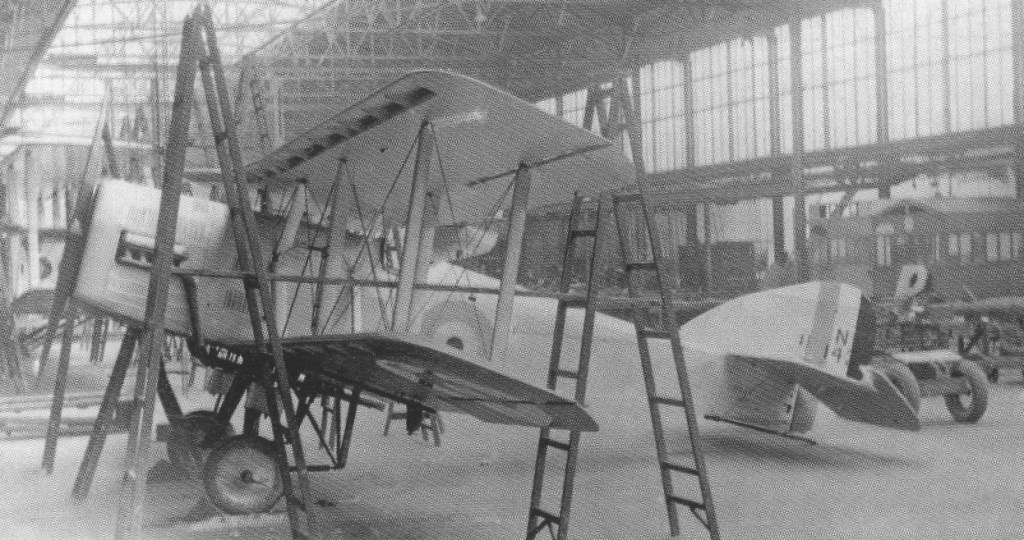
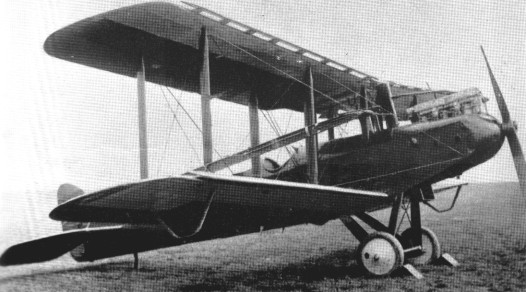
In response to specification 3/20 for a single seat deck landing torpedo carrier Handley Page built the HP.19 Hanley. The all wood Hanley had folding wings with full span leading edge slats and a divided undercarriage to fit a torpedo. Three were powered by a 450 hp Napier Lion IIB, the first, N143, first flew on 3 January 1922. Despite extensive modification trying to improve performance, the type did not enter production. Two, one prototype and one new airframe were supplied to Russia.
Wing leading-edge slots, per¬fected by Sir Frederick Handley Page and Dr. G. V. Lachmann in 1919, were first flown on the H.P.17, a modified D.H.9. By controlling airflow over the wing and so enabling aircraft to fly very slowly under perfect control, they ended the danger of the stall-and-spin type of crash.
Following its initial services into Europe with modified O/400 bombers shortly after the first World War, Handley Page Transport operated a series of two and three-engined developments of the bomber, designated W8, W9 and W10.
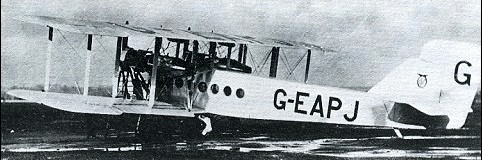
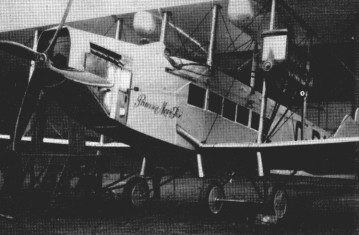
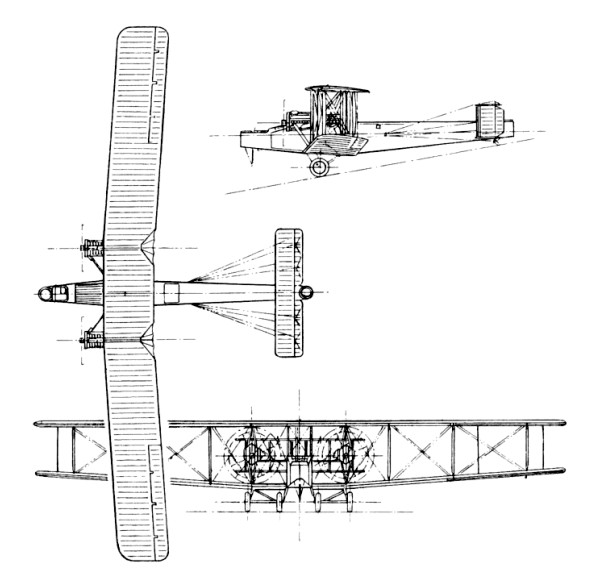
First flown on 2 December 1919 the W.8 had twelve passenger seats in two rows in a glazed cabin, while the pilot and co-pilot sat in an open cockpit in the nose of the fuselage. Powered was 335kW Napier Lion IB engines. The Handley Page W.8B (three of which were originally operated by Handley Page Transport and then from 1924 by Imperial Airways on its London-Paris service) was a refinement of the original W.8. The W.8Bs each had two 268kW Rolls-Royce Eagle VIII engines. The last W.8B was retired in 1932. A trio of W8bs named Princes Mary, Prince George and Prince Henry, started a London Paris service in May 1922.
In addition to the British-operated W.8Bs, one was built and exported to Belgium, where SABCA licence-built three more for Sabena. Handley Page also delivered a single example of the W.8E, with two 171kW Siddeley Puma and one nose-mounted 268kW Rolls-Royce Eagle IX engines. Eight were subsequently licence-built in Belgium. The final new W.8 version, the W.8F Hamilton, was similar to the W.8E and had been designed to be used in the Belgian Congo. Practically a standard W.8B, the nose of the fuselage ahead of the cabin was considerably modified. One of these machines in 1925 completed a flight from Brussels to the Belgian Congo, a distance of 11,000km, piloted by Lt Thieffry, of the Belgian Army, accompanied by Mecanicien De Bruycker. Imperial Airways received only one W.8F
W.8f Hamilton
The HP.24 Hyderabad was a military derivative.
Following its initial services into Europe with modified O/400 bombers shortly after the first World War, Handley Page Transport operated a series of two and three-engined developments of the bomber, designated W8, W9 and W10.
Imperial Airways received one W.9A Hampstead and four W.10s (the last retired in 1933). The Hampstead was powered by three 287kW Siddeley Jaguar and then 335kW Bristol Jupiter VI engines and had a 5.31m long, 1.35m wide and 1.78m high passenger cabin for 14 persons.
The W.10s each had two 335 kW Napier Lion IIB engines and featured a new type of rudder, fitted with a balance of the inset-hinge type, instead of the earlier horn-balance arrangement. The W.10 featured an entirely metallic structure for the engine mountings, replacing the usual wooden bearers.
Imperial Airways received W.10s (the last retired in 1933).
W8b Engines: 2 x Rolls Royce Eagle VIII, 360 hp Props: 10 ft 6 in (3.20 m) 4 blade. Wing span: 75 ft. (22.86 m). Length: 60 ft.1 in (18.31 m). Wing area: 1456 sq ft (135.26sq.m). Gross wt: 12500 lb (5,670 kg). Max speed: 104 mph (167 km/h). Range: approx 500 miles (800 km). Crew: 2. Pax cap: 12.
W.9a Hampstead Engine: 3 x Siddeley Jaguar, 287kW Max take-off weight: 6577 kg / 14500 lb Empty weight: 3794 kg / 8364 lb Wingspan: 24.08 m / 79 ft 0 in Length: 18.39 m / 60 ft 4 in Wing area: 145.30 sq.m / 1563.99 sq ft Max. speed: 183 km/h / 114 mph Ceiling: 4115 m / 13500 ft Range: 644 km / 400 miles
Chief designer George Volkert designed the even bigger four-engined V/1500, but the Armistice was signed before it became operational.
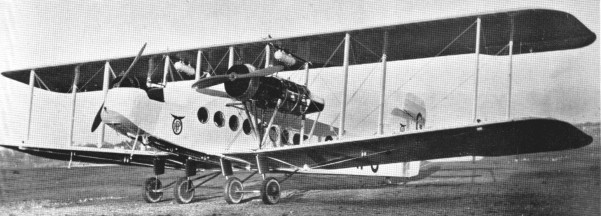
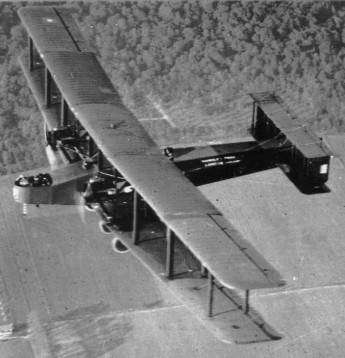
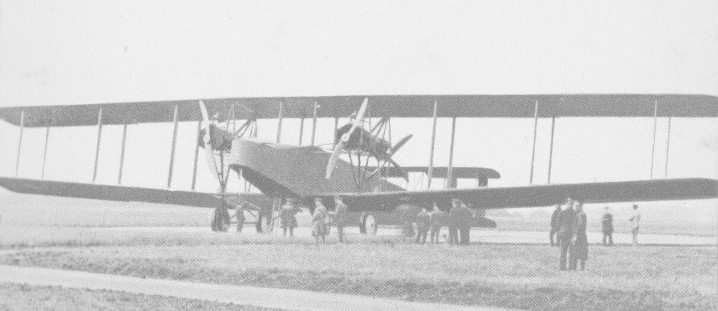
The V/1500 was of conventional construction. The 64ft 4in long fuselage was mainly of silver spruce, with ash cross¬ beams strengthening the bomb bay. The folding wings were also of spruce with cross bracing tie rods and, except for the plywood sheathed nose section contain¬ing the open cockpit, the aeroplane was fabric covered. The four engines installed in tandem pairs in mid gap were 12 cylinder 375 hp geared Rolls Royce Eagle VIIIs. The tractor units turned 13ft 5in ¬diameter two bladed propellers, and the pushers drove four bladers of 10ft 4in diameter.
Ordered as an experimental bomber in the summer of 1917, the V/1500 was envisaged bombing Berlin from bases in England and was designed to carry five tons of crew and disposable load. The Armistice intervened before the weather was sufficiently favourable for the three machines delivered to fly to the German capital. Power for each aircraft was provided by four 279.5kW Rolls-Royce Eagle VIIIs mounted in tandem pairs. To accelerate its introduction to RAF ser¬vice, production was ordered in January 1918, ahead of first flight, although the V/1500 took to the air for the first time on 22 May 1918, only nine months after definitive design had begun. The first prototype did crash in April that year.
At 126 ft it had the longest wingspan of any bomber the RAF would operate, but the type was too late to see service before the war ended. Nevertheless, with an endurance of 17hr it was ideally suited to long range flights, and its four engines, mounted between the upper and lower mainplanes as tractor/pusher pairs, gave it at least some measure of redundancy.
In October 1918, the Independent Force received its first bombers, each planned to drop 7,500 lb of bombs on the German capital. A Flight was formed at Bircham Newton and received its three machines early in November, just prior to the end of hostilities.
255 aircraft were ordered, but only three were operational with No.166 Squadron at the time of World War l’s end, and only about 32 were completed by the parent company, Beardmore in Scotland and Harland and Wolff in Northern Ireland. The first long flight of a V/1500 was from England to India in 1919, which included one stretch of 1,285km over water and another non-stop stage of 1,610km from Cairo to Baghdad. Flown to India by Lt. ‘Jock’ Halley, DFC, AFC, the smallest pilot in the RAF in charge of the biggest aeroplane in the world. With him went Brig.-General McEwan.
In spite of fears that it might not get over the Pathan Hills with a bomb load, Halley bombed Kabul, blowing out the walls of the Emir’s Zenana.
Only three squadrons (Nos 166, 167 and 274) ever received the type, which made some long-distance flights including the bombing of Kabul in 1919 from bases in India. The type disappeared from service in the early 1920s when it was appreciated that the smaller Vimy could undertake the same basic role at lower manpower and operating costs.
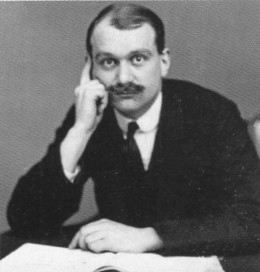
Born at Cranham Villa, Kings Road, Cheltenham, Gloucestershire, on November 15, 1885, Frederick Handley was the second son of Frederick Joseph Page and his Wife Arm Eliza, nee Handley. He always used the combination of “Handley Page”. A Cheltenham Grammar School report of 1896 placed him first in his class of 13 boys. He then studied electrical engineering at Finsbury Technical College, and in 1906 became chief designer for electrical machinery manufacturers Johnson & Phillips.
Already interested in mechanical flight, Frederick began experimenting with model gliders and ornithopters, eventually being invited to assist Maj R.F. Moore ,on the “Wings Committee” of the Aeronautical Society of Great Britain (ASGB). In 1908 he was introduced to landscape artist Jose Weiss, who had patented a wing of distinctive shape, but Weiss was no engineer, so his gliders were rather crude. On June 10, 1908, FHP joined the Weiss Aeroplane & Launcher Syndicate. While still at Johnson & Phillips he instituted some unauthorised aeronautical work using the factory track, but his employers took a dim view of this and dismissed him. Undeterred, FHP set up an office in a shed in Woolwich, even taking a stand at the Olympia Aero & Motor Boat Show in 1909, featuring the Weiss gliders and his own canard glider, of better construction but having the Weiss patent wing. He attempted to fly this from marshlands near Barking Creek, Dagenham, but without success. He was also manufacturing Weiss propellers and supplying small parts to budding aeronautical engineers and experimenters.
Frederick floated his new business as a private company on June 17, 1909, registering “Handley Page Ltd” for the express purpose of the design and manufacture of aircraft at Berking Creek, Essex. He always claimed that his was the first such company in the UK, but by this time Short Bros was well established as an aeroplane manufacturer. However, Short Bros was a partnership, not a company.
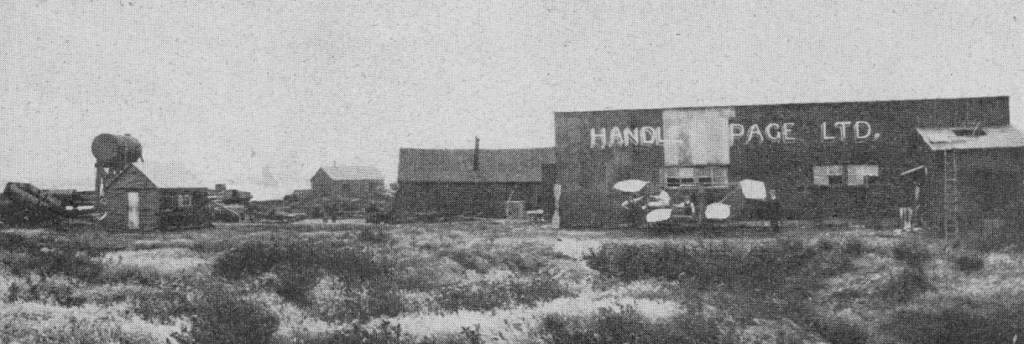
The first Handley Page factory were some wooden huts on the banks of the Thames at Barking, operating from 1909 to 1912. The company’s aerodrome was a playing field at Fairlop.
Handley Page factory 1911
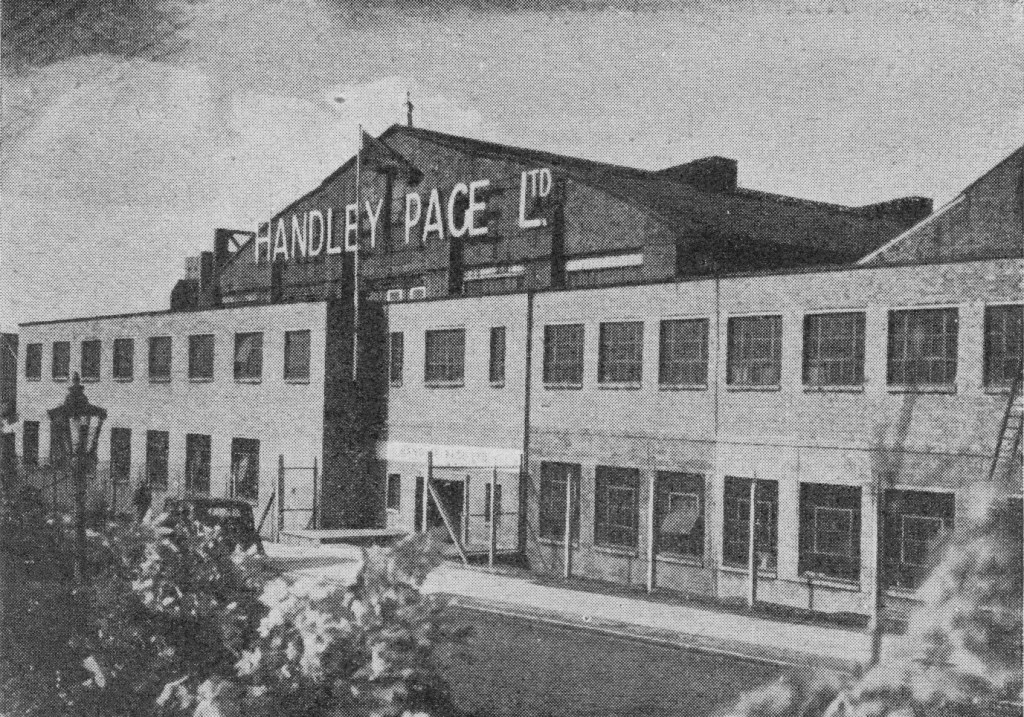
In September 1912, the H.P. works moved to 20,000 sq.ft of converted riding stables in Cricklewood, north London.
Handley Page Cricklewood 1949
From Cricklewood, final assembly and flying was done from Radlett.
Until the start of the First World War the young company built very few aircraft.
As soon as civil aviation was permitted after the war’s end, FHP formed his own airline, using converted O/400 bombers and flying to France and the Netherlands. It was taken over by Imperial Airways in 1924. He also exported six aircraft to China. A big coup was his acquisition, using a company called the Aircraft Disposal Co Ltd, of some 10,000 government surplus military airframes, 30,000 engines and a huge amount of stores, in 1920. At the end of World War One orders and military work ceased abruptly. FHP weathered the ensuing lean years remarkably well, with a minimal staff. Volkert and his assistant, S.T.A. Richards, produced an inspired series of designs comprising different fuselages combined with a standard set of biplane wings and tail. This was the “W” series of airliners and bombers, built throughout the decade. They also introduced air-cooled engines and metal structures. 24 October 1919 Patent No 157567 is issued for the HP slotted wing.
During the rearmament programme of the mid-1930s the company developed modern monoplane wings for its stopgap Harrow aircraft, and also started designing for dispersed production of components with final “flowline” assembly. The H.R 52 Hampden medium bomber continued this principle, and was the first H.R aircraft to have a retractable undercarriage. Two-thirds of the Hampdens produced were built by other firms. Despite his strong and prescient urging for a change in bombing policy, from large bombers with heavy and draggy defensive armament to smaller unarmed bombers relying on high speed, Volkert designed the Halifax to an Air Ministry specification. Neither the span limitation of less than 100 ft nor the use of watercooled engines were to his liking, and only when Bristol Hercules engines and increased span were introduced in 1942-43 did the aircraft became competitive with the Avro Lancaster. Nevertheless, the “Halibag” proved capable of operation in all theatres, particularly the Far East. The parent firm built only 1,590 of the 6,177 produced, the rest being made in “shadow” factories.
Handley Page (Reading) Ltd was formed on 5 July 1948 to take over Miles Aircraft Ltd of Woodley for production of Marathon four-engined feederliner aircraft.
Handley Page (Reading) produced the aircraft as a navigational trainer for the RAF, and also as a short-haul airliner. The Reading-based company was also responsible for development of the HPR.3 Herald airliner, which flew initially with four piston engines in 1955, and was subsequently manufactured with two Rolls-Royce turbines as the Dart Herald.
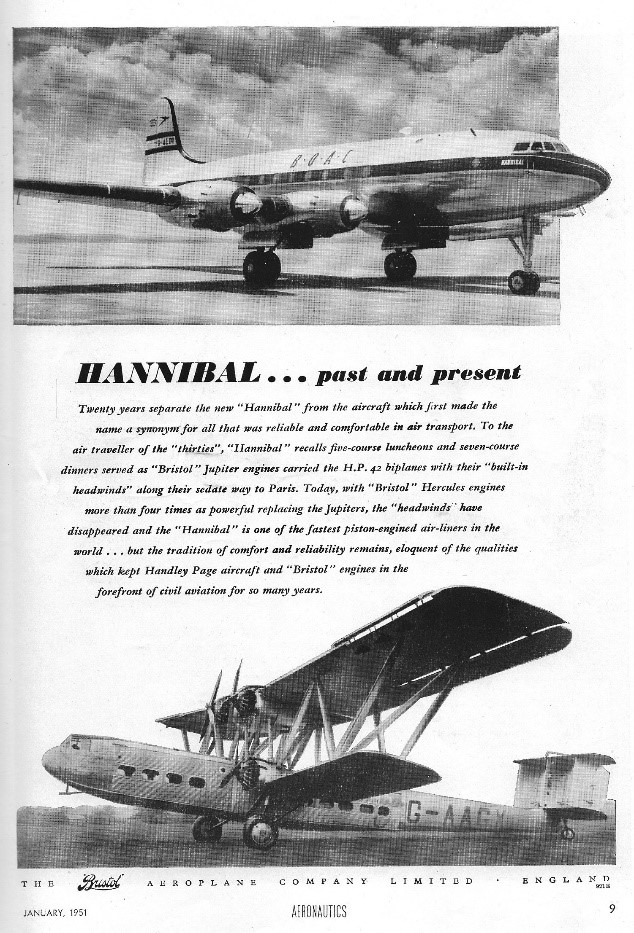
January 1951
Sir Frederick died on April 21, 1962
The Handley Page company had completed the move of its headquarters from Cricklewood to its aerodrome at Radlett by 1966. It had facilities at Radlett and at Cricklewood for the manufacture and assembly of major components and the erection of complete aircraft. Total floor space available to the company was 971400 sq.ft and it employed some 4000 people.
Test facilities include a structural test rig for any specimen or structure up to 120 ft long by 70 ft wide and 26 ft high with a total applied load capacity of up to 400 tons; fatigue test equipment for 100 ton fluctuating load; water pressure tanks and a range of equipment for standard mechanical environmental, pneumatic and hydraulic tests, chemical and photoelastic analysis, metallography and radiography, and high- and low-speed wind tunnels. The aerodrome, which occupies more than 400 acres, has two paved runways, the longest being 6990 ft.
Directors of the Handley-Page company in 1966 were Air Chief Marshal Sir Walter Dawson, chairman; J. H. S. Green, managing director; C. F. Joy, chief designer; R. S. Stafford, technical director; G. C. D. Russell; S. L. Hastings; and E. Manley Walker. Senior executives are E. W. Pickston, general works manager; D. F Corbett, works manager at Radlett; K. Pratt chief engineer; E. P. Hessey, sales manager; J. Duthie, secretary; J. W. Allam, chief test pilot; and S. A. H. Scuffham, public relations manager.
The major sources of revenue of the company were aircraft sales, sub-contract manufacture, design and test facilities, aircraft overhaul, aviation equipment, domestic and industrial heating and ventilation equipment, food and chemical processing plant, and factory airconveyance installations. The factories were engaged on military contracts in connection with the conversion of Victor bombers, production and overhaul of the Herald, and the design and development of its new 8/18-seater HP137 Jetstream for which the first production line was being laid down in 1966. The company had sold 58 Heralds and was about to start production of more than 20 “off-the-drawing-board” Jetstream orders.
In 1966 feasibility and market studies revealed a definite market for a medium-sized turboprop mini-airliner for commuter and executive use. The H.P.137 Jetstrearn was launched, attracting nearly 200 orders and options in the first year. it even won the United States Air Force contest for the C- 10A transport. But it was a difficult aircraft for a firm used to large and expensive military designs, and development was prolonged. Its airworthiness category imposed a nominal limit in all-up weight which severely affected range/load performance. This was improved with the advent of higher-power engines and a change in category, which allowed take-off weight to rise to the level for which the Jetstream was designed. But it was too late. Development costs had risen to £13 million, and the backers pulled out; the company went into administration.
The death knell came on August 8,1969, when the company went into receivership. A reprieve seemed at hand when it was bought up by an American consortium, the K.R. Cravens Corporation, in January 1970 and rebranded Handley Page Aircraft Ltd. At the same time, however, the consortium’s head was diagnosed with terminal cancer and all foreign interests were dropped. By the end of February the company had ceased trading and on June 1, 1970, the name of Handley Page was consigned to history – after some six decades of aeronautical achievement.
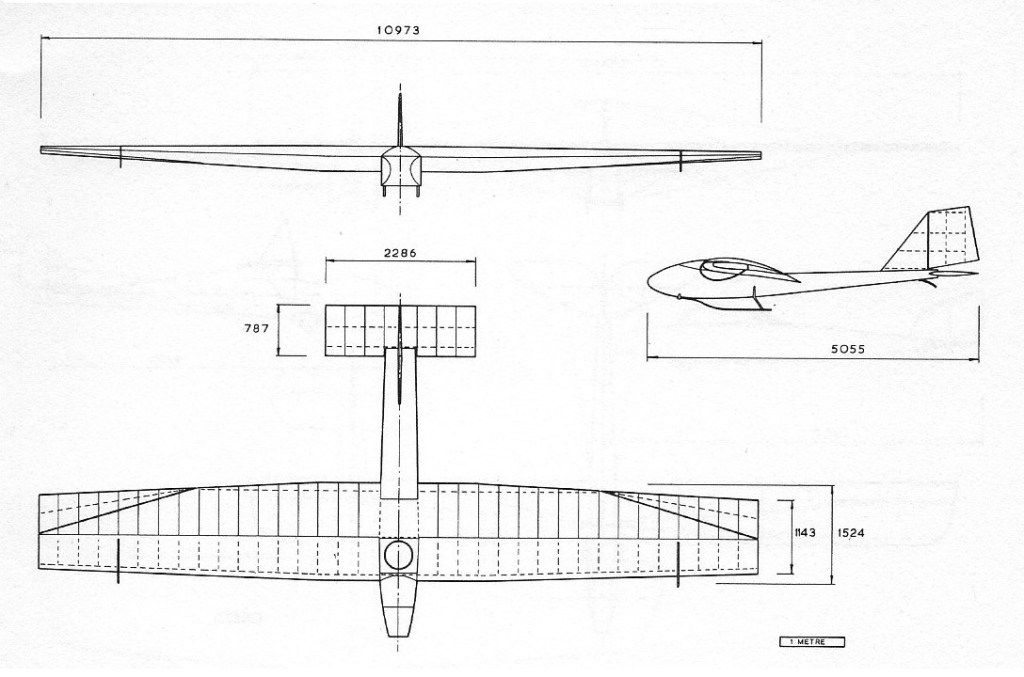
A single seat glider designed by G.A. Handasyde, F.P. Raynham and Sydney Camm, and was built for the Handasyde Aircraft Co by the Air Navigation Co, Addlestone, near Chertsey, Surrey, of wooden construction. Cantilever wing, Twin main skids + tail skid .
Flown by F.P. Raynham at the Itford 1922 competition who achieved the second longest time of 1 hr 53 min.
After the contest the glider was ditched into the sea at Torquay, Devon. During film work.
Wingspan: 10.97 m / 36 ft 0 in Length: 5.06 m / 16 ft 7 in Wing area: 14.59 sq.m / 157 sq.ft Aspect ratio: 8.3 Wing section: Gottingen 441 Empty weight: 72.58 kg / 160 lb AUW: 145.15 kg / 320 lb Wing loading: 10.05 kg/sq.m / 2.06 lb/sq.ft
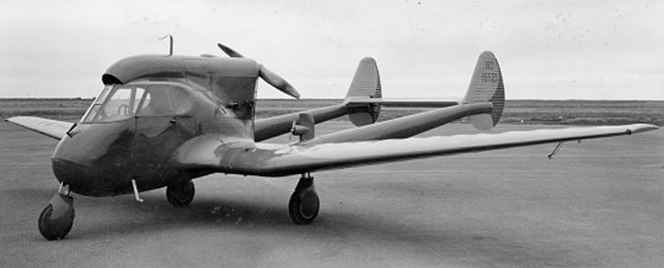
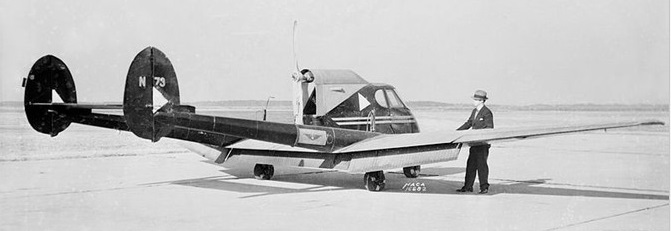
In 1934 the Bureau of Air Commerce held a competition for a safe and practical $700 aircraft. Dean Hammond designed the Hammond Model Y, a low-wing monoplane twin-boom pusher monoplane, aluminum and fabric cover. The aircraft had no rudder as such, the tailplane fins being adjustable but fixed in flight. Turning was by differential aileron and elevator alone.
In 1936 the winner of the competition was the Stearman-Hammond Y-1, incorporating many of the safety features of the Ercoupe W-1. Two other winners were the Waterman Aeroplane and the Autogiro Company of America AC-35.
Granted an Approved Type Certificate, Hammond cooperated with Lloyd Stearman to develop the type for production. They formed the Stearman-Hammond Aircraft Corporation in 1936 to build the aircraft as the Stearman-Hammond Y-1. The first aircraft was powered by a 125 hp (93 kW) Menasco C-4 piston engine driving a pusher propeller. The performance was not impressive so it was re-engined with a 150 hp (112 kW) Menasco C-4S and re-designated the Y-1S.
25 examples were ordered by the bureau at a price of $3190 each. The first delivery was considered unnacceptable in finish, prompting the production of the re-engineered Y-S model.
The Y-1-S was distinguished for its exceptional slow speed handling characteristics and two-control flight system with the intent that an experienced automobile driver would be able to solo with only an hour of flight instruction. A national demonstration tour generated interest but no buyers, as many preferred the simple lines and prices of other aircraft, and experienced pilots found the plane confusing to fly.
Two Y-1S, serial numbers 0908 and 0909, were used for radio controlled development trials by the United States Navy as the JH-1. A successful unmanned radio-controlled flight was made with a JH-1 drone on 23 December 1937 at the Coast Guard Air Station, Cape May, N.J. Takeoff and landing was controlled via a landbased radio set; for flight maneuvers, control was shifted to an airborne TG-2.
Tests with two Stearman-Hammond JH-1s were very secret at the time and little has been published about them. They were painted yellow, the standard for primary trainers, and classified as Utitlity (J) planes to hide their identity as one of the very first radio-controlled aircraft in the USN. Both planes were tested as unmanned drone targets for anti-aircraft fire, and both were assigned to Utility Squadron One (VJ-1). Rumors had it are that both were shot down, but there is no confirmation of this, and the aircraft history card for [0908] simply says “crashed 11/7/38,” and [0909] was stricken off on 9/13/38, according to a Confidential letter from the Officer in Charge of Radio-Controlled Aircraft, Base Force, Utility Wing. (— William T Larkins)
KLM purchased a Y-1 (PH-APY) for use in training their pilots in tricycle undercarriage. The Royal Air Force also evaluated the former KLM Y-1S in the 1940s.
Although designed to be easy to fly the high price meant only 20 aircraft were produced and work was abandoned in 1938.
The fourteenth Y-1-S built was donated to the National Air Museum in 1955 by Dean Hammond, after the ownership had been transferred by Ford Slagle in 1952. The Museum’s Stearman-Hammond, Waterman Aerobile, Stout Skycar, and Erco Ercoupe stand as testaments to the “flivver” movement of the 1930s.
Hammond Model Y Prototype for the 1934 Bureau of Air Commerce safe airplane competition.
Stearman-Hammond Y-1 Prototype aircraft with a 125hp (93kW) Menasco C-4 engine.
Stearman-Hammond Y-1S Production aircraft with a 150hp (112kW) Menasco C-4S engine.
JH-1 United States Navy designation for two Y-1S used for tests.
Specifications:
Y-1S Crew: 1 Capacity: 1 Length: 26 ft 11 in (8.20 m) Wingspan: 40 ft 0 in (12.19 m) Height: 7 ft 7 in (2.31 m) Empty weight: 1,400 lb (635 kg) Gross weight: 2,150 lb (975 kg) Powerplant: 1 × Menasco C-4S piston engine, 150 hp (110 kW) Maximum speed: 113 kn; 209 km/h (130 mph) at 3000 ft (915 m)
USA Formed 1931 to take over production of Ryan Speedster biplane from Detroit Aircraft Corporation. A prototype twin-boom two-seat lightplane, the Hammond Model Y, was built in 1934. Redesignated Stearman-Hammond Y-1S, it was produced in small numbers until 1938.