In 1928 Hartland Engine & Machine co built a 7-cylinder air-cooled radial aero engine, designed by Nick Rowinski, which produced 125hp.
Inter-Wars
Hartland Engine & Machine co
Hartland WI.
USA
1928 engine builder
Harlow PJC-2 / UC-80
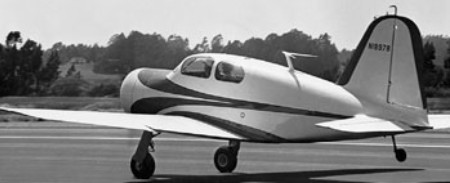
The Harlow Engineering Corp. of Alhambra, California, began production of the Harlow PJC-2 in 1938. In the following year, the company changed its name to the Harlow Aircraft Co. The Model PJC-2 was a fourseat cabin-monoplane of all metal construction and was fitted with retractable landing gear. The Harlow was under development for three years and submitted to over a year of flight testing before it was placed on the market. Production was continued in small numbers until 1941.
Seats 4.
Gross wt. 2,600 lb
Empty wt. 1,700 lb
Engine 145-hp Warner Super-Scarab seven-cylinder radial.
Top speed 150 mph
Cruise 135 mph
Landing speed 53 mph
Initial climb rate 660 fpm
Range 500 miles
Ceiling 15,500 ft
Harlow
Formed 1938 to develop the Harlow PJC-2 four-seat allmetal cabin monoplane, which remained in production until December 1941. Four were delivered to the USAAF as UC-80s. A PC-5A two-seat trainer version was developed in 1939 and assembled under license 1941-1942 by Hindustan Aeronautics Ltd. After America’s entry into Second World War, Harlow Engineering undertook military contract work.
Harkness Hornet
Don Harkness was the first Australian who designed and developed a type-approved aircraft engine. The engine was the Harkness Hornet, first built in 1928 and later installed in two locally built aircraft types, the Genair and the Wonga.
Hansen Baby Bullet
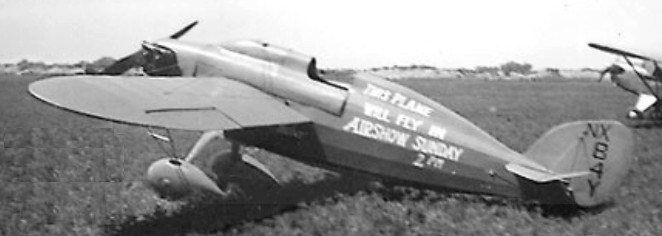
Three Hansen racers were built. The first a modified Heath Baby Bullet as Baby Bullet [11351]. The second, from a Heath 115, with 40hp Continental A-40 (span: 16’6″) as Baby Bullet II for 1932 Nationals [NR282W] (piloted by Art Davis and Walt Bagnick). The third as Baby Bullet III for 1934 Nationals [NR84Y] (piloted by Art Davis), and rebuilt in 1947 as Francis-Angell midget racer.
Baby Bullet I
Engine: Wright-Morehouse, 29hp
Wingspan: 20’0″
Seats: 1
Baby Bullet II
Engine: Continental A-40, 40hp
Wingspan: 16’6″
Seats: 1
Baby Bullet III
Seats: 1
Hansen, Perry D
Perry D Hansen, Lansing MI. USA.
Built the Hansen Baby Bullet in 1932
Hanriot H.220
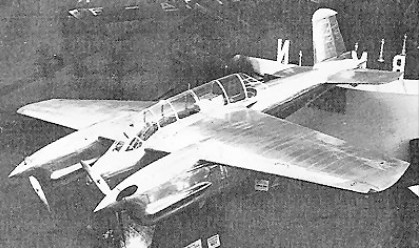
Included among exhibits at the Salon de l’Aeronautique held in Paris in November 1936 was a striking all-metal twin-engined three-seat fighter. It had a somewhat abbreviated oval-section monocoque fuselage, a shoulder-mounted semi-cantilever wing carrying split trailing-edge flaps over its entire span and two 450hp Renault 12Roi 12-cylinder inline air-cooled engines projecting ahead of the fuselage nose. This, the H.220, had been designed to a C3 requirement prepared by the Service Technique de l’Aeronautique and issued in October 1934. Other contenders were the Breguet 690, the Potez 630, the Loire-Nieuport 20 and the Romano 110. As it became evident that the H.220 would be underpowered, the Renault engines were discarded in favour of 680hp Gnome-Rhone 14M 14-cylinder radials, and, with these installed, the first flight test was made at Avord on 21 September 1937.
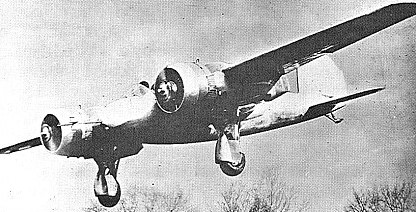
The intended armament of the H.220 comprised two forward-firing 20mm cannon and two aft-firing 7.5mm MAC 1934 machine guns on a flexible mounting, but, in the event, no armament was fitted. On 17 February 1938, the prototype made a forced landing at Avord after losing the starboard propeller following a failure in the reduction gearbox. The poor stability evinced during flight testing of the H.220 (which had resulted in progressive changes in the contours and size of the vertical surfaces), coupled with inadequate internal capacity and some lack of sturdiness revealed by the forced landing (as a result of which the fuselage was irreparable), dictated major redesign, resulting in the H.220-2.
After the partial destruction of the H.220, major redesign was initiated by the Societe Nationale de Constructions Aeronautiques du Centre, or SNCA du Centre, which had absorbed the Hanriot facility at Bourges on 1 February 1937. The oval-section monocoque fuselage of the original H.220 was discarded in favour of a fuselage built as two half shells mated by a central keel. An entirely new tail assembly with twin endplate vertical surfaces was fitted and the Gnome-Rhone 14M radial engines were enclosed by low-drag nacelles. These features were mated with the wing of the original H.220 to result in the H.220-2, which was first flown (as the H.220 No 02) on 17 March 1939. Four months later, in July 1939, this prototype was to be displayed statically as the NC 600 No 01 multi-seat fighter at the Salon de l’Aeronautique. In fact, the genuine NC 600 was to differ from the H.220-2 in several major respects.
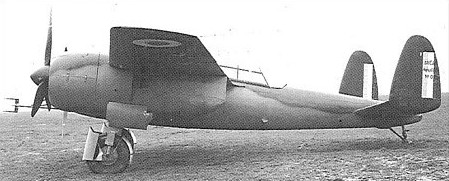
H.220
Max take-off weight: 3700 kg / 8157 lb
Empty weight: 2673 kg / 5893 lb
Wingspan: 12.80 m / 41 ft 12 in
Length: 7.87 m / 25 ft 10 in
Height: 3.40 m / 11 ft 2 in
Wing area: 21.16 sq.m / 227.76 sq ft
Max. speed: 520 km/h / 323 mph
Range: 850 km / 528 miles
H.220-2
Max take-off weight: 3850 kg / 8488 lb
Empty weight: 2820 kg / 6217 lb
Wingspan: 12.80 m / 41 ft 12 in
Length: 7.87 m / 25 ft 10 in
Height: 3.40 m / 11 ft 2 in
Wing area: 21.16 sq.m / 227.76 sq ft
Max. speed: 532 km/h / 331 mph
Range: 770 km / 478 miles
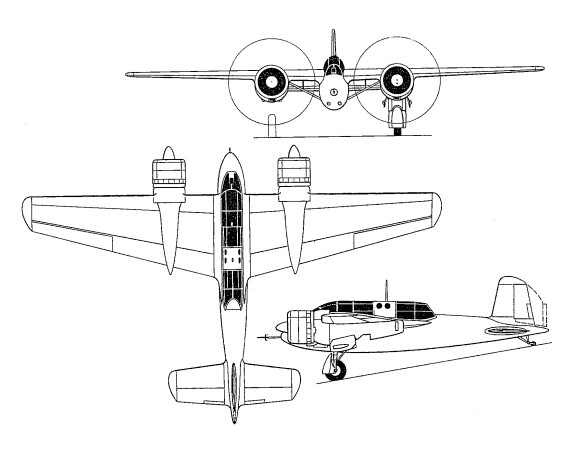
Hanriot H.170 / H.171 / H.172 / H.173 / H.174 / H.175 / H.180 / H.181 / H.182 / H183 / H.184 / H.185 / H.190 / H.191 / H.192 / H.195
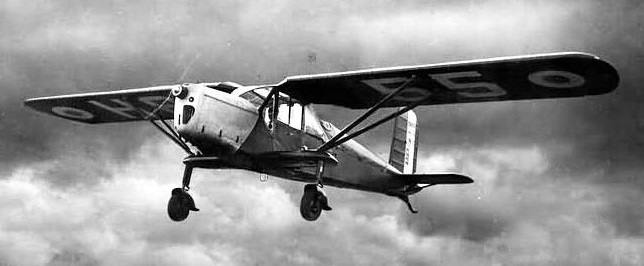
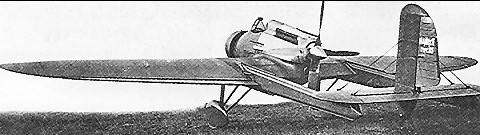
The Hanriot H.170, H.180, and H.190 were a family of light utility aircraft designed by Montlaur and produced in France in the 1930s. First flown in 1934 and all introduced in 1934, they appeared side-by-side at the Paris Air Show that year, the model numbers distinguishing between versions powered by Salmson, Renault, and Régnier engines respectively.
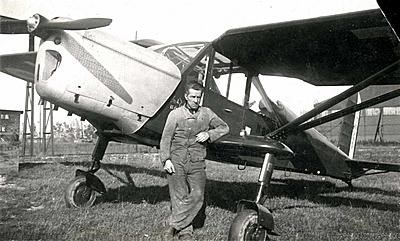
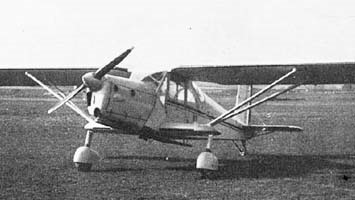
In basic construction, the different variants were otherwise almost identical, as largely conventional monoplanes with high, strut-braced wings and fixed, tailskid undercarriage. The pilot and one or two passengers sat in an extensively-glazed, enclosed cabin.
Although usually described as a monoplane, this family of aircraft all featured small, stub wings at the bottom of the fuselage. These carried the fuel tanks and served as a mounting point for the wing struts and undercarriage. An interesting feature was that the upper portion of the rear fuselage was a removable module, allowing it to be replaced with alternative modules for different roles, for example to carry a stretcher, or a second, open cockpit for pilot or gunnery training.
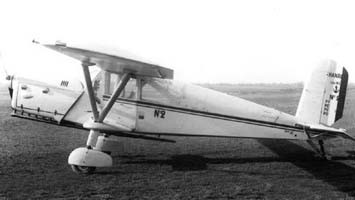
The H.182 was the major production version, accounting for 346 out of the total of 392 aircraft built. Most of these were produced as part of a government order for machines to equip the Cercles Aériens Régionaux reserve flying units, with 172 aircraft still operational at the Fall of France in 1940.
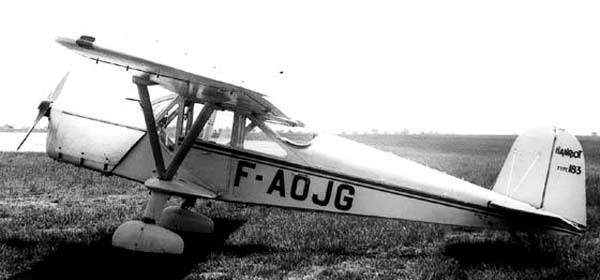
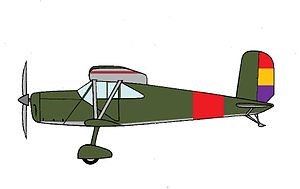
Ten more were purchased by the Second Spanish Republic for use in the Spanish Civil War, and 50 aircraft originally ordered by the French government were diverted to Turkey as part of a military aid agreement.
Variants:
H.170 – two-seat military observation version with Salmson 6Te engine (1 built)
H.171 – three-seat civil tourer version of H.170 (1 built)
H.172
H.172B – two-seat trainer (1 built)
H.172N – three-seat tourer (7 built)
H.173 – aerobatic trainer version (1 built)
H.174 – three-seat trainer (1 built)
H.175 – liaison aircraft for French Navy (10 built)
H.180
H.180T – three-seat tourer with Renault 4Pdi engine (1 built)
H.180M – two-seat military observation version with Renault 4Pei engine (1 built)
H.181 – air ambulance version of H.180T (1 built)
H.182 – main production version as trainer aircraft for French reserve aviation units.
H.183 – aerobatic trainer with Renault 438 engine (1 built)
H.184 – trainer version with uprated version of Renault 4Pei engine (1 built)
H.185 – two-seat liaison version for French navy (6 built)
H.190
H.190M – two-seat observation aircraft with Régnier 60-01 engine (1 built)
H.191 – three-seat tourer (1 built)
H.192
H.192B – two-seat trainer (1 built)
H.192N – two-seat civil trainer with Régnier 6Bo.1 engine (9 built)
H.195 – two-seat liaison aircraft with Régnier 6Bo.1 engine (1 built)
Operators:
French Air Force
French Navy
Spanish Republican Air Force
Turkish Air Force
Specifications:
H.182
Engine: 1 × Renault 4Pei, 104 kW (140 hp)
Wingspan: 12.00 m (39 ft 5 in)
Length: 7.22 m (23 ft 8 in)
Height: 3.15 m (10 ft 4 in)
Wing area: 19.0 m2 (204 ft2)
Empty weight: 604 kg (1,331 lb)
Gross weight: 887 kg (1,955 lb)
Maximum speed: 190 km/h (120 mph)
Range: 600 km (370 miles)
Service ceiling: 5,500 m (18,400 ft)
Crew: Two, pilot and instructor
Hanriot H.115
After its return to Hanriot’s Bourges factory, the H.110 was fitted with a redesigned fuselage nacelle and an uprated Hispano-Suiza 12Xbrs engine offering 690hp. A 33mm APX cannon was mounted in a bulged housing beneath the central nacelle and a four-bladed propeller supplanted the three-blader. With these modifications, the fighter re-emerged as the H.115 and was flown for the first time in April 1934. Further modifications were undertaken by the factory from November 1934, and, in June 1935, the H.115 was submitted to Villacoublay for official evaluation. Flight testing ended on 16 August. At this time it was concluded that, in view of its radical configuration, the H.115 was of no more than academic interest.
Max take-off weight: 1786 kg / 3937 lb
Empty weight: 1428 kg / 3148 lb
Wingspan: 13.50 m / 44 ft 3 in
Length: 7.60 m / 24 ft 11 in
Height: 2.69 m / 8 ft 10 in
Wing area: 24.00 sq.m / 258.33 sq ft
Max. speed: 390 km/h / 242 mph

