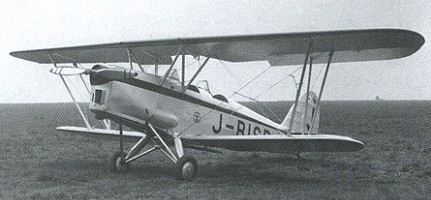
Itoh Emi 16 Fuji-go / Emi 18 / Emi 19 / Emi 20

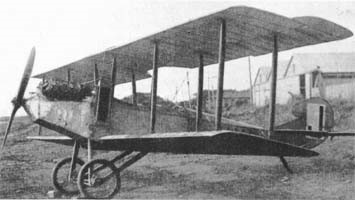
The Itoh Emi 16 Fuji-go (Fuji) designed by Tomotari Inagaki and built in 1920, was intended as a cheap and simple general purpose civil biplane but gained publicity with exhibition flights and successful speed and altitude contests against higher-powered fighter aircraft.

Though the Fuji-go was best known for its successes in speed contests, it was designed as a multi-purpose, economical civil aircraft, powered by a war-surplus Le Rhône rotary engine and with a cost kept low by structural simplicities such as wings without sweep or stagger.

It was a two-bay biplane with a wooden structure and fabric covering. Its wings had rectangular plans apart from blunted tips, braced together with pairs of parallel interplane struts. Behind the engine the fuselage was rectangular in section with two open cockpits, one under the upper wing and the other for the pilot under its trailing edge, which had a small cut-out to improve the upward field of view. The forward cockpit could carry a passenger or an extra fuel tank to increase the range.

The tail was conventional with a tailplane mounted on top of the fuselage carrying elevators with a cut-out for rudder movement. Both the small fin and generous balanced rudder had polyangular profiles.

The Fuji-go had fixed, conventional landing gear with wheels on an axle between pairs of V-struts mounted on the lower fuselage longerons and a long tailskid mounted below the fin leading edge.

Its first flight was on 22 July 1920.

The Fuji-go was soon into competitions, beginning with the First Prize-winning Flight Competition held in August. Flown by Yutichi Goto, it won first prize for altitude and came second in a speed race, covering a route between Funabashi and Chiba at 128 km/h (80 mph; 69 kn). It went on to perform publicity flights over Kyoto and Osaka. It also competed in the Imperial Flying Association’s Second Airmail Flying Contest which involved a race between Osaka and Kurume. Since several competitors had much more powerful engines it was decided to reduce drag by cropping the lower wings beyond the first bay, leaving a span of 7.04 m (23.1 ft). This increased the maximum speed by 21%. Goto and the Fuji-go came second, gaining an 8,000 yen prize and beaten only by a SPAD XIII fighter with a 220 hp (160 kW) engine.

After a period of further promotional flights the aircraft returned to competition in May in the 1921 Second Prize-winning Flight Competition. It was flown into third place by Komayoshi Yasuoka.

One Emi 18 was built in 1921 powered by a 120 hp (89 kW) Clerget nine-cylinder rotary engine. The wing area was greater and airframe was shorter than the original.

The 1921 Emi 19 was the same as the Emi 18 but powered by a 120 hp (89 kW) Turrin nine-cylinder rotary engine.

The 1921 Emi 20 had shorter span and length and was powered by an 80 hp (60 kW) Le Rhône rotary engine.
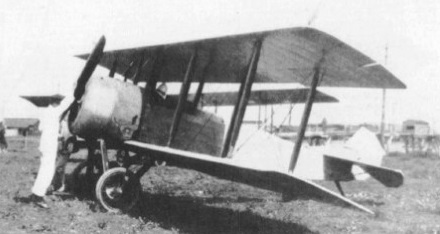
Itoh Emi 20 Oguri-go

Emi 16 Fuji-go
Powerplant: 1 × Le Rhône, 89 kW (120 hp)
Propeller: 2-blade
Wingspan: 9.34 m (30 ft 8 in)
Wing area: 23.5 m2 (253 sq ft)
Length: 6.05 m (19 ft 10 in)
Height: 2.52 m (8 ft 3 in)
Gross weight: 740 kg (1,631 lb)
Maximum speed: 167 km/h (104 mph, 90 kn)
Time to 1,000 m (3,300 ft): 3 min 30 s
Crew: One
Capacity: one passenger

Emi 18
Engine: 120 hp (89 kW) Clerget
Span: 9.50 m (31.2 ft

Emi 19
Engine: 120 hp (89 kW) Turrin
Span: 9.34 m (30.6 ft)

Emi 20
Engine: 80 hp (60 kW) Le Rhône
Span: 9.0 m (29.5 ft)
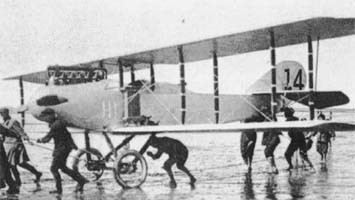
Itoh Emi 14

Stimulated by 1920 reports of flights from Italy to Japan the Imperial Flying Association launched a long-distance contest for Japanese aircraft with a non-stop return trip from Tokyo to Osaka and back, a distance of just over 1,000 km (620 mi; 540 nmi). Four companies prepared designs but only the Nakajama Type 7 and the Itoh Emi 14 were ready when the race was due.

For many early, long-distance flights the main design challenge was to ensure the aircraft, heavily loaded with fuel, could become airborne in the distance available. At Susaki the runway was only 600 m (2,000 ft) long, so Tomotari Inagaki gave the wings an aspect ratio of eight, at the time unusually high, to minimize induced drag. Otherwise the Emi 14 was a conventional two bay biplane with rectangular plan wings braced together with pairs of vertical, parallel interplane struts. Two parallel pairs of short cabane struts braced the central upper wing to the upper fuselage longerons. The Emi 14, like some other Itoh designs, had overhung ailerons, placed only on the upper wing.

The Emi 14 was powered by a 110 kW (150 hp) Gorham engine in a smoothly-tapered cowling but with its upper half exposed. Its flat, narrow, rectangular radiator was attached edge on and vertically just behind on the port side, where the engine cowling joined a flat-sided fuselage. It was originally designed with two open cockpits and flown from the rear seat, but for the long round trip the forward cockpit was used to hold extra fuel. There was a small, central trailing edge cut-out to improve the pilot’s upward field of view. The tailplane was mounted on top of the fuselage and the fin was triangular, with a rounded rudder.

Its fixed undercarriage was of the single axle type, mounted on V-struts from the lower fuselage longerons. During development the Emi 14 had a conventional tailskid but for the challenging contest flight takeoff the tail was raised on a wheeled dolly, dropped as the Emi 14 became airborne.

The date of the Emi 14’s first flight is not known but it was ready on 21 April 1920, the preset contest date. Both it and the Nakajama Type 7, piloted by Kintaro Iinuma, took off successfully and began the outward leg but Iinuma soon ran into thick fog, became lost and crashed into Mount Tanzawa. He was badly injured but survived. Toyotaro Yamagata, in the Emi 14, continued and completed the 1,013.67 km (629.87 mi; 547.34 nmi) circuit in 6 hr 43, an average speed of 151 km/h (94 mph). The flight was seen as a big step forward in Japan’s aeronautical progress. The Itoh Aeroplane Research Studio were awarded a 5000 yen prize and Yamagata received the same amount as a personal reward plus another 600 yen a month for three years, though he did not live to collect much of it.

There was one more competitive flight to come: on 2-3 August 1920 Yamagata flew the Emi 14 in another Imperial Flying Association contest, this time over a route between Funabashi and Chiba, about 16 km (9.9 mi; 8.6 nmi) apart. The Emi 14 won the speed first prize at 137 km/h (74 kn; 85 mph) and the altitude second prize with 3,375 m (11,073 ft). Together these prizes were worth 8000 yen.

At the end of August Yamagata was practising loops for an upcoming display when a wing detached, killing him. No more Emi 14s were built.

Powerplant: 1 × Gorham, 110 kW (150 hp)
Propeller: 2-bladed
Wingspan: 11 m (36 ft 1 in)
Wing area: 32 m2 (340 sq ft)
Aspect ratio: 8
Airfoil: U.S.A.-1
Length: 7.17 m (23 ft 6 in)
Height: 2.74 m (9 ft 0 in)
Empty weight: 760 kg (1,676 lb)
Gross weight: 1,150 kg (2,535 lb)
Maximum speed: 146 km/h (91 mph, 79 kn)
Endurance: 8 hr
Time to 1,000 m (3,300 ft): 4 min 30 s
Cruise: 115 km/h
Crew: one or two, according to flight

Itoh Emi 13

From mid-1919 Otojiro Itoh’s flying school at Itoh Airfield at Tsudanuma had relied heavily on the Itoh Emi 9, its only two-seat trainer. Its designer, Tomotari Inagaki, had already designed a similar but improved successor, powered by the same Hall-Scott V-8 engine. This, the Emi 13, was built between the summer of 1919 and the following spring.

The Emi 13 was a wooden-framed, fabric covered two bay biplane with pairs of parallel interplane struts. Its wings were rectangular in plan, with overhung ailerons only on the upper wing. Tall, outward-leaning cabane struts braced the wing over the fuselage, where there was a broad trailing edge cut-out to increase the field of view from the rear seat. The lower wings were mounted on the lower fuselage longeron.

Its V-8 engine was nose-mounted with its upper parts exposed and a flat, narrow, rectangular radiator attached vertically just behind it on the port side where the engine cowling joined a flat-sided fuselage. The two separate cockpits of the Emi 5 were replaced by tandem seats in a single open cockpit, with the student under the central wing and the tutor under the trailing edge. This change was made to ease communication between them. Behind them the fuselage had rounded upper decking. The tail was conventional, with the horizontal surfaces mounted on top of the fuselage and the tailplane strut-braced from below. The fin was small and triangular in profile but carried a large rounded rudder with a prominent horn balance.

The Emi 13 had a single axle undercarriage with large wheels. The axle was rubber-sprung on a cross-braced frame with forward legs and trailing drag struts to the lower fuselage longerons. Its tall tailskid was mounted below the tailplane leading edge.

First flying c. May 1920, to demonstrate its abilities the Emi 13 took part in a competition sponsored by the Imperial Flying Association held In August 1920 in Tokyo. It gained the fourth prizes for both speed, at 109 km/h (68 mph; 59 kn) and altitude 1,370 m (4,490 ft).

By late 1920 the Hall-Scott engine was reaching the end of its life so Inagaki revised the design to take a 90 hp (67 kW) Curtiss OX-5, another water-cooled V-8. Itoh completed this aircraft, referred to as the Emi 13 no.2, in 1921 and it became the principal trainer at the flying school.

Engine: Hall-Scott V-8, 80 hp
Propeller: 2-bladed wooden
Wingspan: 10.37 m (34 ft 0 in)
Wing area: 29 m2 (310 sq ft)
Length: 6.40 m (21 ft 0 in)
Height: 2.50 m (8 ft 2 in)
Empty weight: 450 kg (992 lb)
Gross weight: 600 kg (1,323 lb)
Maximum speed: 106 km/h (66 mph, 57 kn)
Cruise speed: 95 km/h
Endurance: 2 hr
Time to1,000 m (3,300 ft): 7 min
Crew: one tutor
Capacity: one student

Itoh Aeroplane Research Studio / ltoh Hikoki Kenkyusho

Otojiro Itoh

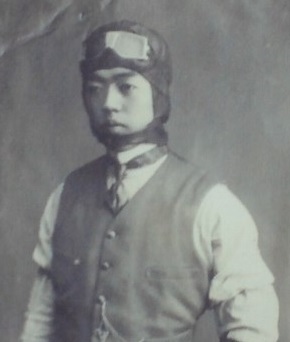
Itô was born in in southern Osaka. While employed as a young man by the Sadoshima Copper and Iron Company in his hometown of Osaka, Otojiro Itoh (伊藤音次郎, Itô Otojirô) (June 3, 1891 – December 26, 1971) became inspired with flight when seeing the Wright brothers’ success in a film. ‘

In September 1909, after reading an article about the new biplane developed by Sanji Narahara, Itô wrote a letter to Narahara pleading to be employed as a pilot. At Narahara’s urging, Itô began taking night classes on mechanical engineering at the Kôshu Gakko (now Kogakuin University). He continued to maintain a correspondence with Narahara for many years.

At the age of 19, in 1910, ltoh left home and moved to Tokyo where he worked as a mechanic at the Narahara aeroplane company. Impressed with his eagerness and interest in aviation, Narahara made ltoh an assistant to Einosuke Shirato, who had worked exclusively for Narahara as a pilot. This association was interrupted when Itoh reached the age of 20 because, like all other young Japanese men, he was conscripted for a one year term of service in the military. Upon returning to Narahara in 1912, he assisted in the manufacture of the aeroplanes and accompanied demonstration flights around Japan as a ground crewman.

In February 1915, following Narahara Sanji’s departure from the aviation community, Itô established the Itô Aircraft Research Center in present day Mihama Ward of Chiba City.

As spare-time employment, ltoh assisted Shigesaburo Torigai with the manufacture of the Torigai Hayabusa-go Aeroplane which eventually crashed in September 1913. ltoh borrowed this aeroplane, quit his job and moved with the aeroplane to Inage, on Tokyo Bay just north of Chiba City. There he made repairs and modifications to the aeroplane, and began to learn to fly with the help of two others. The sandy beach there proved an excellent runway, but its availability was dependent upon the height of the tide. After three months of flying training, maintaining and repairing his own aircraft, he had accumulated a total of a mere 3 hours of flying.

Pilot licences, or, for that matter, any regulations concerning flying and aeroplanes were yet to come. Therefore, Itoh established a flying school on the beach at Inage in February 1915, and called it the ltoh Kyodo Hiko Renshusho (Itoh Co-operative Flight Training Ground). The ltoh Aeroplane Research Studio and Training Ground were both known to the public as ltoh Airfield. For flying training, he used the Torigai Hayabusa-go Aeroplane after it had been modified. To supplement his income, Itoh joined part time with Shirato, formerly with the Narahara company, who now was building his own aeroplanes. This added income allowed ltoh to begin his commercial construction of aircraft and by the autumn of 1915 he completed his first; the Itoh Emi I.

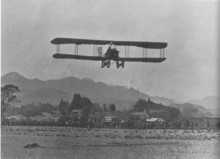
In November 1915, Itô finished construction of an airplane named after himself and his hometown, the “Itô-Emi Type 1.” On January 8, 1916, Itô flew his aircraft over Tokyo, making him famous among Japanese aviators. After Itô’s aircraft facility suffered severe damage from winds and flooding in late September 1917, he moved his operation to Tsunanuma-chô (now Naraishino City), and reestablished his business under the name “Itô Aircraft Manufacturing.” Among the pilots that Itô trained was Tadashi Hyōdō, the first Japanese woman to earn her pilot’s license, and Inoue Chôichi, who established the Japan Air Freight Corporation.

Ito-Emi type 1

When the Asahi News Corporation established the Tôsai Teiki Airlines in 1923, Itô Aircraft Manufacturing provided both aircraft and pilots, thereby contributing to civil aviation transportation. In 1930, Itô established the Japan Light Aircraft Club and appointed Sanji Narahara as club president, which contributed to the spread of lighter-than-air aircraft in Japan.

Although Itô was one of the few successful aviators to come from a purely civil aviation background, he withdrew from the world of aviation following the ban on all aviation activities from the GHQ after the Occupation of Japan. Itô established a farming cooperative with volunteers drawn from the former workers at his factory in 1948, and moved to Tôyama Village in Chiba Prefecture (now Tôhô, Narita City) to open up new farmland as part of the post-war land reclamation project.

Despite the great effort expended by Itô’s group to cultivate land that had once been bamboo forest, their farm was eventually included in the area designated for the Tokyo International Airport (now Narita International Airport). The sudden announcement of this plan was devastating for many local residents, some of whom participated in the Sanrizuka Struggle, but it was said that Itô alone of all the area’s residents welcomed the arrival of the airport. Although he had put his energy into farming, Itô willingly agreed to sell his land, and was among the first to sign a contract with the airport organization.

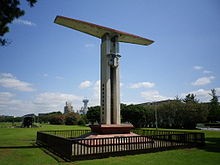
Memorial to the birthplace of civil aviation

Afterwards, Itô put his energy into the establishment of the Civil Aviation Memorial in Inage Seaside Park. The journals and written records that Itô left behind were eventually used by author Hiragi Kunio. On December 26, 1971, Itô died at the age of 80.

Isotta Fraschini Delta / R.C.21/60 / R.C.35

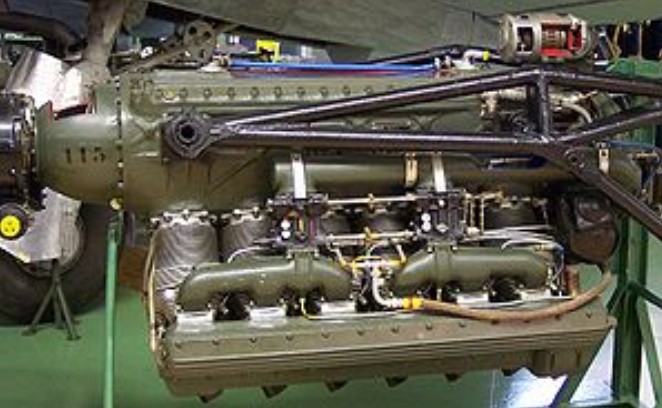
Isotta Fraschini Delta RC131

The Delta was a 12-cylinder inverted-V aircraft engine built by Isotta Fraschini prior to and during World War II. First run in 1927, the Delta produced about 750 hp in common versions, although others were rated up to 900 hp. The Delta was not widely used, although it could be found on a number of production aircraft and some advanced prototypes.

Although the air-cooling might be considered an anachronism even during the 1930s, the engine included a number of otherwise advanced features. For instance, the valves were powered by dual overhead cams driven by power shafts at the rear of the engine. Exhaust ports were arranged to exit toward the middle of the engine, one cylinder bank being the mirror of the other, allowing the piping to be ganged below the engine nacelle.

Around 3300 were built.

Applications:
Ambrosini SAI.107
Ambrosini SAI.207 prototype
Ambrosini SAI.403 prototype
CANT Z.515
Caproni Ca.313
Caproni Ca.314
Caproni Ca.331
Caudron C.714 (C.760) prototype
Henschel Hs 129 prototype
Reggiane Re.2001 prototype

Specifications:

Delta R.C.35 IS
Type: 12-cylinder air-cooled 60 degree inverted vee
Bore: 132 mm (5.197 in)
Stroke: 160/165 mm (6.299/6.496 in), with main and articulated rod
Displacement: 26.685 Litres (1,628.44 in³)
Length: 2000 mm (78.8 in.)
Width: 840 mm (33.07 in.)
Height: 883 mm (34.76 in.)
Dry weight: 510 kg (1,111 lb)
Valvetrain: 2 Poppet valves per cylinder, sodium cooled exhaust valves, double overhead camshafts.
Supercharger: single stage single speed centrifugal type supercharger, gear ratio 9.8:1
Fuel system: 4Isotta Fraschini downdraft carburetors Fuel type: 80/87 octane petrol (aviation gasoline) Oil system: dry sump, 2 scavenging, 1 pressure pump Cooling system: Air-cooled Power output: 770hp/2600rpm take off, 750hp/2600rpm/4000meters. Reduction gear ratio 0.64:1 Specific power: 0.75 hp/in³ (34.1 kW/L) Compression ratio: 6.4:1 Specific fuel consumption: 270 grams/hphour maximum, 250 grams/hp*hour cruise (70%)
Power-to-weight ratio: 1.485 hp/kg (0.67 hp/lb)

Israel Redhead

Gordon Israel moved to Stinson, where he worked as a welder. He was merely marking time, though, and soon the opportunity came to design a new racer. Israel came up with the Redhead, a slippery, tricky airplane powered by a six cylinder supercharged Menasco Buccaneer.
A friend of Israel’s agreed to give the airplane its first flight, and Jimmy Doolittle, who’d heard about the test, was there to lend advice. Doolittle counseled the pilot, “Don’t be too anxious to land. Keep the airspeed up and let it float down.” The pilot’s brother took a dim view of that and, unsolicited from Israel, rendered his own verdict: “You better bring it in nose high or you’ll never get it down inside the airport.” The pilot placed greater faith in family than experience and bent the Menasco’s crankshaft in a brutally hard landing. Doolittle calmed Israel, persuading him not to tear the engine down and have another go the same day. Instead, Doolittle took him to his office at Shell Oil and gave him a Shell sticker. The sticker went on the airplane, and Shell sprang for a brand new crank. Israel took his time rebuilding the engine revealing some ruined bearings in addition to the crank failure; after he got the engine sorted out, he flew the airplane himself to a third place finish in his first ever attempt as a race pilot.