JAI Sparless

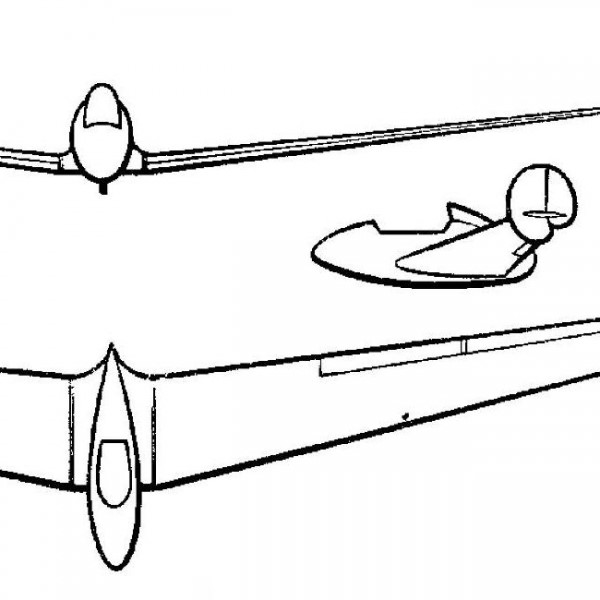
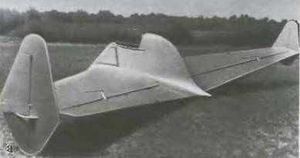
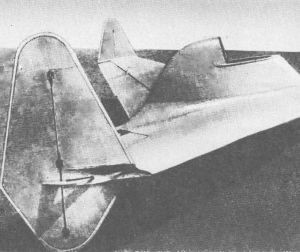
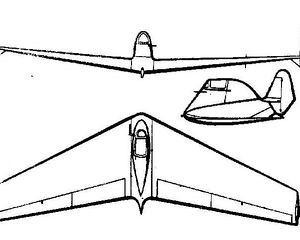
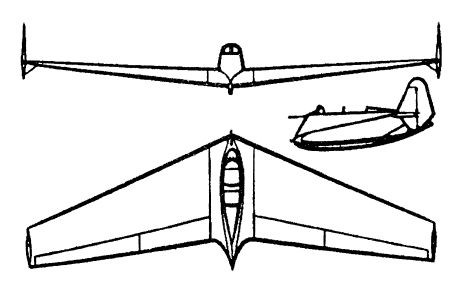
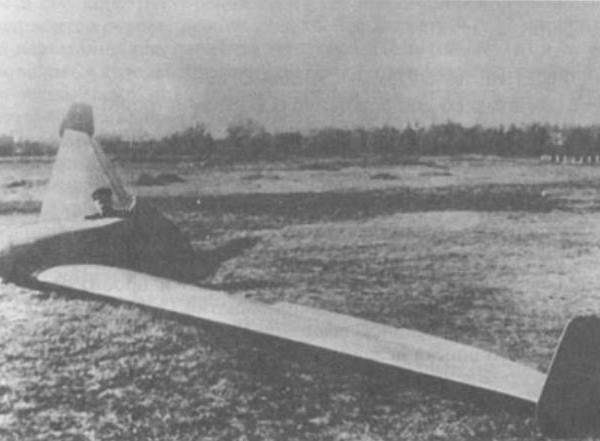
The tailless experimental glider known as “Biezlonzherokka JAI” or “Stringerless Glider” (Russian: ХАИ Безлонжеронка) was designed and built under the direction of Professor Serguei Ivanovich Kuzmin at the Kharkov Aviation Institute (JAI) in 1934. Its development was with the collaboration of engineers AA Lazariev and Ye. S. Balinski.

The Stringerless Glider was designed in a tailless flying wing composition with fluted wings with empennage at the ends. The entire construction was made of wood.

The wing stood out for the marked aspect of 13. The center plane was characterized by a structure of four spars on which the cabin was located.

The removable consoles featured a remarkable dihedral and specific wing profile. As a distinctive detail of the project, it is worth highlighting the total absence of a stringer in the construction of these consoles, which was reflected in the name of the glider. These sections were built using a honeycomb structure with an outer covering around stringers. The lightened wing veins served as the basis for the thin covering layer. The wing consoles were fixed by means of duralumin pieces to the steel supports fixed to the spars of the center plane. This construction method would be the basis for the further development of modern three-layer structures.

The extreme empennages consisted of a fixed keel and rudders. The control of the apparatus was achieved by means of double-section mobile elements covering a large part of the span (60%). The outer section of the ailerons was capable of turning upward at a greater angle than the inner, thereby achieving increased control at large angles of attack.

The glider control system in the center plane was rigid and in the wing by ropes. When installing the consoles to the center plane, the control of the surfaces of these sections was automatically connected.

The glider featured an open cockpit for the pilot, located above the small centerplane, which ended with a tall fairing headrest.

The JHA project without stringers was completed in March 1933. Its construction was started at the Kharkov Aviation Factory with the direct participation of KA Kalinin. Later the works were transferred to the JAI workshops with the participation of KA Kalinin, IG Nieman and S. Ya. Zholkovski. In June the glider was successfully tested in the institute’s laboratories.

The JHA without spars first flew the 14 September of 1934. The tests, developed by the pilot VD Kozulya, showed excellent stability. The sparless JHA was able to hold the course with the stick free and could execute various manoeuvres.

Wingspan: 13 m
Length: 3.2 m
Height: 1.5 m
Empty weight: 160 kg

JAI Osoaviajimoviets JAI

In January 1932, the JHA chair of aircraft construction began on its own initiative the development of tailless flying wing aircraft. The head of the chair IG Nieman considered this scheme from the point of view of aerodynamics and a good basis for in-depth studies.

Pavel Georgievich Bening, one of the engineers from the KA Kalinin construction bureau, was invited as the main builder of the group. The group was reinforced with the addition of AA Krol, AA Lazariev, SI Kuzmin, among others.

In January 1933 work began on the design and the calculations showed the aerodynamic resistance should decrease by 5%. When designing the model, the manufacturers decided to abandon the use of a long fuselage, forcing the implementation of a swept wing with a permanent center of pressure profile. The wingtips were provided with vertical surfaces with the rudders.

In order to verify the conception of the system and its calculations, it was decided to proceed with the construction of a glider with a similar scheme to that of the future airplane and of proportional dimensions. This glider had to allow, economically, to be able to test the concept and introduce the necessary modifications in the development and testing process.

The new glider was named “Osoaviajimoviets JAI” (Russian: ХАИ Осоавиахимовец ХАИ).

The “Osoaviajimiviets JAI” was designed as a single-seater glider in a tailless flying wing configuration. The construction was of wood with plywood coating.

The wing exhibited sagging and ended in vertical surfaces that included the aerodynamically compensated rudders.

The wing trailing edge featured full-span control surfaces that could perform the function of operating as ailerons or flaps.

On the longitudinal axis was the open cockpit for the pilot, with an aerodynamic fairing that made a smooth transition to the center plane.

A central wooden ski was used as the landing gear, supported by small skids under the vertical planes of the wing tip.

The project and plans for the tailless monoplane glider were ready in July 1933. Constructively it differed from the projected plane in its lower dimensions, the absence of an engine and landing gear. During the landing, an ash ski placed in the lower part of the apparatus was used. The cabin lantern was removable and made of celluloid.

The construction was sponsored by the Osoaviajim of the Ukrainian Soviet Socialist Republic, hence the name finger to the glider. The glider was designed by Bening and its construction began at the Kharkov Photomusical Factory in late 1933. Among the group of carpenters and cabinetmakers, M. Lass, AP Glinski and Grebenyuk stood out among others. When construction was at 90% completion, the decision was made to move it to the GVF Aviation Repair Shops in Kharkov (JARM), located in Sokolniki.

Once the “Osoaviajimoviets JAI” was finished, it was transferred to the JARM track.

On the 6 of February 1934 the first flight took place with BN Kudrin controls. After being launched with the use of an elastic band, the flight passed without great difficulties.

The first tests showed the excellent stability of the device in the air, but they must have been suspended as the weather conditions worsened. Only in May could they be continued by the pilot LS Ryzhkov. Originally, six roll-off flights were developed with takeoffs with elastic bands, in which heights of 10 meters and distances between 200 and 300 meters were achieved, making some small turns.

When the stability of the plane became evident, it was approved to carry out towed flights, originally from a car and later using a Polikarpov U-2. Sharp turns, dips, and reversals were tested on these flights. Subsequent flights were developed with towing from a Polikarpov R-5 at altitudes between 1,100 and 1,500 meters.

In mid-May, Ryzhkov managed to complete 26 closed loops in the “Osoaviajimoviets JAI” of which one started in the opposite direction, after the pilot inverted and made a 180º turn.

These manoeuvres were observed by members of a delegation from the Academy of Sciences of France led by J. Perren academic. Professor Gross, a member of the delegation, declared that the new tailless glider was a brilliant achievement of Soviet technique.

The glider also performed eights and combat evolutions, spinning and landslides. The diameter of the turns of the dead loop did not exceed 8 – 10 meters, the radius of the turns about 8 meters, the spirals 5 – 6 meters, which was quite difficult even for sports aircraft.

The tests demonstrated the excellent stability of the glider, its good response to the controls and the simplicity of the handling. It was also shown that the glider wing had a large reserve of strength, so the future JAI-4 was lightened.

In August 1934 the “Osoaviajimoviets JAI” was shown at the 2nd International Exhibition in Copenhagen and in September in Paris.

The model would be continued in the two-seater “PP Postyshev” or JAI-2.

Wingspan: 10.9 m
Wing area: 22 m²
Length: 3.75 m
Height: 1.1 m
Accommodation: 1

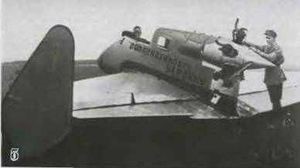
JAI JAI-4 Iskra

In January 1932 the JAI began, on its own initiative, the development of tailless flying wing airplanes. IG Nieman considered the aerodynamics a good basis for in-depth studies.

Pavel Georgievich Bening, one of the engineers of the KA Kalinin construction bureau, was invited as the main constructor of the group. The group was reinforced with the addition of AA Krol, Alexandr Alexeyevich Lazariev and Sergei Ivanovich Kuzmin.

In January 1933 work began on the design of an experimental flying wing airplane. The calculations showed that due to the absence of the empennage the aerodynamic resistance should decrease by 5%. When designing the model, the manufacturers decided to abandon the use of a long fuselage, forcing the implementation of a swept wing with a permanent center of pressure profile. The wingtips were provided with vertical surfaces with the rudders.

Originally it was decided to build non-motorized versions for testing. In parallel with construction of the experimental gliders, Osoaviajimoviets JAI and PP Postyshev, work began on the three-seater experimental JAI-4 Iskra or “Osoaviajimoviets Ukraini” (in Russian: ХАИ-4 Искра, “Осоавиахимовец Украины”) to highlight the participation of this society in financing the development of the project.

With accumulated experience, In the summer of 1934 engineers AA Lazariev, NG Bening and AA Krol completed work on the new original design experimental aircraft.

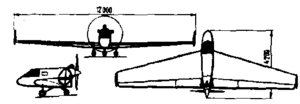
The “Iskra” was conceived as a three-seater, low-wing, tailless, monoplane aircraft with a 100-hp Shvietsov M-11 engine in thruster configuration, located behind the crew cabin and wing configuration.

The construction was of wood with fabric covering. The fuselage presented a semi-monocoque structure with straight sides and a curved upper surface and was developed on the centerplane spars. Inside the fuselage the cockpits and crew cabins were located.

The wing, integrated with the fuselage, had a trapezoidal shape with a 22º sweep on the leading edge and 11º on the trailing edge, also characterized by a slight positive dihedral. The M-11 was selected.

The wing construction was made of wood and had two trunk-type stringers, which crossed the entire fuselage. The coating was plywood with fabric and lacquered to finish it.

The trailing edge was fully mobile and divided into four sections. The ailerons, of normal type, were located in 65% of the wingspan and between them the elevons were located. The wingtips ended in empennages to which the rudders were attached. These were constructed of wood integrally with the wing and covered with plywood. In the lower part of the empennage the supports fixed to the stringers were installed. The rudders were covered in fabric. As a noteworthy feature, it should be noted that the empennages were located at a certain angle with respect to the vertical and were slightly inward. This configuration generated a thrust effect and made it possible to reduce the inductive resistance of the wing. The wing quality with this innovation was increased by 8% in relation to a conventional wing. In parallel, the bearing capacity grew by 7%.

The JAI-4 was, along with the SAM-13 of Moscaliov, the first model with tricycle gear designed and built in the USSR. The front wheels had a rubber ball and the rear wheels were made of wood. The rear wheel was steerable and the main wheels were linked by a hydraulic link, so that, in the event that one was out of balance, the other would react by trying to resolve the situation. This innovation allowed the JAI-4 to start takeoff with a 0º angle of attack and gradually increase it, which shortened the takeoff run. This hydraulic system also allowed the retraction of the main gear.

The powerplant selected was the 100-hp Shvietsov M-11 five-cylinder engine driving a 2.4-meter-diameter, two-bladed wooden propeller. The pitch of the propeller could be modified on the ground. The removable powerplate was constructed of welded steel tubes in a pyramidal shape with an annular structure at the end, to which the motor was attached. The fuel system incorporated tanks with a capacity for 4 hours of flight.

The crew cabin was located at the front of the fuselage and closed by a transparent cover. The rear two-man cabin featured windows on both sides.

The control system of the moving surfaces was by means of cable. The rudders were operated by the pedals, the elevator and ailerons were operated with the joystick.

In order to obtain the aerodynamic characteristics of the future airplane, in May 1933, a series of reduced-scale models were tested in the aerodynamic laboratory of the JAI. After validating the solution, construction began.

The JAI-4 was built at the GVF Aviation Repair Workshops in Kharkov (JARM), located in Sokolniki and the financing of the project was assumed by the Central Committee of the Osoaviajim of Ukraine. Construction and flight tests were entrusted to Alexandr Alexeyevich Lazariev. The plane was finally ready by the summer of 1934.

At the beginning of June, 1934, the plane was taken to the airfield in Sokolniki and on June 20 the test pilot BN Kudrin took flight for the first time. Initially it was difficult to get the plane off the ground. During the roll and due to the moment of the propeller the front gear was compressed and the angle of attack decreased, being insufficient. The effectiveness of the elevator was lost and the aircraft could not lift off the ground. Only when it reached 180 km / h was it able to take flight.

In the air the “Iskra” showed problems with longitudinal flight control and delays in the response to the control lever due to a large moment of inertia caused mainly by the large forward cabin and the location of the engine. The flight path was undulating. There was also a lack of longitudinal stability due to the vertical surfaces being outside the action of the propeller.

During the flight a height of about 600 meters was reached. The low ceiling was motivated by the low dive moment of the propeller and the low effectiveness of the elevons. The pilot was forced to raise the aircraft while keeping the stick in a neutral position.

After 15 minutes of flight and making two circles over the airfield, the pilot decided to land. The landing was also difficult and could only be achieved at high speed with a small angle of attack. The plane touched down abruptly by cutting the engine at a height of close to one meter. The landing gear managed to withstand the impact with the ground.

The takeoff problems were mainly motivated by the incorrect location of the engine in the elongated fuselage, which generated an important moment of inertia in relation to the transverse axis. The unstable behaviour of the aircraft on takeoff and landing was also motivated by the negative action of the elevons. During take-off, these surfaces incline upwards, achieving an S-shaped profile in this area that led to a decrease in lift. During landing, when tilting downwards, the opposite happened, lift increased and the plane tended to rise.

During August 1934 the pilot BN Kudrin made two more flights and then the tests were continued by LS Ryzhkov. The tests carried out between 1934 and 1935 made it possible to define the main principles and bases for the flight of airplanes in a tailless flying wing configuration.

JAI-4 Iskra
Engine: Shvietsov M-11, 100 hp
Wingspan: 2 m
Wing area: 21.24 m²
Length: 4.7 m
Empty weight: approx. 600 kg
Maximum takeoff weight: 850 kg
Maximum speed: 180 km / h
Landing speed: 100 km / h
JAI JAI-2 P. P. Postyshev

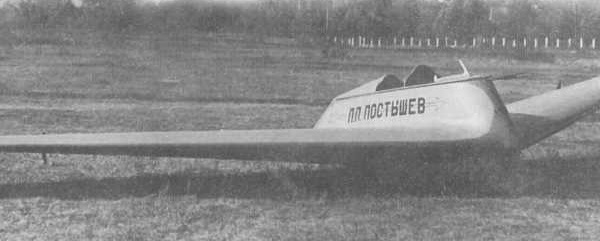
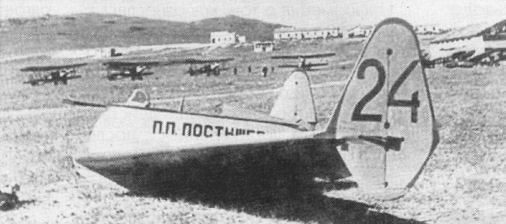
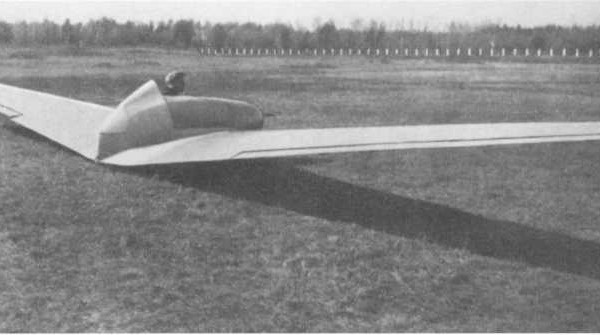
Two-seater glider “P. P. Postyshev” in Koktebel.

The JAI-2, or JAI P. P. Postyshev (In Russian: П. П. Постышев (ХАИ-2)) was created to study tailless design. The name was chosen in honour of the secretary general of the central committee of the Communist Party of Ukraine Pablo Petrovich Postyshev.

On February 6, 1934 at the GVF Aviation Repair Shops in Kharkov (JARM) the first flight of the Osoaviajimoviets JAI tailless glider designed by Bening was developed. This project was followed by a second model in a two-seater configuration, which received the official name P. P. Postyshev (JAI-2). The glider was designed and built at the JAI by Pavel Georgievich Bening.

The two-seater JAI-2 P. P. Postishev was a tailless flying wing configuration. The construction was of wood with plywood coating.

The wing featured in-plane sagging and notable positive dihedral, ending in vertical surfaces that included the aerodynamically compensated rudders. The wing trailing edge incorporated full-span ailerons used to gain control of pitch and roll. The selected wing profile was M-12.

On the centroplane were the open tandem cabs, protected only by a small front windshield. The pilot was in the lead. The passenger was located in the rear cabin with his back to the pilot, a solution that was dictated by the need to achieve the least possible deviation of the aircraft’s center of gravity, characteristic for this type of airplane configuration.

A central wooden ski was used as the landing gear, supported by small skids under the vertical planes of the wing tip.

The construction of the glider was carried out at the GVF Aviation Repair Workshops in Kharkov (JARM) in 1934 and lasted a month and a half.

The glider tests took place in September 1934 in Kharkov.

Later in 1934 the model would participate in the X National Sailing Competitions held in Koktebel. The glider was aero-towed using a Polikarpov R-5 piloted by V. A. Keglevich as a tug. The glider had the pilot L. S. Ryzhkov at the controls and the constructor Pavel Bening as a passenger. Once at the destination the glider was improved with the addition of the front windshield and the rear upper fairing.

During the competitions the pilot L. S. Ryzhkov performed on the “P. P. Postyshev” flights over thermals. During the competitions, on October 2, pilot S. N. Anojin made the first experimental jump from the back seat of the glider while flying at 300 meters. Getting out of the back seat Anojin left the cabin and stood on the wing. To achieve the opening of the parachute, the glider began a dive until it reached a speed of 105 km / h. Upon reaching the height of 300 meters, he activated the ring and without jumping into the void, he detached himself from the device when he was dragged by the parachute.

The effectiveness of this test opened the possibilities of preparing paratroopers without the need for free jump in the air before proceeding to open the parachute. As a result, it was also proposed to modify the configuration of the rear cabin of the JAI-2 “P. P. Postyshev”, so that the skydiver, without getting up from the seat and without standing on the wing, could parachute.

The P. P. Postyshev proved to be more effective than the LAK-1, LAK-2, TsAGI-1 and TsAGI-2, also in the tailless configuration, and set a glide record for tailless models by staying in the air for 58 minutes.

According to the magazine “Samoliot” upon return from Koktebel on October 6, three gliders without a tail made a record-breaking flight without stops forming a tow “train” to the city of Kharkov. Towed by a Polikarpov P-5 piloted by the pilot Danilivtsiev, the TsAGI-1, piloted by Skorodumov remained in the center, to his left the “P. P. Postyshev” piloted by L. S. Ryzhkov with technician M. Lass in the back seat and on the right the TsAGI-2 with pilot Yudin. The gliders stayed in the air for 4 hours and 30 minutes, covering a distance of 620 km / h with an average speed of 145 km / h. During part of the flight the “train” was immersed in a cloudy area with turbulence, but the gliders passed this test.

Later the P. P. Postyshev glider (JAI-2) was used by the JAI athletes for towed aerobatic flights. On August 19, 1936 he was successfully shown in the Túshino air parade, performing high figures.

In August 1936 L. S. Ryzhkov began testing an improved version of the JAI-2, but on July 12, 1937 the model was destroyed.

Wingspan: 10.90 m
Wing area: 22 m²
Length: 3.75 m
Height: 1.1 m
Stabilizer surface: 1.17 m²
Area of the empennage: 1.54 m²
Aileron surface: 1.17 m²
Empty weight: 160 kg
Wing loading: 14.6 kg/m²
Accommodation: 2

Jacobs R-915 / L-6

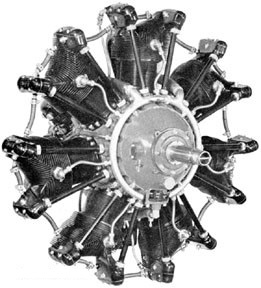
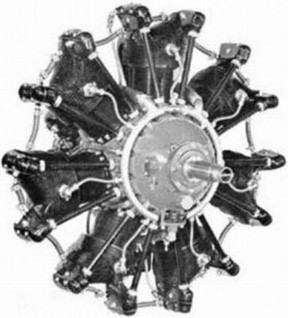
The Jacobs R-915 or L-6 is a seven-cylinder, air-cooled, radial engine for aircraft manufactured in the United States, production started in 1936.

The R-915 was effectively an enlargement of the R-755 with strengthened stressed parts. With a bore and stroke of 5.5 in × 5.5 in (140 mm × 140 mm) the displacement was 914 cu in (15 L), takeoff power was around 330 hp (246 kW). The engine features steel cylinders with aluminum-alloy cylinder heads. The R-915A4 variant features a drive shaft for autogyro use.

Applications:
Avro Anson
Beechcraft Model 18
Beechcraft Staggerwing
Fleet 50
Howard DGA-8
Kellett KD-1

Specifications:
R-915A1
Type: 7-cylinder air-cooled radial piston engine
Bore: 5.5 in (140 mm)
Stroke: 5.5 in (140 mm)
Displacement: 914 cu in (15 L)
Length: 40 in (1,030 mm)
Diameter: 45.5 in (1,160 mm)
Dry weight: 555 lb (252 kg)
Valvetrain: 2 valves per cylinder, pushrod-actuated, Sodium cooled exhaust valves
Fuel system: Single Stromberg NA-R7A carburetor
Fuel type: 73 octane
Oil system: One pressure pump, two scavenge pumps
Cooling system: Air-cooled
Reduction gear: Direct drive, right hand tractor
Power output: 330 hp (246 kW) at 2,200 RPM at sea level
Specific power: 0.36 hp/cu-in (16.4 kW/L)
Compression ratio: 6:1
Power-to-weight ratio: 0.6 hp/lb (1 kW/kg)

Jacobs R-755 / L-4

Jacobs R-755

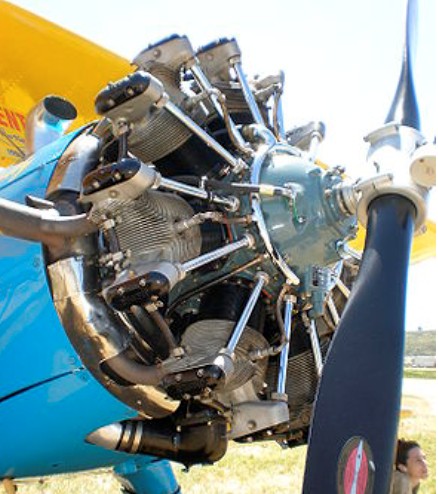
The Jacobs R-755 (company designation L-4) was a seven-cylinder, air-cooled, radial engine for aircraft manufactured in the United States by the Jacobs Aircraft Engine Company.

The R-755 (ATC 237) was first run in 1933 and was still in production in the 1970s. With a bore and stroke of 5.25 in × 5 in (133 mm × 127 mm) the displacement was 757 cu in (12.4 L), power ranged from 200 hp to 350 hp (150 kW – 260 kW). The engine features steel cylinders with aluminum-alloy cylinder heads. An R-755E variant was developed for use in helicopters.

The Jacobs must be primed on every start; two or three strokes on warm days, and five to seven strokes on cold days. Then, with mixture “Full Rich,” carb heat at Cold, and prop set at “Low rpm” (to keep from taking too much oil from the engine), master switch “On,” throttle cracked, and prop clear, turn the ignition key to “Battery Start- and press the starter button. As soon as the engine fires, turn the ignition to “Both Run”. Another shot or two of prime may be needed to keep the engine running at first.

Jacobs R-755

During the take-off run, it needs full right rudder trim to handle the torque, and the 195 will leave the ground in a slightly tail-low attitude at about 60 mph, using about 900 feet of runway. You are allowed full throttle for one minute with this engine; but a good cruise-climb with 2,000 rpm at 23 inches manifold pressure at 115 mph will usually produce around 500-600 fpm.

The S model was produced by Page Industries.

Applications:
Anahuac Tauro
Avro Cadet
Beechcraft Staggerwing
Boeing-Stearman Model 75
Cessna AT-17
Cessna 195
Funk F-23
Grumman Ag Cat
Kellett KD-1
Morane-Saulnier MS-505
Waco CG-15
Waco Custom Cabin series (YKC, YKC-S etc.)
Waco Standard Cabin series (YKS-6 etc.)

Specifications:
R-755-A1
Type: 7-cylinder air-cooled radial piston engine
Bore: 5.25 in (133 mm)
Stroke: 5.0 in (127 mm)
Displacement: 757 cu in (12.4 L)
Length: 27.25 in (692 mm)
Diameter: 44 in (1,188 mm)
Dry weight: 505 lb (229 kg)
Valvetrain: 2 valves per cylinder, pushrod-actuated, Sodium cooled exhaust valves
Fuel system: Single Stromberg NA-R7A carburetor
Fuel type: 73 octane
Oil system: One pressure pump, two scavenge pumps
Cooling system: Air-cooled
Reduction gear: Direct drive, right hand tractor
Power output: 245 hp (183 kW) at 2,200 RPM at sea level
Specific power: 0.32 hp/cu-in (14.8 kW/L)
Power-to-weight ratio: 0.48 hp/lb (0.8 kW/kg)