In 1927, L. V. R. Jones designed and built the Wonga, the first aeroplane in Australia which used steel instead of wood for the majority of its structure.
Inter-Wars
Johnson Twin 60
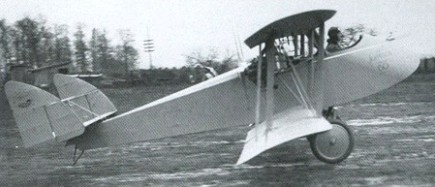
The last product of the Johnson Airplane & Supply Co (first flown December 1936) was the Twin-60, a twin-pusher-engined two-seat open-cockpit biplane with 30 hp Cherub engines.
Johnson Canary
A single engined three-seat biplane.
Johnson Airplane & Supply Co. Inc
USA
Johnson Airplane & Supply Co. Inc, Dayton, Ohio, was a firm supplying aeronautical equipment and rebuilding surplus military aircraft. Expanded in 1926, rebuilding DH-4s and also producing the Canary, a single engined three-seat biplane. Last product (first flown December 1936) was the Twin-60, a twin-pusher-engined two-seat open-cockpit biplane with 30 hp Cherub engines.
Jendrassik Cs-1
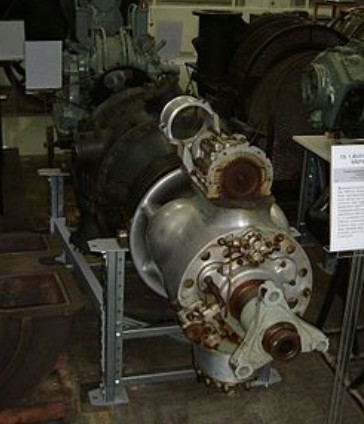
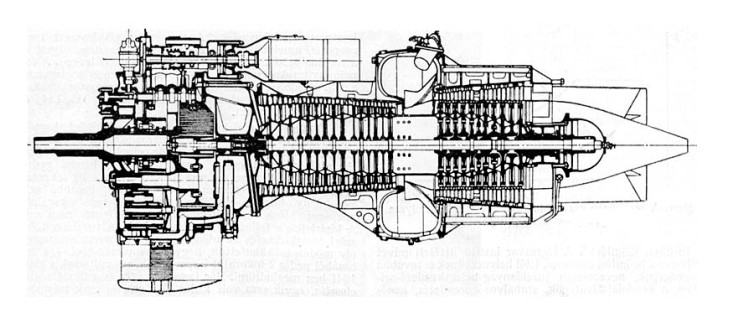
The Jendrassik Cs-1 was the world’s first working turboprop engine. It was designed by Hungarian engineer György Jendrassik in 1937, and was intended to power a Hungarian twin-engine heavy fighter, the RMI-1.
The engine was designed by György Jendrassik in 1937 and built at Ganz Works. It ran for the first time in 1940, but problems with combustion stability limited the power to 400 hp, from the design goal of 1,000 hp. There was nothing inherently wrong with the design, however, and continued work on the flame cans should have allowed it to develop to full power.
All work on the engine was later stopped when the Hungarian Air Force selected the Messerschmitt Me 210 for the heavy fighter role, and the engine factory converted over to the Daimler-Benz DB 605 to power it. The prototype RMI-1 was later fitted with these engines in 1944.
Jendrassik
György Jendrassik (1898 Budapest – 1954 London), Hungarian physicist and mechanical engineer.
Jendrassik completed his education at Budapest’s József Technical University, then at the University of Berlin attended lectures of the famous physicists Einstein and Planck. In 1922 he obtained his diploma in mechanical engineering in Budapest. From 1927 he worked at Ganz Rt, where he helped to develop diesel engines. He designed the world famous Jendrassik Cs-1 turboprop engine, of which the first few pieces were made with single and double cylinders; later, the 4- and 6-cylinder four-stroke versions were developed, without compression and with mixing chamber. The world’s first turboprop was the Jendrassik Cs-1, designed by the Hungarian mechanical engineer György Jendrassik. It was produced and tested in the Ganz factory in Budapest between 1939 and 1942. It was planned to fit to the Varga RMI-1 X/H twin-engined reconnaissance bomber in 1940, but the program was cancelled.
Later on he was active in improving gas turbines and in order to speed up research, he established the Invention Development and Marketing Co. Ltd. in 1936. His reputation continued to grow, and he became the factory’s managing director from 1942 to 1945. In recognition of his scientific work he was elected in 1943 corresponding member of the Hungarian Academy of Sciences. After the war he was not able to continue developing gas turbines. Political distrust surrounded him, and therefore he did not return from one of his travels abroad. He lived in Argentina for a while, then settled in England, where he established his own workshop, becoming in addition a consultant to the Power Jets company. The number of his inventions on record in Hungary is 77. His last invention of great importance was the pressure-compensating device.
Jefferson, G.
A small single-seat glider was designed and built by G.Jefferson at Leeds, UK, in 1933. It was not completed and components were incorporated in the second Addyman S.T.G.
Janowski Sport plane
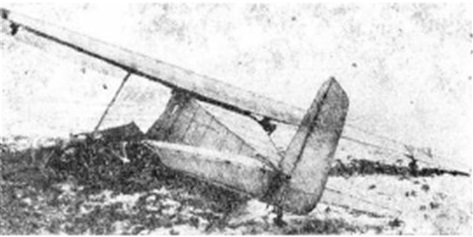
In 1930 Antoni Janowski was a designer at Samolot factory in Poznań designed and built a modern sports plane with two seats abreast and enclosed cockpit. Unfortunately the plane crashed during the test flight and second plane, which was also to be built, was never completed.
Janka Gyongyos 33
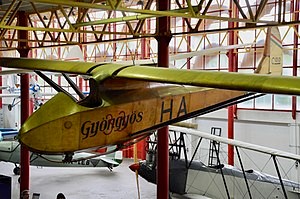
The Gyöngyös 33 was the first Hungarian designed sailplane and was named after its place and year of manufacture. It was designed by Zoltán Janka and built in the MOVERO (Aviation Section of Hungarian National Defence Association) workshops at Gyöngyös. His design target was to produce an aircraft that would out-perform the 1928 RRG Professor.
It was an all wood monoplane with a two-part wing built around a forward main spar and a rear false spar. The inner area of each part was rectangular in plan, tapering strongly outboard. The leading edges ahead of the main spar were plywood-covered, as was the whole wing at the inner-outer junction; the rest was fabric-covered. An aileron filled the whole trailing edge of each outer section. The two parts joined at a narrow centre-section on a raised fuselage pylon and were braced on each side with a V-strut from the fuselage bottom to the wing spars at the inner-outer junctions.
The Gyöngyös 33’s six-sided fuselage was formed by a wooden frame and was plywood-covered. The pilot had an open cockpit ahead of the wing leading edge with the wing pylon immediately behind him. A rubber-sprung landing skid below him ran from the nose almost to the trailing edge. The fuselage tapered rearwards to a cantilever empennage. The fin was small and ply-covered with a tall rudder which, like the all-moving tailplane apart from its leading edge, was fabric covered.
The first flight took place on 11 June 1933. A fortnight later the Gyöngyös 33 slope-soared for 5 h 43 m, gaining 1,140 m (3,740 ft) of altitude, a Hungarian record. On 27 June it set a national duration record of 10 h 7 m. In 1934 it made a 64 km (40 mi; 35 nmi) flight.
The Gyöngyös 33 is now on display in the Hungarian Technical and Transportation Museum, Budapest.
Length: 7.37 m (24 ft 2 in)
Wingspan: 18.55 m (60 ft 10 in)
Wing area: 19.3 sq.m (208 sq ft)
Aspect ratio: 17.8
Airfoil: Göttingen 549
Empty weight: 179 kg (395 lb)
Gross weight: 250 kg (551 lb)
Maximum glide ratio: >20 at 55 km/h (34 mph; 30 kn)
Rate of sink: 0.6 m/s (120 ft/min) minimum
JAI JAI-9
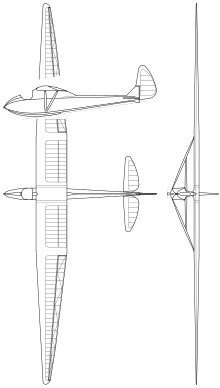
In the late 1930s, more modern gliders with improved aerodynamics were developed in various Soviet cities, designed to set new competition records. Among these models was the JAI-9 (Russian: ХАИ-9) single-seat monoplane glider designed by AV Kovalenko built by JHA students in 1937.
The JAI-9 wing presented a cantilever configuration with high aspect. In the JAI-9, for the first time, the TsAGI flaps were installed. It is worth noting the JAI-9 high wing loading.
The pilot was located in a cockpit closed by a transparent cover, which barely protruded in the contours of the glider’s fuselage.
The tests showed that the JAI-9 flew well and was easy to control in the air.

