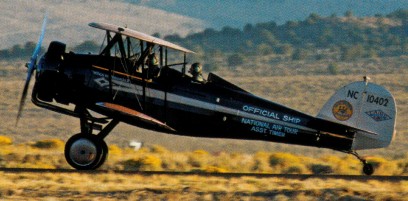
The Laird LC-DW-300 Solution, had been the only biplane ever to win the Thompson Trophy.
Inter-Wars
Laird LC-8
Engine: Wright, 220 hp
Laird LC-1B-300
1930
Laird LC-B-200
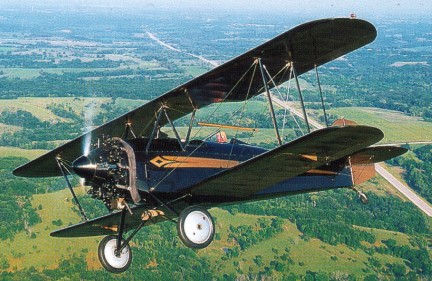
Top speed: 130 mph
Laird Speedwing
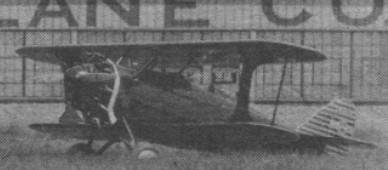
The Laird Speed Wing was built with a wire-cinched, riveted, steel tube fuselage. Laird offered this aircraft for sale to those who wanted a custom-built airplane.
Engine: Wright, 220 hp.
Laird Swallow / Swallow Aircraft Swallow
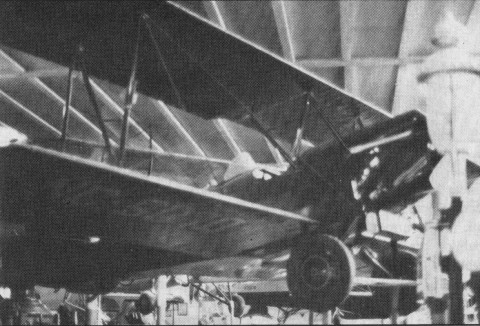
The Burke Moellendick Laird partnership of Wichita began work, and in April 1920 the first Laird Swal-low rolled out of the hangar. In April 1920, Matty Laird (builder of the Swallow) first tested his three place OX 5 biplane built in a shed in Wichita. The plane earned the nickname “Swallow” from one of the Wichita hotel men who witnessed the flight, commenting, “It flies like a swal¬low:’ The Laird Swallow became the first commercial, not military, plane offered for sale in the United States.
The company that became United Airlines began its early air operations fly¬ing a Laird Swallow.
Production went from two planes a month to four. After 43 Laird Swallows had been sold, Matty Laird quit and went back to Chi¬cago to resume business as the E.M. Laird Airplane Company.
Jake Moellendick re¬named his plant the Swallow Airplane Manufacturing Company.
First product of the Swallow Aircraft Co was Model 1924 Swallow Commercial three seater (a refined Laird Swallow). Type was successful, especially in Middle West, and improved progressively.
On April 6,1926 a Swallow biplane (modified New Swallow type, called Swallow Mail plane) made inaugural flight for Varney Air Lines (later part of United Air Lines) marking significant advance in U.S. air transport.
The 1927 Swallow featured a 90 hp Curtiss OX-5 engine, an adjustable stabiliser, 2.5in trim via a cockpit lever and carried ATC 21.
Swallow Commercial of 1928 offered with various engines; Swallow Special 3-seater had Axelson engine. In 1930s company developed Swallow Coupe light cabin monoplane.
Engine: Curtiss OX-5, 90 hp
Prop: Brewster 8 ft 4 in
Wingspan: 32 ft 8 in
Length: 23 ft
Wing chord: 5 ft
Height: 8 ft 4 in
Empty weight: 1469 lb
Useful load: 731 lb
Top speed: 100 mph
Cruise speed: 60 mph
Landing speed: 35 mph
ROC: 600 fpm
Ceiling: 12,000 ft
Laird Airplane Co / E.M. Laird Co
Laird, who first learned to fly in 1913 from an empty field between Cicero Avenue and 52nd Street, north of 22nd Avenue, built a few promising airplanes at this location before going to Wichita.
Emil Matthew “Mattie” Laird built his first Model S aircraft in 1919.
The E.M. Laird Company of Wichita started operation as a partnership in 1920. Bill Burke, an Oklahoma Buick automobile dealer, asked Matty Laird to leave Chicago and come to Wichita to build airplanes. Bill Burke put up one half of the capital needed ($15,000) to start the company. The other partners were Jack Mollendeck, a Wichita oil man who contributed the remaining $15,000, Matty Laird, and his brother Charlie, who provid¬ed the design and technical know how to build the airplanes.
Commercial activity at Chicago began in 1920 with the Swallow, a redesigned Curtiss JN-4, claimed as first U.S. commercial aircraft. Design sold to Lloyd Stearman’s Swallow Aeroplane Manufacturing Company as the New Swallow.
In 1921, Walter Beech, who had barn¬stormed in a Jenny after WWI, joined the company to assist Laird in testing the air¬craft. Also in 1921, Lloyd Stearman joined the company to assist in the design, assem¬bly, and rigging work on the Swallow.
In 1921, Bill Burke left the company and returned to his Buick automobile dealership. In 1923, Matty Laird left the company, returning to his former Chicago location to build the Laird Speed Wing.
Built the first LC (Laird Commercial) 1924. Also designed Super Swallow, an improved New Swallow. Laird concentrated subsequently on custom-built sporting and racing aircraft, such as LC-DW Solution, the only biplane to win the Thomson Trophy.
The E.M. Laird Company did not survive and went into receivership on 13 August 1927.
In 1931 Super Solution Jimmy Doolittle set U.S. coast-to-coast records. With same aircraft set record of 293.193mph (471.8kmh) at 1932 National Air Races. Production continued of threeseat Speedwing biplane. Last project was in 1936, redesigning and completing ex-Lawrence Brown racer for Colonel Roscoe Turner, as LTR 14 Meteor.
Lafayette T
A 1928 five place cabin biplane. One was built, N6792, c/n C-7.
Engine: Menasco-Salmson
Wingspan: 33’4″
Length: 20’6″
Lafayette Aircraft Works
1928
230 W Washington Blvd
Los Angeles
California
USA
Airplane builder
Also were remodelers of the Fisk-Standard.
K+W Häfeli DH-5
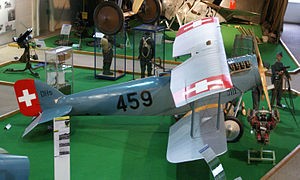
The Häfeli DH-5 was a two-seat reconnaissance aircraft designed by August Häfeli. It was a single-bay biplane of wood and fabric construction. The aircraft was powered by a 180 hp (134 kW) LFW I engine produced by the Swiss Locomotive and Machine Works.
Built by the aircraft department of the Federal Construction Works (Eidgenoessische Konstruktionswerkstaette, K + W) at Thun, Switzerland, test flying of the prototype commenced in March 1919 and 39 were ordered. Some aircraft were later modified with Handley Page slats.
A second batch of 20 aircraft were powered by a 200 hp (149 kW) LFW II engine. A further batch of 20 aircraft designated the DH-5A used the LFW III engine.
The DH-5 entered service in 1922 with the Swiss Air Force and was not withdrawn from service until 1940.
Variants
DH-5
Initial production version with either the LFW I or LFW II engine.
DH-5A
Version with a 220 hp (164 kw) LFW III engines, survivors were modified at Thun in 1932 with Handley Page slats and changes to allow crew to wear parachutes.
DH-5X
Trials aircraft powered by a Hispano-Suiza HS-42 (8Fb) engine imported from France. The aircraft was not ordered into production due lack of availability of the engines and the DH-5X crashed in 1933.
DH-5A
Engine: 1 × LFW III, 220 hp (164 kW)
Wingspan: 39 ft 4½ in (12 m)
Wing area: 338 ft² (31.40 m²)
Length: 24 ft 11¼ in (7.60 m)
Height: 10 ft 2 in (3.10 m)
Empty weight: 1,894 lb (859 kg)
Max takeoff weight: 2,802 lb (1271 kg)
Maximum speed: 112 mph (180 km/h)
Range: 298 miles (480 km)
Service ceiling: 18,375 ft (5600 m)
Armament:
one fixed forward-facing machine-gun
one pivoted machine-gin in the rear cockpit
Crew: two

