Lambert The Major Lambert / R-266

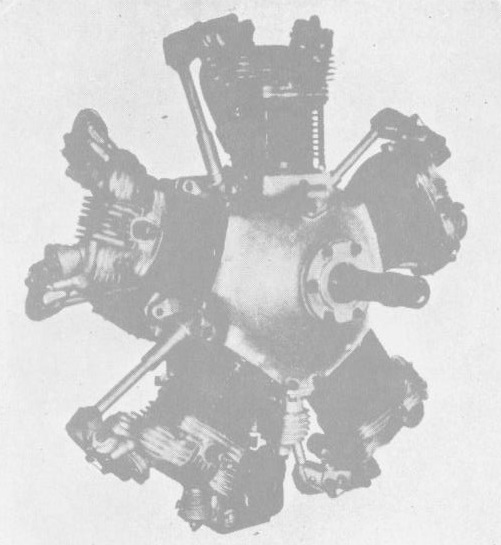
The Lambert R-266 features a solid master connecting rod and two piece crankshaft. A two piece magnesium alloy crankcase, split on the cylinder centreline, is held together with ten bolts. The front section carries the front main ball-bearing and thrust ball-bearing. The inlet passage and valve lifter guides are cast in the rear section.

Cylinder barrels are nickel semi-steel castings. Removable cylinder hads of aluminium alloy with exhaust and inlet ports toward the rear, are held in place with four long studs which run through the crankcase. Enclosed valve actuating mechanism is at the rear of the cylinders.

Accessories and their drives are grouped at the rear making for easy cowling.

Equipment incules a propeller hub, exhaust ring, carburettor air heater and muffler, tool kit, and instruction and parts book.

Type: 5 cylinder air cooled, fixed radial
Dept of Commerce Rating: 90 hp at 2375 rpm
Displacement: 266 cu.in
Compression ratio: 5.55-1
Bore: 4 1/4 in
Stroke: 3 3/4 in
Length: 30 3/8 in
Diameter: 33 in
Weight: 214 lb
Fuel consumption: not more than .55 lb/hp/hr
Oil consumption: not more than .025 lb/hp/hr
Lubrication: Pressure and dry sump
Ignition: Dual Scintilla
Carburation: Stromberg NAR 3
Spark plugs: 2 per cylinder Champion

Lambach HL.II / Delft Student Aeroclub Lambach HL.II

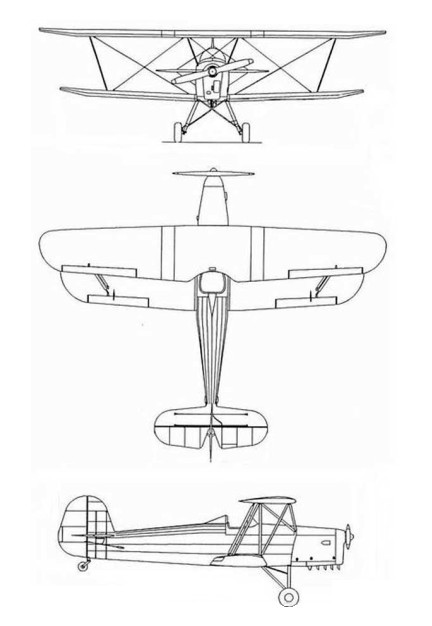
As next project, Lambach designed a small single-seat biplane intended for aerobatics. It was the intention that at aerobatic contests held in the Netherlands it could beat the German competition. For construction of this new plane, designated as HL-2, Lambach founded the Lambach Aviation works. It was housed in the ‘Starlift’ elevator factory at Voorburg near The Hague. The HL-2 was flown for the first time from Ypenburg airfield on 4 May 1937 by Hein Schmidt-Krans, carrying the civil registration PH-APZ. The plane showed to have excellent flying characteristics, but because there was little time to practice for the next aerobatic contest held at Eelde airfield it scored a 3rd place only with German pilots on 1st and 2nd place. Pilot on the HL-2 during this event was again Schmidt-Crans.

After this contest it was handed over to the national aviation school NLS for training of future aerobatic pilots. However, during the 1938 aerobatic contest the Germans won again very convincingly! Pilot of the HL-2 on this occasion was Dick Asjes who finished at the 7th and last place. Because of the worsening international situation no contest was held in 1939. During the five-days war in May 1940 the HL-2 was destroyed at Ypenburg by German bombs. Although Hugo Lambach designed as the HL-3 an attractive high-wing twin-engine passenger plane the Lambach factory was soon closed and Hugo Lambach joined the Fokker aircraft works. He died in July 1972.

Replica: Delft Student Aeroclub Lambach HL.II Replica

Lambach HL.I / Delft Student Aeroclub Lambach HL.I

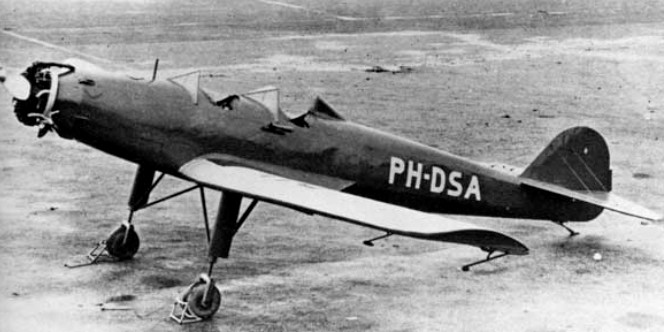
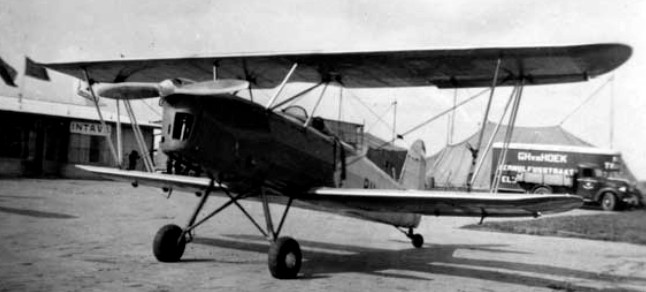
When in the early 1930s members of the Delft Student Aeroclub were trying to bring down the costs of tuition they decided that in the absence of public finance they would build their own aircraft. J.W.H. (Hugo) Lambach, a former DSA member, was asked to design a machine which would be cheap to produce and operate. A group of about twenty-five students set about its construction; some members of Pander Aircraft, including their chief designer Theo Lock, also assisted from time to time. Work began in the spring of 1934 and the Lambach HL.I made its first flight on 5 July 1935, piloted by Dick Asjes.

The HL.I was a cantilever low wing monoplane with wings of constant chord and rounded tips. Its tail was conventional, with a braced, straight tapered horizontal tail mounted on top of the fuselage and a largely rounded vertical tail with a rudder which extended below the tailplane, moving within an elevator cut-out.

Its fuselage was round in section and tapered a little both forward and aft of the wings. The front open cockpit was just ahead of the wing leading edge and the rear one, from which the HL.I was flown solo and which had a short, faired headrest, was at about two-thirds chord. During early testing the HL.1 was configured as a single seater; it was also initially powered by a 34 kW (45 hp) Szekely SR-3 three cylinder radial engine installed with its cylinder heads exposed for air cooling, but this proved unreliable and was replaced by a 67 kW (90 hp) Pobjoy Niagara seven cylinder radial, also with cylinders exposed. Both engines drove two blade propellers. The HL.1 had a fixed, conventional undercarriage with its mainwheels on tall, vertical, largely faired legs braced laterally by an inverted V pair of struts and longitudinally by trailing struts; there was also a tailskid.
Operational history

The HL.I was appropriately registered as PH-DSA on 1 January 1936. In March the DSA transferred it to the Nationale Luchtvaartschool (National Flying School) at Ypenburg Airport where it served until the Germans invaded the Netherlands on 10 May 1940. The HL.1 avoided destruction by bombing which took many Dutch aircraft that day. The aircraft began to degrade after being moved out of its hangar by German forces and it was eventually handed back to the Technical University of Delft for instructional purposes, where it was dismantled.

Engine: 1 × Pobjoy Niagara, 67 kW (90 hp)
Propeller: 2-bladed
Wingspan: 11.20 m (36 ft 9 in)
Length: 7.70 m (25 ft 3 in)
Gross weight: 585 kg (1,290 lb)
Maximum speed: 140 km/h (87 mph; 76 kn)
Seats: Two
Laird, Charles L.

Charles L Laird, Wichita KS.
Brother of Matty Laird.
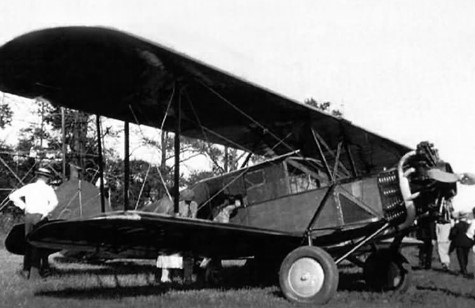
Charles Laird of Wichita, Kansas, built the Whippoorwill cabin biplane and changed company name in 1927 to avoid confusion with his brother “Mattie” of E. M. Laird Airplane Company.

1930: Aircraft Engineering, Chicago IL.

Charlie Laird established Aircraft Engineering (unrelated to the parent company for ACE biplane) in Chicago after he left Wichita in 1930, also had a hand in the Greer College Bryan-Laird B-1B N516K.

Laird-Turner LTR 14 Pesco / (Lawrence) Brown Pesco Special

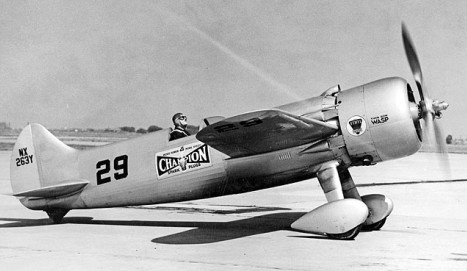
The Laird-Turner LTR 14 Pesco (or (Lawrence) Brown Aircraft Co Special / Pesco Special) was designed by Howard Barlow and Roscoe Turner, and built by the (Lawrence) Brown Aircraft Co of Montebello CA., USA, in 1937. It was sometimes known as the Turner-Laird because of its Laird-built wings, originally 22’0″.

Registered NR263Y Ring-Free Meteor, it was renamed by Turner in 1938 for sponsor Pesco Pump Co, and won the 1938 and 1939 Thompson Trophies.

Engine: P&W Twin Wasp, 1830 hp
Wingspan: 25’0″
Length: 23’0″
Max speed: 330 mph
Stall: 87 mph
Seats: 1

Laird LC-DW-500 Super Solution

In the Super Solution, Doolittle had won the 1931 Bendix and gone on to set a transcontinental speed record of 2,882 miles in 11 hours, 16 minutes, and 10 seconds, while averaging 217 mph. But in the seventh lap of the Thompson, the plane’s 525-hp Pratt & Whitney Wasp Junior radial engine blew a piston, forcing Doolittle to drop out.

Less than two weeks remained before Labor Day weekend and the 1932 National Air Races at Cleveland, Ohio. The main events—the Burbank-to-Cleveland Bendix Trophy endurance race and the closed-course, 100-mile Thompson Trophy dash—demanded two very different types of aircraft, but Doolittle believed he had a plane capable of winning both.
The pace of innovation meant that not even the Super Solution could age a year without the threat of obsolescence. Figuring the decreased drag would more than offset the increased weight, Doolittle replaced its fixed, spatted wheels with a retractable landing gear. He was about to regret the decision. As he attempted to winch down the hand-cranked gear, which had functioned according to plan in ground tests, the pressure of the slipstream prevented the wheels from deploying.

“I spent two hours trying to jar the gear loose…nothing worked,” recalled Doolittle. Finally he resigned himself to bellying in the LC-DW-500. He emerged unhurt, but with the plane’s prop blades bent and fuselage crumpled, the Super Solution would never make the Nationals.