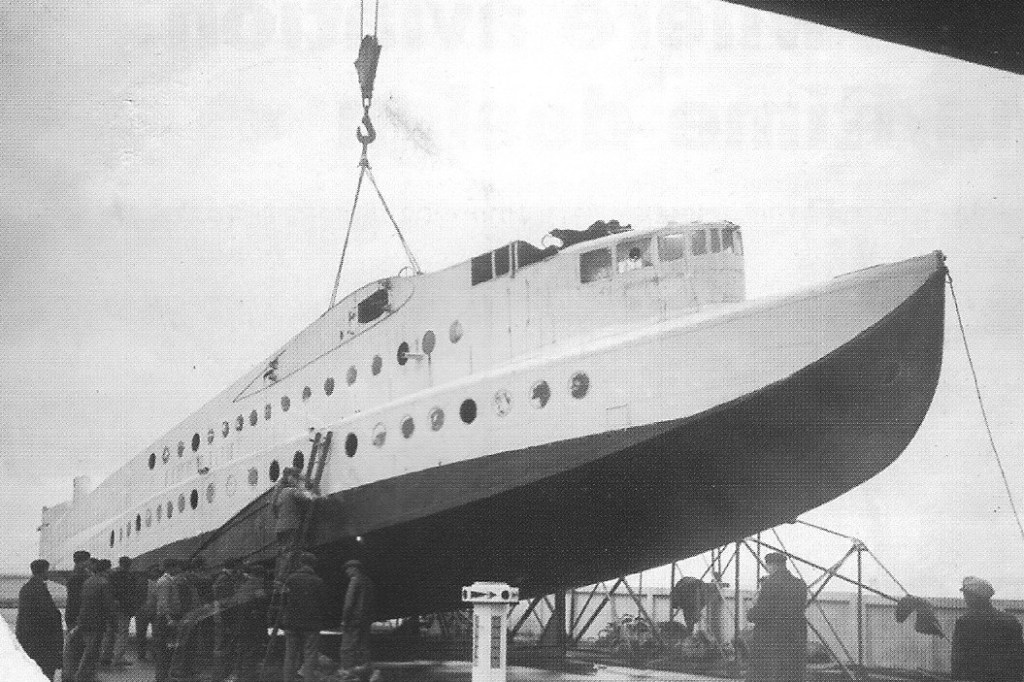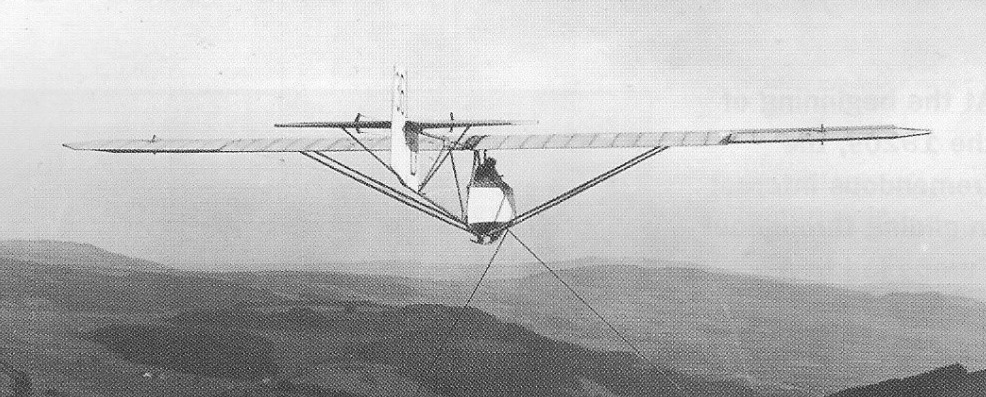
Laubenthal Württemberg / Akaflieg Darmstadt Württemberg

The Akademische Fliegeruppe Darmstadt also received some orders from individuals or club and these, built in ones or twos, were client named, received no D- number and brought welcome funds to the group. These, too, were sometimes also designed by student teams and often built by them.

The Württemberg was made for Wolf Hirth, who named it after his home state. The Württemberg was a high, cantilever wing aircraft. Its wing, like the rest of the aircraft was wooden and covered with a mixture of plywood and fabric. It was built around a single spar, with ply covering from it around the leading edge forming a torsion-resistant D-box. Behind the spar the wing was mostly fabric covered. In plan there was a rectangular centre section that filled about 40% of the span and tapered outer panels tapering to elliptical tips. The ailerons filled about 40% of the span from the tips.

The Württemberg’s wing was mounted over the fuselage on a low, ply covered pylon which sat on top of the fuselage and extended well behind the wing trailing edge, gradually decreasing in height. Its open, unscreened cockpit was partly under the leading edge. The fuselage was ovoid in cross section, tapering and becoming more pointed on its underside aft. It was entirely ply covered. All tail surfaces were built in a similar way to the wing. Both rudder and elevators were all-moving and balanced, with straight edges, rounded tips and with their short mountings faired into the fuselage. The rudder extended down to the keel, so a generous cut-out in the elevators was provided for its movement. The Württemberg had a short landing skid under the forward fuselage and a spring type tailskid.

A second Württemberg was completed in 1929 at the Klemm Leichtflugzeugbau GmbH (“Klemm Light Aircraft Company”) for the Württembergischer Luftfahrt-Verband (Aeronautical Association Württemberg) at Stuttgart, with slightly greater wing area and a shorter fuselage.

First flying in 1927, in 1928 Hirth flew the Württemberg in France at the International contest at Vauville, on the Channel coast near Cherbourg, with great success. Glider flight here followed the coast over sandhills and relied on slope lift from a West wind; the Württemberg was suited to the weak wind that blew during the competition. He won prizes for the greatest height gain (327 m (1,073 ft)), straight-line distance (29 km (18 mi)), height (1,244 m (4,080 ft)) and for the number of flights lasting more than 30 minutes (10).

Württemberg (1927)
Wingspan: 15.20 m (49 ft 10 in)
Wing area: 15.75 m2 (169.5 sq ft)
Aspect ratio: 14.6
Airfoil: Göttingen 535
Length: 6.465 m (21 ft 3 in)
Empty weight: 149.25 kg (329 lb)
Gross weight: 235 kg (518 lb)
Wing loading: 15 kg/m2 (3.1 lb/sqft)
Crew: One
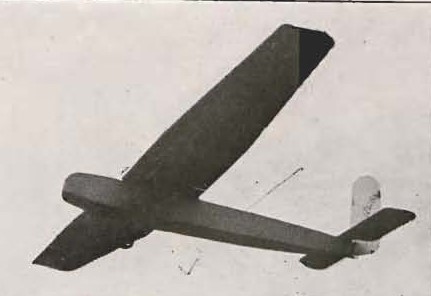
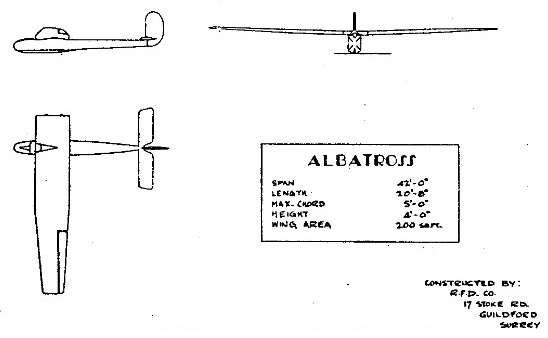
Latimer-Needham Albatross / R.F.D. Albatross

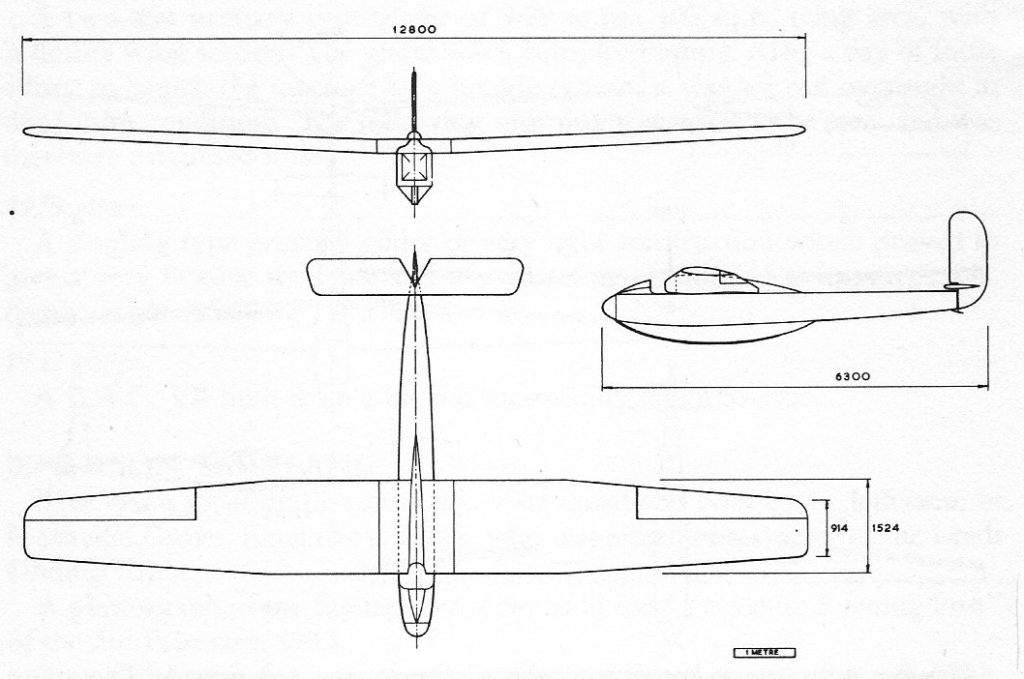
The RFD Company constructed the Albatross to C.H. Latimer-Needham’s design, the first British-designed and built sailplane. It was a conventional wooden single-seat aircraft, its cantilever high wing having a constant chord centre section and outboard straight-tapered panels from about mid-span. Ailerons were fitted from the wing tips over most of the outboard sections but here were no flaps or air brakes. The wing was mounted with slight dihedral on top of the fuselage, which was rectangular in cross section and tapered only a little towards the tail. There were no fixed rear surfaces, both elevators and rudder being all moving. The elevator, mounted on top of the fuselage, had constant chord apart from a cut-out for rudder movement; the latter was tall, with a vertical leading edge and curved trailing edge.

The Albatross’s single-seat open cockpit was at the leading edge of the wing, with a fairing behind the pilot’s head reaching aft beyond the trailing edge. Originally it landed on a skid which was part of a V-shaped ventral extension of the fuselage, running from just behind the nose about half the length of the aircraft. Twin landing wheels were fitted later.

Only one Albatross was built, receiving its Certificate of Airworthiness in October 1930. It appeared at the Glider Show held at The Royal Agricultural Hall, Islington in May 1931.

One owner was A.E. Coltman of the Leicestershire Air Sports Club who did some soaring at Sutton Bank.

It was later sold to Edwin S Griffis, who was killed when the wing failed when it was being launched at the Furness Gliding Club site at Ireleth on 12 August 1936.

Wingspan: 42 ft 0 in (12.8 m)
Wing area: 180 sq ft (16.72 m2)
Length: 20 ft 8 in (6.3 m)
Aspect ratio: 10
Airfoil: Göttingen 535
Empty weight: 205 lb (93 kg)
Gross weight: 360 lb (163 kg)

Latham

Latham et Cie Societe Industrielle de Caudebec
Hydravions Latham

France
Jean Latham built flying-boats during the First World War. After the war became Latham et Cie Societe Industrielle de Caudebec, later Hydravions Latham, continuing the design and construction of single- and multi-engined flying-boats. In 1920 built the Gastambide-Levasseur variable- incidence biplane. Explorer Raoul Amundsen was lost on the Latham 47-2 searching for the crew of the airship Italia in 1925. In 1929 company amalgamated with Societe d’Emboutissage et de Constructions Mechaniques, later Amiot.

Latécoère Late 631

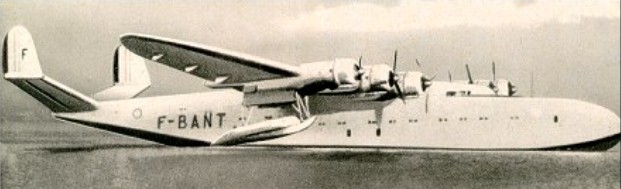
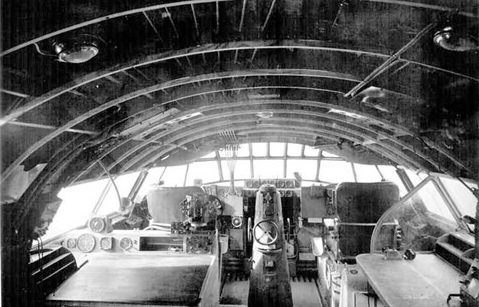
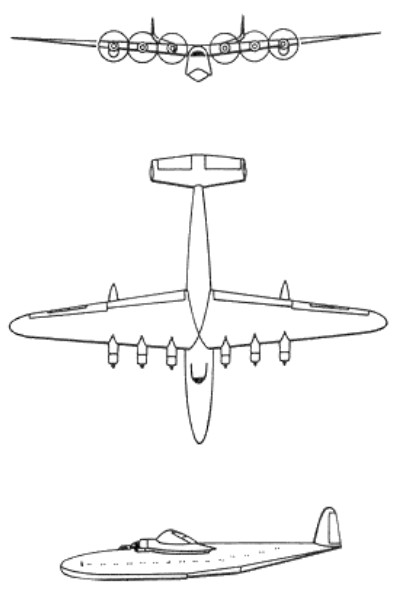
Developed in 1939, construction of the L.631 was interrupted by the war. The prototype Late 631 flew for the first time on 4 November 1942. It was a high-wing monoplane flying-boat powered by six 1,192kW radial engines. Accommodation was provided for 46 passengers in two- or four-berth cabins. However this aircraft was confiscated by the Germans during the occupation of France. It was flown it to the Bodensee (Lake Constance) on the German–Swiss–Austrian border. In 1944, it was attacked and destroyed at anchor by RAF Mosquitos.

Despite the war raging through France, Latécoère managed to complete the first production model in March 1945, now powered by Wright Cyclones instead of its original Gnome et Rhône engines.

In October of 1945 a propeller on F-BANT separated in flight with a blade slicing through the cabin and killing two passengers. Four production models were bought by Air France and inaugurated transatlantic services between their base at Biscarosse, south-west of Bordeaux, and Fort-de-France in Martinique on 26 July 1947.

Other operators were SEMAF (Société d’Exploitation du Matériel Aéronautique Français) and SFH (Société France Hydro).

The first Transatlantic Flight, Geneva, Switzerland to Fort de France, Martinique by “Latecoere 631” was on June 14, 1948. They covered the distance of nearly 5000 km in 16 hours.

A special mail flight arrived at Fort de France on June 16th, 1947. The plane disappeared on its return flight.

In February of 1948, F-BDRD crashed in the English Channel during a snowstorm killing all 19 on board. After just over one year of service, there was the total loss, with all passengers and crew, of F-BDRC on 1 August 1948. In March of 1950, F-BANU was lost off the coast of France, again with no survivors and finally in 1955, SFH’s F-BDRE had a wing failure, crashing with the loss of half of the 16 people on board.

The Societe France-Hydro operated one on cargo services in French Equatorial Africa for three years, but it crashed: after which all remaining Late 631 were broken up.

Latécoère 631

Production total: 11
F-BAHG 01 First flown 4/11/1942
F-BANF (not completed)
F-BANT 02 First flown 6/03/1945
F-BANU 3 First flown 15/06/1946
F-BDRA 4 First flown 22/05/1947
F-BDRB 5 First flown 5/09/1947
F-BDRC 6 First flown 9/11/1947
F-BDRD 7 First flown 26/01/1948
F-BDRE 8 First flown 28/11/1948
F-BDRF 9 First flown 20/11/1948
F-BDRG 10 First flown 7/10/1949
F-BDRH 11 not completed

Engines: 6 x Wright Cycl. GR 2600-A5B, 1175kW
Max take-off weight: 71350 kg / 157301 lb
Empty weight: 32332 kg / 71280 lb
Wingspan: 57.4 m / 188 ft 4 in
Length: 43.5 m / 142 ft 9 in
Wing area: 350.0 sq.m / 3767.37 sq ft
Max. speed: 405 km/h / 252 mph
Cruise speed: 320 km/h / 199 mph
Range w/max.fuel: 6000 km / 3728 miles
Crew: 6
Passengers: 70

Latecoere L.631 Lionel de Marmier

Latécoère Laté 610 / 611 / 612

The Latécoère Laté 610 Series were 1935 4-engined long-range flying boats

Laté 610: [Project] May 1935 recce flying boat for Aéronavale
Laté 610 as designed, single fin, span 38 m, length 24.5 m
Laté 611: enlarged recce flying boat to mod. Dec 1935 spec.
Laté 611 as planned, 4 x 1000 hp HS.79.02 radials
Laté 611-01: 1939, conv. under const. to 4 x 10¹⁰ hp G-R 14N4/5
Laté 611-01, G-R 14N30/31 engines substituted after trials
Laté 612 diff. in having 4 x powered turrets (incl. tail turret)

Latécoère Late 521 Lieutenant de Vaisseau Paris / Late 522 / Late 523

The Late 521 was a flying-boat with strut-braced high wings and short stub sponsons. Named Lieutenant de Vaisseau Paris, it was powered by six 641kW Hispano-Suiza 12Ycrs engines (inboard engines mounted as tandem pairs) and flew for the first time on 17 January 1935. A total of 76 passengers could be accommodated on the two decks of the two-step hull. The craft sank in a storm on its inaugural flight to the USA, but was salvaged and rebuilt with 484.4kW Hispano-Suiza 12Nbr engines. It subsequently established seaplane load-over-distance and load-to-height records in 1937.

Latecoere 521 Article

The Late 522 (powered by six 671kW Hispano-Suiza 12Y37 engines) appeared in April 1937 but World War II prevented a regular transatlantic service. Both the Late 521 and 522 were impressed into French Navy service on 1 September 1939, three naval Late 523 having already been delivered between January and October 1938. These were armed with five 7.5mm Darne machine-guns and carried up to 1,200kg of bombs. Maximum endurance was 33 hours.

The Late 522 returned to passenger service in March 1940. The remaining aircraft of the series performed Atlantic patrols with Escadrilles E6 and E12. One Late 523 had been lost in September 1939, a second was scuttled in June 1940; and the Late 521 was demobilised in August of that year. The surviving Late 523 was grounded in August 1942, having flown with Escadrille 4E out of Dakar since June 1941. The Late 521 and 522 were destroyed at Berre by retreating Germans in August 1944.

Late 521

Variants:
Laté 520: [Project] 1930-33, 4 x 1000 hp HS.18 Sbr, engine abandoned
Laté 521: 1935, 6 x 860 hp HS.12Ybrs (2 x tandem pairs, 2 x tractors)
Laté 521 sunk at Pensacola in hurricane, to France for rebuilding
Laté 521: 1937, rebuilt with 6 x 650 hp HS.12Nbr (later to mil.)
Laté 521: 1939, Aéronavale serv., 970 hp HS.12Y-37 then 900 hp ’27
Laté 522: 1939, Air France transatlantic serv., 970 hp HS.12Y-37
Laté 522: 1939, Aéronavale, 900 hp HS.12Y-27, then back to ’37
Laté 523: 1938, Aéronavale recce vers., 900 hp HS.12Y-27, 3 built

Engines: 6 x HS 12 Ybrs, 630kW
Max take-off weight: 37400 kg / 82453 lb
Empty weight: 21480 kg / 47356 lb
Wingspan: 49.3 m / 161 ft 9 in
Length: 31.6 m / 103 ft 8 in
Wing area: 330.0 sq.m / 3552.09 sq ft
Max. speed: 250 km/h / 155 mph
Cruise speed: 213 km/h / 132 mph
Ceiling: 6300 m / 20650 ft
Range w/max.fuel: 5800 km / 3604 miles
Crew: 6
Passengers: 70