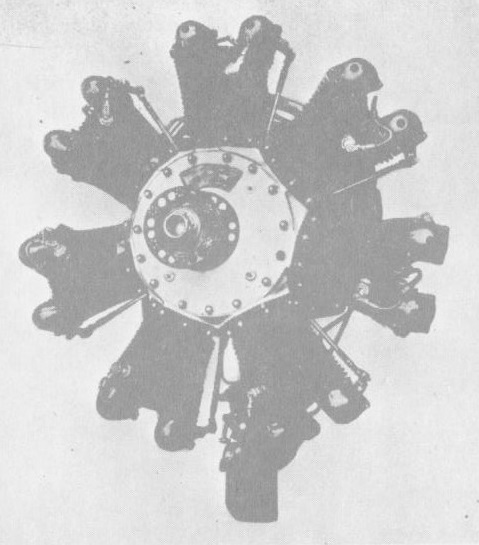
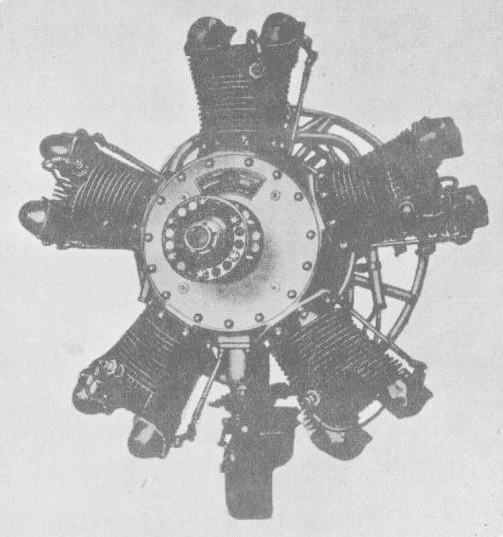
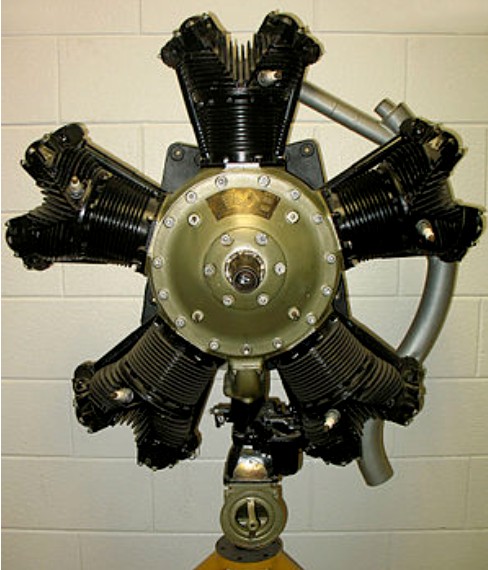
The LeBlond 90-7D was available with an Eclipse electric starter at extra cost.
Type: 7 cylinser air cooled radial Approved Type Certificate No.20 Rating: 90 hp (67.1 kW) at 1975 rpm Displacement: 351 cu.in (5.75 L) Compression ratio: 5.42-1 Bore: 4 1/8 in Stroke: 3 3/4 in Length: 23 1/16 in Diameter: 32 3/4 in Weight: 285 lb Fuel consumption: not more than .55 lb/hp/hr Oil consumption: not more than .015 lb/hp/hr Lubrication: Dry sump, full pressure feed Ignition: Duan Scintilla Carburation: Stromberg Spark plugs: 2 per cylinder Champion Price: $1610
Introduced in 1928, the 60-5D was a 60 hp (45 kw) 5-cylinder, air-cooled, radial piston engine with a displacement of 234 cu.in (3.8 l). This model used iron cylinder heads and was a direct development of the Detroit Air Cat. An Eclipse starter was available at extra cost.
Type: 5 cylinder air cooled radial Approved Type Certificate No.12 Rating: 65 hp at 1950 rpm Displacement: 351 cu.in Compression ratio: 5.42-1 Bore: 4 1/8 in Stroke: 3 3/4 in Length: 22 1/4 in Diameter: 32 3/4 in Weight: 222 lb Fuel consumption: not more than .55 lb/hp/hr Oil consumption: not more than .015 lb/hp/hr Lubrication: Dry sump, full pressure feed Ignition: Dual Robert Bosch Carburation: 1 Stromberg Spark plugs: 2 per cylinder Champion Price: $1230
The LeBlond radial engines were a family of 5-cylinder and 7-cylinder, air-cooled radial engines for aircraft, built in the 1930s by the LeBlond Aircraft Engine Corporation.
Variants:
LeBlond 70-5DE Introduced in 1930, the 70-5F was a 70 hp (52 kw) at 1,950 rpm 5-cylinder, air-cooled, radial piston engine, (4.125 x 3.75 = 250.57 cuin (4.11 l)), using iron cylinder heads and two bearings.
LeBlond 85-5DF Introduced in 1930, the 85-5F was a 85 hp (63 kw) at 1,975 rpm 5-cylinder, air-cooled, radial piston engine, (4.25 x 3.75 = 265.99 (4.36 l)), using aluminum cylinder heads and three bearings.
LeBlond 70-5E Introduced in 1930, the 70-5E was a 70 hp (52 kw) 5-cylinder, air-cooled, radial piston engine. Production of the 5E continued in production under Ken-Royce as the Rearwin Ken-Royce 5E.
LeBlond 80-5F Introduced in 1930, the 80-5F was an 80 hp (60 kw) 5-cylinder, air-cooled, radial piston engine with a displacement of 266 cubic inches (4.4 litres) Using three bearings as developed for the earlier 5DF series, the LeBlond 5F was introduced in 1930. When aircraft powered with the 5F were commandeered by the U.S. Army, the engine was re-designated the R-265. This engine was the last of the so-called ‘greasers’. Production of the 5F continued under Ken-Royce as the Rearwin Ken-Royce 5G.
LeBlond 85-5DF Introduced in 1930, the 85-5F was an 85 hp (63 kw) 5-cylinder, air-cooled, radial piston engine with a displacement of 266 cubic inches (4.4 litres)
LeBlond 90-5F Introduced in 1930, the 90-5F was a 90 hp (68 kw) 5-cylinder, air-cooled, radial piston engine with a displacement of 266 cubic inches (4.4 litres)
LeBlond 90-5G Introduced in 1930, the 90-5G was a 90 hp (68 kw) 5-cylinder, air-cooled, radial piston engine with a displacement of 266 cubic inches (4.4 litres) Production of the 5G continued under Ken-Royce as the Rearwin Ken-Royce 5G.
LeBlond 110-7DF 110 hp (82.1 kW) at 2,150rpm 4.25 x 3.75 = 372.39 cu in (6.10 L) (Rearwin (Ken-Royce) after 1937)
LeBlond 120-7
Applications: Aeronca L Arrow Sport Rearwin Sportster Vulcan American Moth Monoplane
USA W. Lawson of Wisconsin designed a pursuit aircraft in 1918; not built. Followed by two-seat training biplane, and the twin-engined L-2 of 1920, built for the Lawson Airline Company. The L-4 three-engined airliner of 1922-1923 had sleeper berths and a shower.
After the end of World War I, the Lawrance engineers worked with both the Army and the Navy in developing their L-1 onto a nine-cylinder radial engine, which became the 200 hp Model J-1. It was the best American air-cooled engine at the time and passed its 50-hour test in 1922.
The U.S. Navy badly needed light, reliable engines for its carrierborne aircraft. As a means of pressuring Wright and other companies into developing radial engines, it gave a contract to Lawrance for 200 of the J-1 radial and ceased buying the liquid-cooled Wright-Hispano engines. At the urging of the Army and Navy the Wright Aeronautical Corporation bought the Lawrance Company, and subsequent engines were known as Wright radials. The Wright Whirlwind had essentially the same lower end (crankcase, cam, and crankshaft) as the J-1.
The Lawrance Aero Engine Company was founded in 1917 by Charles Lawrance. After the end of World War I, the Lawrance engineers worked with both the Army and the Navy in developing their L-1 into a nine-cylinder radial engine, which became the 200 hp Lawrance J-1. It was the best American air-cooled engine at the time, and passed its 50-hour test in 1922.
The United States Navy was very enthusiastic about air-cooled radials, but was concerned that Lawrance couldn’t produce enough engines for its needs. The Navy suggested to Wright that it purchase the Lawrance company and build the J-1 itself. In May 1923, Lawrance was purchased by Wright Aeronautical, with the J-1 being further developed by Wright into the J-5, J-6, and R-795.
Laville DI-4 (Russian: Лавиль ДИ-4) was a prototype two-seat fighter aircraft developed in the Soviet Union in the 1930s.
The chief designer Henri Laville was one of several French aviation specialists invited to work in the Soviet Union and the DI-4 layout was typical of the French trend at the time with a high-mounted gull wing (first for a Soviet aircraft) and all-metal construction.
First flying on 4 January 1932, the test flight program was completed in 1933 but despite good performance the aircraft did not enter mass production, in part because Soviet Union had no plans to purchase the Curtiss V-1570 engine. Only the one was built.
Powerplant: × Curtiss V-1570 Conqueror, 448 kW (601 hp) Propeller: 2-blade fixed-pitch Wingspan: 13.3 m (43 ft 8 in) Wing area: 23.9 m2 (257 sq ft) Length: 8.5 m (27 ft 11 in) Empty weight: 1,448 kg (3,192 lb) Gross weight: 1,949 kg (4,297 lb) Maximum speed: 266 km/h (165 mph, 144 kn) Range: 500 km (310 mi, 270 nmi) Service ceiling: 6,440 m (21,130 ft) Time to 5,000 m (16,404 ft): 17 minutes Wing loading: 81.5 kg/m2 (16.7 lb/sq ft) Power/mass: 0.230 kW/kg (0.140 hp/lb) Horizontal turn time: 15 seconds Crew: 2