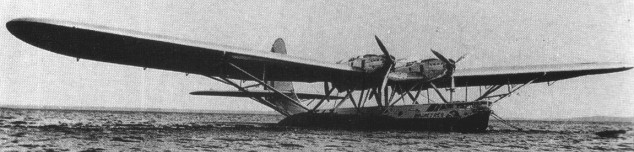
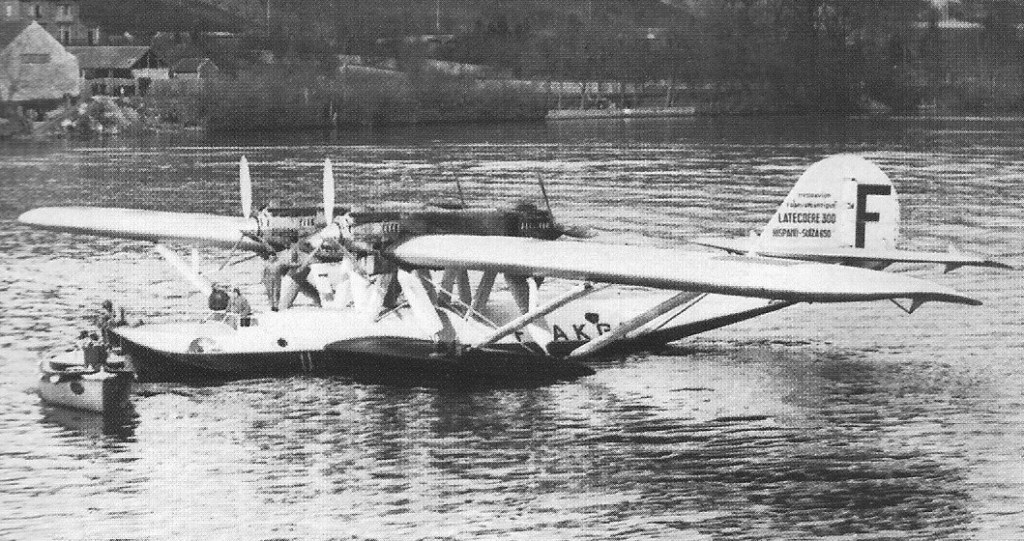
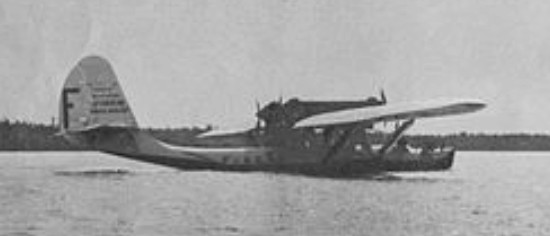
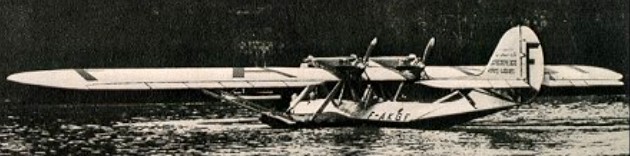
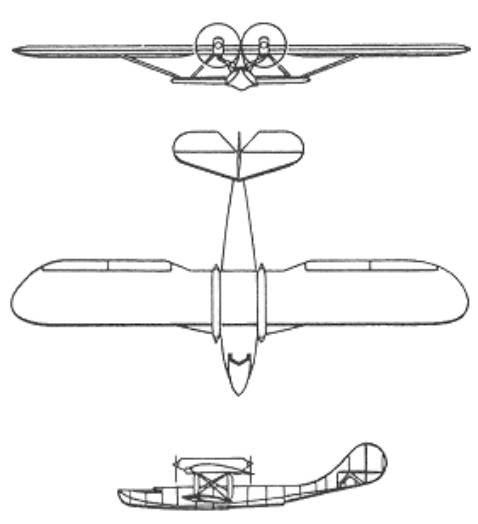
The Latécoère 300.01 was the company’s first four-engined flying-boat and flew originally in 1931, but sank in the Etang de Berre, near Marseilles, later that year. When salvaged it was re¬built and named Croix du Sud (First flight 7 October 1932) with four 650 hp / 484.4kW Hispano-Suiza 12NBr water-cooled engines in tandem pairs. On 31 December 1933 Croix du Sud set up a new international class record by flying the 2,285 miles (3,679 km) from Berre to St Louis (Senegal) in just under 24 hours.
It operated the Air France South Atlantic mail service between Dakar, Senegal and Natal, Brazil. It completed 23 missions before being lost at sea on December 7, 1936. The pilot was the famous French aviator Jean Mermoz.
Jean Mermoz’s Croix du Sud. Latécoère 300 in 1936
Three improved Latécoère 301 aircraft with 485-kW (650-hp) Hispano-Suiza l2Nbr engines were built during 1935-6, incorporating changes made to the Late 300 in 1935, including increased wing dihedral and enlarged tail surfaces. The all-metal two-step hull accommodated a four-man crew with sleeping accommodation, mail load and most of the fuel.
The first of the 301s was lost, the remaining two were used in South Atlantic service until 1939. In 1939 the last remaining 301 was converted to military service, joining the 302s in patrol duties in West Africa.
The basic type’s long-range performance attracted the attention of the French Navy, and in 1936 the French naval air service received three examples of the Latecoere 302, a fully navalised version of the Latécoère 301, with 930-hp / 693kW Hispano-Suiza 12Ydrs engines, between 1935 and 1936. They had machine-gun posts in bow and two beam positions, as well as two in the engine nacelles. Bomb load was 300kg. The aircraft supported a crew of four and included sleeping accommodations. Fuel and payload were stored inside the hull.
Late 302 equipped Escadrille E4 at Berre, joined by the last civil but militarised Late 301 in August 1939. These were operated in the patrol role, operating from West Africa together with a single navalised Latécoère 301 until scrapped in 1941.
Laté 300 – 1931 flying boat for Aéropostale (Dakar-Natal), 4 x 650 hp HS.12Ner Laté 300-01: aground Berre Dec 1931, rebuilt 1932 as Croix-du-Sud Laté 301: 1934-35 version for Air France, 3 built (2 later to military) Laté 301 to Aéronavale: 2/1017 for spares, 3/1018 to part Laté 302 std. Laté 302: 1936 version for Aéronavale, 4 x HS.12Ydrs, 3 built Laté 302 crew of 8 (inst. of 4), 3 x Darne MGs, 4 x 75 kg bombs
Variants:
Laté 300 Mailplane with Hispano-Suiza 12Nbr engines, one built.
Laté 301 Mailplane with Hispano-Suiza 12Nbr engines, three built.
Laté 302 Maritime reconnaissance aircraft with Hispano-Suiza 12Ydrs engines, three built.
Latécoère 300.1 Engines: 4 x Hispano-¬Suiza 12 Nbr, 750 hp, Propeller: three blade. Wing span: 145 ft 0.25in (44,20 m). Length: 84 ft 9in (25.83 m). Wing area: 2.798.6 sq.ft (260 sq.m). Gross weight: 50,706 lb (23,000 kg). Max speed: 130 mph (210 kph) at S/L. Typical range: 2,985 miles (4,800 km). Crew: 4. Pas¬senger/mail payload: 2,910 lb (1,320kg).
Latécoère 301
Latécoère 302 Engines: 4 × Hispano-Suiza 12Ydrs2, 694 kW (930 hp) each Length: 26.16 m (85 ft 9.5 in) Wingspan: 44.01 m (144 ft 4.25 in) Height: 7.98 m (26 ft 2⅛ in) Wing area: 258 sq.m (2,755.6 sq.ft) Empty weight: 14,340 kg (31,548 lb) Loaded weight: 24,050 kg (52,911 lb) Maximum speed: 240 km/h, 130 knots, 149 mph at 2,000 m (6,560 ft) Cruise speed: 185 km/h (xx100 knots (190 km/h), 115 mph (185 km/h)) Range: 3,300 km (1,783 nm, 2,050 mi (3,300 km)) Range w/max.fuel: 4800 km / 2983 miles Service ceiling: 5,000 m (xx16,400 ft (5,000 m)) Wing loading: 93.2 kg/sq.m (19.2 lb/sq.ft) Power/mass: 0.11 kW/kg (0.070 hp/lb) Endurance: 20 hours at 150 km/h (93 mph) Climb to 2,000 m (6,560 ft): 12.5 min Armament Guns: 1 7.5 mm (0.3 in) Darne machine gun in bow, 2 firing through beam windows Bombs: 4 x 75 kg (165 lb) bombs Crew: 8 Armament: 5 or 7×7.5-mm (0.295-in) Darne machine-guns plus provision for up to 300 kg (661 lb) of bombs under wing. Crew: 4
The design of Latécoère 299 was started on March 8, 1937, when the Marine Ministry of France approved a general program for the renewal of the aircraft fleet.
Among other specifications, an assignment was made for the design of SB aircraft (observer-bomber). The specification was for a single-engine seaplane weighing up to 3,500 kg, a double seaplane weighing up to 1600 kg and a twin-engine aircraft with a folding wing for the carrier “Bearn”. There are several tasks at once: planes must be reconaisance, spotting enemy submarines, dive bombing or torpedo attack, and also covered by friendly vessels with smoke. the max speed should be at least 300 km \ h.
In May 1936, Socièté Industrielle d’Aviation Latécoère successfully tested the Latecoere 298 floatplane. In some parameters, such as the speed, it did not fit into the requirements, but otherwise it was quite suitable for completion of the category SB.
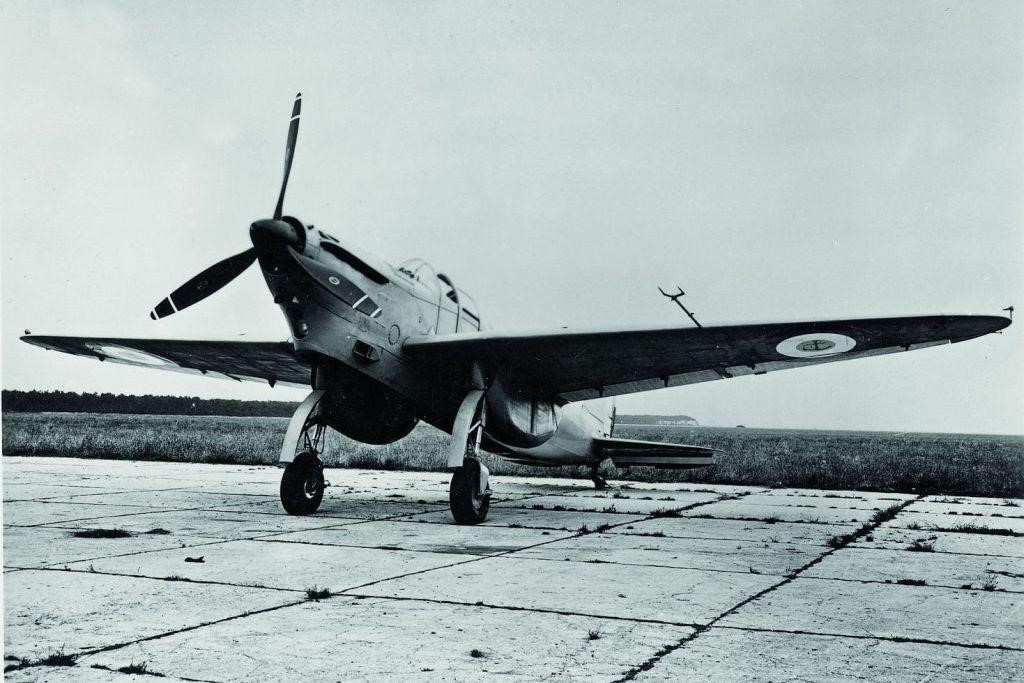
In December 1937 the ministry issued an updated specification, which indicated a speed of 400 km / h, and the folding and unfolding time of the wing should not exceed 3 minutes. In such parameters Latecoere 298 clearly did not fit, so it was necessary to refine the fuselage, tail and wing, and also had to provide for the installation of a more powerful 920 hp HS.12Y-27 motor. In June 1938, the layout of Latecoere 298 was revised accordingly and presented by the evaluation commission. The new aircraft, switched to the usual wheeled undercarriage, was named Latecoere 299. The preliminary design was liked by the higher ranks of naval aviation, especially as it was developed on the basis of the already serial torpedo carrier. The first order for two prototypes was received on July 5, 1938, with the final delivery date no later than July 5 of the following year.
Both prototypes were built and successfully passed tests. The only thing that does not succeed was the maximum design speed. The mass production of the Latecoere 299 was prevented by the capitulation of France. Further development of this aircraft was considered a secondary task and all work on it in July 1940 was stopped. Two Latecoere 299 remained standing in the hangar, and slowly parts were removed for other aircraft.
In the autumn of 1940, work was resumed on the design and construction of a twin-engine fighter Arsenal VB.10 with a tandem arrangement of motors. A few months earlier, the Ministry of Aviation had signed a contract for the construction of 30 serial aircraft, although they had not even begun to build a prototype. This fighter was designed by designers Vernis and Gatier and had very promising characteristics, so VB.10 fell into the category of priority developments. If now there was nowhere to hurry, Verniss “bargained” from the DTI (Office of Advanced Technology) both Latecotere 299 prototypes, the Laté 299-01 and Laté 299-02, both with 970 hp HS.12Y-43 engines.
It was not difficult to do this, as these planes suddenly turned out to be unclaimed. Verniss suggested using them to develop the installation of tandem HS 12Z motors, connected by an Arsenal 200 transmission system and rotating in opposite directions, two coaxial props with a diameter of 3.2 meters. Because of this, the single-seat cockpit was moved closer to the tail. Because of this, it was necessary to make the cabin single and move it closer to the tail, but in the rear part there was a place for a mechanic who could regulate the operation of the power plant.
Reconstruction of the aircraft began in 1942 and after processing it received the new designation Latecoere 299A. When the aircraft was almost ready for testing, it turned out that it was not realistic to get the HS 12Z engines in the near future, and instead of them the less powerful but quite affordable HS 12Y-31 (800 hp) were installed.
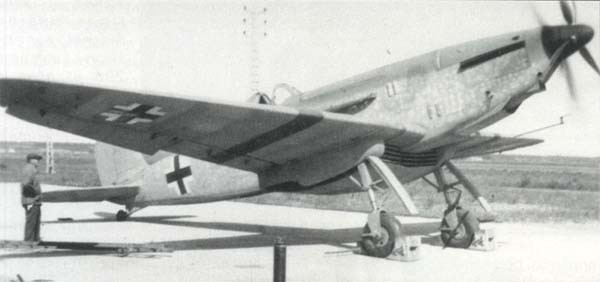
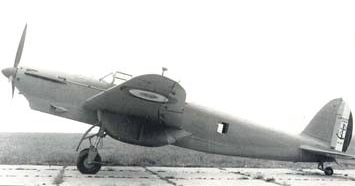
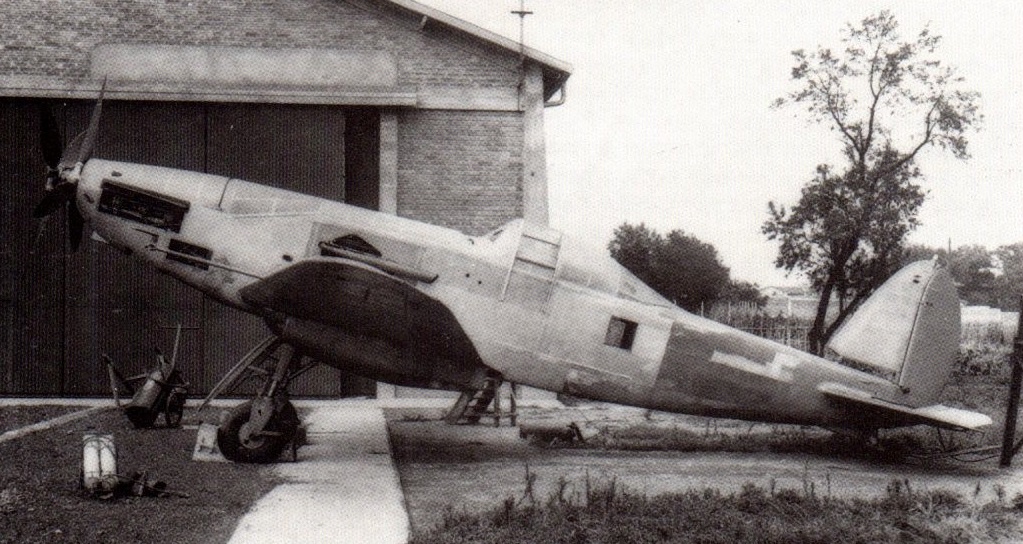
Complete occupation of the country prevented the completion of the matter, but Verniss managed by some miracle to convince the Germans to continue building prototypes, which was done in 1943. As a result of delays, the Latecoere 299A was rolled out onto the take-off field only in April 1944, after two months of preliminary static tests. He never rose into the air. The German pilots at the Bron airbase took several runs on it, ending in capotation with damage to the nose of the fuselage. Latecoere 299A was again sent for repair, where he waited for a raid of allied aircraft. On April 30, 1944, this aircraft burned down in a hangar, leaving Verniss without a test bench.
Late 299 Engine: Hispano-Suiza 12 Y-43, 920 hp Wing span: 15.64 m Wing area: 34.60 sq.m Length: 12.28 m Height: 4.46 m Empty weight: 3170 kg Normal takeoff weight: 4650 kg Maximum speed: 345 km / h Cruising speed: 275 km / h Range: 900 km Rate of climb: 348 m / min Ceiling: 6600 m Crew: 3 Armament: two stationary and one manual 7.5 mm Darne mg Bombload: up to 900 kg
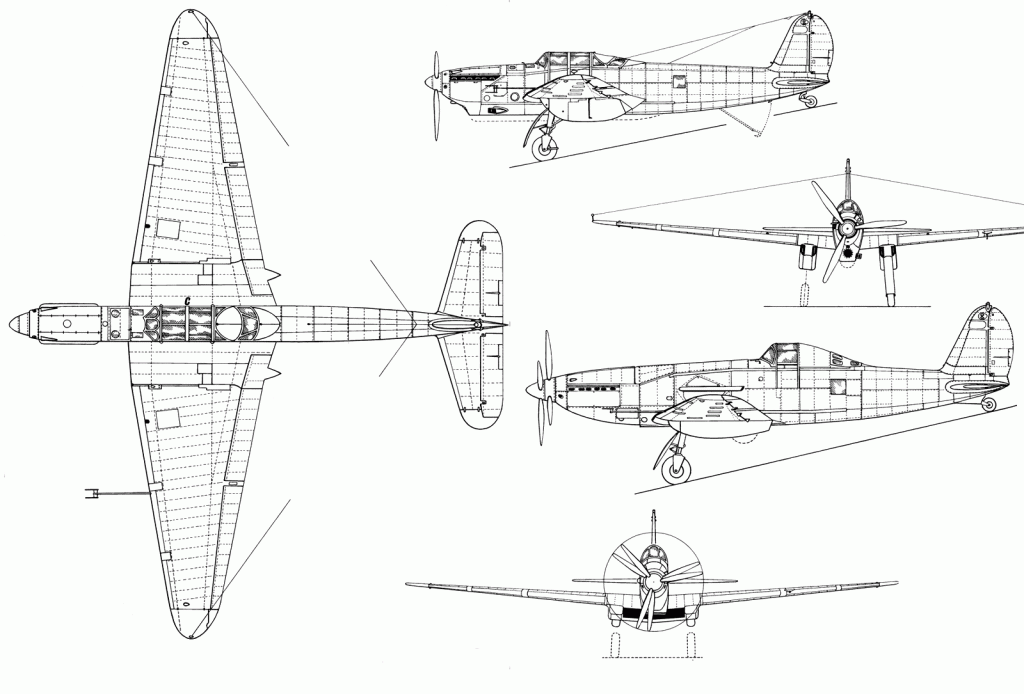
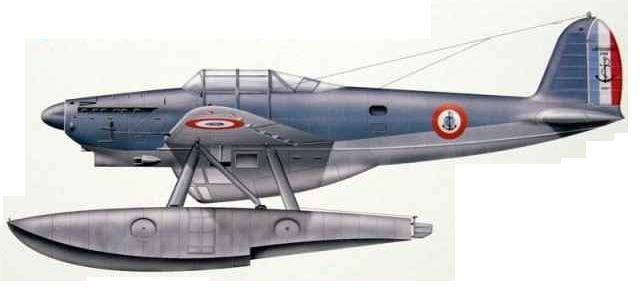
In the early 1930s, the Marine nationale (French navy) was looking to replace its aging Levasseur PL15 and Latécoère 290 torpedo seaplanes. The new aircraft had to be stable in flight, drop torpedoes, dive-bomb, and carry out long-range reconnaissance patrols. Late 298 was designed in the Bureau at the Latecoire plant in Toulouse in 1934. It had to meet the requirements of the task for a modern float torpedo carrier, issued by the fleet command a year earlier. It was assumed that this aircraft will replace Late 29.0.
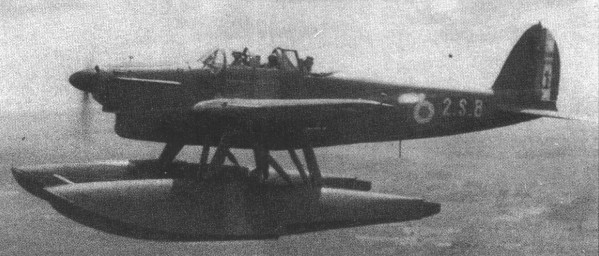
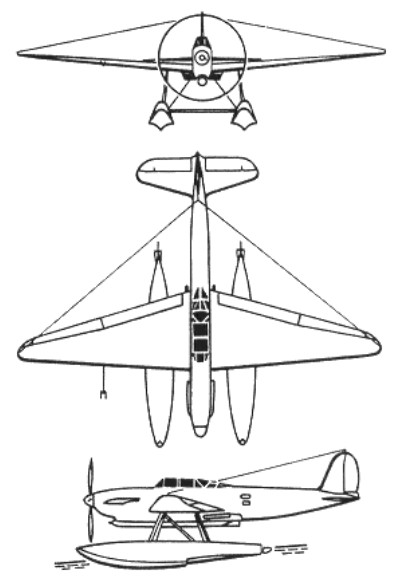
The Laté 298 was a monoplane with large floats, metal structure, and a metal skin with some fabric-covered parts, powered by a Hispano-Suiza 12Ycrs inline engine that drove a Ratier variable-pitch propeller. The radiators were retractable and located below the wing roots. One pilot, one rear gunner, and one navigator/radio operator (who was carried only if required) operated the aircraft. Ordnance could be attached under the fuselage, with provision for a type 1926 DA 670 kg torpedo semi-recessed into the underside of the fuselage. The fuselage could not accommodate the desired 20-mm (0.79-in) Hispano-Suiza HS.9 cannon, leaving forward firing armament to consist of only two 7.5-mm (0.295-in) Darne machine guns in the wings. The rear gunner manned a single mobile weapon of the same type. Intended missions included torpedo bombing; horizontal or shallow dive bombing (with two bombs of up to 150 kg each); long-range reconnaissance (with extra 535 litre fuel tank); night reconnaissance; and smokescreen laying. In each of the floats there was a 260 liters fuel tank. The horizontal wing was all-metal, and the vertical fin had metal frames and wooden ribs, fabric covered. The floats were attached to the wings with N-shaped struts and paired struts to the fuselage.
The Aéronautique navale (naval aviation) authorities accepted the project for evaluation, and SILAT built the first prototype in Toulouse-Montraudan. The Late 298-01 was collected in the spring of 1936 and transported to Saint-la-Raur-de-la-Salanca, where tests were to be conducted on Lake Locate. Its maiden flight took place May 8, 1936 from St-Laurent-de-la-Salanque.
The plane flew 24 hours and 35 minutes on tests. Factory tests ended on September 24, 1936. During the tests a strut was installed between the two floats. It was preserved on all subsequent machines. On September 25, Late 298-01 flew to Saint-Raphael for official tests.
On June 22, 1938 Late 298-01 took to the air with a Ratier automatic prop. Equipped with an electrical control step, similar to that of the first production aircraft in Biskarossa. Fuselages and floats for them were manufactured in Montadran, and wings and tail fins in Angle near Bayonne.
On March 17, 1937, the French fleet ordered 36 seaplanes, 12 of which were to be distinguished by the folding of the outer sections of the wing for operation at the Commandan Test.
Since October 28, 1938, the Late 298-01 began to be used for retraining pilots in Saint-Raphael, where they were temporarily deployed by squadron T2. At the beginning of the next month, the personnel of the T1 squadron joined the retraining process.
Accordingly, on August 10, contracts were signed for 24 Late 298A aircraft without folding the wing and 12 Late 298B with folding of the outer sections of the wing.
A cantilever low-wing monoplane with an all-metal oval-section stressed-skin fuselage, production orders were placed for 177 Latecoère 298s in three variants. The first production Late 298A flew in October 29 in Biskarossa.
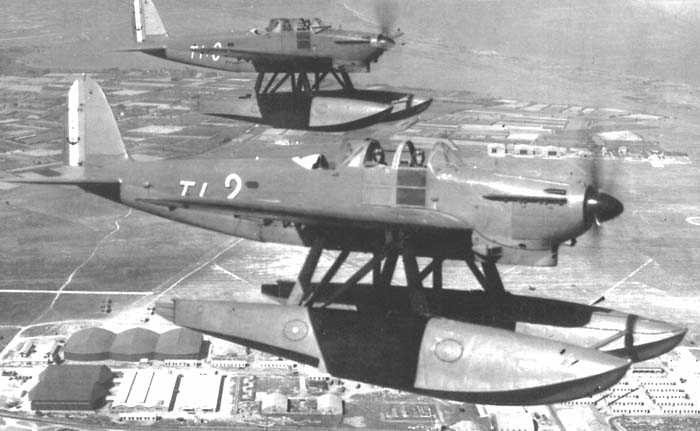
The first examples delivered to operational units, in January 1939, equipped Escadrille (Flight) T2, based in Cherbourg. Escadrille T1, based in Berre, adopted the type shortly thereafter, as did Escadrilles HB1 and HB2, which, while theoretically assigned to the seaplane carrier Commandant-Teste, never flew Latés – which were not designed for catapult launches – from the ship. Early in deployment, two fatal accidents revealed that the crews needed supplementary training to handle these modern highly wing-loaded aircraft. T3 received its seaplanes in September 1939 and T4 was so equipped in early 1940.
In early 1939 squadron HB1 received Late 298A before the appearance of the Late 298B with folding wings. The serial Late 298A was very close to the Late 298-01 except for the cockpit, redesigned to improve visibility. The production Late 298A was powered by a 656kW / 880 hp Hispano-Suiza 12Ycrs engine and had a crew of three accommodated under a new glazed canopy by comparison with the prototype.
The 42 Latecoere 298Bs featured dual controls and folding wings for shipboard stowage. Armament comprised two fixed 7.5mm Darne wing guns and a third Darne machine-gun on a flexible mounting at the rear of the crew canopy. The Late 298B also provided for the deployment of a fourth crew member, an observer. Both modifications were carried by the TGPU / CERA torpedo carrier, on which it was possible to suspend an additional fuel tank with a capacity of 534 liters (for the so-called IIP reconnaissance with a flight range up to 2200 km) or a smoke device (for “task V” – cover for ships ) The armament could be supplemented with two GPU bomb detonators for 150 kg bombs (for “task II” -bombing) or nine holders for lighting missiles (for “task IV” – night reconnaissance).
The serial aircraft of the Late 298A type learned factory numbers from 1 up to 24, and Late 298 B numbers began with 25. On April 2, 1938, and a new order for 15 Late 298B (NN 37-51) and five Late 298D (NN 52-56), the last modification was similar to type B, but the wing did not fold. The designation Late 298C was assigned with modifications that were not implemented.
The next series of 25 Late 298D (NN957-81) was ordered on April 5, 1939, but the lack of Ratier propellers held back production and on August 29 it was decided to temporarily install two-blade wooden Xavier fixed pitch props. The use of this propeller forced to reduce the normal take-off weight from 4600 kg to 4,400 kg, and also to lay a ballast of 55 kg, attached to the second frames of both floats.
At the beginning of World War II, the French fleet had four squadrons armed with Late 298. These were the T1 in Berrre, T2 in Cherbourg, HB1 and HB2 aboard the Commandant Test. September 15, 1939 formed a squadron of TZ, which received the same type. By the beginning of the next month, the fleet had 53 seaplanes Late 298, another 28 were waiting for the delivery by the military. November 22, 1939 ordered an additional 65 aircraft.
With the declaration of war in 1939, T2 began to patrol the English Channel in an uneventful hunt for German submarines, but the unit would face the more substantial threat of German ground forces the next year. On May 19, the Armée de l’air headquarters of the Zone d’opérations aériennes Nord (Northern France air operations zone; ZOAN), overwhelmed by German pressure, requested help from the Aéronautique navale. The commander-in-chief of the Forces maritimes du Nord (Northern France naval forces) at first committed its naval dive-bombers to the ground battle, and, on May 23, ordered T2 to destroy an enemy armoured column “somewhere between Abbeville and Boulogne”. The headquarters officers of the Aéronautique navale tried to help stem the German invasion but were not necessarily well informed about modern air war and the capabilities of the naval aircraft under their command.
Despite the T2 commander’s protests that his aircraft were only equipped with anti-shipping bombs and his crews were not trained to attack ground targets, the order was confirmed – anything that might slow down the Germans was to be attempted. On the first sortie, the crews of the Laté 298s could not locate the target column, but one of the seaplanes was shot down by flak. Another four T2 Latés took off for a second attack on the same poorly defined target, and this time encountered nine Bf 110s of I./JG 27. Only one Laté made it back home. Even more desperate missions of this type were carried out by the crews of T2 and T3.
The 106 Latecoere 298Ds had dual controls and a fourth crew member, but fixed wings.
One Latecoere 298D was modified as a Latecoere 298E with an underfuselage reconnaissance gondola but was found unsatisfactory.
Laté 298E Obs. version with belly gondola, Laté 298D conv.
110 Late 298 of all versions had been built by 25 June 1940 and after the Armistice of June 1940, 30 single-control Latecoêre 298Fs were built for overseas use by the Vichy forces. The 298F had MAC instead of Darne weapons and two additional 7.7mm machine-guns for ventral ‘under-tail’ defence.
The first naval escadrilles to equip with the type were T2 at Saint-Raphael and T1 at Berre in February and March 1939 respectively. Escadrilles HB1 and HB2 on the seaplane carrier Commandant Teste re-equipped with Late 298B in April and July the same year. From then on the type saw widespread service, flying overland in shallow dive-bombing attacks during the May-June 1940 ‘Blitzkrieg’ on France and subsequently continuing to operate – mainly on reconnaissance missions – with both the Vichy and Free French forces. Several captured aircraft were used for liaison duties by the Germans.
Following Italy’s declaration of war on France, the Laté 298-equipped units were redirected towards the Mediterranean. Escadrilles T2 and HB2 engaged a few Italian naval targets, with little result, shortly before the Armistice came into effect. By then, most torpedo seaplanes had been evacuated to North Africa, with the exception of Escadrille T4, which had been training and remained in southern France.
According to Armistice terms, all French aircraft were grounded, but after the Royal Navy attack on the French fleet in Mers el-Kébir, maritime patrol off the North African coast became a regular duty for the crews. In spite of the Royal Navy attack, one Latécoère crew defected to British-held Malta in July 1940. The airmen joined the RAF, and their aircraft, repainted in RAF colours, was used operationally for reconnaissance and leaflet dropping. Most Latés saw little use during the Armistice period as several units were disbanded at German request. Vichy France sent Escadrille 1T (formerly T1) to the Levant States in summer 1941 to help fend off British and Free French forces, but the unit arrived too late and without the equipment to play a significant part in the fratricidal conflict before Syria and Lebanon fell.
The Operation Torch landings in North Africa did not mark the end of the Laté’s career, as it did for many other French aircraft types. The need to secure the new Allied stronghold in the Mediterranean forced the Marine nationale to use the Latés for coastal patrol, as a complement to other Allied types such as the Supermarine Walrus.
When German forces invaded southern France in November 1942, they captured 54 Laté 298s. The Italians expressed an interest in acquiring the seaplanes but did not receive them before surrendering to the Allies. The Germans, having evaluated two examples captured in 1940, planned to convert the 45 remaining airworthy Latés for use by Luftwaffe units. Machine guns, bomb racks, and radio sets were to be replaced by standard German equipment. A single converted example was tested in May 1944, but the project came to an abrupt end when in August the Allies landed in southern France, where the Latés were stationed.
After the war, the Aéronautique navale found itself in control of a large number and wide variety of seaplane and flying boat types, including Allied aircraft such as Consolidated Catalinas, Short Sunderlands, Supermarine Sea Otters, ex-Luftwaffe Dornier Do 24s, and even Japanese-built aircraft captured in French Indochina. The Latécoère 298 was assigned trainer duties with Escadrille 53.S before being phased out of service in 1951.
Variants: Laté 298 Series – 1934 design, low-wing monoplane torpedo bomber NB: Laté 298 design was a successor to the Laté 29, not a variant Laté 298-01: 1936 prototype, 1 x 880 hp HS.12Ycrs1, 1 built Laté 298-01 tests successful, float spreader bar added Laté 298A: coastal patrol model, revised canopy, 24* built
24 x Laté 298A ordered in 1937, some sources claim 30 built Laté 298B: folding wing version, crew inc. from 3 to 4, 42 built Laté 298B for use on floatplane carrier Commandant Teste Laté 298C: [Project] floatplane (but details unknown) Laté 298D: as per Laté 298A but with Laté 298B wings, 75 built Laté 298E: Obs. version with belly gondola, 1 x Laté 298D conv. Laté 298F: 1942 simplified Laté 298D ordered for Vichy, 30 built Laté 298D total of 75 built may also incl. Laté 298F production
Late 298 Engine: 1 x HS 12 Ycrs, 630kW Wingspan: 15.5 m / 50 ft 10 in Length: 12.6 m / 41 ft 4 in Height: 5.2 m / 17 ft 1 in Wing area: 31.6 sq.m / 340.14 sq ft Max take-off weight: 4123 kg / 9090 lb Empty weight: 2360 kg / 5203 lb Max. speed: 270 km/h / 168 mph Cruise speed: 243 km/h / 151 mph Range w/max.payload: 800 km / 497 miles Armament: 3 machine-guns, 1700kg torpedo Crew: 3
Late 298A Engine: l x Hispano-Suiza engine 12Ycrs-1, 880 hp Wingspan: 15.50 m Wing area: 31.60 sq.m Length: 12.56 m Height: 5.25 m Gross weight: 4517 kg Maximum speed: 286 km / h at 2500 m Ceiling: 5100 m Range: 1000 km Armament: Three 7.5 mm machine guns Bombload: 1 torpedo 670 or 500 kg of bombs Crew:3
Late 298A Modified Engine: l x Hispano-Suiza engine 12Ycrs-1, 880 hp Wingspan: 15.50 m Wing area: 31.60 sq.m Length: 12.56 m Height: 5.25 m Empty weight: 3060 kg Take-off weight: 4795 kg Maximum speed: 290 km / h Cruising speed: 245 km / h Range: 2200 km Rate of climb: 268 m / min Ceiling: 6500 m Crew: 3 Armament: two fixed and one manual 7.5-mm Darne Mle 1933 mg Bombload: one 670-kg Type 1926 DA torpedo or 500 kg bombs, or three depth charges, or nine flares.
Latecoère 298D Engine: l x Hispano-Suiza 12Ycrs-1, 656kW (880hp). Propeller: 3-bladed variable-pitch Span: 15.5m (50ft 10.25 in). Wing area: 31.6 m2 (340 sq ft) Airfoil: Clark CYH Length: 12.56m (4lft 2.5in). Height: 5.25 m (17 ft 1.75 in) Empty weight: 3,057 kg (6,750 lb) Max T/O weight: 4600kg (10,141 lb). Maximum speed: 295 km/h (183 mph, 159 kn) at 2,500 m (8,202 ft) Service ceiling: 6,397 m (21,325 ft) Time to altitude: 1,000 m (3,281 ft) in 6 minutes 33 seconds Range: 1,000 km (620 mi, 540 nmi) Armament: 3 x 7.5-mm (0.295-in) Darne mg Bombload: 1 x 670-kg (1,477-lb) torpedo, or 500 kg (1,102 lb) bombs, or 3 x depth bombs. Crew: 2 to 4, usually 3
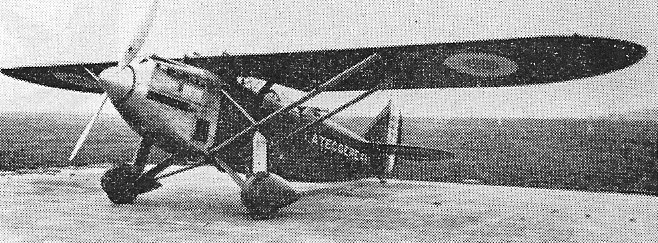
The Laté 49 was a 1931 parasol monoplane 2-seat recce a/c for R.2 contest (Bre.19 repl.)
Laté 49-0: 1931 aka Laté 490, all-Duralumin, 1 x 650 hp HS.12Nb Laté 49-1: 1932 aka Laté 491, slightly longer but lighter loaded weight Both Laté 49-0 and 49-1 too heavy, rejected in favour of ANF-Mureaux 111
Latecoere 49-1 Engine: 650 hp Hispano-Suiza 12Nb Span: 47 ft 10 in Length: 31 ft 10 in AUW: 5656 lb Max speed: 171 mph Seats: 2