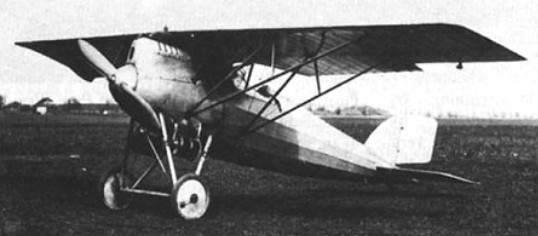
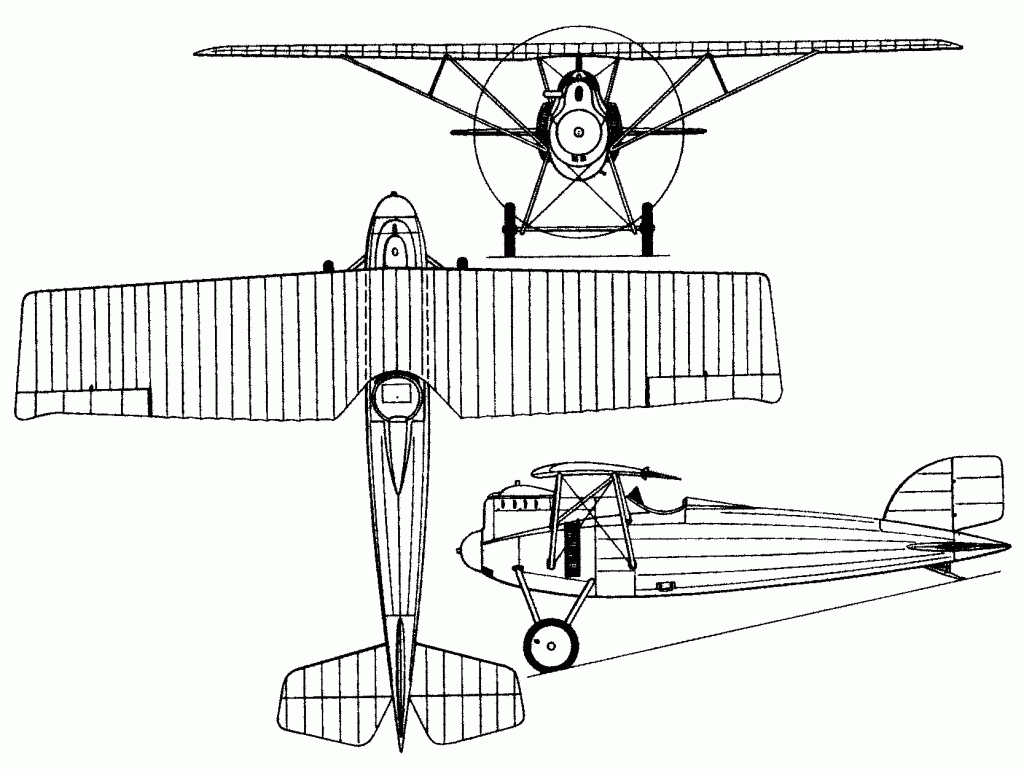
The first original fighter design to be produced by the Vojenská továrna na letadla (State Aircraft Works) “Letov”. The Š 3 was created by Ing Alois Smolik who had formerly worked for the Austro-Hungarian government Initially designated as S B.1, the original prototype was destroyed in a fire at the Prague-Letnany factory on 5 November 1921, but a second prototype entered flight test early in 1922.
A single-seat parasol monoplane powered by a 185 hp BMW l1la six-cylinder in-line engine and carrying an armament of two 7,7-mm Vickers machine guns, the Š 3 was of mixed construction with a wooden wing and metal fuselage and tail. The Š 3 participated in the International Meeting in Zurich in 1922, taking third place in the precision take-off and landing contest and seventh place in the aerobatic contest. Further development was discontinued in favour of the S 4.
Š.3 Crew: 1 Engine: 1 x 185hp BMW IIIa Max take-off weight: 928 kg / 2046 lb Empty weight: 662 kg / 1459 lb Wingspan: 10.13 m / 33 ft 3 in Length: 7.08 m / 23 ft 3 in Height: 3.04 m / 10 ft 12 in Wing area: 17.60 sq.m / 189.44 sq ft Max. speed: 225 km/h / 140 mph Cruise speed: 195 km/h / 121 mph Rate of climb: 508 m/min / 1650 ft/min Time to 9,840 ft (3000 m): 5.9 min Range: 472 km / 293 miles Armament: 2 x 7.7mm
Since the first controllable heavier-than-air flights had been made, the Austria-Hungarian administration did not intend to establish aeroplane manufacturing in Bohemian or Moravian Lands. An Aeroplane Repairs Works “Al-Ma” was set up by Dr. Martius, being of German origin, in the Prague district of Holešovice in 1916. Several days after the independent state of Czechoslovakia had come into existence on October 28, 1918 the Air Force Corps was founded and an order to move all the aeroplanes and air material to Prague was issued. On November 18, 1918 nine planes were seized by the Czechs and eight of them ferried from the town of Cheb to Prague situated near border on Germany so that the Germans were prevented from flying them into Germany. This unexpected raid was commanded by Cpt. Adamec [Addammaets] who was later appointed the Aeroplane Arsenal`s CO. The ninth Czech pilot had to land in Germany and his aircraft was confiscated.
Every plane was concentrated at the Prague Fair Facility until February 1919. A young P/O Alois Smolik was in charge of repairs. He used to be as an asistant to the Air Expert and Scholar Profesor Miess. The Sm-1 biplane designed by Alois Smolik and flight-tested in Apríl 1919 persuaded the Czechoslovak government to prefer the home-production aircraft to ones imported from France, though 115 French planes were presented them.
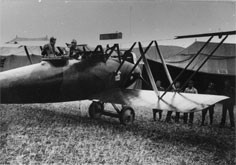
Originally built in 1910 as the SH-1 with 127 kW (230 hp) Hiero L engines, the SH-1 was later redesignated Š-1. 28 were built.
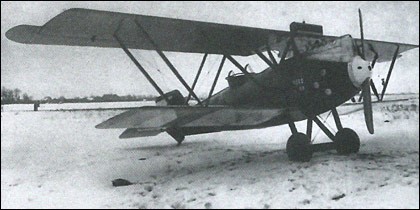
The Letov Š-1 was a single-engined, two-seat biplane surveillance aircraft. Designed by Alois Šmolík at Letov Kbely, it was first military aircraft built in Czechoslovakia.
The Š-1 first flew in 1920.
The SM-1 variant was powered by 194 kW (260 hp) Maybach Mb.IVa engines and later redesignated Š-2. 64 were built. This 2 seater was armed with one forward firing machine gun and had a twin movable machine gun in the rear. 28 were built.
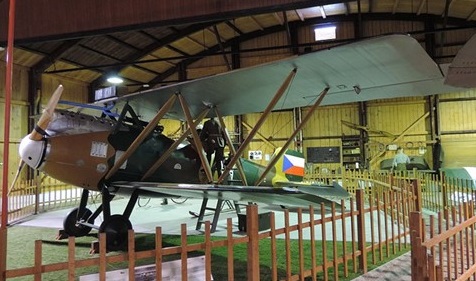
Letov Š-2 (re-engined Š-1) at the Kbely museum
The Sm A 1 was a commercial variant with a canopy over the rear cockpit for 2 passengers.
The Letov Š-10 of 1921 was an Š-1 trainer variant with a 100 hp 6-cyl Breitfeld & Danek Blesk (Czech Mercedes DI) engine.
The Letov Š-5 was an Š-1 modified for evaporate cooling trials.
The primary user was the Czechoslovakian Air Force.
S-1
SH-1 / Š.1 Engine: 1 × Hiero 6L inline engine, 169 kW (230 hp) Wingspan: 13.23 m (43 ft 4.75 in) Length: 8.31 m / 27 ft 3 in Height: 3.10m / 10 ft 2 in Empty weight: 861 kg Max takeoff weight: 1,375 kg (3,031 lb) Maximum speed: 194 km/h (120 mph) Range: 715 km / 445 miles Climb to 5000 m: 52 min Service ceiling: 6,000 m / 19,685 ft Crew: 2 Armament: 1x fixed machine gun, 1x twin machine gun on swivel mount
SM-1 / Š.2 Engine: 1 x 260hp Maybach Mb.IVa Max take-off weight: 1492 kg / 3289 lb Empty weight: 970 kg / 2138 lb Wingspan: 13.02 m / 43 ft 9 in Length: 8.52 m / 28 ft 11 in Height: 3.31 m / 11 ft 10 in Wing area: 36.17 sq.m / 389.33 sq ft Max. speed: 198 km/h / 123 mph Cruise speed: 167 km/h / 104 mph Ceiling: 6500 m / 21350 ft Range: 667 km / 414 miles Armament: 3 x 7.7mm, 120kg of bombs Crew: 2
Czechoslovakia Vojenska tovarna na letadla Letov was created in 1923, initially building the designs of Alois Smolik. Major output centered on the S-1/S-2 reconnaissance/light bomber biplanes; S-4 fighter of 1922; S-6 bomber; S-10 trainer (licensed from Hansa-Brandenburg); S-16 long-range reconnaissance biplane, built late 1920s/early 1930s for Czechoslavakia, Latvia and Turkey; S-18 trainer; S-19 four-passenger civil transport; S-20 biplane fighter; S-21 trainer version of S- 20; S-32 five-passenger high-wing tri-motor; and the S- 328/528 series of reconnaissance/light bomber biplanes. Also undertook license production of Tupolev SB-2 twin-engined monoplane bomber. Built Arado and Junkers types during German occupation 1940-1945.
Note: early designations combined chief designer, Alois Smolík’s initial with engine type and design number. Eg: SHS-4 = S for chief designer, Alois Smolík; HS for Hispano-Suiza 8Ba; and 4 for the fourth Letov design. Designations were later rationalized, dropping the engine type letters. Design evolutions followed the French pattern (eg: S-18 begets S-118, S218, etc.).
Établissements Letord – Société d’Aviation Letord – 1921-1922
Beginning in 1909, Emile-Louis Letord began construction of aircraft out of a facility in Meudon near Paris, France. Ultimately the company was commissioned to build aircraft from other manufacturers (including Dorand and Nieuport) until the concern headed development of their own three-seat biplane – the Letord Let.1. The series encompassed the Let.1 up to the Let.7 and some 1,500 were eventually ordered by the French Air Force for service in World War 1 (1914-1918) but only about 300 were realized.
This company built bombers to designs of the Section Technique de I’Aeronautique, 1916-1918, as the Establissements Letord at Chalais-Meudon. The last of these aircraft to be developed was intended as a night bomber. It was in the same class as the Handley Page bombers, with a wingspan of 25.91m. In 1923 Letord built an experimental aircraft for the government, which was evolved by Becherau, designer of the prewar Deperdussins. In 1925 part of the works was let to Villiers, which built racing aircraft and the small Albert biplane produced under license of Tellier-Duhamel.
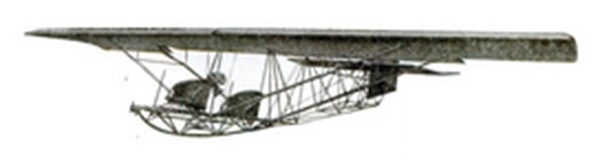
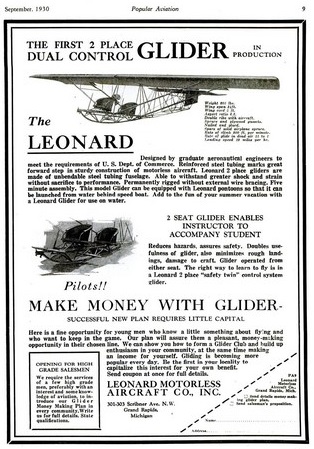
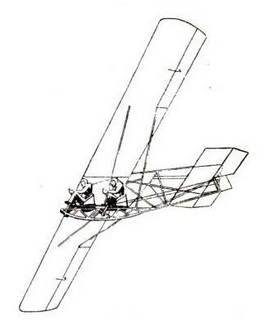
Billed as the first two seat glider to enter production, the 1930 Leonard Motorless Aircraft Company glider of 1930 was designed by graduate aeronautical engineers to meet the requirements of the US Dept of Conmmerce.
The entire fuselage is constructed of steel tubing, welded at all joints and with bals wood inside. The wings are cloth covered and braced with spruce ribs.
Able to be flown from either seat with dual controls fitted, the glider was for sale in 1930 for $550.
Wingspan: 34 ft Wing chord: 5 ft Aspect ratio: 6.8 Empty weight: 210 lb Landing speed: 19 mph Auto tow ROC: 800 fpm Glide ratio: 15-1
France Exhibited its first aircraft, the A.T.-35 two-seat parasolwing monoplane powered by an Anzani 3-cylinder engine, at the 1928 Paris Salon. Subsequently produced the B.T. three-seat low-wing monoplane with 100 hp Michel engine.