Mikhail Leontyevich Mil (died January 1970) began developing helicopters and autogyros in 1929. Mil was a contemporary of Nikolai Kamov at the TsAGI (Central Aero and Hydrodynamic Institute) during the 1930s, was given charge of his own design bureau in March 1947 and became responsible for the first Soviet helicopter to go into quantity production. The GM-1 / Mi-1.
Mi-1 first flown 1948, also manufactured by PZL-Swidnik in Poland 1956-1965. Mi-2 first flown in Soviet Union but production transferred to Poland. Enlarged Mi-4 introduced 1952, also built in China. Mi-6 with detachable wings to provide up to 20 percent of required lift in cruise flight first flown June 1957, then world’s largest helicopter, and 864 built at Rostov-on-Don (now Rostvertol) factory 1959-80, plus 50 at Moscow-Fili 1960-62. Mi-6 formed basis for Mi-22 airborne command post. Mi-8 first flown June 1961, becoming much produced medium civil and military helicopter (well over 7,000 built since 1965 and continuing), as turbine replacement for Mi-4; Mi-8 derivatives include Mi-9 tactical airborne command post (first flown 1977) and Mi-19 variant for use by commanders of tactical rocket units, Mi-17 (first flown August 1975) with change of engines and other modifications and Mi-171/Mi-172 export models, and lengthened Mi-173. Mi-10 flying crane development of Mi-6 first flown 1960, produced up to 1971. Two Mi-6 rotor/power packages used on giant Mi-12 with an overall rotors span of 67m, then the largest helicopter in world. Mi-14 became shorebased amphibious anti-submarine, SAR and mine-countermeasures helicopter (first flown August 1967). Mi-26 first flown December 1977 as very heavy lift helicopter with two powerful turboshaft engines and single eightblade main rotor, with Mi-27 as airborne-command-post derivative. Series of helicopter gunships began with Mi-24 (first flown September 1969) and joining Soviet armed forces from 1970s, with Mi-25 as export version of Mi-24D tandem-cockpit variant and Mi-35 as second and improved export variant based on upgraded versions of Mi-24; most of over 2,500 built between 1970 and 1989, though smallscale production up to 1996. The Mi-28 attack helicopter was first flown November 1982. Mi-34 first flown November 1986 as piston-engined lightweight sporting and training fourseat helicopter. Proposed new types include Mi-40 eighttroop armoured and armed assault helicopter, Mi-46 heavy transport helicopter, Mi-52 three-seat light piston helicopter, Mi-54 utility helicopter, Mi-58 medium civil helicopter, and Mi-60MAI two-seat light training helicopter. Approximately 25,000 Mil helicopters have been built. Became Mil Moscow Helicopter Plant. Has 25 percent shareholding in Euromil.
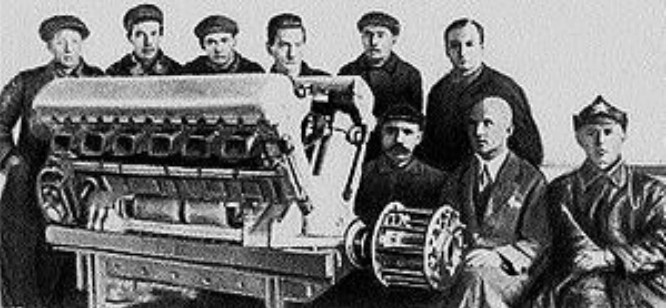
The M-34 began development in 1928 as a replacement for the Mikulin M-17, a license-built copy of the BMW VI. It had similar dimensions and attachment points, but was otherwise an entirely new design. It was a direct-drive, block-type engine with the cylinder block connected by long internal studs with centrally-coupled connecting rods. The development process was prolonged with the engineering drawings not completed until April 1931. The Soviet Union’s first indigenous, mass-produced, liquid-cooled, aircraft engine, the first engine was delivered to TsIAM (Tsentralniy Institut Aviatsionnogo Motorostroeniya, Russian: Центральный Институт Авиационного Моторостроения) on 21 September 1931 for bench testing with imported carburetors and magnetos. It began State testing in November 1931, but failed. It was submitted again a year later with Soviet-designed K-34 carburetors, but was again rejected. It was resubmitted in January 1933, but again failed. It was flight-tested in a Tupolev TB-3 in October 1933.
Despite these failures it began production in 1932 at Factory No. 24 in Moscow and 64 engines had been delivered by the end of the year. 790 were built the following year and it was exhibited in Paris as an achievement of the Soviet aviation industry. The M-34 was redesignated with Alexsander Mikulin’s initials as the AM-34 on 9 August 1936 in honor of his achievement.
The M-34 was used in an unusual system, first tried by Imperial Germany in 1918 with a Zeppelin-Staaken R.VI, that used an external supercharger to supply pressurized air to the aircraft’s M-34FRN engines. The first installation, designated ATsN-1 (Agregat tsentral’novo nadduva – central boosting unit), used an auxiliary M-34 fitted inside the fuselage to drive a central supercharger with ducts leading to the engines in the wings. This was flight-tested in a Tupolev TB-3 in 1935. It was adapted for use in a Petlyakov Pe-8 bomber prototype with a smaller Klimov M-100 engine substituted for the M-34 as the ATsN-2. It was flight-tested during 1938–39, but was not approved for production. The same idea was revived in 1943 by Nazi Germany with the Henschel Hs 130E bomber prototype series, with the Höhen-Zentrale Anlage unit.
The AM-34FRN and subsequent models used articulated connecting rods which increased the stroke to 196.7 mm (7.74 in) and increased the displacement to 46.66 L (2,847 cu.in). Combined with a number of other changes power significantly increased in most models to 1,200 horsepower (890 kW).
Development of a version for motor torpedo boats began in 1932 as the GM-34, but it did not pass its State tests until December 1934, although it was put into production that same year. It was given a reversing gear, a free-wheel sleeve and its cooling and exhaust systems were modified. Production continued through 1943 with the GM-34s adapting features from the aviation models. With the exception of the GAM-34BP and the original GM-34 all maritime engines used a benzene-alcohol fuel mixture.
A version of the GM-34 was adapted for use in heavy tanks in 1939 as the GAM-34BT, although only small numbers were built. It was mounted in the prototypes of the T-100 and SMK heavy tanks and the SU-100y self-propelled gun, none of which were put into production. The cooling system was modified with an external fan and it was given new gearing. An electric starter was used rather than the original pneumatic one. It was rated at 850 hp (630 kW).
Produced between 1934–43, 10,538 were built.
Aviation Variants: M-34 First production version. Direct drive. Early engines used imported Zenith 90R carburetors, although later ones used indigenous K-34 carburetors. In production until the end of 1939. Rated at 800 hp (600 kW) with a weight of 680 kg (1,500 lb).
Coupled M-34 Two engines driving one propeller, project for the Kalinin K-7, no production.
M-34F small batch built in 1933 with a rating at 830 hp (620 kW).
M-34R R for Reduktor or reduction gear. Rated at 800 hp (600 kW) with a weight of 670 kg (1,480 lb). Passed its State trials in May 1933 and in production from the end of that year to the end of 1939.
M-34RD D for Dal’niy or long-range. Ten engines built with special attention to quality, smaller tolerances and K-34RD carburetors to equip the Tupolev ANT-25 record-breaking aircraft. RPMs were boosted to give a power of 830 hp. Later fifty more were built to power Tupolev TB-3 bombers converted to VIP transports.
M-34N N for Nagnetatel’ or supercharged. Development began in 1931 of this direct-drive model, but the first two-stage supercharger design proved to be quite unreliable. A single-speed replacement was developed at TsIAM and tested in November 1933 and production began in September 1934. The centrifugal type supercharger was designed as a removable module and could be installed on other versions of the M-34. Rated at 820 hp (610 kW). A PTK steam-powered supercharger was developed and tested from 1938 to 1940, but was not accepted for production.
M-34RN This geared model used the same geared centrifugal supercharger (GCS) as the M-34N and had the same rating. It failed State testing in September 1934 when the pistons burned through.
M-34NA A version of the M-34N with minor changes to some components to extend service life. It had the same power as the original model.
M-34RA A version of the M-34R with the same changes and power as the M-34NA.
M-34RNA A version of the M-34RN with all the changes introduced on the NA and RA models. Same power as before, but weighed 748 kg (1,649 lb). Flight-tested on a TB-3 in May 1935 and production began at the end of the year.
M-34NB The NA fitted with a strengthened crankcase, a lightened crankshaft with a modified nose and a refined supercharger. The power remained the same, but the weight dropped to 638 kg (1,407 lb). A TK-1 turbocharger was tested with the prototype on a Polikarpov R-Z in 1936.
M-34RNB A geared equivalent of the NB model with a lightened reduction gear. The power remained the same, but the weight dropped to 725 kg (1,598 lb). In production from October 1935 until the end of 1939.
M-34P P for Pushechniy or cannon. A version of the M-34RN adapted to mount an autocannon in the V between the cylinder banks that fired through a hollow gear shaft. The specification was issued in August 1934.
M-34NV NV for Neposredstvenniy Vprysk or fuel-injected. It passed its bench tests in 1935 and was flight-tested in 1937, but was not accepted for production. Rated at 985 hp (735 kW).
M-34RNV Geared version similar to the NV.
AM-34RNV-TK Prototype built in 1938, similar to the RNV with the addition of a TK-1 turbocharger. Rated at 850 hp (630 kW) and an estimated weight of 810 kg (1,790 lb).
AM-34RS Prototype built in 1938 with mixed cooling; air-cooled sleeves and ethylene glycol-cooled cylinder heads. Rated at 1,200 hp (890 kW).
AM-34NF Prototype with a geared centrifugal supercharger and a TK-1 supercharger. Flight-tested in a TB-3. Compression ratio of 6.6:1 and rated at 985 hp (735 kW).
M-34N2B A prototype with a supercharger, two turbochargers and four K-4 carburetors. Rated at 1,030 hp (770 kW).
AM-34FRN F for Forsirovanniy or boosted. Development began in 1934, but development was not completed until 1938. The crankshaft, crank case, gearing and the side joints of the connecting rods were reinforced. The lubrication system was modified, the supercharger improved and a new gas-distribution system was fitted. The carburetors were moved to behind the supercharger. Rated at 1,200 hp (890 kW) and the weight dropped to 690 kg (1,520 lb). It was exhibited in the 1937 Paris Air Show.
AM-34FRNA First main production version of the FRN model. Equipped with four carburetors.
AM-34FRNB Next production model of the FRN. Equipped with six carburetors. A small batch was adapted for the ATsN-2 system with pressurized air provided by an external supercharger and flight-tested in a Pe-8 in 1938–39.
AM-34FRNV The last main production variant of the AM-34. Built during 1938–39. The crankcase was modified and bronze bushings were used for the main supports. It had a longer crankshaft nose, four K-4 carburetors, and a modified lubrication system. The valve castings were made of magnesium alloy. The power remained the same, but the weight increased to 763.5 kg (1,683 lb). Variants with fuel injection and two TK-1 turbochargers were tested, but not put into production.
AM-34RB Superchargers were removed from AM-34RNB engines during 1938–39 to create this model.
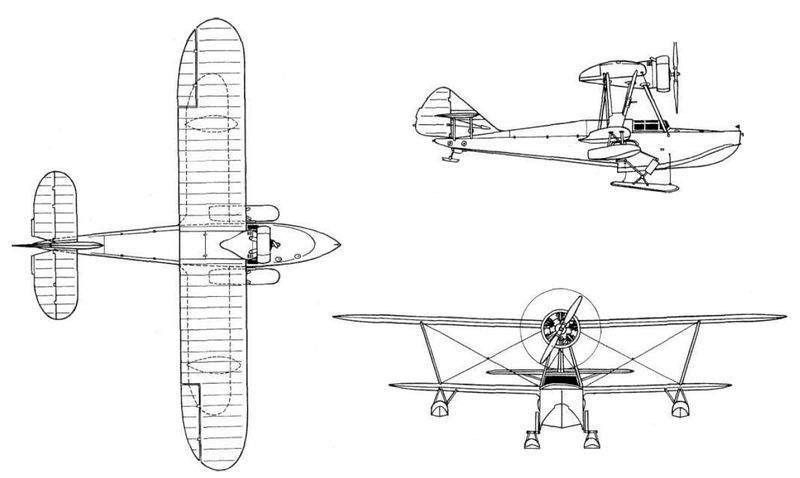
The MU-4 (Russian: Михельсон/Никитин МУ-4) amphibious flying boat was designed and built by NG Mijelson at Leningrad Factory No.23. The initials MU correspond to Morskaya Uchebnaya or Marine Trainer.
The MU-4 was designed as a flying-boat with a single hull and amphibious capacity. The hull was made entirely of wood and was made up of five watertight departments.
The wing configuration was sesquiplanar with the wing box braced by V-shaped struts made of duralumin. The wooden wing featured a double spar structure with a slim profile and constant chord. The covering was fabric. The lower plane was inserted into the fuselage, while the upper one was located high above the cabin, from where the engine supports started. The drop-shaped stabilization floats were located in the lower wing.
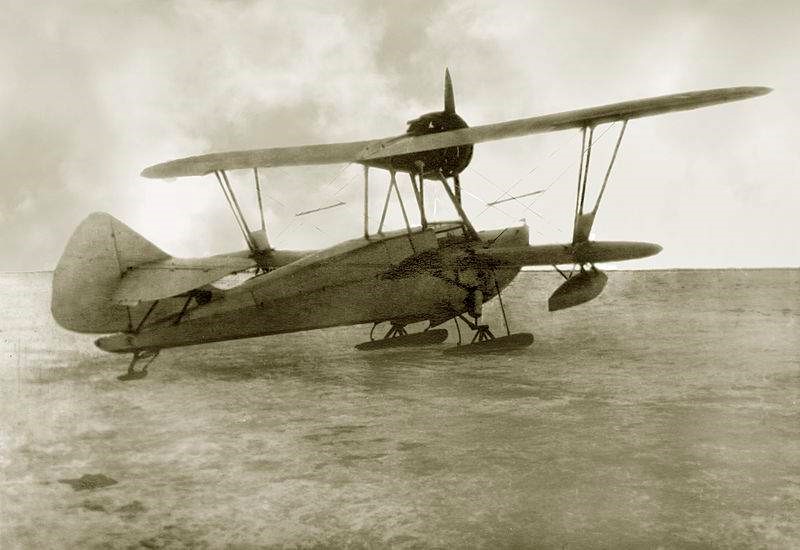
For operations on land, the MU-4 had a conventional landing gear with oleo-pneumatic shock absorbers and a tail skid. The main units retracted forward on the sides of the hull by means of a manual drive system. To allow winter operations the wheels could be replaced by skis.
The MU-4 tested with skis in the winter of 1937 – 1938.
The tail unit was of the conventional monoplane type with the stabilizers located high on the empennage and fixed by parallel struts in its lower part.
The MG-11F engine was installed on the upper wing in a tractor configuration protected by a Townend ring hood and moving a two-blade propeller. For winter, a special “winter” cowl was designed.
The MU-4 could carry two people, seated side by side in an enclosed, dual-control, glazed cabin.
The first prototype was finished in August 1937. Tests showed that the plane had good flight characteristics and could perform aerobatics. During the manufacturing tests this example was destroyed due to a construction defect. The engine fixing brackets to the gunwales were glued with a poor quality glue that ended up coming off. A short time later Mijelson would be imprisoned so the responsibility for further development passed to VV Nikitin.
Mijelson MU-4/2 at Factory No.23.
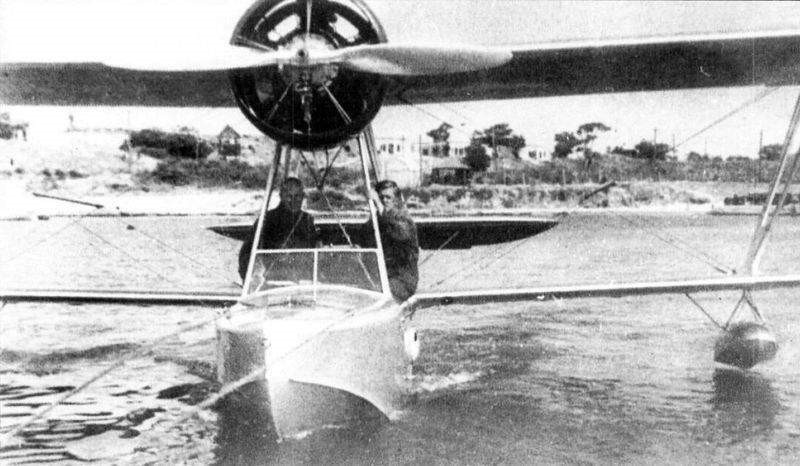
The second prototype was submitted for testing in May 1938. Model tests were carried out at the NII GVF hydrostation located in Konstantinovska Bay in Sevastopol. The flights were carried out by test pilot GI Sergueyev. The MU-4 was presented as a simple plane to fly and capable of taking off and landing in small aquatic spaces.
MU-4/2 during factory tests in 1938.
It was proposed to build a series of 30 examples at Factory No.23, but after Mijelson ‘s conviction this decision was reversed. The Shavrov Sh-2 was produced in series, covering the same needs.
MU-4 Powerplant: 1 x 190 hp MG-11F Wingspan of upper plane: 12.00 m Wingspan of lower plane: 9.00 m Wing area: 33.00 m² Length: 8.70m Height: 3.70m Empty weight: 989 kg Normal takeoff weight: 1255 kg Wing loading: 36.4 kg/m² Power load: 4.2 kg/hp Fuel + lubricant capacity: 80 + 20 kg Top speed: 173km/h Cruising speed: 154 km/h Service ceiling: 3400 m Accommodation: 2
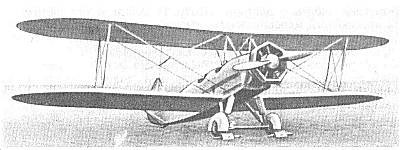
In the mid 1930’s Leningrad Factory No.23 was producing versions of the Polikarpov U-2 trainer. In parallel with the development of the serial versions U-2, AP and others, NG Mijelson and AI Morschijin proposed in 1934 the development of a version with a similar layout, but with larger dimensions and a more powerful M-48 engine of 200hp. The objective of this model was to obtain a medium training aircraft in which the students could continue after finishing the initial classes with the U-2.
Construction of the U-3 (Russian: Михельсон/Морщихин У-3) included a number of bolted duralumin aggregates. These aggregates were generally lighter. This, together with some decrease in the reserves of structural resistance, lightened the model. Other minor modifications were introduced with a view to improving performance.
The M-48 engine was protected by a hexagonal-shaped Townend cowling constructed of “Enerzh-6” stainless steel.
The U-3 was tested in 1935 but the results obtained were not much higher than those of the U-2, and the M-48 engine was not produced in series.
Starting in 1933, a series of projects began to be developed in the USSR under the common name of PSN, acronym for P laner S petsialnovo N aznachenya or Gliders for Special Missions. Among these projects was SF Valk’s idea of using a glider with a torpedo and an infrared or radio guidance system to attack surface ships and naval bases.
This idea had its development in a series of projects known as: LTDD – Letayushaya Torpeda Dalnevo Dieztvya (Long Range Flying Torpedo); DPT – Dalni Planerni Torpedo (Long Range Glider Torpedo); BMP – Bozduzhni Minni Planer (Airborne Mine Glider);
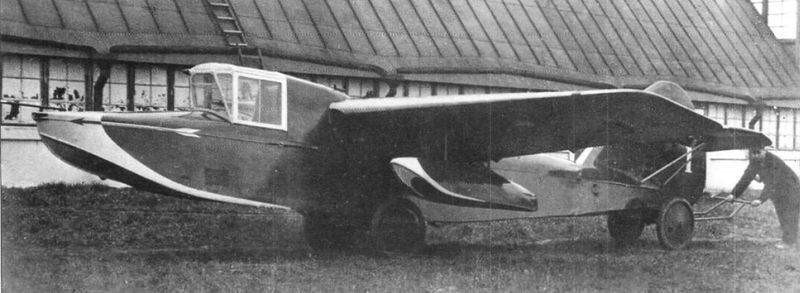
As a development of this conception, Mijelson would receive the task of building an experimental manned hydrofoil glider capable of carrying a torpedo and intended primarily to test remote flight control systems. This glider, called PT, was followed by a small series of copies that received the name PSN (Russian: Михельсон / Никитин ПСН).
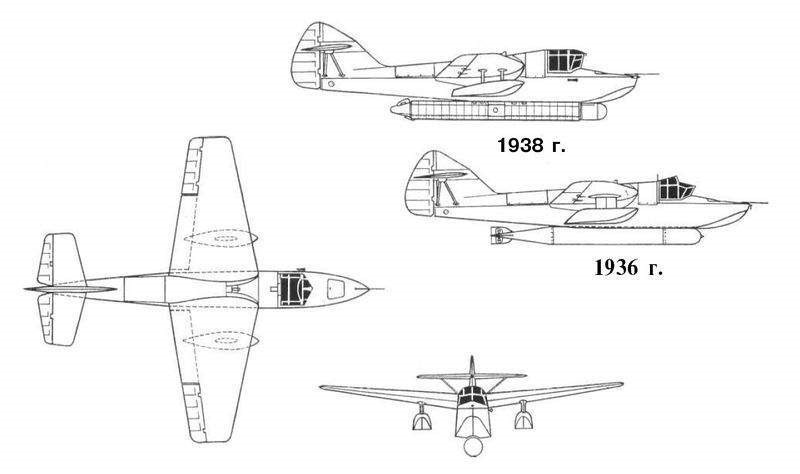
The PSN was designed as a small single-seater hydrofoil glider with stabilization floats located approximately halfway across the wingspan of each half plane. The entire construction was made of wood.
The wings presented high implantation with a trapezoidal shape in the plane. Louvered ailerons and flaps were included as control surfaces. The tail unit featured the outriggers braced by double struts high on the keel.
The pilot was located in a glass cockpit in front of the wing leading edge. At the bottom of the glider was fixed a torpedo.
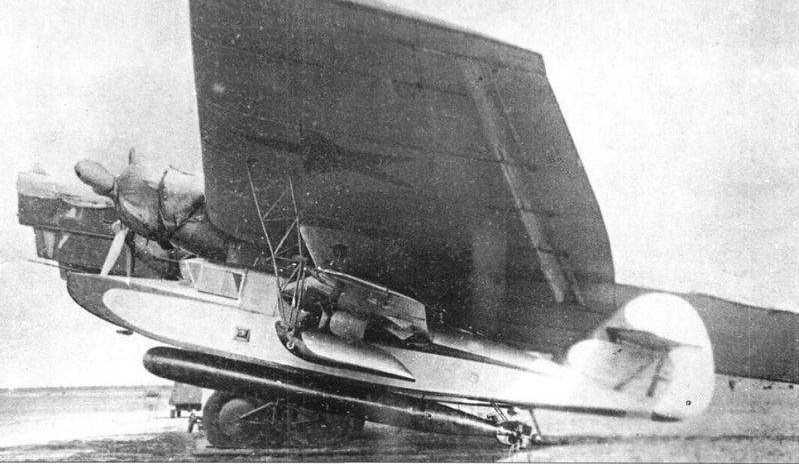
The PSN was carried by a Túpolev TB-3 or TB-7 mother bomber and was released at a pre-calculated height and distances between 30 and 50 km from the target. After launching its torpedo, the glider would land on the water.
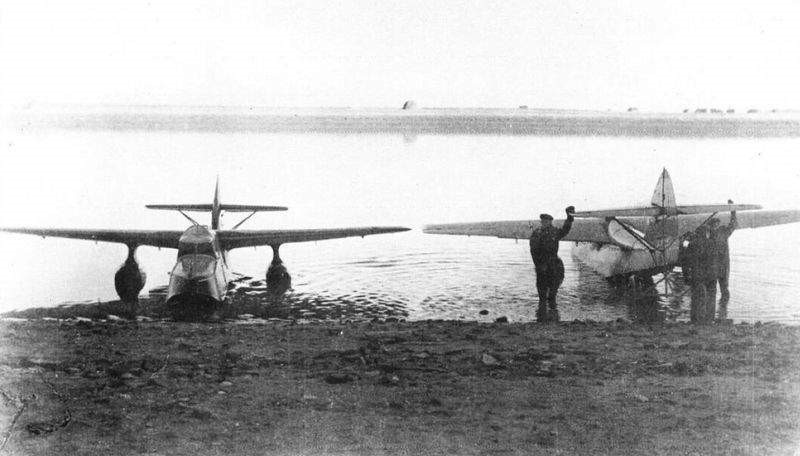
A PSN hydrofoil glider with a torpedo under the wing of the Túpolev TB-3 mother plane.
In 1934 the first PT copies and their equipment were built and tested. The first 4 units were built in 1935 at factory No. 23 in Leningrad. In this case, it was a piloted glider version designed to evaluate the infrared guidance piloting system known as Kvant (Quanto). This project was developed under the direction of Mijelson and Nikitin was in charge of the production.
Two PT gliders during the water tests.
From June until October of August of 1936 at the Naval base Krechevits the first fixation tests PT were performed under a bomber Tupolev TB-3. During these tests the PT was piloted by N N. Ivanov.
Between 1937 and 1938 the construction of a small series of PT without a pilot was requested, which received the name PSN (or PSN-1 in some literature).
In general, 10 copies of the PSN-1 were built, which were used in different tests of the Kvant guidance system and an autopilot system developed at that time.
In March 1938, after the arrest of Mijelson, the works were interrupted. All produced copies of the PSN were destroyed.
PSN Wingspan: 8 m Wing area: 13.2 sq.m Length: 8.9 m Height: 2.11 m Empty weight: 970 kg Loaded weight: 1970 kg Speed: 150 – 350 km / h Dive speed: 500 km / h Range: 30 – 35 km Accommodation: 1
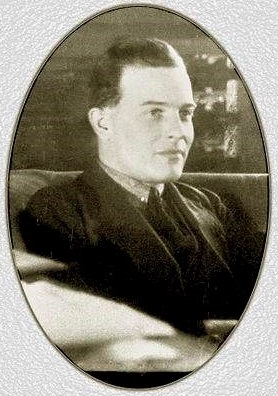
Nikolai Gustavovich Mijelson (in Russian: Николай Густавович Михельсон) was born in 1895 in Bielovostok, Grodnienski governor.
The first references to Mijelson appear after joining the construction bureau “Gamayún” in Saint Petersburg, directed by Schetinin and specialized in the design and construction of hydrofoils. Starting in 1912, after the incorporation of DP Grigorovich to the factory as technical director, Mijelson became his main collaborator, participating in the creation of all his designs during the pre-revolutionary period. Mijelson’s participation was decisive in the development of the famous M-5, M-9 and M-11 hydrofoils, participants in the First World War.
During the events of October 1917 Mijelson was in Krasnoyarsk where he met MM Shishmariov, Grigorovich’s former assistant. Together in 1920 and not without running into great dangers, he managed to move to Taganrog, as they had heard that the “Lieved” factory run by B. Levediev had been created there. The years of civil war ran and the friends were forced to avoid the white and red troops in combat.
The following year, together with Shishmariov and the engineer of the “Liebed” factory, formerly a naval pilot of the Denikin troops, VL Korvin-Kerber, he won a competition promoted by the VVS leadership for the project of a single-seater naval fighter with a Hispano-Suiza 200 hp engine. Construction of the prototype began in Taganrog. The new fighter, called MK-1 “Ribka” (Fish), was designed as a biplane with a monocoque structure that completely hid the engine. This structure used four plywood stringers and frames with holes to lighten the weight. The radiator was located in the center plane of the upper wing.
For the spring of 1922 the VVS made the decision to continue the construction of the experimental MK-1 “Ribka” in Petrograd, at the “Krasni Liotchik” factory. As a result, Mijelson headed there with the details and built components of the new fighter. The other co-authors were sent to Moscow to make themselves available to DP Grigorovich.
In Petrograd Mijelson completed the construction of the plane, but during the tests the prototype refused to take off from the water. The floats were too heavy for the low power of the engine. Measures to lighten the plane did not bring positive results either. Only when Mijelson removed the floats and replaced them with a train of wheels did pilot LI Giks manage to lift it up into the air. The aircraft proved to be well designed, but the low power of its engine did not allow it to go into series production. While waiting for a new engine, the plane was stored in a hangar at the small airfield on Kretovski Island where it was destroyed during a flood in 1924.
Mijelson continued to work at the “Krasni Liotchik” factory until the Department of Experimental Shipbuilding (OMOS) led by DP Grigorovich was transferred there from Moscow. From that moment on, Mijelson joined the group led by his former boss. During this period, he participated in the development of all OMOS works, including the SUVP passenger plane, the MRL-1 naval reconnaissance plane, the I-2bis fighter, the ROM-1 and ROM-2 open sea explorers. and the MUR-1 training scout. Many of these designs were unsuccessful, which was reflected in the collective’s psychological climate. For this reason, when it was decided to return Grigorovich with his collective to Moscow, Mijelson and another group of collaborators made the decision to remain in the “Krasni Liotchik” . Mijelson was in charge of the drawing department.
In 1929 Mijelson was arrested. This happened unexpectedly and was a continuation of the process that began with the arrest of DP Grigorovich and involved a significant number of OMOS workers. For a whole year Mijelson had been summoned to answer as a witness in the trials of DP Grigorovich, AN Sidielnikov, VL Korvin-Kerber and other colleagues, until his time finally came. Judged by article 58, Mijelson was sent to the first Sháraga TsKB-39 of the OGPU, where builders of the Grigorovich and Polikarpov collectives were already working. This collective in a very short time and under a strict supervision system managed to develop the I-5 fighter, the IZ gun fighter and the TB-5 bomber. In all these works Mijelson had an active participation.
In 1931 Mijelson was released and returned to Leningrad. Here at Factory No.23 (new designation of “Krasni Liotchik”) he began working as director of the construction department. In 1935 with the help of IV Chasovikov he created the PV-23 light seaplane and later devoted himself to improving the Polikarpov U-2 by creating the U-3 and U-4 trainers with improved aerodynamics.
Soon after, Mijelson would work on the MU-4, MU-5 and MU-6 training amphibians. The projects looked very promising, which was confirmed during testing of the second MU-4 prototype in Sevastopol. Almost parapelled Mijelson developed a lightweight torpedo boat named MP and was designed to be transported to the attack area under the wings of a TB-3 bomber. Once the torpedo was released, this aircraft was able to return by its own means to its base and land there.
These designs Mijelson could not finish. At the end of 1937 he was arrested again. Mijelson was charged under article 58 and on January 17, 1938, he was sentenced to the maximum penalty. The next 12 days were torture awaiting the announced end. Nikolai Mijelson was shot on January 29, 1938. His remains rest in an unidentified grave in Leningrad, presumably in the NKVD special cemetery “Levashovskaya Pustosh”.
The continuation of these projects was originally assigned to VL Korvin-Kerber and later to the young architect VV Nikitin, but soon they all ended up being closed. In the opinion of the NKVD an “enemy of the people” could not build anything good.
Development has continued since World War 2, the basic post war single seat version being the HM-290 with a 25 hp Poinsard engine.
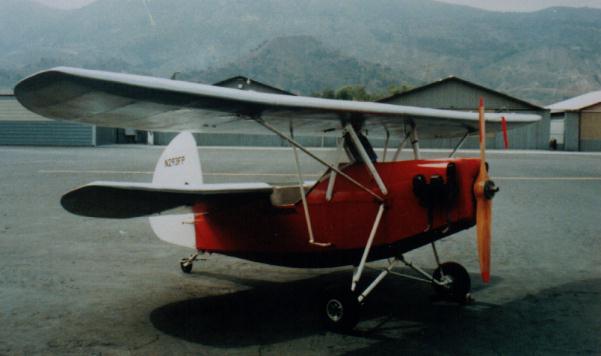
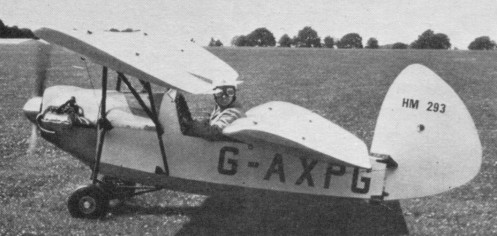
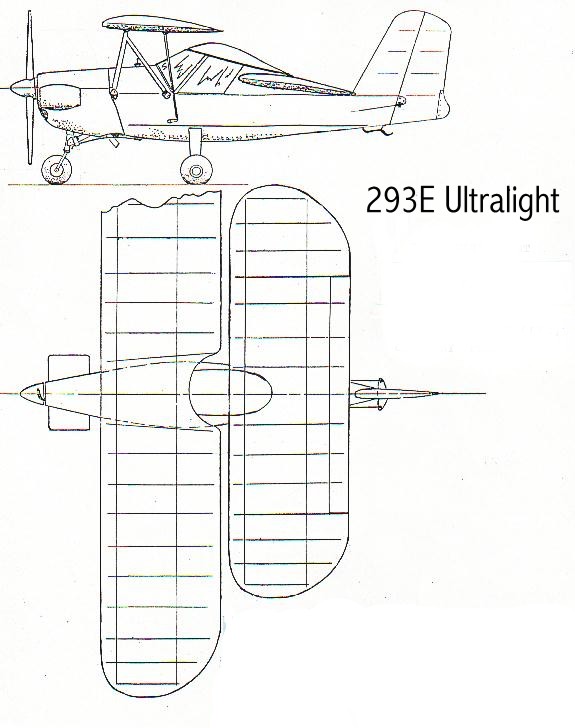
The HM 290 Series included: F293E ultralight model- for medium size pilot F295E ultralight model- for medium size pilot (with simplifications) HM290 amateur built model – for small pilot HM293 amateur built model – for medium size pilot
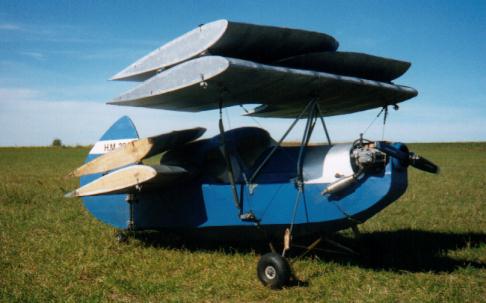
HM293
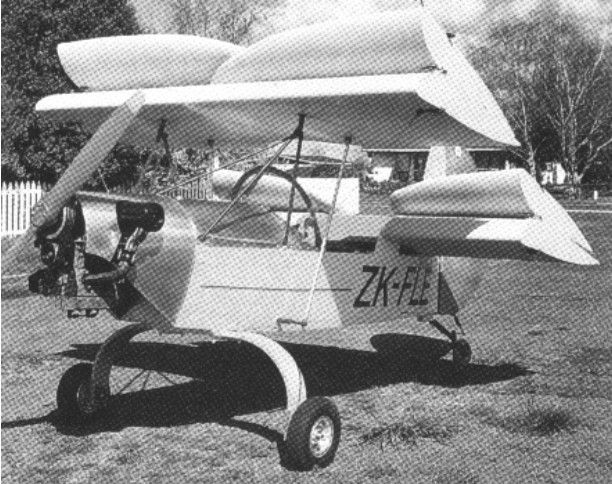
These tandem wing aircraft feature a large speed range, stall resistant, and spin proof. Both wings lift and being small size, minimal space is needed to build. Landing gear arrangement: tail dragger or tri-gear. Options include swept fin and rudder.
Falconar devised design changes for easier construction, modern materials, Delrin bearings, tri-gear and HIPEC® covering.
Rodolphe Grunberg has redrawn the 1940s HM.293 plans, updated them for 1990s materials, and fitted new light weight engines. Over 40 Grunberg HM.293s were reported either flying or close to completition in France in 1998.
Rodolphe Grunberg HM 293
In 2010 Falconar MIGNET “Flying Flea” plans cost: HM290E, HM293E, HM290, HM293 cost US$65. Falconar Avia produced kits as an LSA.
HM 293
On June 30, 2019, Falconar Avia Inc closed for business and assets dissolved. The Master Sets (Original Drawings, Plans, Info Kits, Documentation) were available for sale and full transfer of rights included the MIGNET “Flying Flea” HM 290/293, 290/293 E, F295 E, and 295 F for $4500 USD.
“Flying Flea” HM 290E/293E ULTRA LIGHT Engine: 25/30 hp Hirth or Rotax Cruise speed: 60 mph Length: 13 ft Empty weight: 246 lb Gross weight: 476 lb Wing span: 20 ft
HM290/HM293 amateur built Engine: 50/60 hp Little Demon (VW) or similar Cruise speed: 90 mph Length: 12-13 ft Empty weight: 360 lb Gross weight: 580 lb Wing span: 18-20 ft
HM290/293 Engine: VW, 60 hp HP range: 50-60 Height: 5.5 ft Length: 13 ft Wing span: 20 ft Wing area: 113 sq.ft Cruise: 90 mph Stall: 28 mph Range: 300 sm Rate of climb: 800 fpm Takeoff dist: 150 ft Landing dist: 150 ft Fuel capacity: 10 USG Empty weight: 350 lb Gross weight: 600 lb Seats: 1 Landing gear: nose or tail
HM 293 Engine: VW, 60 hp Speed max: 110 mph Cruise: 90 mph Range: 300 sm Stall: 28 mph ROC: 1400 fpm Take-off dist: 150 ft Landing dist: 150 ft Fuel cap: 10 USG Weight empty: 350 lbs Gross: 600 lbs Height: 5.5 ft Length: 13 ft Wing span: 20 ft Wing area: 113 sq.ft Seats: 1 Landing gear: nose or tail wheel.
Falconar Avia 290E/293E Engine: Kawasaki, 30 hp HP range: 25-35 Length: 13 ft Wing span: 20 ft Wing area: 117 sq.ft Empty weight: 246 lb Gross weight: 476 lb Fuel capacity: 5 USG Cruise: 55 mph Stall: 28 mph Range: 290 sm Rate of climb: 500 fpm Takeoff dist: 180 ft Landing dist: 150 ft Cockpit width: 23 in Landing gear: nose or tail
Rodolphe Grunberg HM 293 Engine: 30-40 hp Wing span: 6.10 m Wing area: 12 sq.m MAUW: 250 kg Empty weight: 117 kg Fuel capacity: 30 lt Max speed: 130 kph Cruise speed: 90 kph Minimum speed: 30 kph Seats: 1 Plan price (1998): 295 Fnc
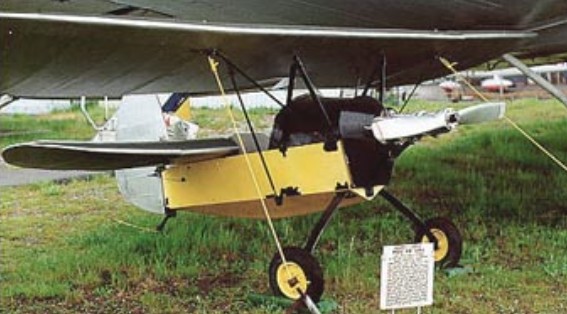
The first Flying Flea took to the air back in 1933 and quickly earned a reputation for being temperamental. Mignet was a furniture manufacturer, and named his creation “Le Pou de del,” or Louse of the Sky. It started out to be Everyman’s Airplane, something you could build for $500, complete, in the Depression years. Mignet’s Flea carried a 17-hp engine and had a speed range from 25 to 62 mph.
The Pou de Ciel (Flying Flea) was introduced to the public during the Paris Aero Salon in 1935.
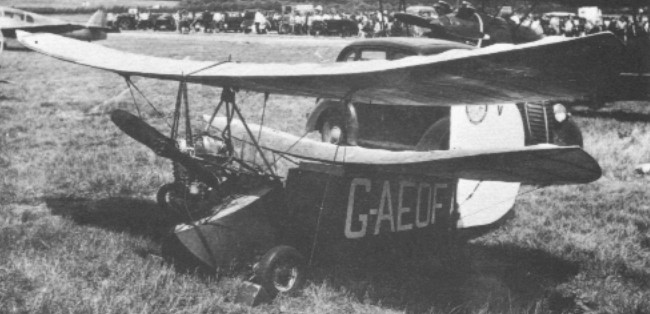
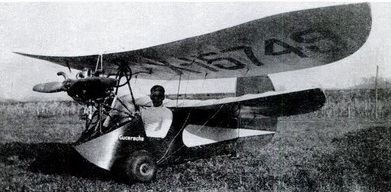
For simplicity the top wing pivoted about the front spar and was tilted up and down for longitudinal control. There were no ailerons, turns being made by the rudder alone. Mignet’s Pou and his book Le Sport de l’Air started a craze for do it yourself aircraft in the 1930s. Translated to English by the British Air League which did not include a true and correct C of G situation. This resulted in numerous crashes. Flea fever swept France, Britain and America. In 1935 some 600 Flying Fleas were under construction in the British Isles alone. Most stayed firmly on the ground. Ignorant of the ways of aircraft, they built their Fleas too heavy, or used unsuitable engines, so that the machines would do little more than tear around re¬fusing even to hop like their namesakes. Most were fitted with the 25 hp Scott or Douglas engine. It was a blessing in disguise, for the Pou du Ciel had an inherent design fault. The trouble lay in Mignet’s tan-dem wing configuration: the rear wing was fixed while the incidence of front surface could be varied to give control in pitch. If the front wing was allowed to stall, the nose would drop and because of an obscure inter¬ference effect between the two wings the aircraft would dive ever steeper until it either became stabilized in an inverted posi¬tion from which recovery was impossible, or struck the ground. Accidents showed that the aircraft became uncontrollable if the wing incidence exceeded 15 degrees, and British Fleas were promptly grounded. It became illegal to fly unmodified Flying Fleas after June 1937.
Mignet fixed the problem and continued to build and develop Poux until his death in 1965.
Douglas developed an engine model specifically for aircraft, with longitudinal finning; the Scott company brought out their 750cc inline model A.25; and Sir John Carden set up in production with a modified version of the reliable Ford 10 engine.
E.D.Abbott Ltd coachbuilders of Wrecclesham, Farnham, Surrey, UK, set up production of kits (at £90) and complete aircraft (at £198). Flight test took place at Heston.
G-AEGD cn CP.1 was modified to ‘Cantilever Pou’ design of L.E.Baynes with strut-braced wings and fitted with an enclosed Carden-Ford engine. It was registered on 15 April 1936, sold in January 1936, and cancelled in February 1943. Following G-AEGD were G-AEJC cn CP.3 and G-AEJD cn CP.4. G-AEJC was registered on 27 July 1936 and cancelled in December 1937. G-AEJD was used for stall investigation.
Mignet HM 14 Pou de Ciel / Flying Flea Engine : Bristol, 35 hp Length : 11.483 ft / 3.5 m Height : 6.562 ft / 2.0 m Wingspan : 16.732 ft / 5.1 m Max take off weight : 441.0 lb / 200.0 kg Weight empty : 242.6 lb / 110.0 kg Max. speed : 65 kt / 120 km/h Crew : 1
Mignet Pou-du-Ciel (Flying Flea) Engine: 75 hp McCulloch horizontally opposed Maximum speed: 91 mph (146 km/h) Empty weight: 421 lb (191 kg) Maximum weight: 643 lb (292 kg) Span: 18 ft 2 in (5.5 m) Length: 12 ft 6 in (3.8 m) Height: 5 ft 8 in (1.7 m) Wing area: 108 sq ft (10 sq m)
Engine 22-38 hp. Gross Wt. 700 lb Weight empty 350 lb (160 kg.) Fuel capacity 12 USG Top speed 56 mph Stall 35 mph Climb rate 500-600 fpm Ceiling 16,400 ft Seats: 1 Length 13 ft. (3.96 m) Wing span 22 ft. (6.7 m) Max cruise 60 mph (96 kph) Range 200 miles (320 km)
Engine: ABC Scorpion, 35 hp Top speed: 80+ mph Cruise speed: 70 mph Landing /TO speed: 30 mph Landing dist: 150 ft TO dist: 200 ft Fuel capacity: 7 USG Range: 280 mi Empty wt: 316 lb
Avions Henry Mignet Societe D’exploitation Des Aeronefs Henri Mignet Mignet do Brasil
Early aircraft from Henri Mignet was HM.14, popularly known as the Flying Flea (first flown 1933). Founded Mignet do Brasil postwar, but later returned to native France to produce series of new aircraft. or kit form is HM.1000 Balerit microlight, a tandem-wing two-seat Pou-du-Ciel type; customers include the French Armee de I’Air, for surveillance.
1998: Aviona Henri Mignet, 17600 St.Romain de Benet, France.
Available in assembled or kit form is HM.1000 Balerit microlight, a tandem-wing two-seat Pou-du-Ciel type; customers include the French Armee de I’Air, for surveillance.
1998: Aviona Henri Mignet, 17600 St.Romain de Benet, France.


 All Aero