A 1934 glider.
Developments:
Shultz ABC
A 1934 glider.
Developments:
Shultz ABC
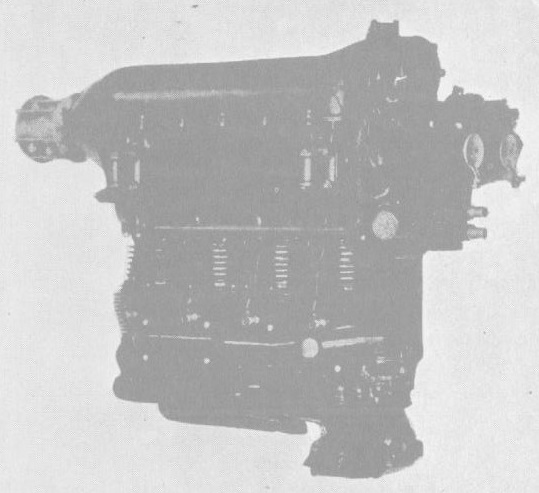
The Rover features ribbed, die-cast aluminium alloy cylinder heads, cast nickel iron cylinders, and an integral five bearing crankshaft. Connecting rods are dropped forged Dural.
An inverted type, valve gear ports are completely enclosed. The lubrication system is designed completely within the engine. With a dry sump, all oil is carried in an external tank. There is an independent scavenger system for each end of the crankcase.
All accessories are arranged at the rear. Standard equipment was a main cooling air scoop, complete exhaust system, carburettor air heater with control, propeller hub, tool kit and instruction book.
Available at extra cost was a hand or electric starter.
Type: 4 cylinder inverted inline air cooled
Commercial Rating: 75 hp at 1970 rpm
Displacement: 267.28 cu.in
Compression ratio: 5.15-1
Bore: 4 1/8 in
Stroke: 5 in
Length: 42 1/4 in
Width: 11 1/8 in
Height: 31 7/8 in
Weight: 232 lb
Fuel consumption: not more than .18 lb/hp/hr
Oil consumption: not more than .055 lb/hp/hr
Lubrication: 3 gear scavenging pump, 2 gear pressure pump
Ignition: 2 Scintilla magnetos
Carburation: 1 Stromberg NA*R3 with altitude adj.
Spark plugs: 2 per cylinder AC
Price: $1200
Lansing
Mich.
USA
Circa 1920 built the Rover engine
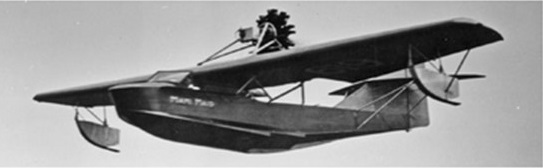
The five-seat amphibian monoplane MM-200 Miami Maid appeared in 1928 or 1929 with a 230 hp Menasco-Salmson B-2 radial engine pusher mounted on top of the wing, and registered NC619. The design combined an all-wood Fokker cantilevered wing with the wooden hull of a Curtiss F boat.
A second aircraft, the MM-201 registered NC178N, was modified in 1930 for installation of a 300 hp Wright R-975 Whirlwind engine.
MM-200
Engine: Menasco-Salmson B-2, 230 hp
Wingspan: 44 ft
Length: 33 ft
Useful load: 1250 lb
Top speed: 120 mph
Cruise speed: 100 mph
Range at cruise: 500 mi
Established at Hieleah, Florida, in February 1929; designed and built Miami Maid five-seat amphibian monoplane with Menasco-Salmson radial, production aircraft powered by 300 hp Wright J-6 engine.
Formed 1936 at Tecumseh, Michigan. Developed OTW- 160 biplane trainer and MEW-165W monoplane trainer for U.S. schools within CAA War Training scheme. Postwar production included MAC 125 and MAC 145 two-seat cabin monoplanes with Continental engines. Meyers 200 four-seat cabin monoplane flown 8 September 1953, deliveries began 1959. Acquired by Rockwell-Standard Corporation 12 July 1965, and marketed Model 200 as Aero Commander 200. Manufacturing rights in this model were acquired in 1977 by Meyers Aircraft Manufacturing Company of Broomfield, Colorado, to build the Meyers 200D.
1980: Meyer Aircraft, 576 Abby Dr, Corpus Christi, TX 78413, USA.

During the autumn of 1935, the considerable potential of the Fieseler Fi 156 project for the tasks of short range reconnaissance and aerial observation had prompted the RLM to draw up a requirement for an army co-operation and observation aircraft with its performance parameters. The requirement stipulated the use of the Argus As 10 or the Hirth HM 508 engine and placed emphasis on short field performance, maximum possible all-round view for the two crew members, and a wide range of speed. It was intended that the resultant aircraft, which the Siebel Si 201 was also designed to compete for, would be evaluated in competition with the Fi 156.
The Bf 163 followed closely the formula established by the Fi 156 in being a high-wing braced monoplane with a metal structure, automatic leading edge wing slots, double slotted flaps, and an exceptionally tall undercarriage. The aircraft’s most interesting feature was the provision for varying the incidence of the entire wing which swivelled on its mainspar, the bracing struts being attached to the fuselage by ball joints and changing their angle with movement of the wing. Construction of the sole prototype was entrusted to Weserflug Flugzeugbau GmbH, Bremen Lemwerder, though it retained the RLM prefix for BFW (Bf).
The plane normally carried a crew of two (three in an emergency). Its wings were foldable for rail transport. The structural design of the plane resembled that of the Bf 108 Taifun, in particular, as regards fuselage construction, engine mount and cowl, shape of horizontal tail surfaces etc.
Most information has been lost in time, but a weight breakdown table, originating from the Augsburg design office, proved extremely valuable in that it provided a clear picture of the equipment carried by the plane and of the weights of the various components, thus permitting a rough estimate of their dimensions. The list also proved of great value in a later phase of the reconstruction, when wing and landing gear positions were established by calculating the approximate centre of gravity location.
The next “find” was a couple of more precise dimensional figures (wing span and area). As the shape of the wing was known to have been rectangular, it was now a simple matter to provisionally establish the overall wing dimensions. With the length of the Argus As 10 C engine known, the overall length of the fuselage could be roughly determined.
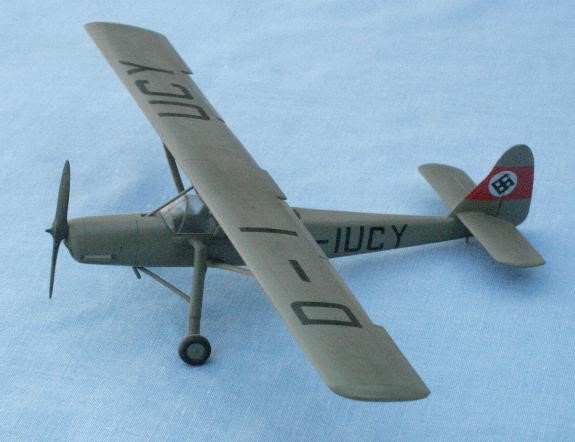
Various people had mentioned the incidence control system, but nobody seemed to remember clear¬ly just how it had worked and where the linkage had been at¬tached to wing and fuselage.
Questioning the pilot who had been in charge of testing the Bf 163 led to the dis¬covery of the plane’s registration, which in turn, enabled H. J. Ebert to identify the a/c in the back¬ground of two snapshots of the old Messerschmitt Archives. Un¬fortunately, the two photos were rather foggy and showed only part of the plane. Yet they supplied a wealth of most welcome informa¬tion, in particular, about the verti¬cal position of the tailplane and the true shape of fin and rudder.
H. J. Ebert found an elementary ¬view of a “Fieseler Storch like plane” in a 1944 issue of “Luft¬fahrt & Schule”. It depicted what must have been an early design sketch of the Bf 163, clearly showing the latter’s unique wing incidence control system, the posi¬tion of the main wing strut, the peculiar semi cantilever landing gear, but a different fuselage contour.
A report titled “A comparison of the amount of riveting opera¬tions for various aircraft types” detected shortly afterwards in the old WFG archives contained a diminutive schematic drawing: the basic outline of the outer panel of the Bf 163 wing. Using the data contained in this report (list of numbers of rivets, wing , slot and flap ribs etc.), it was now possible to re establish the structural design of the outer wing panels and using the available other wing data that of the entire wing.
First flown on 19 February 1938, the Bf 163 V1 proved to have similar performance characteristics to those of the Fi 156 but was more complex and expensive. Although some components for a second prototype were manufactured, the Bf 163 V2 was not completed and further work on the Bf 163 was terminated in favor of the Fieseler Fi 156.
The Ilmavoimat / Maavoimat evaluated the Bf 163 but considered that as the Germans had already ordered the Fi 156 Storch into production, while the Bf 163 was a good aircraft it was so similar in performance and capabilities to the Fi 156 that it probably wasn’t going anywhere. It remained under consideration but as an unlikely fallback option, given that Bayerische Flugzeugwerke (BFW) was unlikely to produce the aircraft only to meet a small Finnish order. License production was contemplated.
In a very rare decision, the RLM issued the airframe designation number 8-163 for the Me 163 Komet rocket-propelled interceptor, after having used the number for the Bf 163. The two aircraft are distinguished by the abbreviation: the earlier Bf 163, and the later Me 163. The new “Me” prefix was adopted for all new designs of Messerschmitt aircraft, after the company’s official name of Bayerische Flugzeugwerke (BFW) was changed to Messerschmitt AG in July of 1938.
With a Crew of 2, the Messerschmidt Bf 163 was powered by a single Argus As 10C 8-cylinder inverted-vee air cooled engine, 179 kW (240 hp) and had a maximum speed of 112mph. Performance characteristics overall were very similar to the Fi 156.
Engine: Argus As 10 C

The Messerschmitt Bf162 was developed from the Bf110 Zerstorer (“Destroyer”) fighter but with few common parts. It was created to meet a requirement for a Schnellbomber or fast bomber. The type first flew in 1937. Unofficially named Jaguar, only three prototypes were built before the project was abandoned when the Junkers submission, the Ju88, won the contract.
Superficially resembling the Bf 110, but with a new fuselage, incorporating a glazed nose, initially 65 aircraft were ordered in the 1937/38 programme but due to Messerschmitt committment to the Bf109 and Bf110 programmes coupled with the superiority of th Ju88 this was reduced to 5 with only 3 being completed. The first two models V1 and V2 (werke no 817 and 818 reg. D-AIXE, D-AOBE) were powered by Daimler Benz DB600D and the third model V3 (werke no 819 D-AOVI) was powered by the DB601A. The first two aircraft flew in 1937 the third on the 7th July 1938. The first aircraft (V1) was dismantled after it’s initial flight trials, the second (V2) went to Rechlin and the third (V3) was used alongside the equally ill fated Me161 at Ausberg towing the Me163A.

Any parts left over including the incomplete V4 and V5 were used in Bf110 production.
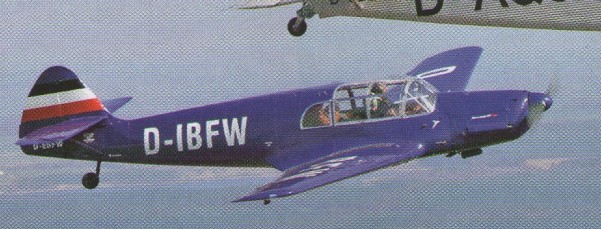
In 1934 Messerschmitt designed the M37, later to become the Bf 108 Taifun, for the German team taking part in the 1934 Challenge de Tourisme International. The original design was for a light tourist two-seater, and even though the Challenge was not a great success for the Bf 108, as the best German pilot Theo Osterkamp only came in fifth, the RLM still ordered thirty-two Bf 108s.
Messerschmitt Bf 108 Taifun Article
The M 37 prototype flew first in spring 1934 powered by a 250 PS (247 hp, 184 kW) Hirth HM 8U inverted-V engine, which drove a three-blade propeller. It could cruise at 145 knots and was orig¬inally equipped with full span flaps and spoilers for lateral control. It featured automatic Handley Page leading edge slats, a retractable undercarriage, fully stressed skin fuselage construction and flush rivets.
Although it was outperformed by several other aircraft in the competition, the M 37’s overall performance marked it as a popular choice for record flights. Particular among these traits was its extremely low fuel consumption rate, good handling, and superb takeoff and landing characteristics. One of the first major changes made to the production variants was to adapt the fuselage for a four-seat configuration.
Production as the Bf 108 Taifun began in 1934 and the first foreign pilot who tested the Bf 108 was Charles Lindbergh.
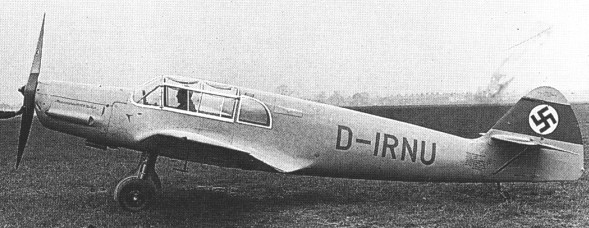
The Bf 108A first flew in 1934, followed by the Bf 108B in 1935. The production of the improved version, the Bf 108B, was set-up in November 1935. The B version was redesigned to be a four-seater with a new 179kW Argus As 10C engine. The Bf 108B was a very modern light aircraft with an all-metal airframe, retractable undercarriage, adjustable propeller, and with excellent flight characteristics.
The military version of the Taifun was the Bf 108B-2 and was acquired by the Luftwaffe in 1939. It was widely employed during the war years by all operational Luftwaffe units as a light liaison aircraft. The nickname Taifun (German for “typhoon”) was given to her own aircraft by Elly Beinhorn, a well known German pilot, and was generally adopted.
In 1941 the Bf 108D replaced the B on the production line. An Argus As 10R engine powered the D version and included the new Argus automatically adjustable propeller and improved fuel assembly.
Production was transferred to the S.N.C.A. du Nord factory at Les Mureaux in France in 1942, where 170 Bf 108D were completed before the liberation of France in 1944. In total 626 military Taifuns, versions B-2 and D-1, were produced. At least 180 civilian or export versions, Bf 108B-0 and B- 1, were produced.
French production continued after the war where another 115 aircraft as the Nord 1000 and Nord 1002 Pengouin were manufactured. 285 were built post-war.
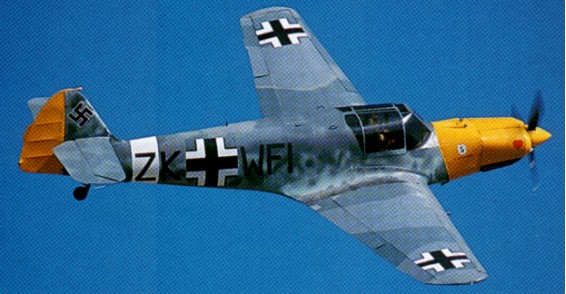
Production of the Bf 108 amounted to 885 aircraft in total.
The Hungarian Air Force had eight Taifuns, both the Italians and Rumanians had three, the USSR bought two and Switzerland and Yugoslavia had twelve each. One aircraft was used in Chile, one or two in Japan and one was in Australia. The Bulgarian Air Force had six and at least one was in Spain. One Bf 108B-1, coded XC44, was operated by the US Embassy in Berlin. Two Bf 108B-1s were flown by the German Embassy in London but the RAF confiscated these two aircraft in 1939. After the war, one Bf 108B-2 was flown in Czechoslovakia, two in Poland, one in Denmark and one in Sweden. Some 115 Bf 108Ds (Nord 1000) were used by the French Air Force and Navy until the late 1950’s.
The Ilmavoimat / Maavoimat evaluated both the Bf108 but considered the design unsuitable for their overall requirement, correctly assessing the aircraft as a light passenger aircraft unsuitable for combat reconnaisance and without any real STOL capability.

Bf 108B Taifun
1 x Argus As 10C, 179kW / 237 hp
Max take-off weight: 1385 kg / 3053 lb
Empty weight: 880 kg / 1940 lb
Wingspan: 10.50 m / 34 ft 5 in
Length: 8.30 m / 27 ft 3 in
Height: 2.30 m / 7 ft 7 in
Wing area: 16.40 sq.m / 176.53 sq ft
Max. speed: 300 km/h / 164 kts / 186 mph
Service ceiling: 5000 m / 16400 ft
Range: 1000 km / 540 nm / 621 miles
Endurance: 4 hr
Initial climb rate: 787.4 ft/min / 4.00 m/s
Seats: 4
Nord 1001
Engine: 240hp Renault 6Q-10, 240 hp
Span: 34ft 6in (10.51m)
Width wings folded: 10 ft 7 in
Length: 27ft 3in (8.3m)
Height: 7 ft 7 in
Max wt: 2990 lbs (1355kg)
Max speed: 186 mph (299 kmh) at 5000 ft
Cruise: 160 mph at 6000 ft
TO speed: 70 mph
Ldg speed: 65 mph
Stall: 53 mph
TO roll at 3000 lb: 950 ft
TO to 50ft: 1120 ft
Ldg rol: 750 ft
Ldg from 50 ft: 1100 ft
ROC: 1200 fpm
Ceiling: 23,500 ft
Range: 620sm (997 km)
Nord 1002
Engine: 240hp Renault 6Q-11, 240 hp
Nord 1002
Engine: 240hp Argus As 10c V8
Span: 34ft 6in (10.51m
Length: 27ft 3in (8.3m)
Max wt: 2990 lbs (1355kg)
Speed: 186mph (299 kmh)
Range: 620sm (997 km)

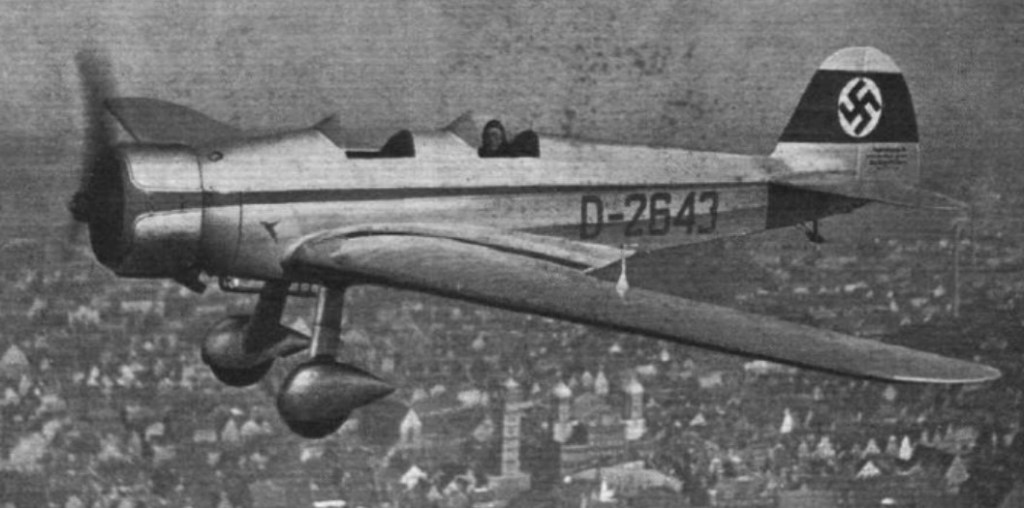
During 1927-33, Messerschmitt designed a series of six sport planes, the single-seat M.17 and M.19, and the two-seat M.23, M.27 M.31, and finally the M.35. With the exception of the M.23, none sold in large numbers. They were all single-engine low-wing cantilever monoplanes with open cockpits and fixed undercarriage. The M.35 kept the extended fuselage of the M.27 and combined it with an undercarriage of single leg, spatted form.
Two different engines were used. The M35a had a 112 kW (150 hp), seven-cylinder radial Siemens Sh 14a, and the M.35b a 100 kW (135 hp) four-cylinder inline inverted air-cooled Argus As 8b. The former was the shorter and faster of the two. The aircraft first flew in 1933.
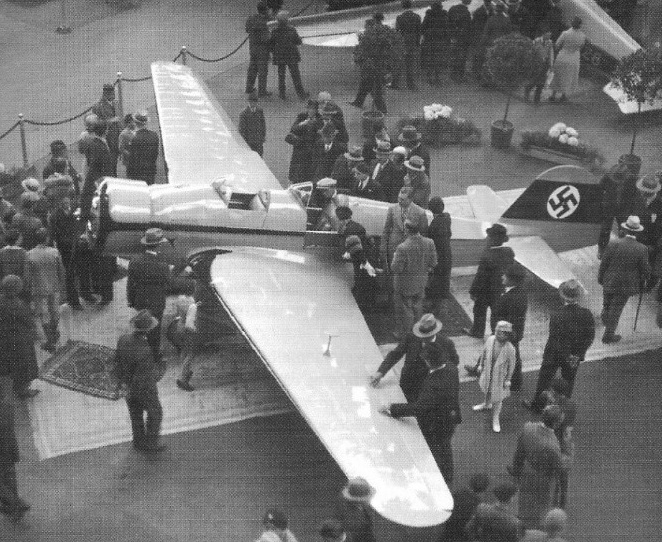
The aircraft was first shown to the public and potential buyers at the 1934 Aerosalon in Geneva. In that year, Rudolf Hess won the Zugspitz trophy in a M.35. In 1934-1935, Wilhelm Stör won the German Aerobatic Championship in a M.35b, and in 1935 the women’s prize was taken by Vera von Bissing in a similar machine. Stör can be seen flying an M.35 in daring acrobatic maneuvers during the 1935 German film Wunder des Fliegens (Miracle of Flight).
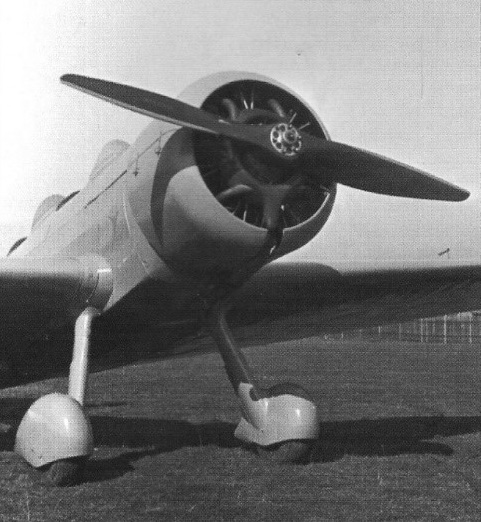
Despite these successes and strong performances at other venues in the late 1930s, only 15 M.35s were built, 13 registered in Germany, one in Spain and reputedly one in Romania. Though the M.35a was faster, the M.35b was commoner; only two M.35as are definitely identified.
M.35a
Powerplant: 1 × Siemens Sh 14a, 110 kW (150 hp)
Wingspan: 11.57 m (37 ft 11.33 in)
Wing area: 17.0 m2 (183 sq ft)
Length: 7.48 m (24 ft 6 in)
Height: 2.75 m (9 ft 0 in)
Empty weight: 500 kg (1,102 lb)
Gross weight: 800 kg (1,764 lb)
Maximum speed: 230 km/h (143 mph, 124 kn)
Cruise speed: 195 km/h (122 mph, 106 kn)
Range: 700 km (435 mi, 378 nmi)
Service ceiling: 5,800 m (19,000 ft)
Rate of climb: 5.05 m/s (994 ft/min) to 1,000 m (3,200 ft)
Crew: two
 All Aero