A two-seat cabin monoplane was built 1937. Powered by Pobjoy Niagara III engine, it was converted to open cockpit configuration 1938.
Inter-Wars
Moss Brothers Aircraft Ltd
Formed in 1936 at Chorley, Lancashire, where prototype M.A.1 two-seat cabin monoplane was built 1937. Powered by Pobjoy Niagara III engine, it was converted to open cockpit configuration 1938. Following year open-cockpit M.A.2 completed, powered by Cirrus Minor, and later converted to cabin version.
Moscow Aviation Institute / MAI

The Moscow Aviation Institute (MAI) was founded in 1930 on the basis of the aeromechanical faculty of the Moscow National Technical University “Bauman” (MGTU), becoming independent from it due to the wide importance that, since then, the aviation in the Soviet Union. It began with two faculties, aircraft construction and engine construction, since then it has been the most important aeronautical academic institution in the entire region, becoming a leader both in the scientific field, being the first to offer science chairs. aeronautics and training its own teachers and doctors who would make up the university boom, as well as technical-industrial, this is confirmed by the fact that it is the only university in the world that has launched its own aircraft on the market, built by its professors and students since 1932, when the MAI set up its own aircraft construction office.
After the Second World War the MAI expanded its academic and scientific interests, a new teaching system was developed, faculties were added in all aeronautical fields, as well as in physical-mathematical sciences, electronics and robotics. The student campus was built with more than 35 buildings, aeronautical infrastructure, workshops and laboratories were acquired, as well as the aerospace faculty, and in this way the MAI obtained the category of technical university. In 1979, artificial satellites ” Radio ” and ” Cosmos ” were launched into space, built with the participation of a large delegation from the MAI.
Although it is true in Soviet times the MAI as a national university maintained a margin of military defense, together with the state and the armed forces, always collaborating with the country, the university has also specialized its engineering in the commercial and experimental field.
The Moscow Aviation Institute (Russian: Московский авиационный институт (МАИ)) is a Russian university located in Moscow dedicated to the study of everything related to the aeronautical and aerospace industry. However, education is currently multidisciplinary and teaching and research programs are offered in multiple scientific and technological fields.
Over the years, the university grew to become the largest aerospace engineering teaching center in Russia, and one of the most prestigious universities in the world. More than 130,000 students, including 1,000 international students from 40 countries, have graduated from MAI after its founding in 1930.
In 1982 by the order of Ministry of Aircraft Industry the Design Bureau was transformed into a branch-wise experimental students aircraft construction design bureau of the MAI. The work was carried out by professional engineers. If necessary the co-workers from among the MAI students and teachers and also from among the workers of the industry were invited. The production facility of the MAI aircraft development plant (EOZ) in the experimental development shop (shop № 3) are manned by qualified technicians. The OSKBES work on the experimental aircraft engineering constantly received high estimations of the industry. Their technical novelty and utility are confirmed by nine Introduction Certificates and more than twenty Invention Certificates. By the end of 1980s six experimental aircraft of different types were designed and built: Kvant, Elf-D UAV, PS-01 small-sized UAV, Elf, Photon and Yunior aircraft.
The basic structure, address and the industrial areas occupied by it in the OSKBES MAI have remained the same. The EOZ MAI (shop № 3) and the MAPO (Moscow aircraft building plant) were used as an industrial base. On July 27, 1992 the application on realization the inspection work in the OKB MA for reception the certificate for the right to develop the civil aircraft engineering was sent to the Aviaregister of the MAK and the Air Industry Department of the Ministry of Industry of Russian Federation. It was made on behalf of the “Aviatika” joint-stock company. According to the inspection results the Aviaregister of the MAK issued Certificate № R-9 to the “Aviatika” joint-stock company with the right to develop light civil aircraft. It was on February 17, 1993.
Aircraft designed and developed at OSKBES include:
A single-seater Aviatika-MAI-890 aircraft — passed certification, had a temporary Certificate of a type of 31 March 1994 № 52В-890, valid till 1 April 1995, is series produced by the RAC “MiG”; A two-seater Aviatika-MAI-890U aircraft is serially produced by the RAC “MiG”; An agricultural Aviatika-MAI-890SKh aircraft is serially produced by the RAC “MiG”; A single-seater Aviatika-MAI-900 aerobatics (“Akrobat”)’ A two-seater Aviatika-MAI-910 with wings, folding on the ground; An Aviatika-MAI-920 glider; A single-seater Aviatika-MAI-890A autogyro, a pre-production model at the stage of flying test. The basis for the “Aviatika” aircraft manufacture at the MAPO plant is the License Agreement concluded by this plant with the “Aviatika” joint-stock company on 10 April 1995 (contract № 4276).
In 1997 Aviatika withdrew from the Design Bureau of Moscow Aviation Institute (Aviatikas) program, after which the manufacturer of Aviatika lightplanes became known as KB MAI.
The personnel of the OSKBES have continued to work in the field of light civil aircraft together with the MAPO MIG.
In April 27, 1998 the Aviaregister of Interstate Aviation Committee issued a Design Organization Certificate R-52 of the developer of light civil aircraft.
29 September 1999 eight members of our design bureau, Moscow Aviation Institute and RAC “MIG” were rewarded by “State Prize of the Russian Federation in science and technology” for designing and development of light multipurpose airplanes in a serial production. They are:
OSKBES MAI Chief Designer K. Zhidovetskiy (posthumously); OSKBES MAI Deputy Chief Designer (after the death of K. Zhidovetskiy — Chief Designer) N. Goryunov; OSKBES MAI Deputy Chief Designer V. Demin; OSKBES MAI Deputy Chief Designer V. Feigenbaum; Rector of MAI A. Matveyenko; Manager of MAI Experimental Plant P. Ogadzhanov; General Manager of RAC “MIG” plant G. Nemov; Deputy Manager of RAC “MIG” O. Chukantsev.
Autogyro MAI-205 made the first flight in 2001, chief designer Andrey Zorin.
In 2002 OSKBES MAI has started designing a new plane MAI-223. This plane made the first flight in 2004.
In 2003 OSKBES MAI started to work on different aircraft, airships and autogyros. It designed and produced gondolas, nacelles, fly-by-wire power plant controls and empennages of NPO “RosAeroSystems” airships Au-30 and Au-12M.
The design and development of Autogyro MAI-208 was started in 2006. The first MAI-208 is undergoing testing. OSKBES MAI presented MAI-208 at the 2nd International exhibition of the helicopter industry “HeliRussia-2009” (21…23 May 2009, Moscow). The new autogyro has caused the big interest of visitors and the press.
July 1, 2008 Vadim Demin was appointed Chief Designer of OSKBES MAI. The same year the design office has started working on a new multi-purpose four-seat twin engine aircraft MAI-407.
In 2009 OSKBES MAI started designing a new training glider MAI-227.
Volokolamskoe Shassé,
Building 4,
Moscow,
Russia,
125993
Faculties and Departments of MAI:
High school.
Faculty № 1. Aeronautical Engineering.
Faculty №2. Aircraft Engines
Faculty №3. Computer Science and Navigation System
Faculty №4. Radio and Electronics
Institute of Economic Engineering
Faculty №6. Aerospace
Faculty №7. Robotics and Intellectual Systems
Faculty №8. Applied Physical-Mathematical Sciences
Faculty №9. Applied Mechanics
Faculty №10. Humanities (Social Engineering)
Military Institute
Moscalev SAM-9 Strela

It was that VM Molotov’s international espionage system had received information about the development in the United States of a low aspect ratio aircraft designed by the Russian émigré Glukhariev. When asking the TsAGI about the subject, the scientists from this institution could not give an objective answer, since they generally worked on more conventional designs. About six months later the information reached Stalin, who paid great attention to aviation and decided that behind that news there must be an important aeronautical development. Suddenly someone remembered about Moscaliev’s shelved project “Sigma”. It was decided without fail to call him to Moscow.
After exposing the characteristics of the “Sigma” project and defending the theory of the development of aircraft with this scheme and reactive engines as a way to achieve high speeds, Moscaliev received the task of building an aircraft analogous to the “Sigma” in the OKB-31 and submit them for state testing. The TsAGI was ordered to carry out experimental work in the wind tunnel on a scale model and the additional task of beginning studies and developing a low aspect ratio model. Its construction was assigned to the specialist of the TsAGI Kamniemostski.
For Moscaliov’s new plane, two 140 hp Renault 4 pi engines were purchased and the decision was made to name the model Moscaliev SAM-9 “Strelá” (Arrow) (Russian: Москалёв САМ-9 «Стрела»), due to the shape of its fuselage in the plane. Moscaliev was given two and a half months to get the prototype ready. The short time was motivated by Stalin ‘s interest and the need of the TsAGI to give a quick response.
The conceptual project of the new aircraft was developed by Moscaliev still in Moscow . For this purpose, Professor Cheremujin ‘s office at the TsAGI was lent to him and he was assigned cartoonists and copyists. This project was ready in just three days.
The general composition of the new aircraft was approved by TsAGI Victor Pavlovich Gorski. In general, the “Strelá” kept the wing shape of the “Sigma” but lacked the horizontal surfaces at the wing tips, presenting a conventional empennage with rudder.
It was agreed to work in parallel in two directions: the creation of a mock-up for the development of the tests at TsAGI, under Gorski’s tutelage, and the construction of the aircraft at the Voronezh Aviation Technology under the direction of Moscaliev. The construction of the aircraft without having received the checks from the TsAGI represented a great risk, but the short time allotted to the task did not allow another sortie. Moscaliov ‘s OKB was isolated to dedicate itself exclusively to this new task, which had a strategic character and for that reason it worked with a high level of secrecy. In the agreed two and a half months the new aircraft was found finished. In the numbering of the company it became known as SAM-9.
The SAM-9 “Strelá” was entirely in wood with plywood and fabric covering.
The triangular shaped wing with elliptical sides and rounded base had a very low aspect ratio with an aspect ratio of 0.975. It was also characterized by the use of a very thick profile (RAF-38 modified) that started right from the nose. The wing structure consisted of three spars and box-type ribs with plywood covering. The control surfaces was carried out by means of cables.
The wing trailing edge was made up of two large-area control surfaces, which served as elevators. By reaching unequal angles these surfaces could also be used as spoilers.
The fuselage was integrated into the wing with a smooth transition and ended in a large-area empennage.
The landing gear was of the conventional type with a tail skid. The main undercarriage was cantilever type and fairings, featured unique balloon wheels.
The pilot was located in a closed cabin located on the wing with transparent cover. The power plant consisted of a 140 hp MV-4 engine (licensed version of the French Renault 4 pi) moving a 2.2 meter diameter Ratier wooden propeller.

The prototype was ready for the beginning of the summer of 1937. By that time, the necessary calculations and static resistance tests had been carried out. In parallel, tests were carried out in the TsAGI wind tunnel under the direction of VP Gorski. The results obtained allowed fine-tuning the details of the aerodynamic calculation, stability, definition of the center of gravity and the ideal size for the control surfaces.
It was decided to carry out the tests of the prototype in a remote airfield, used as a reserve base for long-range bomber aviation and located about 10 kilometers from Voronezh. As a test pilot, AN Gusarov was selected, who since the end of 1936 had left his position as head of the flight group of the Voronezh flying club and joined OKB-31.
Ground tests began on July 27. The new aircraft responded acceptably to the controls, behaving well in turns on the runway, increasing speed quite well and maintaining course without difficulty with the tail off the ground. The pilot was astonished to see that at a speed of only 70 – 80 km/h the plane voluntarily detached itself from the ground.
The factory test evaluation commission included the pilot, Moscaliov himself and a group of specialists made up of LB Polukarov, SA Zavyalov, NA Marietski and Dolgov. In August this commission was reinforced with the arrival of a government commission from Moscow. After once again reviewing the documentation, it was decided to proceed with the development of the tests. Due to the lack of a standard to define the structural resistance of this new concept, Professor VN Belyayev was asked to review the calculations and the results of the static tests, in order to give the go-ahead for the start of the flights.
After Belyayev’s positive assessment, it was decided that the flight tests would be entrusted to experienced test pilot Boris Nikolayevich Kudrin, who had previously tested unconventional configuration aircraft produced by Cheranovski and other Soviet builders.
Arriving at the site, Kudrin watched the plane for a long time, checking its parts. He reviewed the calculations and finally told the commission that he would not only not fly the plane, he would not even conduct ground tests on such a strange device. According to Moscaliev ‘s own words in his memoirs, the pilot Kudrin stated that he would not fly in an airplane “… that not only did not have a tail, but also lacked wings”
After several discussions, it was decided to continue the tests with factory pilot AN Gusarov, who gladly agreed to fly the prototype. Soon tail-up racing around the track began again. These were successful if one discounts an incident in which, during a race on the runway, the pilot stepped on the pedals and the plane suddenly went into a spin and overturned. Luckily neither the aircraft nor its pilot received damage due to the low speed and the grass on the runway. The plane was returned to its position on the wheels and the pilot, after starting the engine, headed towards the starting point. As a result of this incident, steel tube protection was added to the cabin deck.

Finally, the first flight was authorized, which was carried out by Gusarov on August 7, 1937. Around 10:30 a.m., after raising the tail of the plane, reaching about 150 km/h, it took off about 20 meters from where the commission was, making a dangerous turn that almost placed the planes in a vertical position to the ground, to then straighten out. After a flight of about 1,200 – 1,500 meters, the plane touched down.
Despite the pilot’s opinion that he maintained control over the plane at all times, the commission considered that the flight could have ended in a catastrophe and only the pilot’s expertise saved the plane. As a result it was decided to continue the tests in Moscow.
The aircraft was transferred on the bed of a truck to the TsAGI NII, located at the Central Aerodrome in Moscow. The tests this time were started from scratch. The races around the track were carried out by practically all the LIS pilots – Korzinshikov, Chernavski, Rybko, Ribushkin and even the LIS boss NF Kozlov, but no one showed up wanting to fly it. During these evaluations, well-known USSR test pilots such as Gromov, Alexeyev, Stefanovski and Chkalov were present, who expressed doubts about the flight possibilities of the plane, which increased the misgivings of the pilots to raise it. Finally, Gusarov decided to try again.
The flight was carried out with extreme care. The plane rose about one meter from the ground and after testing the operation of the ailerons it landed. Realizing that the model could fly and was capable of responding to commands, the SAM-9 executed several short, low-altitude jumps flown by Chernavski, Rybko , Ribushkin and others.
Nikolai Stepanovich Rybko was selected as test pilot who started the systematic flight program. Starting with short duration flights, he gradually increased the range until he achieved more than 1 kilometer. On August 27, Rybko reported that he was ready to carry out a real test flight that was carried out the following day and in which the plane failed to increase the altitude, so the pilot was forced to land at the neighboring Aeroclub Central aerodrome, in Tushino. The reason for the lack of height was the requirement of the new scheme for angles of attack greater than 22º to achieve ascent, motivated by the low engine power.
In the month of September a new flight was carried out, which was completely successful. The next flights of the SAM-9 were carried out already in winter on Lake Plesheyevo on skis and later again in Moscow. The tests lasted until the middle of 1938 and in them the performance of the airplane was fixed, despite the fact that it was understood that with a Wheel undercarriage the results should be superior.
In August 1938 the “Strelá” was returned to the OKB with a detailed report of the conclusions about his scheme and the request to solve a small problem of oscillations that appeared to fly at low speeds. Due to the secrecy of the project, the plane was packed in a big box and moved by train to Factory No.18.
After small modifications that included increasing the empennage area by 30% and installing vertical surfaces at the tips of the wings, further tests were carried out by AN Gusarov, which yielded a top speed of 343 km/h.
At the end of these flights and following orders from Moscow, the SAM-9 “Strelá” plane, which had already fulfilled its mission, was destroyed.
SAM-9 “Strela”
Power plant: 140 hp MV-4
Prop: 2.20 m diameter Ratier
Wingspan: 3.55 m
Wing area: 13.00 m²
Length: 6.15m
Empty weight: 470 kg
Maximum takeoff weight: 630 kg
Wing loading: 48.5kg/m²
Power load: 4.5kg/hp
Fuel + oil load: 60 + 10kg
Maximum speed: 310 km/h
Landing speed: 102km/h
Service ceiling: +1500 m
Landing run: 100m
Take-off run: 200m
Accommodation: 1

Moscalev SAM-7 Sigma
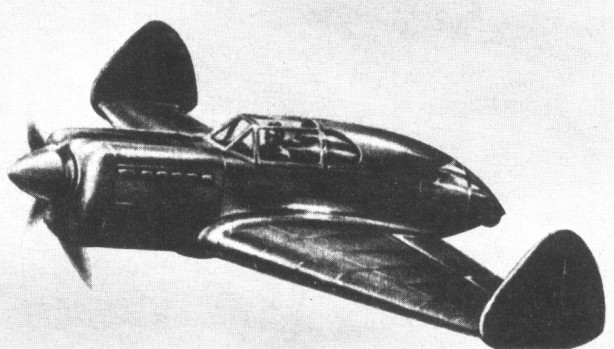
As part of the “Sigma Project” about 1934 Moscaliov began work on the development of a new model of unconventional design designated SAM-7 “Sigma” (Russian: Москалёв САМ-7 «Сигма»). with M-34 engine. The work in the RDD delayed a little the projection work of the model. This was the main task of the OKB of Factory No.18 at that time. The SAM-7 was designed as a two-seat escort fighter designed in a tailless configuration.
The SAM-7 was constructed entirely in metal. The steel structure was covered by thin sheets of 1.5 – 2.5 mm.
The aircraft featured a relatively short fuselage with swept wings terminating vertical surfaces, operated as rudders. The entire wing trailing edge featured control surfaces that were used as elevators. The outer sections additionally operated as conventional ailerons. The selected wing profile was the R-11a with a thickness of 12% at the root and 10% at the wingtips.
The fuselage ended in a cockpit for the gunner, who operated two machine guns located in a mobile turret. Under normal conditions this cabin remained closed in order to improve aerodynamics. During combat the cover was opened and the turret moved to the rear, allowing an excellent firing range. Two ShKAS synchronized machine guns were located in the engine.
The cockpit was located just behind the M-34R 850 hp V-12 linear engine. With this powerplant the expected speed for the SAM-7 at 4,000 meters was 600 km/h. The absence of a reducer in the M-34 engine made it necessary to use a 4-blade wooden propeller. The SAM-7 had the center of gravity at 13 – 15% of the chord, but tests showed excellent stability.
The cooling system included evaporative radiators located in the wings, plus a conventional type retractable auxiliary radiator, located behind the downward opening pilot seat, to be used in low speed operations (landings, takeoffs and taxiing). on the track).
The landing gear was of the conventional type, retractable towards the inside of the wing by turning it and with hydraulic shock absorbers. Landers were attached to the forward spar of the wing. The tail skid was practically hidden in the fuselage.
The prototype was built between 1934 and 1935 at Factory No.18 Voronezh and the factory tests were carried out successfully, although for precautionary reasons they only included tests of taxiing and small flights in a straight line.
At the same time that Moscaliev was developing the SAM-7, at the Kharkov Aviation Factory KA Kalinin was developing the K-12 or VS-12 bomber, also known as “Zhar Ptitsa” or Firebird. This M-22 twin-engined medium bomber also featured a trapezoidal-shaped R-11a airfoil.
Taking advantage of the delay caused by the development of the RDD, the Kalinin K-12 was delivered to state tests some time before. The first flight carried out by the test pilot of the NII VVS P. M. Stefanovski, was a total failure, mainly due to the ignorance of the characteristics of an airplane with this scheme.
The SAM-7 was eventually found ready for state testing at the NII VVS, but GUAP’s decision to cancel all flights soon followed. The cause was the similarity to the unsuccessful K-12.
Despite the fact that the SAM-7 had a 20º wing camber on the leading edge, which should have eliminated the defect shown by the K-12, the evaluation of the latter’s flights concluded that the tailless scheme was unreliable and he had no prospects. However, flights by factory pilots in K-12 and SAM-7 aircraft showed that the tailless scheme was capable of flying and being controlled in flight.
SAM-7 “Sigma”
Engine: 1 × 750 hp M-34
Wingspan: 9.60 m
Wing area: 20.00 m²
Length: 7.00m
Empty weight: approx 1000 kg
Maximum takeoff weight: 1480 kg
Wing loading: 74 kg/m²
Power load: 2.0 kg/hp
Speed at sea level: 435 km/h
Maximum speed at altitude: 500 km/h
Landing speed: 138km/h
Practical range: 800 km
Practical ceiling: 9200 m
Armament: Four 7.62 mm ShKAS machine guns.
Accommodation: 2

Moscalev, Aleksandr Sergeyevich

Alexandr Moscaliov was born on 16 of November of 1904 in the city Valuiki, the governor of Voronezh, Russia. In 1913 his family moved to Voronezh where at the age of 10 he started school. Previously his education had been at home.
In 1922 entered the physical-mathematical faculty of the Voronezh University, but it was closed two years later, so Moscaliov was forced to move, first to the Kazan branch and later to Leningrad. In 1928 he finished his studies at the physical-mathematical faculty of the Leningrad State University.
After graduating, he enrolled in a job board from which he was sent to work at Factory No. 23 (formerly “Krasni Liotchik”). His first important work was the development of tests of 12 types of radiators to be located in the I-2bis fighter developed by Grigorovich. Applying his university knowledge Moscaliov managed to make a good selection and propose methods to improve radiators. In this period, externally, he took examinations at the Leningrad Technical Institute, which was soon reflected in his work.
In 1930 Moscaliov entered the competition to develop a fighter-interceptor with the new M-34 engine. His project was selected, but delays in tuning the engine prevented its construction. In 1931 at the “Krasni Liotchik” his first aeronautical design would see the light: the MU-3 training hydrofoil, a development of DP Grigorovich’s MU-2.
Due to health problems, Moscaliov left Leningrad and returned to his native Voronezh where a large aviation factory had begun to be built. From 1932 he began to work as a substitute for the head of the serial construction department (SKO) of the Voronezh Aviation Factory No. 18. From 1933 he began his teaching activity at the Voronezh State University and from 1936 he became a substitute for the director of the Voronezh Aviation Technology.
In 1932 – 1933 Moscaliov led a group of enthusiasts who designed and built one of the first all-metal light aircraft, the SAM-5, in response to a request from the Osoaviajim. This aircraft was the first of the family of aircraft with the acronym SAM designed as high-wing cantilever monoplanes for 5 passengers.
With the help of the facilities of the Voronezh State University, Moscaliov began to develop a research project to achieve a supersonic configuration. As a result of his research, in 1933 he developed a project, not so ambitious, of an interceptor fighter capable of approaching 1000 km / h using two paired tandem engines moving counter-rotating propellers that was called SAM-4 and known as “Sigma”.
The project turned out to be too innovative and received a rather cold reception until a few years later it became known that in the United States experiments were being carried out on a similar configuration and it was urgently requested to create a scale demonstrator, which was launched as SAM-9 “Stelá” in 1937.
By 1936 Moscaliov’s work volume had grown, for which the Main Directorate of the Aviation Industry (GUAP) decided to allow him a bureau of his own design, which became known as OKB-31, in Factory No.18. In 1939 the construction workshop was built and in 1940 the independent building on the airfield was completed. This OKB would be responsible for the creation of a score of new projects.
Moscaliov belongs to that group of enthusiastic designers who stood out for their aeronautical productions despite the absence of regular financial support and their own production base. His aeronautical design and production work included more than 35 models of which 23 were built between 1930 and 1945. Moscaliov’s planes set several records for range and flight duration.
With the start of the war, OKB-31 was evacuated to Siberia, near the city of Yalutorovska, Tyumen Oblast. The decision was made to unify with OKB of P. Grojovski and a small factory Muscovite creating the new factory No.499. Moscaliov was selected as principal director and constructor.

This factory prepared the serial production of the first Soviet reactive fighter, the Bereznyak / Isayev BI, produced the landing cabins for the Ilyushin DB-3 bombers and built different types of gliders. For his contribution in the construction of the AM-14 aircraft for the support of the guerrilla groups in Belarus, Moscaliov received the 1st level “Guerrilla of the Great Patriotic War” medal.
On his return to Leningrad in 1945 the OKB of Moscaliov designed the project supersonic fighter PM-1 with reactive engines Dushkin. This aircraft was also known as SAM-29 RD-2P-3V and maintained the same general scheme of the Sigma project of 1933.
This time the project was studied in depth at the TsAGI and its construction was proposed, but changes in the direction of the MAP led to the closure of the project, the replacement of Moscaliov and the liquidation of the OKB.
From 1948 Moscaliov began working as a professor at the Leningrad Military Aeronautical-Engineering Academy named after AF Mozhaiski (LKVVIA), sharing his experience with new generations of aeronautical designers and engineers. From 1954 he directed the scientific-research laboratory for the development of perspective military technique.
He died on 3 as January as 1982 and his remains lie the North Cemetery in Leningrad (St Petersburg).
Orders and medals:
Order of the Red Star
Medals
In 1979 he was awarded the Koroliov Academic gold medal for contributions to aviation and on the occasion of his 75th birthday.
Aeronautical production:
First designs
SAM-1 – 1930 fighter project with an M-34 engine. It was not built.
MU-3 – 1931 training floatplane. A single copy built.
OKB-31 works in Voronezh:
RDD – Modernization of Túpolev RD with diesel power plant. A single prototype was produced in 1936.
SAM-4 ‘Sigma’ – High speed aircraft project developed between 1933 and 1934
SAM-5 – 1933 light aircraft built in metal.
SAM-5bis – Development of the SAM-5 but with wood construction.
SAM-5-2bis – Improved development of the SAM-5 from 1937.
SAM-6 – Experimental aircraft to test single-wheel landing gear.
SAM-7 “Sigma” – Tailless escort fighter project. A copy was built in 1936.
SAM-9 “Strela” – Development of the SAM-4 concept in an experimental light aircraft prototype.
SAM-10 – Light passenger aircraft from 1938, development of the SAM-5.
SAM-10bis – Improved version of SAM-10 with new powerplant.
SAM-11 – Amphibious training aircraft from 1939.
SAM-11bis – Improved development of SAM-11 with new powerplant.
SAM-12 – 1939 Training Plane Project.
SAM-13 – Experimental twin-fuselage aircraft similar in conception to the Fokker D-XXIII. A copy produced in 1939.
SAM-14 – Light transport aircraft, development of the SAM-5-2bis for Aeroflot. 1939.
SAM-16 – reconnaissance floatplane from 1940. The prototype was never finished.
Works at Factory No. 499 during evacuation
AM-14 – Landing glider. Enlarged version of the Antonov A-7 built in series since 1942. * SAM-18 – Passenger amphibian project for 12 – 14 people.
SAM-19 – Hydrofoil project with tandem paired engines moving counter-rotating propellers
SAM-22 – Motor glider project developed during the war at Factory No.499
SAM-23 (LT) – Cheap “disposable” ground attack aircraft project, developed in 1942 with a similar objective to that of the Tomashevich Pegas.
SAM-23 – Landing glider from 1945. Not built by the end of the war.
SAM-24 – Project for a passenger plane with two M-11E engines.
SAM-25 – Staff liaison aircraft over SAM-5-2bis with M-11E engine. 1943.
SAM-27 – Project for a passenger plane with capacity for 22 people from 1943.
SAM-28 – Motor glider project developed during the war at Factory No. 499 with M-11E engine and capacity for 21 soldiers.
SAM-29 or RM-1 – Project obtained as supersonic fighter development of the concept of the Sigma in 1933 with reactive power plant.
Morse MB-3 / Thomas-Morse MB-3 / MB-6 / R-2
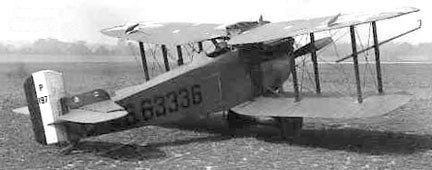
The MB-3 first flew on 2 February 1919. Fifty were for the US Army (AS63331-AS63380), 10 for USMC (A6060 to A6069); plus 1 static and 3 flying prototypes (AS40092 to AS40095), and 4 production for tests at McCook Field (AS63332, and AS63336 and AS63337).
The 1922 MB-3A featured a new cooling system and four-bladed prop. First flying on June 7, 1922, 200 Morse MB-3A fighters (AS68237 to AS68436) were built by Boeing during 1921 -1922, contracted by the government in 1920. Some later became MB-3M advanced trainers. Design elements went into Boeing PW-9. In addition 50 were built by Thomas-Morse.
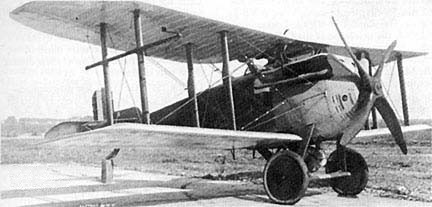
Three clipped-wing models were built in 1921, with one becoming MB-6 / R-2, and 10 for the USMC in 1921.

The MB-3B modified Boeing four-aileron design was cancelled.
Thomas-Morse MB-3
Engine: 300hp Wright-Hisso H
Wingspan: 26’0″
Length: 20’0″
Useful load: 823 lb
Max speed: 141 mph
Cruise speed: 125 mph
Range: 310 mi
Ceiling: 23,700′
Seats: 1
Moreland M-1
A three-seat biplane powered by a 225 hp Wright engine, circa late 1920s.
Moreland Aircraft Inc.
Founded by G. E. Moreland in the late 1920s at Inglewood, California, to produce the Moreland M-1 three-seat biplane powered by a 225 hp Wright engine.
Tatra T.101
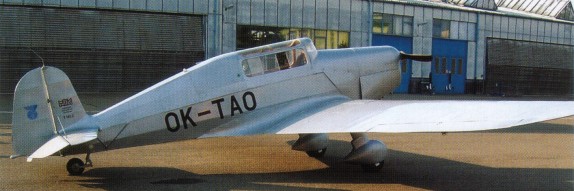
Only one Tatra T.101 was built in the late 1930s. It held various world records in its day, including a distance record of 4340 km, Prague to Al-Khartoumn.
The aircraft has 11 fuel tanks in both wings and fuselage giving around 30 hours endurance. The wing is one piece, of wooden construction.
Engine: Tatra T-100
Wingspan: 13 m
Endurance: 30 hr
 All Aero