Turkey
Established in 1937 at Istanbul, NUD built gliders under license and produced the two-seat NU D.36 training biplane and a prototype NU D.38 high-wing, twin-engined six-passenger airliner.
Inter-Wars
North Star Aerial Service Loomis Special
The 1926 Loomis Special was a redesign by C G Taylor of another plane for barnstormer Jack Loomis (Taylor’s flight instructor). With a steel tube fuselage, Clark-Y wing, and two place cabin under a monoplane wing. Registered N2594 c/n 2, powered by a 120hp Anzani, it crashed in August 1927, and rebuilt as a four place open cockpit with a 135hp Hallett and reregistered N2954.
Engne: 120hp Anzani
Wingspan: 40’0″
Length: 24′
North Star Aerial Service JN-4D
Pre-1928 a three-place JN-4D was rebuilt as 285=3035 c/n 1.
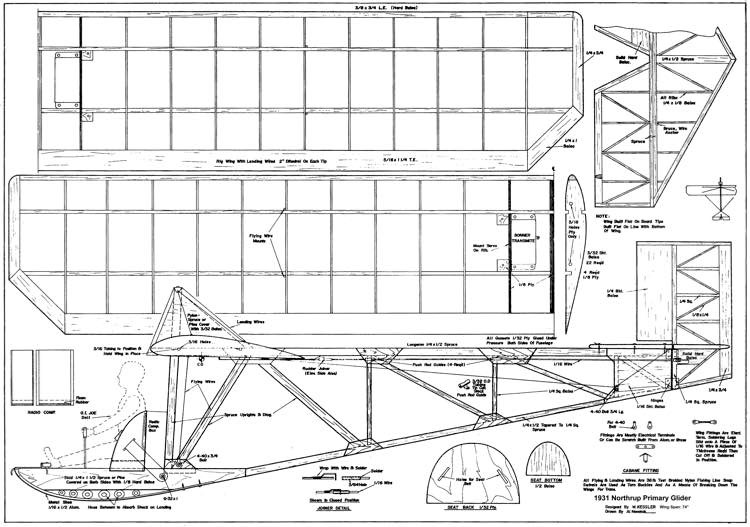
Northrop Primary Glider / Zogling
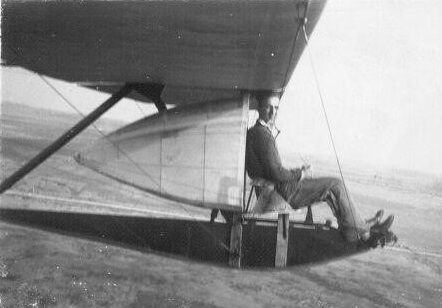
The “Northrop” is an American copy of the “Zogling” which was designed in Germany in the 1920s as a training glider. Apparently, the Northrop primary glider takes its name from a Marvin Northrop of Minneapolis who imported a Zogling from Germany and from that glider had plans drawn and published in Modern Mechanics in 1930.
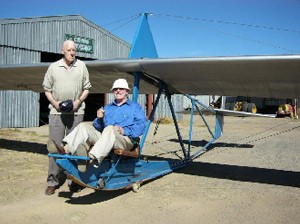
Thousands of Primaries were built all over the world starting with the Grunau 9 by Edmund Schneider. The Zogling was copied and modified by many. In Britain Slingsby got started with a copy called the “Dagling”
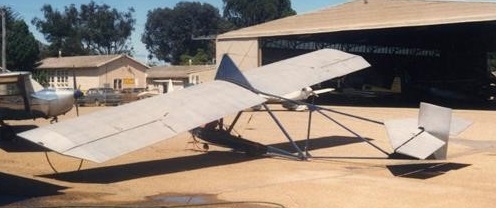
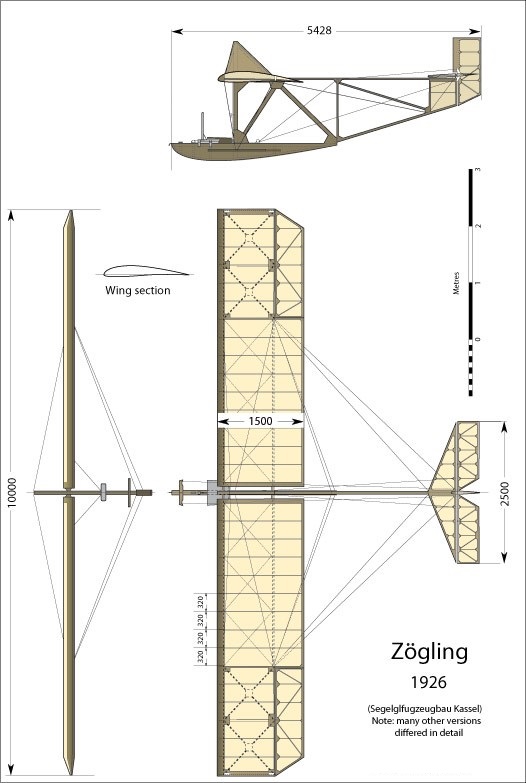
Wingspan: 10 m
Wing area: 15 sq.m
Wing chord: 1.5 m
Length: 5.428 m
Empty weight: 86 kg
Takeoff weight: 170 kg
Aspect ratio: 6.7
Northrop, Marvin
Marvin Northrop was not related to J. Northrop who started a large Aircraft Company in USA
Northrop FT-1 / FT-2 / BT-1 / BT-2
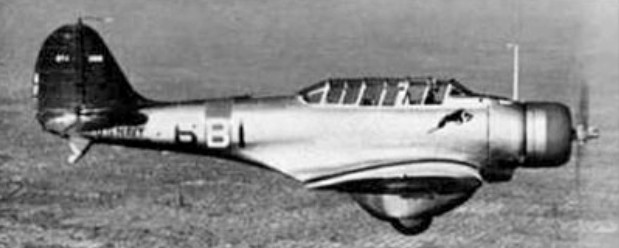
While Northrop was working on the YA-13/XA-16 developments of the Gamma, the company was also testing a scaled-down version for the US Navy under the designation Northrop XFT-1. This was one of two Northrop prototypes which failed to attract production orders, the other being the Type 3-A of 1935. Both were all-metal fighters, the XFT-1 with fixed landing gear being intended for the US Navy. Powered originally by a 466kW Wright XR-1510 radial, it was later re-engined, as the XFT-2, with a 485kW Pratt & Whitney R-1535, but crashed three months later, in July 1936.
The Northrop 3-A was a similar design for the US Army, but differed from the navy aircraft in having retractable landing gear and a modified canopy. Developed alongside these prototypes was the XBT-1, which had semi-retractable landing gear, and this entered production as the BT-1 torpedo-bomber, the first of 54 being delivered in April 1938. The BT-1 had a 615kW Pratt & Whitney R-1535 Twin Wasp Junior radial engine, but one aircraft was modified as the BT-2 to have revised landing gear and a 597kW Wright XR-1820 Cyclone. With other modifications this was to become the Douglas SBD Dauntless as the original Northrop Corporation had by then become the El Segundo Division of Douglas.
Northrop 3A
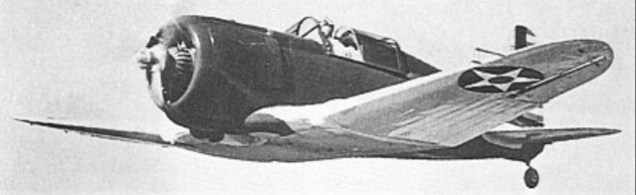
Based on the design of the XFT, the Model 3A was developed as a contender in the US Army’s Materiel Division competition for a successor to the P-26 in service with the USAAC. A low-wing all-metal semi-monocoque monoplane with fully-retractable main undercarriage members and an enclosed cockpit, the Model 3A was powered by a Pratt & Whitney SR-1535-6 Twin Wasp Junior 14-cylinder radial engine rated at 700hp for take-off. It had provision for one 7.62mm and one 12.7mm gun in the fuselage. Completed in July 1935, it was briefly tested at Wright Field where it was found to be somewhat unstable and prone to spinning. Returned to the manufacturer for modification, the Model 3A was under test over the Pacific on 30 July, but failed to return, no trace of the aircraft nor its pilot ever being found. The design of the Model 3A was subsequently sold to Chance Vought Aircraft which further developed it as the V-141.
3A
Max take-off weight: 1769 kg / 3900 lb
Wingspan: 10.21 m / 33 ft 6 in
Length: 6.78 m / 22 ft 3 in
Height: 2.77 m / 9 ft 1 in
Wing area: 17.37 sq.m / 186.97 sq ft
Max. speed: 434 km/h / 270 mph
Northrop XFT
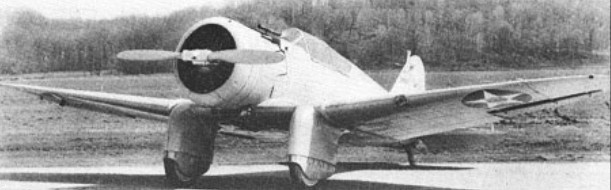
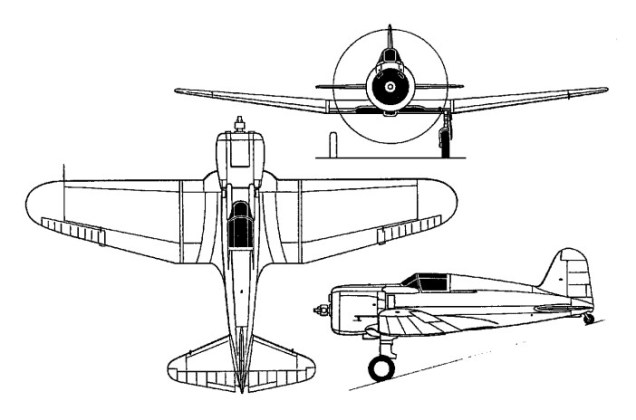
Despite some scepticism concerning the practicability of the monoplane configuration for the shipboard fighter, the US Navy’s BuAer issued a second requirement for such a warplane on 24 January 1933, the first having been issued seven weeks earlier and for which the Boeing Model 273 was designed and built (as the XF7B-1). To meet the later but essentially similar requirement, a contract was let to Northrop for a prototype assigned the designation XFT-1.
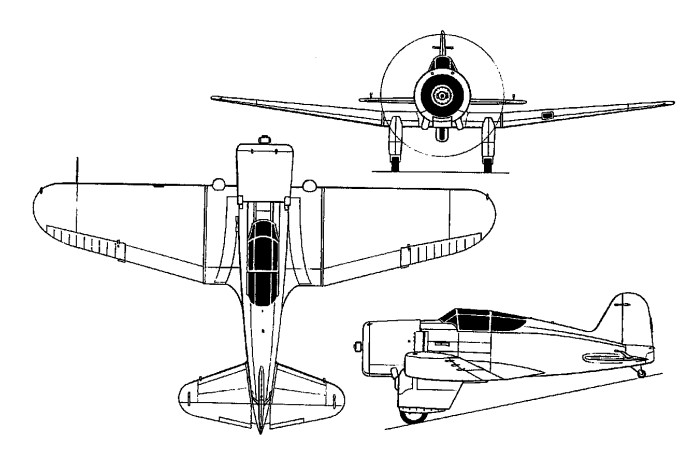
A single-seat all-metal cantilever monoplane with split flaps, spatted main undercarriage members and an enclosed cockpit, the XFT-1 was designed by a team led by Ed Heinemann. Powered by a Wright R-1510-26 14-cylinder radial rated at 600hp at sea level and 625hp at 1830m, and carrying two 7.62mm cowl guns, the XFT-1 first flew on 16 January 1934.
The US Navy was critical of its manoeuvrability, its tendency to spin out of certain manoeuvres, its low speed characteristics and its landing speed. During the course of initial tests, an XR-1510-8 engine affording 650hp at 2590m was substituted for the -26, and, in April 1936, the XFT-1 was returned to the manufacturer for more extensive modification. A Pratt & Whitney R-1535-72 Twin Wasp Jnr 14-cylinder radial rated at 700hp for take-off and 650hp at 2285m was installed, this having a long-chord cowling; the vertical tail surfaces were enlarged, and the mainwheel spats were revised.
Redesignated XFT-2, the fighter was now 118kg heavier in empty condition, speed and climb performance were marginally improved, but manoeuvrability and low speed characteristics were worse. It was pronounced unairworthy by the US Navy and crashed on 21 July 1936 while being returned to its manufacturer.
XFT-1
Max take-off weight: 1704 kg / 3757 lb
Empty weight: 1120 kg / 2469 lb
Wingspan: 9.75 m / 31 ft 12 in
Length: 6.43 m / 21 ft 1 in
Height: 2.87 m / 9 ft 5 in
Wing area: 16.44 sq.m / 176.96 sq ft
Max. speed: 378 km/h / 235 mph
Range: 1570 km / 976 miles
Northrop Delta / RT-1
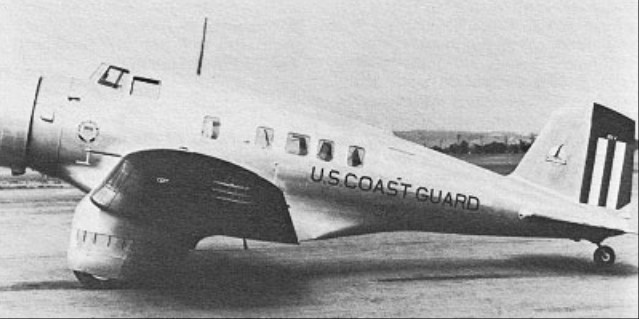
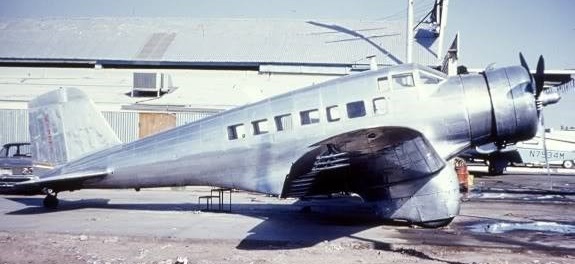
While the Gamma was being developed, Northrop was working on a nine-seat transport, which was basically a new fuselage married to Gamma wings. Unfortunately for Northrop, the US 1926 Air Commerce Act was amended to prohibit the use of single-engine aircraft for carrying passengers by night, or over rough terrain where emergency landings could not be made. Consequently, airline use for its intended role was nonexistent in the USA, although three had been sold before the new regulation was announced. Eight others were used as executive transports, and one was bought by Swedish AB Aerotransport, which subsequently acquired a second.
The US Coast Guard operated a Delta under the designation RT-1, as the Secretary of the Treasury’s personal aircraft.
The last Delta was supplied to Canada as a pattern aircraft for assembly in that country by Canadian Vickers, who built 20 of various marks with both wheel and float landing gear. Deltas were flown with various engines, including the 529kW and 548kW Wright SR-1820, 485kW, 492kW and 522kW Pratt & Whitney Hornets.
Northrop Gamma 2C / Gamma 2F / A-13 / A-16 / A-17 / A-33 / Nomad / 8A / Douglas A-33
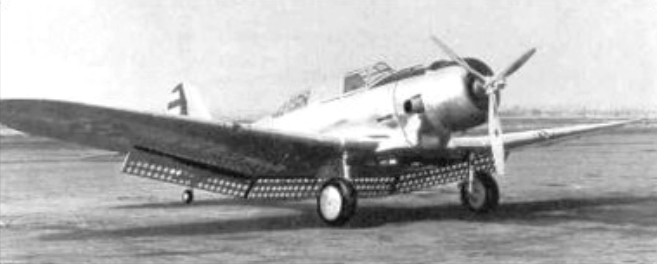
Northrop used the Gamma transport as the basis of a private-venture design for a light attack bomber, identifying this as the Northrop Gamma 2C which, powered by a 548kW Wright SR-1820F radial engine, was acquired for evaluation by the US Army Air Corps in June 1934 under the designation YA-13. Subsequently re-engined with a 708kW Pratt & Whitney R-1830 Twin Wasp, this aircraft was redesignated XA-16 (Northrop Gamma 2F).
Following tests of the YA-13 and XA-16, Northrop received $2 million contract for 110 attack bombers designated A-17, but because testing of the XA-16 had shown that the aircraft was over-powered, the Gamma 2.F was re-engined with a 559kW Pratt & Whitney R-1535 Twin Wasp Junior, serving as the prototype for the A-17. Following the incorporation of several other modifications, the first of 109 production A-17 aircraft was delivered in December 1935.
A contract was received in the same month for an improved A-17A, introducing retractable tailwheel landing gear and the 615kW Pratt & Whitney R-1535-13 engine. Some 129 were built, initially by Northrop, but in 1937 Douglas acquired the remaining 49% of Northrop Corporation’s stock, and it was the Douglas Company which completed production of these aircraft. Of the total, 93 served with the USAAC for only 18 months, then being returned to Douglas for sale to the UK and France. The Royal Air Force received 60, designating them Nomad Mk I, and all were transferred to the South African Air Force.
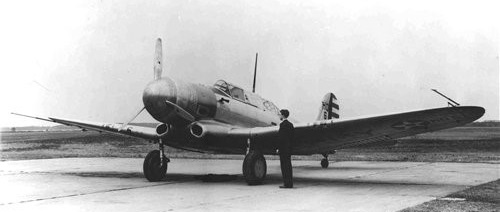
An experiment with the Northrop A-17 aircraft in 1940 consisted in changing the way the air was taken to cool the engine to which the air is fed through special channels at the root of the wing.
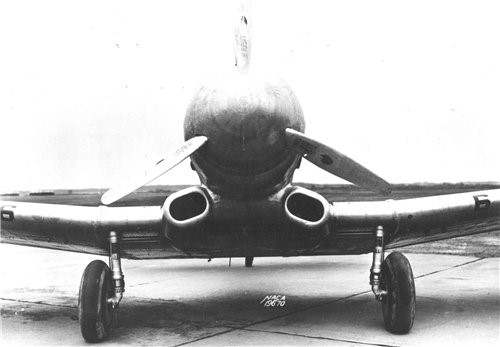
These air intakes, even supported by a special suction fan (hot air was emitted through special blinds from above), turned out to be completely inadequate to supply the required air volumes. Ground tests gave normal temperature only at idle speed and without load. Any attempt to increase the amount of power led to a rapid overheating of the engine.
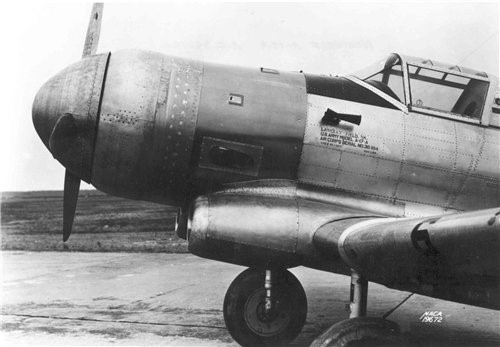
Douglas also built this aircraft for export under the designation Douglas Model 8A, supplying them to Argentina, Iraq, the Netherlands and Norway. In 1939 the first SAAB built 8A-1 was completed (as the B5).
Early in 1940, the Norwegian government ordered 36 8A-5s which not had been delivered before Norway was invaded by the Germans. Completed between October 1940 and January 1941, the aircraft were delivered to a training center in Canada that had been set up for the Norwegian government-in-exile, named “Little Norway” at Toronto Island Airport, Ontario.
The 8A-5 was powered by a 1,200 hp (895 kW) Wright R-1820-87 engine, with four wing mounted 0.30 in machine guns, two 0.50 in machine guns in pods below the wing, a rear-firing flexibly mounted 0.30 in gun, and the ability carry up to 2,000 lb of bombs.

After the loss of two aircraft and a reassessment of the training needs now met by the use of other aircraft, the remaining 34 Model 8A-5Ps were sold to Peru. However, 31 were repossessed by the Army Air Corps at the start of World War II. These aircraft, designated A-33, were used for training, target tug, and utility duties. Serial numbers: 42-13584/13601; 42-109007/109019
A-17A
Engine: 1 x Pratt & Whitney R-1535-13 radial, 615kW
Max take-off weight: 3421 kg/ 7542 lb
Empty weight: 2316 kg / 5106 lb
Wingspan: 48 ft 8.5 in
Length: 9.65 m / 31 ft 8 in
Height: 3.66 m / 12 ft 0 in
Wing area: 33.63 sq.m / 361.99 sq ft
Max. speed: 354 km/h / 220 mph
Ceiling: 5915 m / 19400 ft
Range: 1175 km / 730 miles
Armament: 5 x 7.62mm machine-guns, 4 x 45kg bombs
Douglas A-33
Powerplant: 1 × Wright GR-1820-G205A Cyclone, 1,200 hp (890 kW)
Propeller: 3-bladed variable-pitch propeller
Wingspan: 47 ft 9 in (14.55 m)
Airfoil: root: NACA 2215; tip: NACA 2209
Wing area: 363 sq ft (33.7 m2)
Length: 32 ft 6 in (9.91 m)
Height: 9 ft 4 in (2.84 m)
Empty weight: 5,510 lb (2,499 kg)
Gross weight: 8,600 lb (3,901 kg)
Max takeoff weight: 9,200 lb (4,173 kg)
Maximum speed: 248 mph (399 km/h, 216 kn) at 15,700 ft (4,800 m)
Service ceiling: 29,000 ft (8,800 m)
Time to altitude: 10,000 ft (3,000 m) in 5 minutes 48 seconds
Guns:
4 × forward-firing .30 cal (7.62mm) 1919 Browning machine guns, 500rpg
2 × forward-firing .50 cal M2 Brownings in gun pods, 200rpg
1 × .30 cal (7.62mm) 1919 Browning machine gun in rear cockpit, 1,000 rounds
Bombs: 2,000lb max load
Internal: Up to twenty 20 lb (9.1 kg) bombs in internal racks
External: Eight hardpoints under the fuselage, four outboard hardpoints can take 500 lb (230 kg) bombs, all eight can carry 100 lb (45 kg)
Crew: 2
 All Aero