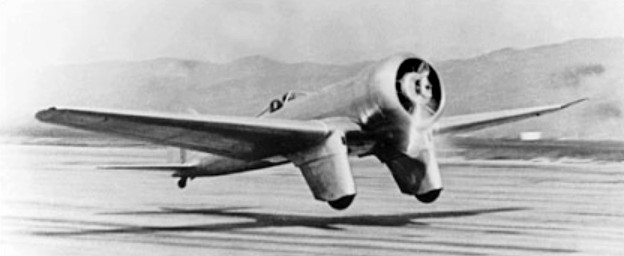
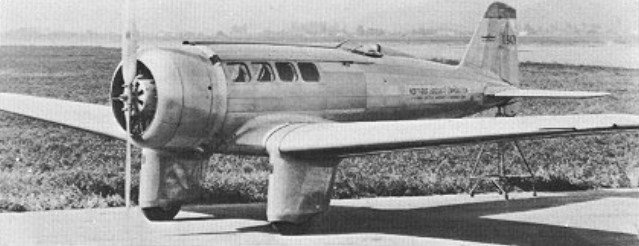
In January 1932 John Northrop and Donald Douglas formed the Northrop Corporation and the first aircraft from the new corporation was the Northrop Gamma, several of which were built to special order for record-breaking flights and research work. The first two aircraft, a Gamma 2A and a Gamma 2B, were powered respectively by a 585kW Wright and 373kW Pratt & Whitney Wasp radial. Both were delivered at the end of 1932, the first to Texaco who loaned it to Frank Hawks for record-breaking flights.
Gamma NR12265 was built for Lieutenant Commander Frank Hawks of the Texas Company, as a long-range, high speed mail transport in 14/2/33. Named Texaco Sky Chief, it was flown out to the Antarctic via South America to assist with the search for Lincoln Ellsworth when he and pilot Herbert Hollick-Kenyon were declared missing in late 1935. Later sold to “Gar’ Wood and renamed Kinjockety II, it exploded in midair during the 1936 Bendix Trans¬continental Race.
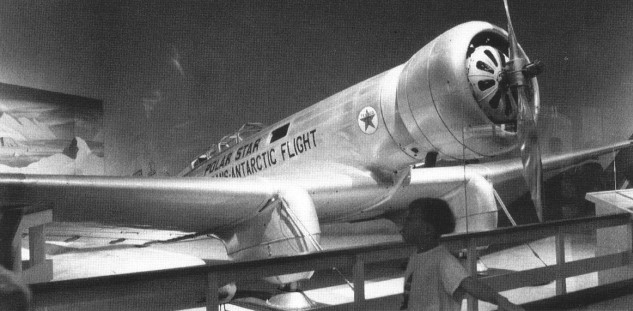
The second, 2B NR12269, being the first to fly after being completed in August 1932. Sold in early 1933 to millionair explorer Lincoln Ellsworth, it was shipped to the Antarctic in late 1933 and test flown on skis by Bernt Balchen before being damaged in an unseasonable ice breakup. The aircraft was back in Dunedin, New Zealand, on 28/1/34 for transshipment on to California for repairs. Returned to the United States after the successful trans polar cap flights between 23/11 and 9/12/35, the Gamma was presented to the Smithsonian on 25/4/36.
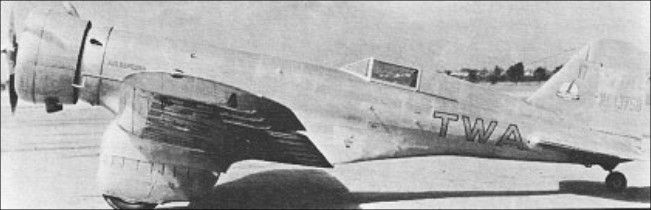
TWA bought three Gamma 2D aircraft with 529kW Wright Cyclone engines as single-seat mailplanes in 1934. The second was later re-engined with a 578kW Wright and was used by Texaco to test oil temperatures and flows before being sold to the US Army Air Corps, which designated it UC-100.
A number of Gammas were delivered to individual customers, including two to the UK, a 2E for the Aeroplane & Armament Experimental Establishment and a Gamma 2L, the last to be built, was used by the Bristol Aeroplane Co. as a test-bed for its Hercules engines.
The Chinese government ordered 24 Gamma 2E aircraft as light bombers, with 529kW Wright engines. They could carry a 726kg bombload and had four 7.62mm forward-firing machine-guns in the wings, and one rearward-firing in the rear cockpit. A further 25 Gamma 2Es were assembled in China from components provided by Northrop.
Engine: Pratt & Whitney Wasp, 500 hp Seats: 2 Range: 2000 miles
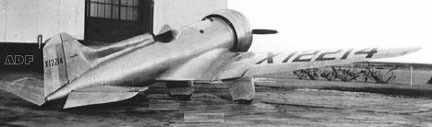
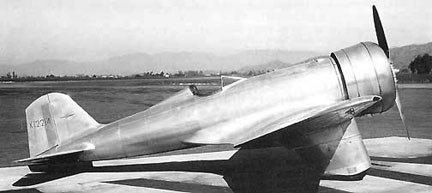
In 1931 Northrop built the prototype of an all-metal low-wing sporting monoplane X/NC12214, the Beta (ATC 2-401), a two-seater with a 119kW Menasco Buccaneer inline engine.
Designed by Don Berlin, a dorsal fairing and canopied cockpit were later added. An advertisement in Dec 1932 Aero Digest quoted a $5,000 sale price.
Stearman-Northrop Beta 3D with dorsal fairing NX12214
It was converted to single-seat high-speed mailplane configuration in 1933 and fitted with a 300 hp / 224kW Wright Whirlwind radial engine, in which form it became the first aircraft of such power to exceed 200mph / 322km/h. Reported speeds up to 212 mph were reached.
Damaged in a landing accident on 16 January 1933, it was rebuilt by Stearman for planned testing of various wing flaps, but destroyed in a crash on 5 June 1934.
Stearman-Northrop Beta 3D NX12214
Beta 3D Engine: 300hp P&W Wasp Jr Wing span: 32’0 Seats: 1
Northrop’s first aircraft for his new company was known as the Flying Wing but of more immediate consequence was the next design, the Northrop Alpha, an all-metal seven-seat single-engine low-wing monoplane. In 1929 Avion Corporation became the Northrop Aircraft Corporation, a division of United Aircraft and Transport Corporation of which Boeing was also a part.
First flown in 1930, Trans Continental and Western Air Inc, (later to become Trans World Airlines) ordered five Alphas with 313kW Pratt & Whitney Wasp engines and began services on 20 April 1931 from San Francisco to New York, with 13 intermediate stops, the journey taking just over 23 hours.
The Alphas were configured for three passengers and 211kg of mail and cargo, for mail flying was a plum contract at that time, but regularity and reliability was required. To achieve all-weather and night-flying capability, the Alphas had the most modern radio and navigation equipment, and for winter operations became the first commercial type to be fitted with Goodrich rubber de-icer boots on wing “and tail surface leading edges.
Thirteen of the 17 Alphas built saw service with TWA, and three were supplied for evaluation to the US Army Air Corps where, had production orders been given, they would have been designated C-19.
Various configurations carried the designations Alpha 2, Alpha 3, Alpha 4 and Alpha 4-A, and a number of changes were made between individual aircraft as late modifications were made retrospectively to earlier aircraft, including fitting of streamlined ‘trousers’ over the original rather utilitarian landing gear.
The 1931 Alpha 3 was certified under ATC 2-335. The 1931 Alpha 4 (ATC 451) prototype was built at Northrop, the rest at Wichita. Eleven were built, of which 7 were modified from Northrop Alpha 2 and 3. ATC 2-371 was for Alpha 4 NC127W powered by a 420hp Wasp installation.
The 1932 Alpha 4A (ATC 461) was a single-place cargo conversions of Alpha 4. Ten were built.
The last conversion was the Gamma 4-A, an all-cargo aircraft which could carry 567kg; the Gamma 4 and Gamma 4-A had a 336kW Wasp engine and most of the earlier aircraft were similarly retrofitted.
The last surviving Alpha, the third built, served with the US Assistant Secretary of Commerce for Aeronautics, the Ford Motor Company, National Air Transport (part of United Airlines) and TWA. It was re-acquired by the airline in 1975 and superbly restored before being placed in Washington’s Smithsonian Institution National Air and Space Museum.
Alpha 3 Engine: 420hp P&W Wasp Seats: 3
Alpha 4 Engine: 450hp P&W Wasp Wingspan: 43’10” Length: 28’5″ Useful load: 1900 lb Max speed: 177 mph Cruise: 155 mph Stall: 62 mph Range: 650 mi
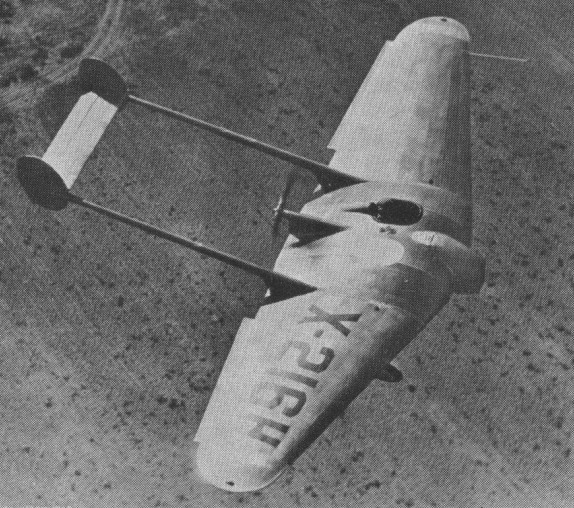
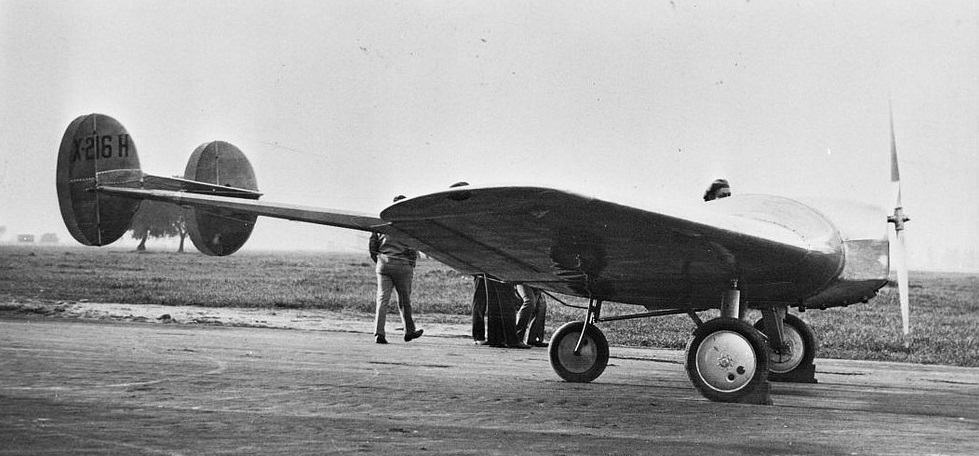
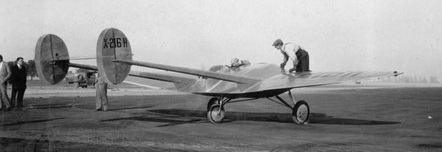
Jack Northrop in 1928 wanted to “do his own thing”, which was to start investigating all wing aircraft, He decided to keep a tail, for the time being. So the Northrop Flying Wing, with experimental registration X 216H, was intended to solve only some of the problems. The wing was a fairly conventional shape, apart from the thick centre section so that the pilot and passenger could sit comfortably inside it on each side of the centre line. The whole structure was a duralumin cellule with multiple spars and a stressed skin. To the rear projected an extremely, light pair of duralumin monocoque tail booms carrying a twin finned tail, the whole assembly weighing less than half as much as a conventional rear fuselage and tail. The main wheels were well forward under the leading edge, and under the trailing edge was a large steerable tailwheel.
The 90 hp / 67kW Menasco Pirate engine was carried just ahead of the leading edge, with cooling air ducted to an outlet near the trailing edge. Northrop was deeply concerned to secure smooth airflow over his flying wings and never again put a propeller in front of one.
The aircraft, built by Northrop’s newly formed Avion Corporation (later the Northrop Aircraft Corporation), initially driving a pusher propeller but modified later to tractor configuration.
Courtesy John Frazer
X 216H flew perfectly well. Reports say it flew well and was 25% faster than anything else in its class. It had conventional controls, and Northrop wanted to explore alternative arrangements and ultimately take the giant step of removing the tail, but he was prevented by financial and business difficulties.
In 1916, while working for the Loughead Aircraft Company (later Lockheed), he co-invented a process for making monoplane fuselages and helped design the F-1 flying boat. He became chief engineer at Lockheed in 1927 and built the Vega monoplane. With the help of designer Jack Northrop, Lockheed built the F1, but it was turned down by the Navy. In 1923 Northrop left to take a job with Donald Douglas, and later founded his own corporation.
Jack Northrop (1895-1981) was employed by United Aircraft and Transport Corporation. All went well until United decided Northrop should leave Burbank and join another United division. He remained in California to form a new company. In July 1929 Jack Northrop formed Northrop Aircraft Corp, as a division of United Aircraft and Transport Corporation and built the Alpha (first flown 1930), first all-metal stressed skin airplane, followed by the Beta 300 hp aircraft of 1931, first to exceed 200mph (322kmh).
New Northrop Corporation founded after split with United Aircraft and Transport Corporation, with Douglas Aircraft holding a majority shareholding.
Producing the Gamma high-speed mailplane in 1933 and other types. Northrop Corporation absorbed into Douglas 1937, and new independent Northrop Aircraft Inc established 1939 to concentrate on military projects, including the A-17 attack-bomber and P-61 Black Widow three-seat, twin-boom night fighter, first aircraft in this category to be ordered by USAAF. Northrop experiments with the tailless XP-56 interceptor led to a number of postwar flying-wing projects, culminating in eight jet engined YB-49 flying-wing bomber of 1947. The F-89 Scorpion all-weather fighter entered production two years later, serving USAF and Air National Guard Units until 1963.
Extending its activities into other fields, the company changed its name to Northrop Corporation in the year 1959. In May 1994 Grumman and Northrop merged to form Northrop Grumman Corporation. Northrop’s final pre-merger production aircraft included the F-5E/F Tiger II lightweight tactical jet fighter/fighter trainer, developed with U.S. Government funding mainly for export as International Fighter Aircraft (first F-5E flown August 1972), derived from the 1959 N-156 prototype and early production F-5A/B Freedom Fighters built for supply under Military Assistance Programs. The T-38 Talon two-seat advanced trainer variant of N-156 for the USAF (first flown April 1959) went out of production in 1972 after 1,187 had been built, but these are being modernized to T-38C standard for redelivery from 1999 by Northrop Grumman. Northrop developed the YF-17 Cobra for competition against the Lockheed YF-16 for the USAF’s Lightweight Fighter Program, but lost and became principal subcontractor to McDonnell Douglas on a proposed carrier borne naval fighter derivative. This eventually entered production as the carrier- and land-based F/A-18 Hornet. Finally developed the B-2 Spirit subsonic strategic stealth bomber (first flown July 1989) for the USAF. Two of the five main divisions of Northrop Grumman Corporation were Commercial Aircraft, to construct aerostructures and components for the commercial aircraft of other companies and engines, and Military Aircraft Systems, working on B-2 and all other Northrop Grumman aircraft production and modernization programs, and principal subcontractor to Boeing on Hornet. Delivered 21 B-2A Spirit stealth bombers, achieving initial operational capability with the USAF in April 1997 and full capability with the 715th Bomb Squadron in 1999. Undertakes F-5/T-38 modernization, F-14 work, EA-6B Prowler remanufacturing, production of E-2C Hawkeye in latest Hawkeye 2000 form (first flown April 1998; see Grumman entry for earlier development and production of E-2), and production of E-8C Joint STARS as joint USAF and U.S. Army co-operation program for an airborne surveillance and target acquisition system (first flown August 1995 for first production E-8C).
In 2000, Northrop Grumman is to sell its commercial aerostructures arm to the Carlyle Group for $1.2bn. NG was planning to specialise in the defence electronics and IT industries and its aerostructures business, which manufactures subassemblies for Boeing commercial aircraft, the C-17 and Gulfstream V, no longer fits the bill. Carlyle will rename the Dallas, Texas-based company Vought Aircraft and NG will reorganise its Integrated Systems and Aerostructures sector into the Integrated Systems Sector. NG, which recently acquired Comptek Reseach, has also cited expected decline in Boeing production schedules as one of the reasons for the sale. The Carlyle Group, however, has been active in the aero-manufacturing sector having purchased Textron’s aerostructures unit four years previous and buying out Gemini Air Cargo in 1999.
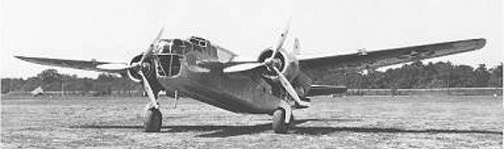
A twin-engined Attack Bomber was produced in 1939 and was available for export as the NA-40 series. A single prototype was built.
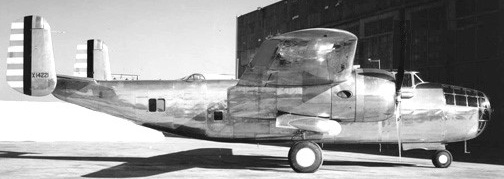
The NA-40-1 NX14221 was first flown in January 1939 by Paul Balfour, powered by two 1100hp P&W R-1830. It was re-powered on factory model NA-40-2 with 1350hp Wright GR-2600.
North American NA-40-1 NX14221
Designed by Howard Evans and team, NA-40B NX14221 crashed during Wright Field tests, but the shoulder-wing, twin-tail, tri-gear design eventually led to B-25.
NA-40 Engines: 2 x P&W R-1830-S6C3, 1100hp Wingspan: 66’0″ Length: 48’3″ Useful load: 5780 lb Max speed: 309 mph Cruise speed: 282 mph Range: 1200 mi Crew; 5
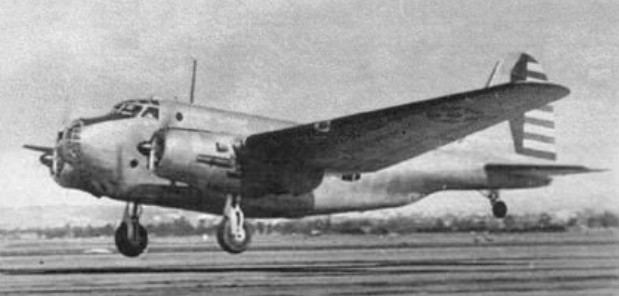
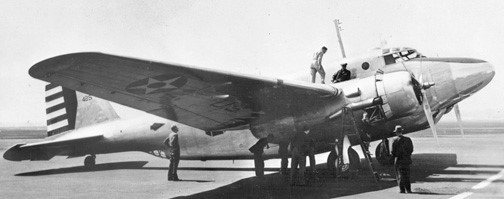
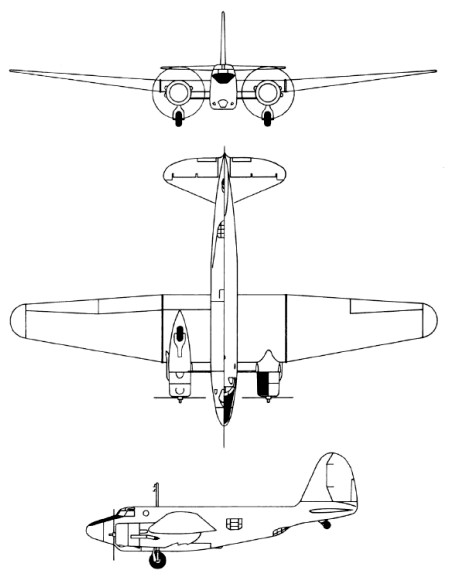
Similar in appearance to the Douglas B-18 Bolo, but intended to achieve significantly improved performance, the North American NA-21 bomber was developed at the company’s Inglewood, California plant during 1935-3, the prototype being completed in March 1937 at a cost of $122,600.
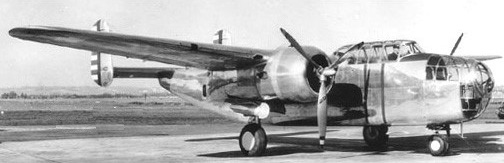
North American XB-21 38-485
Powered by two 895kW Pratt & Whitney R-1820 Twin Hornet engines with F-10 turbo-superchargers, the XB-21 carried a six-man crew and armament comprised single 7.62mm machine-guns in nose and dorsal turrets, plus a similar weapon in each of the ventral and two waist positions. Short-range bomb load was 4536kg, reducing to 998kg over 3058km.
North American XB-21 Nose mod at Wright Field
Only the prototype was built, 38-485, as XB-21 Dragon, an unofficial title, with no appeal to the USAAC despite a second attempt the following year by Douglas to use it for their B-23, which led to the NA 40 prototype, which led directly to the B-25.
XB 21 Engines: 2 x Pratt & Whitney R-1820 Twin Hornet 1200 hp Wingspan: 28,96m / 95 ft 0 in Length: 61’9″ Max weight: 18144 Kg / 40001 lb Useful load: 8171 lb Power loading: 7,560 Kg/hp Max speed: 354 kph / 220 mph Cruise speed: 190 mph Ceiling: 25,000 ft Range: 3060 km Armament: 3 x 7,62 mm mg Bombload: 4535 kg Crew: 6
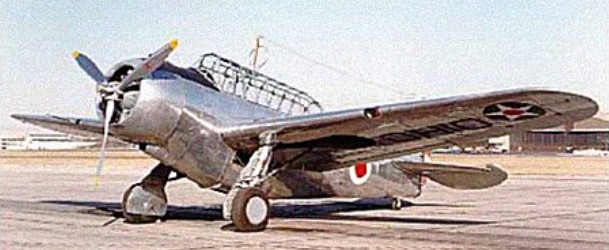
Developed by General Aviation (the precursor of North American Aviation) to meet a US Army specification for an observation aircraft, the GA-15 represented a radical change in design for such a role in that, unlike its predecessors, it was a low-wing monoplane with an enclosed cockpit, seating a three-man crew.
Powered by a 634kW Wright Cyclone engine, the prototype GA-15 / XO-47 36-145, built at Dundalk MD, flew in mid-1935 and to provide an acceptable field of view for the observer a glazed nose position was located under the fuselage. North American put the type into production to meet a USAAC contract for 109 North American O-47A aircraft ordered in February 1937, later increased to 164. They were powered by 727kW Cyclones, while 74 O-47B aircraft had 790kW engines and additional fuel capacity. During World War II they served as trainers and target tugs.
North American O-47A 37-260
The O-47A model was released for export in 1939 and is known as the NA-25. 164 of the 1937 O-47A (NA-25, NA-60) were built: 37-260 to 37-368 and 38-271 to 38-325.
Seventy-four 1939 O-47B (NA-51) were built: 39-139 to 39-141.
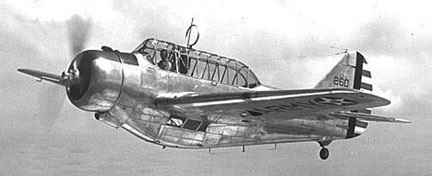
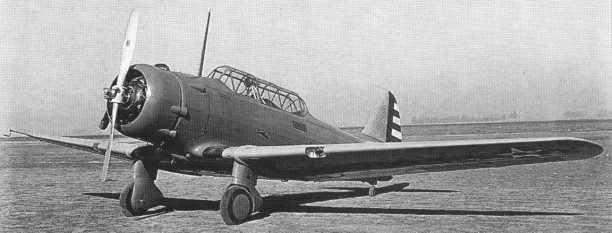
The Texan began life in 1935 as the NA-16, a prototype trainer designed by James H. “Dutch” Kindelberger, president of North American Aviation, Inc. It had two open cockpits and a fixed gear and was powered by a 400-hp engine.
In 1934, the U.S. Army Air Corps had issued specifications for an airplane “to provide a means of command liaison and command reconnaissance for Corps and Divisions, and to provide for the maintenance of the combat flying proficiency of pilots and observers.” Kindelberger and North American worked to secure the contract, and the NA-16 flew for the first time on April 1,1935. The NA-16 was chosen over the competitors’ designs, but before ordering any NA-16s, the Air Corps required North American to enclose the cockpits with a sliding canopy, install streamlined fairings over the wheel struts and add wheel pants.
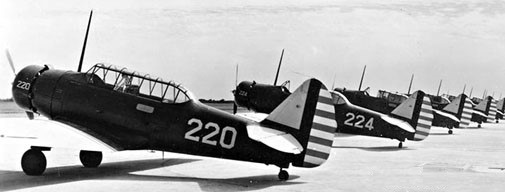
When the modifications were complete, the Air Corps ordered 42 (36-028 to 36-069) under the company design number NA-19; the Air Corps called it the BT-9 (basic trainer, type 9). The first production model was flown on April 15, 1936.
North American BT-9
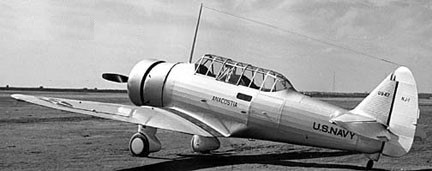
The Navy or¬dered 40 (0910-0949) of them after the existing engine was replaced with a 600hp P&W R-1340 version. That 1937 model was designated the NJ-1 (NA-28, N for trainer and J for North American). The last one was temporarily powered with a 1000hp Ranger XV-770 as NJ-2.
North American NJ-1 0947
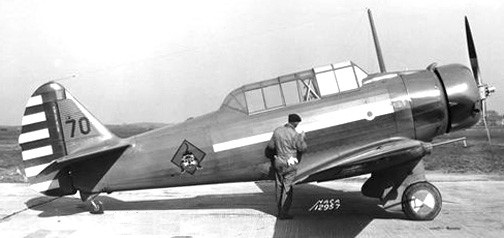
The 40 BT-9As (NA-19A) armed version for Reserve units that followed introduced a fixed forward gun (with gun camera) and a trainable gun in the rear cockpit. Forty were built in 1936, 36-088 to 36-127.
North American BT-9A
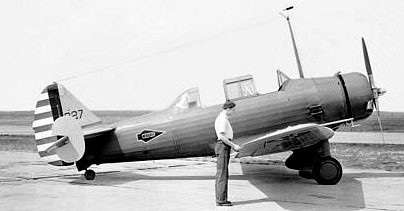
Only small changes were made in the 117 BT-9Bs and 67 BT-9Ds. 117 BT-9B (NA-23) were built in 1937 (37-115 to 37-231) with one modified with new wings and tail as the BT-9D (NA-26) in 1938.
North American BT-9B
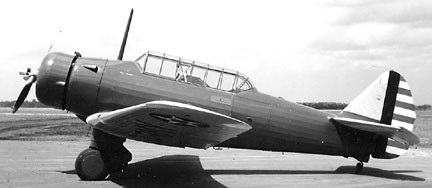
The 1937 BT-9C (NA-29) was an armed version of which sixty-seven were built (37-383 to 37-415). One was modified as the Y1BT-10.
North American BT-9C
One BT-9C, 37-383, was repowered with a 600hp P&W R-1340 in 1938 as the Y1BT-10 (NA-29).
North American Y1BT-10 37-383
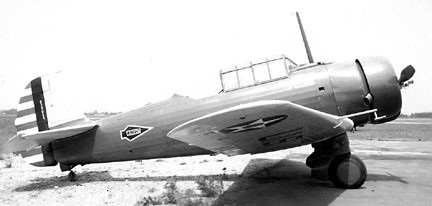
The Australian Commonwealth Aircraft Corporation was formed in 1936 by several of the largest industrial concerns in Australia. To gain manufacturing experience, it had been decided to acquire a licence to produce an aircraft suitable for advanced training and as a replacement for RAAF Hawker Demons. An Australian Air Board Technical Commission visited the USA and evaluated the North American NA-16, ordered into production for the USAAC as the BT-9 (NA-19) basic trainer.
At the time of the Australian Commission’s visit, North American was working on a development of the BT-99 with a 600 hp Pratt & Whitney R-1340, retractable undercarriage and armament provision as a basic combat trainer. Designated NA-26, this aircraft fulfilled the Australian requirements, although there was disagreement over the need for retractable undercarriage.
As a result, two versions of the A-26 were offered to the Australians, the NA-32 (NA-16-1A) with fixed undercarriage, and the NA-33 (NA-16-2K) with a retractable undercarriage, and in 1937, negotiations for manufacturing rights in both the NA-32 and NA-33 were completed, and an order placed for one of each.
NA-32 / NA-16-1A
The NA-32 was completed in July 1937, although it was not taken on charge by the RAAF until 8 November 1938, and by that time, the NA-33 / NA-16-2K, which had been completed in September 1937 and taken on charge by the RAAF on 2 February 1938, had already been selected for Australian production.
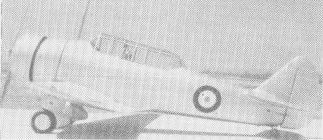
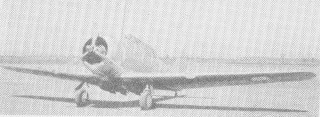
NA-33 / NA16-2K
The NA-16-2K was with a few subtle changes in design to suit it more closely to RAAF requirements and Australian operating conditions, these including a reinforced sub-structure consistent with the rigors of the bombing role and improved offensive/defensive capabilities by the inclusion of 2 x 7.7mm machine guns as opposed to the NA-16’s sole gun.
With the changes, the NA-33 was ordered into production for the RAAF as the A20, the Commonwealth Aircraft Corporation applying the designation CA-1 to the type, and the name Wirraway being adopted. Production of the initial aircraft was handled out of the Commonwealth Aircraft Corporation (CAC) facility at Fisherman’s Bend in Melbourne, Victoria in 1938.
In 1938, Noorduyn acquired the manufacturing rights to the BT-9.
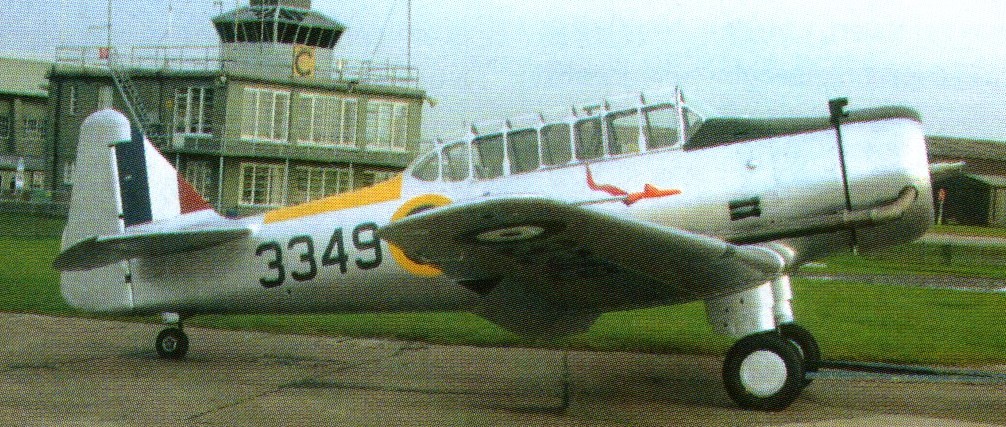
The basic type was then improved with the flying surfaces of the BC-lA and a metal-covered fuselage to produce the BT-14, of which 251 were built with the 336-kW (450-hp) Pratt & Whitney R-985-25 radial. Some 27 were later converted to BT-14A standard with the 298-kW (400-hp) R-985-11 engine.
Concurrently, the French ordered 230 of the BT-9/BT-14 models and called them Tomcats. When France was overrun by the Germans in 1940, Tomcats not yet delivered were given to the Royal Canadian Air Force and designated Yale Mark Is.
BT-9B Powerplant: l x Wright 8-975-7, 298kW (400 hp) Span: 12.8m (42 ft) Length: 8.41 m (27ft 7in) Armament: 2 x 7.62-mm (0.3-in) mg Max T/O weight: 2028 kg (4,471 lb) Max speed: 170 mph at sea level Operational range: 882 miles Seats: 2
Formed originally as a holding company in 1928, North American did not manufacture any airplanes; it was a holding company division of General Motors which had absorbed Atlantic Fokker as General Aviation.
In 1933, North American Aviation Co., Inc., took over the assets of Berliner/Joyce, changing its corporate name to the B/J Co.
In 1935 General Aviation became North American Aviation.
The manufacturing facilities were moved from Dundalk, Maryland, to the West Coast in 1936 and a new modern production plant was erected on the Los Angeles Municipal Airport where the firm has a site of approximately 24 acres. Originally the plant covered an area of 172,000 sq. ft. but it has since been increased to approximately 500,000 sq. ft. The firm maintains one of the most complete laboratories for aircraft production tests and for research in materials.
North American’s first product was the O-47 Army observation aircraft of 1937. The NA-16 Yale two-seat military trainer followed, being developed through fixed- and retractable-landing-gear variants into the T-6 Texan/Harvard trainer which continued in production in Canada until 1954 and served with virtually every non-Communist air arm in the world.
North American’s best known aircraft was the P-51 Mustang fighter, and significant aircraft evolved by North American include the B-25 Mitchell twin-engined medium bomber; the B-45 Tornado, the first American four-jet bomber; the F-86 Sabre, the USAF’s first swept-wing fighter; the F-100 Super Sabre, the world’s first operational fighter capable of supersonic speed in level flight; the T-28 Trojan/Fennec trainer and light ground-attack aircraft which succeeded the T-6; the A-5 Vigilante carrier-based jet bomber/reconnaissance aircraft; the XB-70 Valkyrie supersonic bomber with Mach 3 speed capability; and the X-15 rocket research craft, which attained an altitude of 107,960m in 1963 and was flown at a speed of 7,298km/h in 1967. In the same year
Around 1960 Fokker was looking for and American partner. Lockheed turned down the proposal because they thought it could not be profitable, but Northrop agreed to by a twenty-one percent share. North American and Rockwell merged in 1967, to form the Rockwell Corporation in 1972.
The Aero Commander company was taken over by North American Rockwell.
 All Aero