USA
Established in 1929, Ogden’s only product was the trimotor Osprey cabin monoplane, offered in three versions: the Model C, which carried two crew and four passengers (seven passengers if the toilet was removed), the Model PB with Menasco B4 engines, and the Model PC with Menasco Pirate engines.
Inter-Wars
Oelimichen No.6
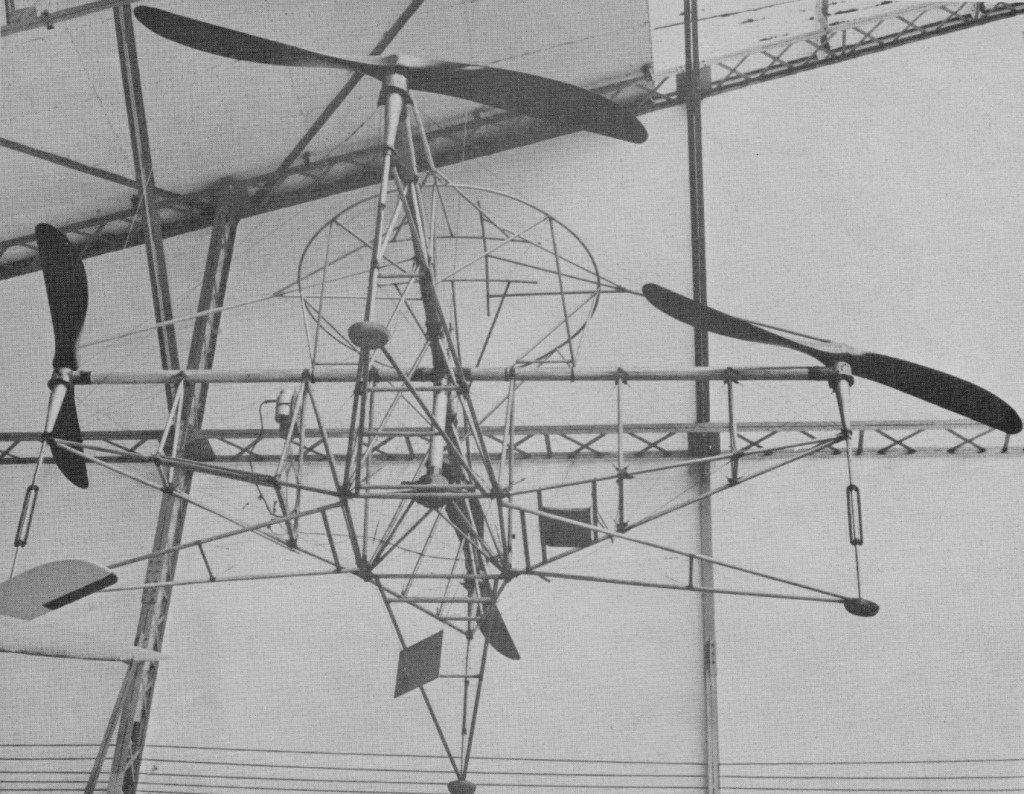
The Etienne Oelimichen No.6 of 1935 was a helicopter with a 353 cu.ft balloon mounted above to assure stability. It also had a quad rotor and quad gear.
On 2 March 1935 Oelimichen flew the craft for 5 minutes in the large dirigible hanger at Orly, demonstrating its stability.
The French Musee de l’Air possesses five of Etienne Oelimichen’s experimental helicopters developed from 1920 through 1938. In 1965 only his sixth project of 1935 was on display.
Width: 16.73 ft
Length: 16.73 ft
Rotor diameter: 9.18 ft
Oelimichen No.3
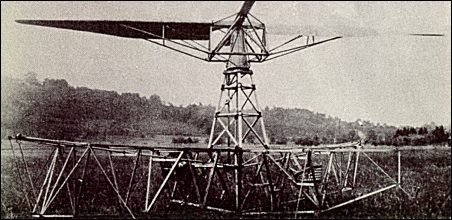
Oemichen was dissatisfied with the modest heights to which No.2 was able to fly, and from the third machine onward he adopted a single main rotor layout, accompanied by two smaller anti-torque rotors. His last design, in 1938, reverted to the balloon-assisted principle of his first aircraft.
Oemichen’s third helicopter which appeared in 1924 had a single large rotor with two blades.
Oelimichen No.2
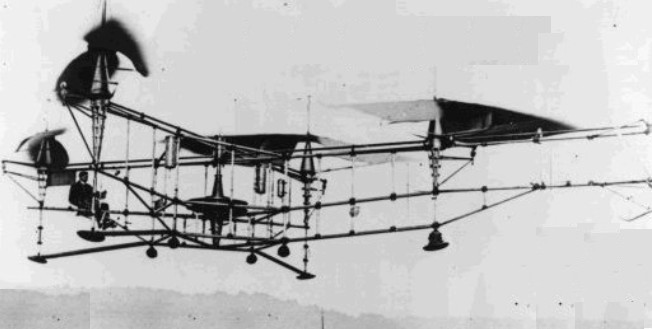
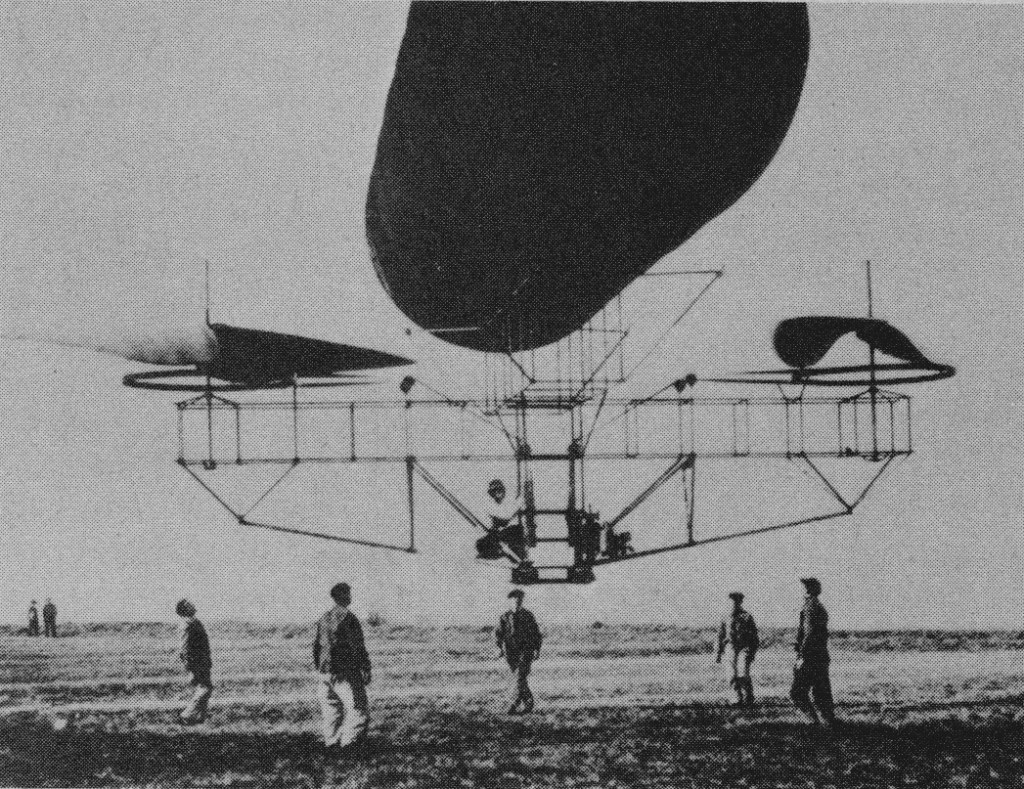
In 1922 Oemichen was able to dispense with the gasbag of the first machine and fly free. Etienne Oelimichen’s No. 2 machine was powered by a 120 hp Gnome rotary engine. It had four large rotors and eight stabilizing and steering propellers about an open lattice work frame and it flew for the first time on 11 November 1922.
Etienne Oelimichen’s first helicopter flew in 1922 for a distance of 60 m (197 ft). In 1923 he made the first hovering flight of more than five minutes.
The Oemichen No.2 was basically a steel-tube framework of cruciform layout, with 2-blade paddle-shaped rotors at the extremities of the four arms. The angle of these blades could be varied by warping. Five of the propellers, turning in a horizontal plane, served to stabilise the machine laterally; another propeller mounted at the nose was for steering the helicopter; and the remaining pair acted as pusher propellers for forward propulsion. The opposing pairs of rotors were of slightly different diameters. The Oemichen No.2 exhibited, for its time, a considerable degree of stability and controllability, and in all made more than a thousand test flights during the middle 1920s. By 1923 it was able to remain airborne for several minutes at a time, and on 14 April 1924 it established the first-ever FAI distance record for helicopters of 360m. Three days later it increased this to 525m. On 4 May 1924 this contraption made a closed¬ circuit flight of 1 km (0.62 mile) at Arlonans to set a distance record for helicopters, It was airborne for 14 min with the kilometer taking 7 minutes and 40 seconds, to win a 90,000 franc prize.
A 180hp Gnome engine was substituted later.
Despite the fact that it was able to demonstrate sufficient controllability and power in ground effect for this historic flight, it was not a practical flying machine. In recognition of the impracticality of the machine, Oemichen began pursuing a series of aircraft with a single-main rotor and two anti-torque rotors, but had little success.
Oemichen No.2
Engine: 1 x Gnome Rhone, 135kW
Rotor diameter: 2 x 7.60m + 2 x 6.40m
Empty weight: 800kg
Oelimichen No.1
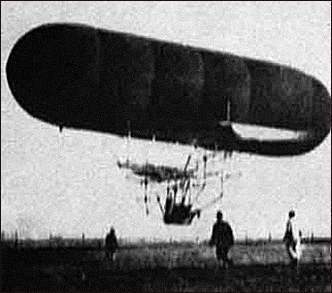
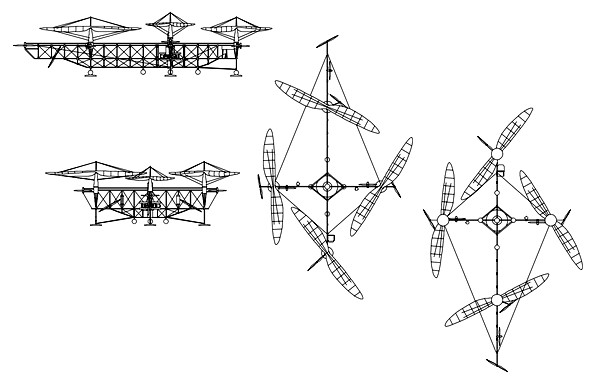
Etienne Oemichen, a young engineer with the Peugeot motor car company, began to experiment with rotating-wing designs in 1920, and in all designed and built six different vertical take-off machines. When the first of these failed to develop enough lift from its twin rotors and 25hp engine to rise off the ground, he added a hydrogen-filled balloon on top of it to give it added stability and lift.
With two rotors of 20.99 ft and weighing 814 lb, it flew for 1 min 40 seconds, and later 5 minutes.
Oelimichen, Etienne
The French Musee de l’Air possesses five of Etienne Oelimichen’s experimental helicopters developed from 1920 through 1938. In 1965 only his sixth project of 1935 was on display.
Odier & Bessiere Clino-giro
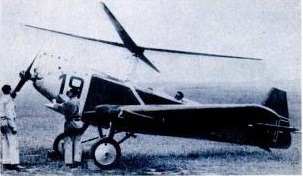
French engineers Odier and Bessiere flew their combination airplane and autogyro, dubbed the “Clino-giro”, in 1931, at Guyancourt. The foundation of the craft is a revamped Caudron C-193 with a rotor smaller and stiffer than normal for an autogyro attached. Th engineers claimed that the craft had a climb angle three times that of an ordinary airplane and a radius of action much better than that of a conventional autogyro.
Oberursel
Motorenfabrik Oberursel
Motorenfabrik Oberursel A.G. was a German manufacturer of automobile, locomotive and aircraft engines situated in Oberursel (Taunus), near Frankfurt (Main), Germany. The company had its origins in 1891, when Willy Seck invented a new gasoline fuel injection system and produced a small one-cylinder stationary engine of about 4 hp, which he called the Gnom. The following year he founded Willy Seck & Co. to sell the design, which became famous around the world. The engine was improved to achieve more power, but in 1897 the shareholders refused to allow Seck to develop a Gnom-powered car and he left the company. The company was reorganized as Motorenfabrik Oberursel the next year, and by 1900 had built 2,000 engines.
The same year the company granted a license to the Seguin brothers in Lyon to produce the Gnom in France. Sold under the French name Gnome, the engine became so successful that they renamed their company to the same name. In 1908 they developed a rotary version of the basic Gnome system as the Gnome Omega aircraft engine, and from there a series of larger versions of the same basic design. The new Gnome engines were wildly successful, powering many of the early record breaking aircraft.
In 1913 Motorenfabrik Oberursel took out a license on the French Gnome engine design and the similar Le Rhône 9C. They produced both, the Gnomes as the U-series, and the Le Rhônes as the UR-series. During World War I it supplied a major 100 hp-class rotary engine that was used in a number of early-war fighter aircraft designs.
The Gnome Lambda seven-cylinder 80 hp rotary engine was also produced by the Oberursel firm as the Oberursel U.0 Umlaufmotor (the generic German term for a rotary engine) as their first-ever powerplant for German military aircraft, and was used on the initial versions of the Fokker Eindecker fighter, the Fokker E.I.
When World War I started the following year the Oberursel U.I of 100 hp, a clone of the Gnome Delta 100 hp rotary, had the best power-to-weight ratio of any German engine. It went on to power most of the early German fighters, such as the Fokker and Pfalz E-series monoplanes
.
Oberursel also built a copy of Gnome’s 14-cylinder Double Lambda two-row rotary. This 160 hp (120 kW) engine, designated U.III in Germany, was difficult to build and quickly wore out in service. It was used on the Fokker E.IV and D.III designs.
The 110 hp Oberursel UR.II, the clone of the Le Rhône 9J of the same power output, was the next major success. Fokker bought the company in 1916 in order to guarantee supplies of the UR.II. This acquisition proved advantageous because Fokker was partial to rotary powered designs, and because supplies of the Mercedes D.III engine were limited. The UR.II was used in the Fokker Dr.I and Fokker D.VI.
By 1917, the UR.II had been rendered obsolete by its relatively low power and poor performance at altitude. An 11-cylinder development, the UR.III, was not used operationally. Indeed, by 1918, rotary engines had largely fallen from favor with the Idflieg and with pilots. The lack of castor oil and the poor quality of the mineral oil substitute “Voltol” severely reduced engine life and reliability.
Nevertheless, in the summer of 1918, the UR.II was installed in the Fokker D.VIII. The light weight and aerodynamic cleanliness of the D.VIII allowed it to achieve excellent performance even with the outdated UR.II.
After the war the company was purchased in 1921 by Gasmotorenfabrik Deutz, another gasoline engine manufacturer, who moved their two-stroke diesel manufacturing to the Oberursel factories. In 1930 they merged with Humboldt-Deutz, but with only one product line. The factory was eventually closed in 1932 during the Great Depression, reopening in 1934 for small-scale production.
In 1938 the company merged Klöcknerwerke AG. From this point on they were known as the Klöckner-Humboldt-Deutz Oberursel factory, known primarily for their locomotive engines.
In 1940 during World War II all diesel research was relocated to Oberursel, where Dr. Ing. Adolf Schnürle led the development of much larger and more advanced engines for aircraft use. This led to the Klöckner-Humboldt-Deutz DZ 700 8-cylinder radial engine, the DZ 710 16-cylinder boxer engine, and the DZ 720 32-cylinder H-block made from twinned 710’s. None of these designs reached operational use by the end of the war, when the factory was occupied by US troops.
For a short period in 1946 the factories were used as a tanks and trucks repair depot by the US army.
In 1956 the factories were returned to Klöckner-Humboldt-Deutz, and from then on have been used primarily for gas turbine development and production. For the next twenty years they produced a variety of designs, typically under license from other companies. In 1980 they were renamed KHD Luftfahrttechnik GmbH.
In 1990 the company was sold to what was then BMW Rolls-Royce. The new owners decided to use the Oberursel plants to produce an entirely modern engine for the “small end” of the aviation market, and started development of the Rolls-Royce BR700 family in 1991. The engines have since gone on to power a number of aircraft including Bombardier, Gulfstream V and the Boeing 717.
The factory in Oberursel is claimed to be the oldest surviving aircraft engine factory in the world.
Engines:
Gnome designs:
Oberursel U.0
licensed Gnome 7 Lambda, 68 hp (51 kW) seven cylinder rotary.
Oberursel U.I
100 hp (75 kW), nine cylinder.
Oberursel U.II
110 hp (82 kW)
Oberursel U.III
Gnome Lambda-Lambda 14-cylinder, two-row rotary engine copy. 160 hp (120 kW).
Le Rhône designs:
Oberursel Ur.II
Le Rhone 9J 110 hp (82 kW) nine cylinder rotary.
Oberursel Ur.III
11-cylinder development of the Ur.II. 145 hp (108 kW).
Oberlerchner Mg 12
Designed by Erwin Musger, the last type to be produced before war broke out was the Mg 12 training glider.
Oberlerchner Mg 10
The Ing Erwin Musger designed Mg 4 of 1931 was developed into the Mg 10.
 All Aero