After completing aviation courses, Bronius Oškinis led the construction of gliders in ATM workshops. Reconstructed the German training glider RRG-23 “Zoegling” and thus in August 1932 developed the Lithuanian T-1 (“Technikas-1”) glider. In Pažaislis.
The Technikas-1 was an improved RRG-23 Zögling (based on German drawings). One was built. The first flight was performed by B. Oškinis himself. This glider was tested by military pilot Gregorius Radvenis. The T-1 was used to test/train Lithuanian military pilots at Kaunas
During 1935-36 four ‘production’ version of the T-1 were built, re-named BrO-1.
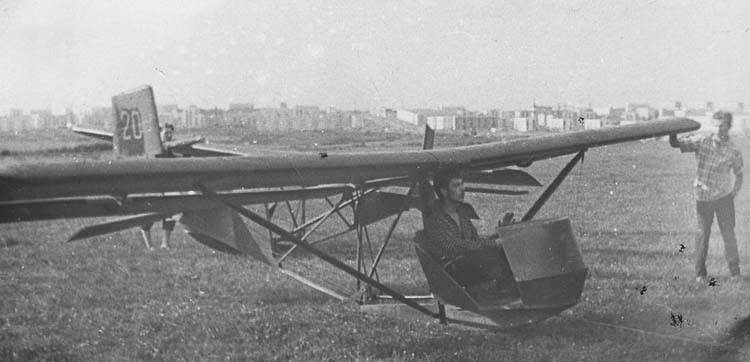
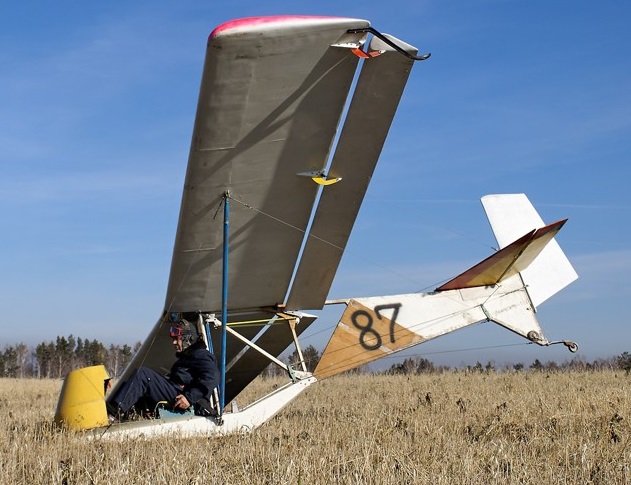
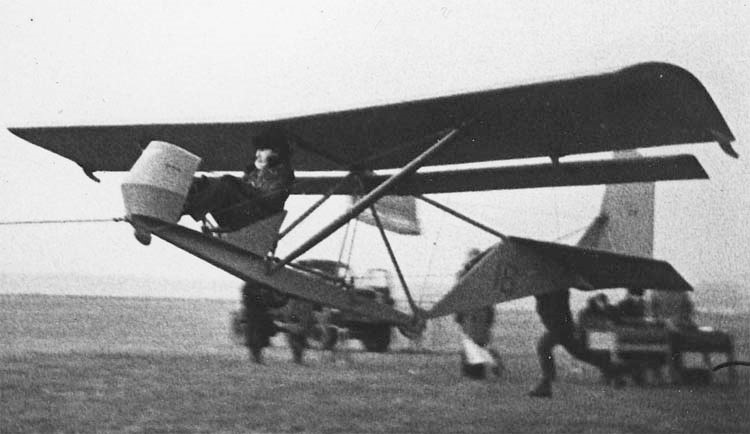
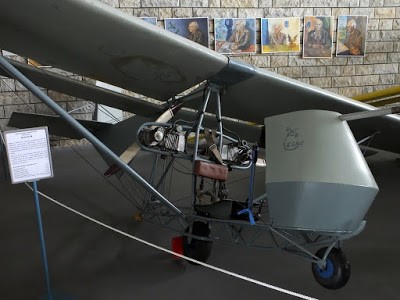
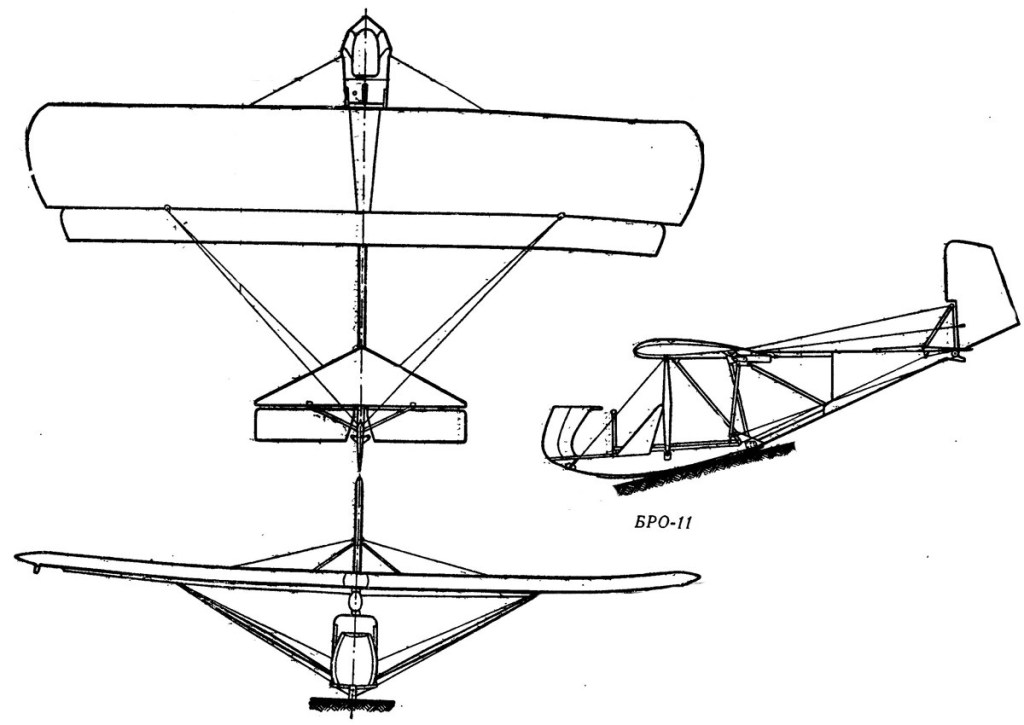
The Oškinis BrO-11 was a simple, single-seat primary glider designed in the USSR by Bronis Oškinis in the open girder style exemplified by the pre-war SG 38 Schulgleiter. It was more refined, with slotted ailerons and somewhat better-protected seating.
Its high wing, mounted on top of the fuselage girder, was rectangular in plan and built around a single, wooden spar with plywood skin ahead of it, forming a torsion-resistant D-box, and fabric covering behind. The wing was braced to the bottom fuselage beam with a single strut on each side, assisted by drag wires from the nose. Narrow and very high aspect ratio ailerons were hung behind and below the whole trailing edge, leaving a slot between wing and aileron.
The wing of the original production model, named Pionier, Lithuanian for Pioneer (or Pionerius, the plural) had a span of 7.58 m (24 ft 10 in) and an area of 10.5 m2 (113 sq ft). The later Zylė (Tit), alternatively known as the LAK-2, had a slightly larger wing with a span of 7.80 m (25 ft 7 in) and an area of 11.8 m2 (127 sq ft), improving the glide ratio a little.
The forward part of the fuselage was a wooden beam which extended aft to end under the wing trailing edge. At the nose there was a simple, semi-circular enclosure formed from two single-curvature surfaces. This gave the pilot, seated just under the leading edge, some protection from the wind, though not for his upper body or sides. The same beam was attached to the wing with an N-form cross-member and also carried the forward end of the horizontal upper fuselage member. The rear lower member ran upwards to meet the upper one at the tail. In addition, they were interconnected at mid-fuselage by a pair of vertical and diagonal struts. Immediately ahead of the tail the fuselage was fabric covered, though not elsewhere.
Both variants had triangular tailplanes mounted on the upper frame with elevators which were rectangular in plan apart from a cut-out for rudder movement. Their little, triangular fins carried rather angular, quadrilateral rudders.
The fuselages of the Pionier and Zylė differed only in their landing gear. The Pionier landed on the underside of the forward beam but the Zylė had a monowheel semi-recessed into its beam below the forward wing and a short nose skid.
The BrO-11 Pionier first flew in 1954 and was very widely used across the DOSAAF; some 2000 were built between about 1955 and 1960. The date of the first flight of the Zile is not known exactly but was about 1968. Production began by Lietuviškos Aviacinės Konstrukcijos (Lithuanian Aero-Construction, LAK) in mid-1969 and ended in 1979. Production numbers for this variant are not known.
BrO-11M Zylė Wingspan: 7.80 m (25 ft 7 in) Wing area: 11.80 m2 (127.0 sq ft) Aspect ratio: 5.05 Height: 2.50 m (8 ft 2 in) Length: 5.16 m (16 ft 11 in) Empty weight: 65 kg (143 lb) Max takeoff weight: 125 kg (276 lb) Stall speed: 31 km/h (19 mph, 17 kn) Maximum glide ratio: 12 Rate of sink: 1.0 m/s (200 ft/min) minimum Crew: One
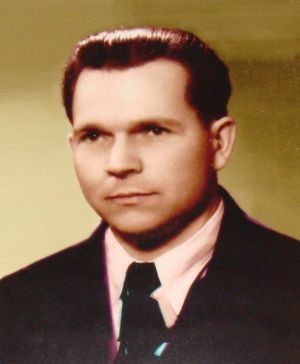
Bronis Oškinis was born April 15, 1913 in Barzdai, Šakiai county, Lithuania, in the family of Jonas and Agnieška Oškiniai.
In 1920 the family moved to Kaunas. 1928–1933 Bronis Oškinis studied at Kaunas Higher Technical School (ATM). Interested in aviation, he was one of the Kaunas ATM aviation group, founded on 13 December 1931.
After completing aviation courses, he led the construction of gliders in ATM workshops.
Reconstructed the German training glider RRG-23 “Zoegling” and in August 1932 developed the Lithuanian T-1 (“Technikas-1”) glider. In Pažaislis, this glider was tested by military pilot Gregorius Radvenis. The first flight was performed by B. Oškinis himself.
In 1933, with others, in Nida set up a gliding school. He later constructed the BRO-2 and BRO-3 gliders. He learned to fly not only gliders but also airplanes. In 1936 appointed Deputy Chief of the Zokniai Military Aviation Workshop. He later served as a military pilot in the 3rd Squadron.
Oškinis tested the BRO-4 “Rūta” glider for acrobatic flying in 1937. Jonas Pyragius and Bronius Oškinis participated in the 1937 world meeting in Elmyra (USA), where B. Oškinis flew the LAK glider “Biržietis”, and J. Pyragius – BRO-5 “Rūta”.
In 1938 he graduated from the Lithuanian Military Pilot School and 1938–1940 studied aeronautics at the Technical University of Berlin. He returned to Lithuania in 1940 and was assigned to the workshop of the National Aviation Squadron of the 29th Territorial Rifle Corps in Pivonia (near Ukmergė). 1941–1944 worked in Kaunas aviation workshop in Freda as a production controller, repaired German Junkers Ju-88 and during 1942–1944 studied at Kaunas Vytautas Magnus University.
1944–1945 was arrested and taken to the Podolsk camp, returning to Kaunas 1947, he gave lectures at the State University and continued to develop new gliders. During 1956–1962 was Head of Kaunas Gliding Station, later headed a gliding school in Palanga.
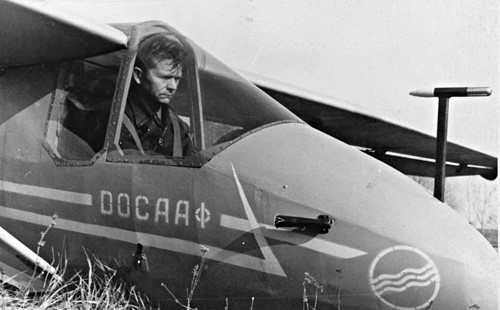
Bronius Oškinis in his design glider BrO-12
Serial production of Bronius Oškinis gliders BRO-9 “Grasshopper”, BRO-11 “Pioneer” and BRO-12 was started in Simferopol aviation workshop. They flew in all aviation sports clubs of the former USSR. 1962 An Experimental Sport Aviation Factory was established in Prienai, where B. Oškinis worked as a designer. Much attention was paid to the development of gliders for young people. They introduced many innovations, using slit wings, slit flaps and ailerons.
Bronius Oškinis developed 25 gliders of various modifications and died on April 7, 1985 in Palanga.
He was awarded by the Lithuanian government and FAI (International Aeronautics Association). The Lithuanian Children’s Aviation School and the street in Palanga are named after him.
Ošk gliders T-1 (BrO-1) (1932) T-2 (BrO-2) BrO-3 “Fluff” (1936) BrO-4 “Ruth” BrO-5 “Ruth II” (1938) BrO-6 “Fluff” BrO-9 Grasshopper BrO-10 “Fluff” BrO-11 Pioneer BrO-11 M Tit BrO-12 (1957) BrO-14 BrO-16 “Pempė” (1973) – water glider BrO-15 “Raguva” BrO-17S Bite (1974) BrO-17V “Antelė” – water glider BrO-18 Boružė (1975) the smallest glider in the world Br0-19 “Duck” BrO-20 “Fluff” BrO-21 “Vyturys” BrO-22 “Rūtelė” BrO-23 “Herons”
Denmark The Royal Danish Naval Dockyard (Orlogsvaerftet) constructed 12 Hawker Danecocks under license in 1927/1928. A single-seat biplane fighter derived from the Hawker Woodcock, the Danecock was armed with two 7.7 mm Madsen machine-guns. It remained in service until 1937 with the Royal Danish Air Force, which designated it the L.B.II Dankok.
USA Ordnance Engineering Corporation’s Model ‘D’ single-seat biplane fighter was the first such aircraft of all-American design. Four wooden prototypes powered by 300 hp Wright-Hispano engines were built, followed by 50 production aircraft manufactured under license by the Curtiss company.
A number of designs were built with money provided to the VfR (Society for Space Travel) in Germany in the late 1920s, by the publicity ¬seeking automobile tycoon Fritz von Opel. First to fly was the tail-first Ente (duck) designed by Professor A M Lippisch, pilotd by Fitz Starrier, it made a rocket propelled flight of about 4,000 ft (1220 m) lasting some 70 seconds, on 11 June 1928. However, it was virtually uncontrollabe and made only two further tests.
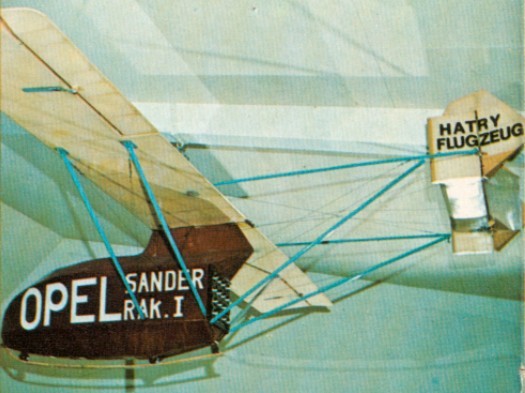
Fritz von Opel had performed a number of publicity stunts involving rocket-powered cars for his Opel motor car company. Along with Friedrich Sander, a pyrotechnics manufacturer and Max Valier, a rocketry advocate, Opel concocted a scheme to attach two rockets to an Alexander Lippisch designed tail-less glider. In the summer of 1928, the three men brought the glider, called “Ente” to Wasserkuppe and hired Fritz Stammer to test it.
Two black powder rockets were attached to the skids on the underside of the fuselage. They were to be electronically fired from a switch in the cockpit. In order to adjust the center of gravity as the powder burned, a counterweight system was positioned under the floor. The rockets were timed to be fired one after the other to provide continuous thrust. Each rocket was intended to burn for about thirty seconds.
The Rak.1, designed by Hatry and flown by von Opel, took off from a raised track on 30 September 1929. After one false start, the rocket fired and the aircraft roared across the grassy field and into the air. Stammer reached an altitude of 1,500 meters (4,900 ft.), circled the mountain and landed safely. On the second flight, the team decided to fire both rockets simultaneously thereby doubling the thrust for a 30 seconds burn. At the instant of launch, one rocket fired, but the other one appeared to sputter and as the plane left the ground, it exploded. The blast tore holes in both wings and set them on fire. Amazingly, Stammer brought the burning aircraft back to ground from an altitude of about 65 feet and quickly abandoned it. The aircraft was a total loss, as was Fritz von Opel’s dream of rocket-powered gliders.
Powered by: Sixteen Sander solid fuel (powder) rockets, each of 55 lb (25 kg) thrust, mounted in four banks of four and fired in stages. Attained speed: 95 mph (153 kph). Distance flown: approx 5,000 ft (1,525m). Accommodation: Crew of 1.
USA Kansas City-based Ong Aircraft Corp manufactured the Ong Model M-32W high-wing monoplane, powered by a Warner Super Scarab engine, before America’s entry into the Second World War.
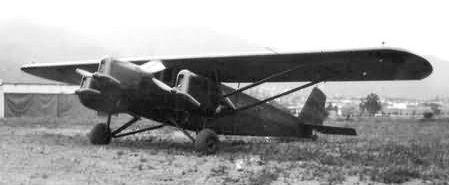
Ogden’s only product was the trimotor Osprey cabin monoplane, offered in three versions: the Model C, which carried two crew and four passengers (seven passengers if the toilet was removed), the Model PB with Menasco B4 engines, and the Model PC with Menasco Pirate engines.
Only six were built, limited by the crisis of 1929.
 All Aero