Roland Payen evolved a radical tandem-wing configuration which he dubbed the Fléchair, the short-span tapered foreplane carrying a combination of ailerons and flaps and the 67-deg aft plane carrying combined elevator-flaps, the pilot’s cockpit fairing into the vertical tail surfaces. In 1938, Payen proposed to the Ministère de l’Air a lightweight fighter version of the PA 112, a racing aircraft then being developed by the Sociêté Co-operative d’Etudes et Productions Aéronautiques (SCEPA) to the Fléchair configuration and intended to participate in the 1939 Coupe Deutsch de la Meurthe. The PA 112 was to be a retractable monowheel undercarriage with outrigger skids retracting into the aft plane. Weighing only 948 lb (430 kg) empty and 1,345 lb (610 kg) loaded, the PA 112 had extremely small overall dimensions which included a span of 13 ft 7¾ in (4,16 m) and a length of 22 ft 1 in (6,74 m), height being 6 ft 11 in (2,11 m), and it was rather optimistically anticipated that a maximum speed of 360 mph (580 km h) would be attainable. The projected lightweight fighter derivative, the PA112 Cl, was to have had two wing-mounted 7,5-mm machine guns and a 20-mm cannon firing through the extension shafts of the Salmson engines, and an elaborate mock-up of the proposed PA112 Cl was built, this, in fact, utilising the airframe of one of the two PA 100 Coupe Deutsch racing aircraft. Possibly as a result of the dramatically unorthodox nature of the proposed PA 112 Cl, no contract was forthcoming from the Ministère de lAir.
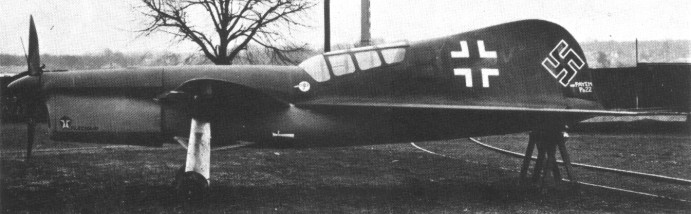
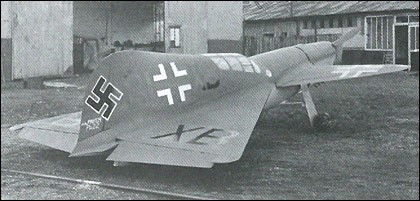
Although no example of the PA 112 was completed and the 1939 Coupe Deutsch was destined never to take place, development of the Fléchair concept continued with the PA 22 which was of similar configuration to the PA 112 but had a conventional engine installation and a conventional fixed tailwheel under¬carriage. The PA 22 had originally been built to test the Mèlot ramjet but was eventually to be completed in 1939 with a 180 hp Régnier R6 inverted inline air-cooled engine. After completion, it was mounted in the Chalais Meudon wind tunnel where it was found by the German occupation forces who expressed some curiosity as to its possible flying characteristics. Accordingly, it was transferred to Villacoublay where it was flown for the first time by Jacques Charpentier in October 1942. A flight test programme was conducted, but before this could be completed, the German authorities decided that the PA 22 should be taken to Rechlin. However, on the pretext that a number of modifications were necessary, Payen succeeded in having the prototype returned to his factory at Juvisy where it was intended to make changes to the undercarriage, mount supplementary fuel tanks and fit a variable-pitch propeller. In the event, these modifications were still in process when the factory was hit during an Allied bombing raid on the Juvisy railway yard, the PA 22 being destroyed.
Engine: Régnier R6 inverted inline air-cooled, 180 hp Empty weight: 1,221 lb (554 kg) Loaded weight: 1,894 lb (859 kg) Wing span: 15 ft 9 in (4,80 m) Length: 24 ft 3.33 in (7,40 m) Height: 7 ft 8½ in (2,25 m) Wing area: 107.64 sq ft (10,00 sq.m) Maximum speed: 224 mph (360 kmh) Maximum cruise: 205 mph (330 kmh) Landing speed: 47 mph (75 kmh)
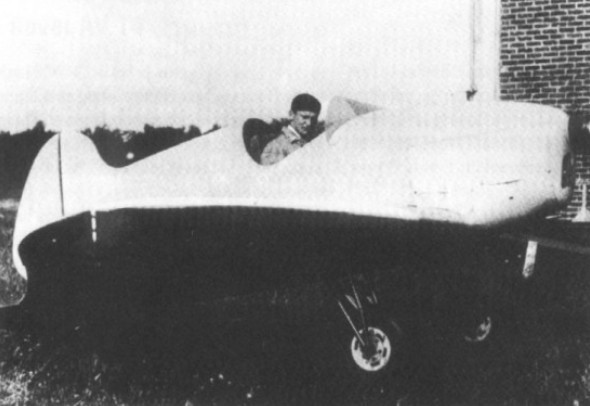
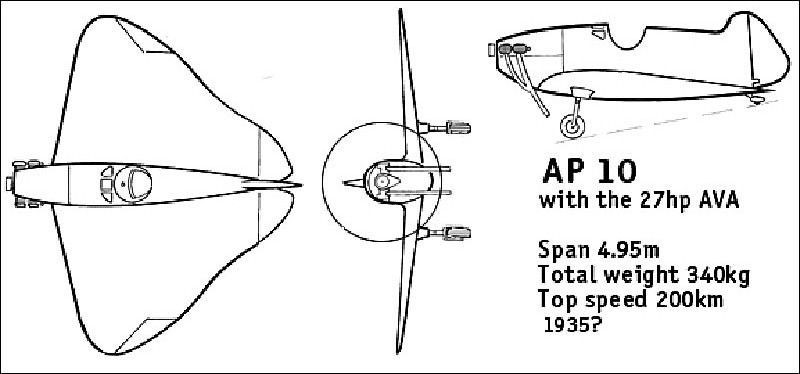
Payen first built a small single-seater AP-10, studied in collaboration with Aubrun. It was a light monoplane with triangular wing with a short length. This machine flew in Dieppe in 1935 and 1936, equipped with an AVA engine of 25 hp, then later a TRAIN of 40 hp. The AP-10 was extrapolated into the two-seater AP-12.
Wing span: 4.95m Length: 4.16 m Wing area: 10 sq.m Empty weight: 200 kg Max. gross weight: 340 kg Min. speed: 45 km/h Max. speed: 200 km/h
Nicolas Roland Payen is known as the inventor of the “fléchair”, marrying delta wing and canard wing. Payen built a sailplane at 14 years age, and deposited his first patent at 18 years. After studies at an Aeronautical University, and the field of hang-gliders, he first built a small single-seater AP-10, studied in collaboration with Aubrun. It was a light monoplane with triangular wing with a short length. This machine flew in Dieppe in 1935 and 1936, equipped with an AVA engine of 25 hp, then later a TRAIN of 40 hp. The AP-10 was extrapolated into the two-seater AP-12 (also called PA-120), which had the same concept a hang-glider, with self-stabilizing profile. The two-seater was to be equipped with an engine of 40 to 50 hp. Unlike the AP-10, the AP-12 did not leave the drawing board. Payen then concentrated more on delta aerofoils. After the war Payen built the single-seater jet PA-49 “Katy”, precursor of the “Mirage” series of the planes with delta wing, and two-seater PA-61 “Arbalète”.
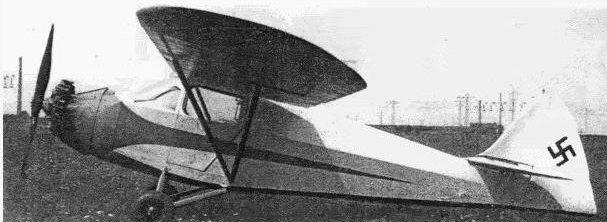
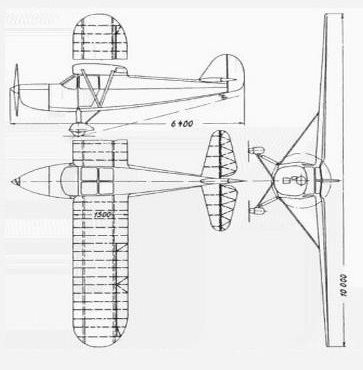
The “Pause-Mücke”, designed by Adalbert Schmid, a two-seater sports and touring aircraft developed in 1939, did not get beyond a prototype due to the war.
Engine: Salmson AD 9 Span: 10.00 m Length: 6,40 m Flying weight: 480 kg Max. speed: 145 km/h
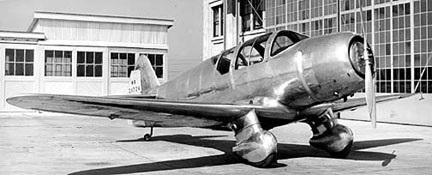
The four-seat Paulic XT3-B NX21726 was originally built in 1939 as a joint project of John W. Thorp and Rudy Paulic. A side-by-side trainer planned for Boeing School of Aeronautics in Oakland, where both Paulic and Thorp worked.
It was dismantled after several test flights and stored until July 1958, when it was redesigned and rebuilt by Paulic as four-place retractable-gear T-3B-1 with a 190hp Lycoming O-435 engine and re-registered NX6497C.
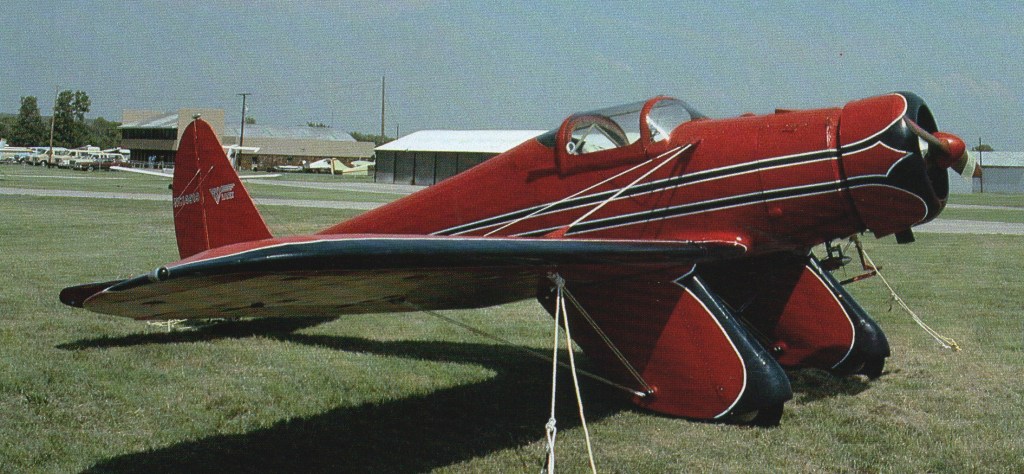
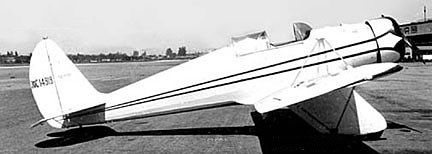
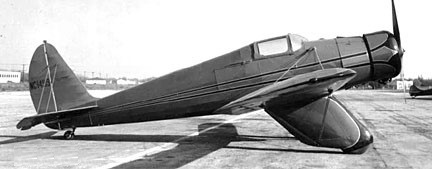
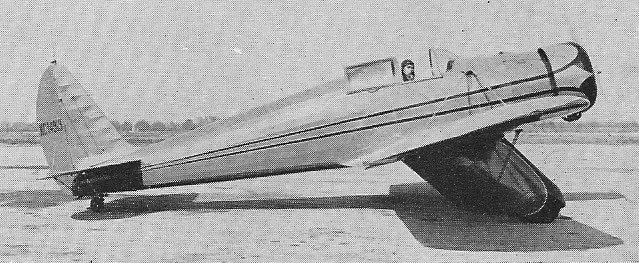
Based at Glendale, California, Fred Pastorius and Stanley Pederson designed the W-1 Skylark two-seat light cabin monoplane in 1935.
NX14919
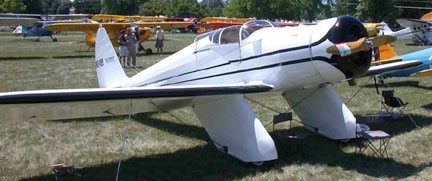
A prototype was built (ATC 2-546) NX/NC14919 c/n 1, powered with a 125 hp Warner Scarab engine. The W-1 was equipped with full-panted gear and side-by-side cockpit with optional enclosure. It was later approved for 145-165hp Warners, but only the one was built at a price of $4,485.
NC14919
The prototype survived and was restored to flight circa 2002.
Pasped W-1 NC14919 Restoration at 2002 AirVenture
Engine: Warner Scarab, 125 hp Wing span: 35’11” Wing area: 187 sq.ft Length: 25’0″ Height: 7 ft 11 in Empty weight: 1288 lb Loaded weight: 1775 lb Useful load: 597 lb Max speed: 139 mph Cruise sped: 125 mph Stall: 35 mph ROC: 850 fpm Service ceiling: 16.000 ft Range: 475 mi Seats: 2
Pasped Aircraft Co (fdrs: Fred Pastorius, Stanley Pederson) Based at Glendale, California. Built Skylark two-seat light cabin monoplane in mid-1930s, with 125 hp Warner Scarab engine; there was no further development.
In 1941 Pasped was acquired by Skylark Mfg Co, Venice CA.




 All Aero