In 1931 Pegasus Aircraft Mfg Co built a two-place, open cockpit, high wing monoplane, registered N11145 c/n 1A1. Powered by a 60hp LeBlond engine, after it crashed the registration was cancelled on 18 October 1932.
Inter-Wars
Pegasus Aircraft
Pegasus Aircraft Mfg Co
Anthony A Guarniere & Jack Harris,
Maple Heights OH.
USA
In 1931 built a two-place monoplane.
Peel Glider Boat
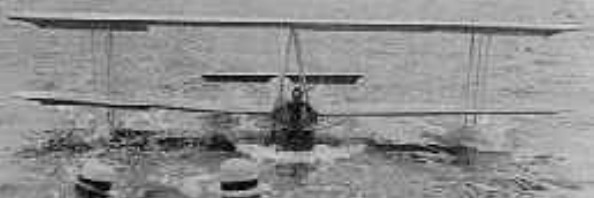
The Peel Glider Boat Company of Flushing Bay, NY was in business around 1930, designing and building the Glider Boat, a biplane glider with stepped flying boat hull and wingtip floats. A number of examples were sold.
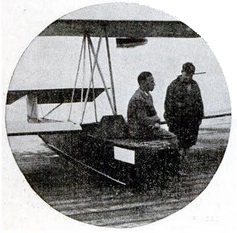
The two occupants sat in tandem in an open cockpit with conventional controls, but without instruments. The structure was wooden spar, steel ribs, fabric covered, and a duralumin hull.
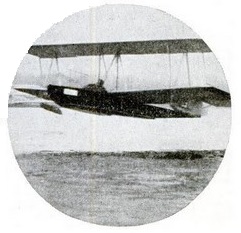
Normal method of launch was behind a motor boat, the towrope being joined to a bridle which attached to either side of the nose outside the front cockpit.
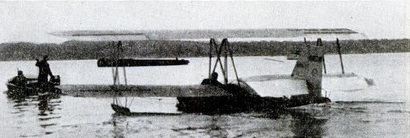
One example belongs to the National Soaring Museum.
Wing span: 9.45 m / 31 ft
Wing area: 25.08 sq.m / 270 sq.ft
Empty Weight: 113 kg / 250 lb
Payload: 159 kg / 350 lb
Gross Weight: 272 kg / 600 lb
Wing Load: 10.84 kg/sq.m / 2.2 lb/sq.ft
L/DMax: 15
Seats: 2
Peel Glider Boat Co
The Peel Glider Boat Company of Flushing Bay, NY was in business around 1930, designing and building the Glider Boat, a biplane glider with stepped flying boat hull and wingtip floats.
Peed biplane
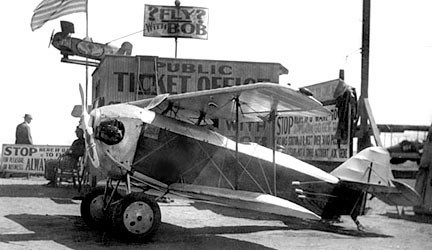
In the late 1920s a single-place biplane was built by, or for Garland Jr & Florence Patrica Kelley Peed.
Peed, Garland Jr & Florence Patrica Kelley
Santa Monica CA.
USA
Peed was a graduate of the Army Flying School at Kelly Field (TX), later stunt pilot for movies in “Lilac Time” and “Hell’s Angels.” Also a test pilot for Alexander Co on the Bullet.
In the late 1920s a single-place biplane was built by, or for Garland Jr & Florence Patrica Kelley Peed.
Pearson-Williams PW-1 Mr Smoothie

Built by C R “Bud” Pearson and Leland Williams, the 1938 Pearson-Williams PW-1 Mr Smoothie was designed by Rod Nimmo. A racer for the Nationals as Mr Smoothie (piloted by Lee Williams) registered NX94Y.
It originally had retracting gear that was wired down after its mechanism was damaged in shipment to Cleveland by railroad boxcar.
Engine: 825hp Curtiss Conqueror V-12
Wingspan: 24’0″
Length: 26’0″
Seats: 1
Pearson-Williams
(C R “Bud”) Pearson-(Leland) Williams,
Venice CA.
USA
Built the Pearson-Williams PW-1 NX94Y in 1938.
Payne MC-7
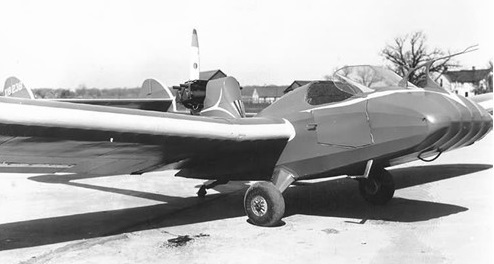
The Payne MC-7 Pusher of 1935 was a two-place open cockpit low-wing monoplane designed and built by Vernon W. Payne. A twin-boom, twin-tail experiment with a side-by-side cockpit and pod-mounted motor. Registered NX18238, it was powered by a 40hp Continental A-40 or 47hp Franklin pusher engine.
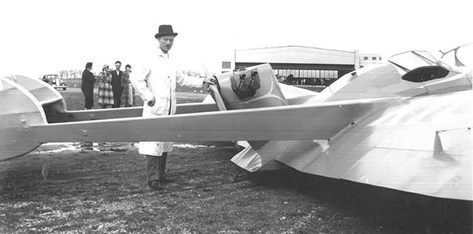
Wingspan: 33 ft 6 in
Cruise: 82 mph
Payne I.C.1
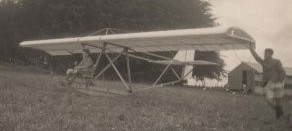
When the Imperial College Gliding Club was formed in February 1930, it had no gliders and therefore decided to build its own. This was designed by J. H. Payne and built by students, with materials donated by the Rector, Sir Henry Tizard. Parts were made in the Chemistry and Glass workshop of the college and the glider was assembled in Payne’s garden.
The I.C.1 had a straight, constant chord, thick section wing built around two spruce box spars with plywood webs. The I-section ribs were also made from spruce and ply, the leading edge from ply and the trailing edge form dural. It had outboard ailerons but neither flaps nor airbrakes. The fuselage was an open frame structure with two horizontal, parallel booms that ran rearwards from the wing spars to the tail, where two cross braces carried the tailplane. A pair of N-form struts converged below the wing onto a third boom, horizontal below the wing then angled upwards to the tail, joining the rear cross brace via a short vertical member and two angled ones. The three long booms formed a triangular section girder that did not require further wire bracing.
The pilot’s seat and control column were mounted, unenclosed, on the lower beam ahead on the wing; below him a shallow, curved member served as a keel for landing. The lower beam also provided an attachment point for lift wires, one on each side, to the forward wing spar. Above the wing two further pairs of wires ran from a central, three strut cabane to both spars. The tail surfaces were straight edged and the fin small, its leading edge formed by a sloping member that joined the forward transverse member at the front of the tailplane to the lower fuselage beam. The rudder extended to the lower fuselage.
Named The Incredible, the I.C.1 was completed during the Club’s summer camp at Gore Farm, near Shaftesbury, in September 1930.
During preparation for its first flight, the Incredible was overturned by a gust of wind and damaged. It was stored at Gore Farm and repair work was begun in the 1931 Easter vacation but never completed and the SC.1 never flew. In December 1930 the club had bought a R.F.D. Primary (Dagling), a steel framed version of the German Zogling, which they designated I.C.II and were soon flying regularly.
Wingspan: 36 ft 0 in (10.97 m)
Wing area: 179 sq ft (16.6 m2)
Aspect ratio: 7.2
Airfoil: Probably Bairstow Aerofoil B
Length: 19 ft 5 in (5.92 m)
Height: 7 ft 6 in (2.29 m)
Empty weight: 190 lb (86 kg)
Capacity: 1

 All Aero