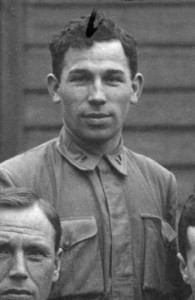
Victor Osipovich Pisarenko (Russian: Виктор Осипович Писаренко) was born in 1897 in Belarus. In 1915, during World War I, he finished technical courses and joined a telegraph battalion. After the October Revolution he voluntarily enrolled in an aviation squadron, beginning as a motorcyclist and later as a mechanic.
In 1920 he received the rank of pilot-observer (corresponding to navigator). He participated in the Civil War, fighting on different fronts. In 1921, after passing new navigator courses, he was assigned to the 13th Aviation Brigade in Kazan. In this unit and under the direction of PJ Mezheraup, he took part in combats on the Northern front against the White Finnish troops that occupied the Karelian Isthmus.
In 1922 he entered the Kacha Aviation School, finishing it a year later with excellent results, so it was decided to keep him there as a flight instructor. In he built the VOP-1 light aircraft in the school workshops, which would become the first Soviet monoplane with a low cantilever wing. On November 27, 1923, this plane rose for the first time and in the following days he would perform another set of flights. In January 1924 the VOP-1 would be transferred to Moscow, where he would end up making several hundred flights.
A short time later Pisarenko would go on to work as an instructor at the Serpujov Higher School of Air Combat, Shooting and Bombing (Strelbom), leading the flight brigade. In this center in 1925 he would build his second self-designed model known as the Pisarenko-T, which was characterized by its original wing profile. After receiving the approval only to run the plane down the runway, Pisarenko disobeyed, remounted the flight and headed for Moscow, landing at the Central Aerodrome. Once there he made a second flight, executing several high school piloting tricks. He planned to build a two-seater training version with financing from the UVVS, but the appearance of the Polikarpov U-2 put a stop to these plans.
Since 1925 by decision of the head of the VVS P.I. Baranov, Pisarenko went to work as a test pilot at the NOA (acronym for Nauchno Opytni Aerodrom or Experimental Scientific Aerodrome), predecessor of the NII VVS. In this period he would participate in tests of the I-4 (ANT-5) fighter in 1927, Heinkel HD-37 (I-7) in 1928, R-5 in 1929 and R-7 (ANT-10) in 1930.
From July 27 to August 9, 1926 with second crew member BV Stierligov, he would make a record Moscow – Kharkov – Rostov-on-Don – Sevastopol – Kiev – Moscow flight, with a total range of 3,000 km.
On July 20, 1928, during the NII VVS spin performance tests of the Heinkel HD-37 fighter, the plane went into a flat spin and Pisarenko found no way out of it. For some time he was unable to leave the aircraft and when he did he was only 300 meters from the ground. The parachute was slow to open and the pilot hit the ground hard, fracturing his leg. As it became known later, in the translated document delivered by the manufacturers, the exit methods were ignored.
On July 21, 1929 Ya. I. Alksnis and VO Pisarenko made a non-stop flight on the Moscow – Sevastopol route in an R-5, covering 1,276 km in 5 hours and 30 minutes.
From September 1930 he began working at the VVS flight inspection as a senior assistant to PJ Mezheraup.
In 1931 Yakov I. Alksnis was appointed Head of the VVS. Coming from the Alksnis ground troops, he decided that he had to learn to fly. The piloting classes were taught by Pisarenko.
He died on September 9, 1931 in a plane crash in an R-5 over the Bryansk region. He and PJ Mezheraup were carrying out an inspection flight in adverse weather conditions. With the fog, visibility decreased and they ended up hitting the tops of some trees. The remains of both crew members were found several days later. The burial took place in the building of the Zhukovski Aeronautical-Military Academy.
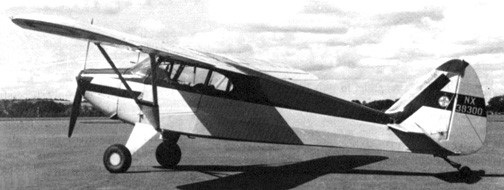
The 1941 four-place Piper P-4, powered by a 120hp Lycoming O-290 engine, was converted from P-1 NX38300. It would have gone into production in 1942 if the war had not interfered.
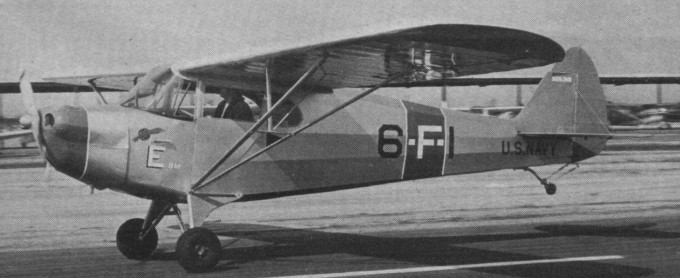
Built in 1938, the P-3 “Rosewing Cub”was a Cub Coupe with experimental William Rose wing with slats, slotted ailerons, flaps; also known as J-4RX [NX22941].
In 1941 the Piper P-2 NX33281 two-place cabin, high wing monoplane was built. Powered by a 60hp Franklin 4AC-171, later 75hp Continental, it had a cowled engine and one-piece hinged door. It was planned to replace the J-3 in production but the war intervened.
Piper introduced the Cub Coupe in 1938 and it went into production the next year, gaining immediate popularity, particularly with pilot sports who liked to take their gals for a ride and hold hands side-by-side. It came out with, wheel pants, full-swivel tailwheel, oleo gear in the under-carriage, and even an airspeed indicator. It had a small increase in wing span and introduced improved landing gear with a fully-castoring tailwheel, and hydraulic brakes. As powered initially by a 37kW Continental A50-1 it had the designation J-4.
The J-4 Coupe was developed and introduced shortly after Taylor brought out his highly successful Taylorcraft Model B side-by-side two seater. Taylor had designed the Piper Cub, and when he split with Piper he decided to offer an airplane better than the Cub was. Piper engineers countered with the J-4 and the market was offered the choice between two airplanes of generally similar configuration.
The initial J-4 Cub Coupes (ATC 703) designed by Walter Jamouneau and Hanford Eckman, were plush inside, upholstered in suede cloth and leather. Elevator tab control and indicator were put up in the ceiling, in front of the pilot’s head where you could see whether you were winding the nose up or down. They were priced at $1,995, with exposed engine cylinders.
The 1938 J-4A (703) was powered by a 65hp Continental A-65 engine with enclosed cowl.
In 1939 Piper introduced the J-4B (ATC 708), differing only in powerplant which initially, was a 45kW Franklin 4AC-171, but that was soon replaced by the 48kW Franklin 4AC-176-B2 without any change in designation. Priced at $1,935, nineteen J-4A and -4B in England were impressed by RAF.
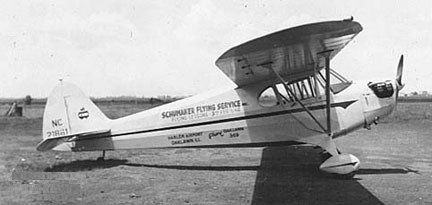
Piper J-4B NC21861
Introduction of the 56kW Continental A75-9 in 1941 brought redesignation as the J-4E (ATC 740), priced at $2,395.
Last of the J-4s was the version powered by Avco Lycoming engines, the 41kW O-145-A1 or -A2, or 48kW O-145-B1, both of these Cub Coupes having the designation J-4F, priced at $1,910.
Piper J-4 Peruvian AF 1950
One J-4, NX21599, was experimental fitted with 60hp Milwaukee Tank engine.
Powered by a 75hp Continental engine, the J-4RX [NX22941 of 1939 tested an experimental William Rose wing with slats, slotted ailerons, and flaps.
By 1941, with production rolling on the Coupe, Piper’s 70-horsepower version came out with. increased speed, range, and altitude, and sold at $2,395, only $799 down, with a free flying course including eight hours of dual time thrown in so you could fly your toy home from Lock Haven all by yourself – hopefully.
This was a step forward from originally published claims for the Cub Coupe, which sold in 1938 for $1,995, only $665 down with a free catalog thrown in. Announced Piper: “Get this luxurious 1939 Cub Coupe and you’ve got everything! Here’s a plane that’s complete in every detail. Nothing more to buy!”
Production of J-4s reached 1,250 by 1942, and during World War II 17 J-4Es were impressed for service with the USAAF under the designation L-4E. 1942 impressed J-4E 42-79555 was first designated UC-83B, later becoming L-4E.
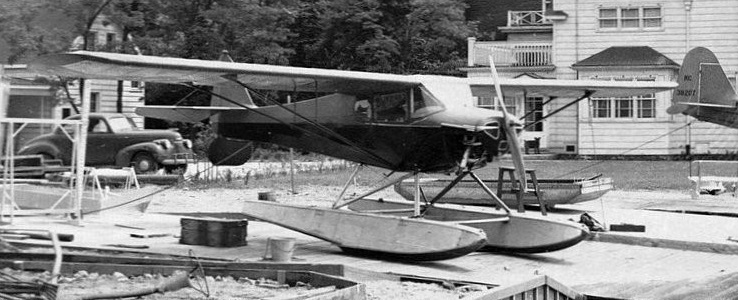
Harry Garland’s J-4A Cub NC30815 on the Garland’s Seaplane Base ramps facing the Detroit River 1946
J-4 Engine: Continental A-50, 50 hp Span: 36 ft 7 in Length: 22 ft 6 in Height: 6 ft 10 in Empty wt: 710 lb Gross weight: 1,200 lb Useful load: 590 lb Top speed: 93 mph Cruising speed: 83 mph Landing speed: 35 mph Cruising range: 340 miles Climb first minute: 500 fpm Service ceiling: 12,000 ft Range: 325 mi Seats: 2
J-4A Engine: 65hp Continental A-65
J4A 65 Cub Coupe Engine: Continental A65-8, 65 hp
J-4B Engine: 60hp Franklin 4AC Useful load: load: 520 lb Max speed: 96 mph Cruise: 85 mph Stall: 36 mph Range: 340 mi
Piper J-4F Engine: 1 x Avco Lycoming O-145-B1, 48kW / 60 hp Wingspan: 11.02 m / 36 ft 2 in Length: 6.86 m / 23 ft 6 in Height: 2.08 m / 7 ft 10 in Wing area: 17.00 sq.m / 182.99 sq ft Max take-off weight: 590 kg / 1301 lb Empty weight: 336 kg / 741 lb Useful load: 480 lb Max. speed: 161 km/h / 100 mph Cruise: 85 mph Stall: 35 mph Ceiling: 3660 m / 12000 ft Range: 547 km / 340 miles
J-4F Engine: 65hp Lycoming O-145 Wingspan: 11.02 m / 36 ft 2 in
J-4F Engine: 60hp Milwaukee Tank Wingspan: 11.02 m / 36 ft 2 in
ln 1938 Piper introduced the improved J-3 Cub. Powered by 40-hp Continental, Lycoming or Franklin engines, the J-3 sold for $1,300. Engine horsepower was soon raised to fifty and reached sixty-five by 1940. Piper also standardized a color scheme; just as Henry Fords Model T’s were all black so Wiliiam Piper’s Cubs were all bright yellow with black trim.
The lightly loaded USA 35 B airfoil, a new aileron shape, modification of the wing interior for durability and ease of manufacture wheel brakes, tail wheel and larger seats, slightly reshaped tail surfaces and an aerodynamically balanced rudder were the only air frame differences between it and the J 2. Though it was initially powered by the same A 40, optional engines for the J 2 were soon offered as other manufacturers began to see a future in general aviation. Fifty hp Continental, Lycoming and Franklin models as well as the three cylinder Aeromarine Lenape radial were available, although only a few of the last were ever installed as the engine/ airframe combination resulted in excessive vibration. In 1938, the 65 hp Continental, Lycoming and Franklin were added to the list even though some felt the plane overpowered with that staggering amount of thrust.
1938 Piper J-3 “Sport” NC26792
The J 3 had a balanced rudder and a modified vertical stabilizer, upholstered chair type seats (instead of plywood chair frames), and such other refinements as a tailwheel and brakes items that remained essentially unchanged as the J 3 evolved into the Super Cub 12 years later.
In the J 3, yellow was established as the standard Cub colour; earlier models could be purchased with solid blue, red or green paint schemes.
J-3C
When first produced by Piper in 1937 under ATC 660, the Piper J-3 Cub was powered by a 30kW Continental A40-4 flat-four engine, but it was not long before the 37kW A50-4 or alternative A50-5 with dual ignition system was introduced on the J-3C-50 Cub. The resulting improvement in performance made this already attractive lightplane an extremely marketable commodity and during 1938, which was the new company’s first full year of production, 737 Cubs were built. The Cubs initially sold for $1,249, then $1,098 in 1939, and $995 in 1940. The Continental A50 was a new engine, early experience proving that it was reliable and had development potential, and it was later re-rated at 48kW at a higher engine speed. Its introduction by competitors meant that Piper had to follow suit, and in 1940 the J-3C-65 Cub appeared with the Continental A65 engine. With alternative Franklin flat-four engines, the 37kW 4AC-150 or 48kW 4AC-176, the Cub was designated J-3F-50 and J-3F-65 respectively and, similarly, with the Avco Lycoming 37kW O-145-A1 or 48kW O-145-B the Cub had the respective designations J-3L-50 and J-3L-65. Also built in comparatively small numbers was a version designated J-3P-50, powered by a 37kW Lenape Papoose 3-cylinder radial engine. The higher-powered Continentals and Franklins Cubs were Group 2 (ATC 691, 692, 695, 698).
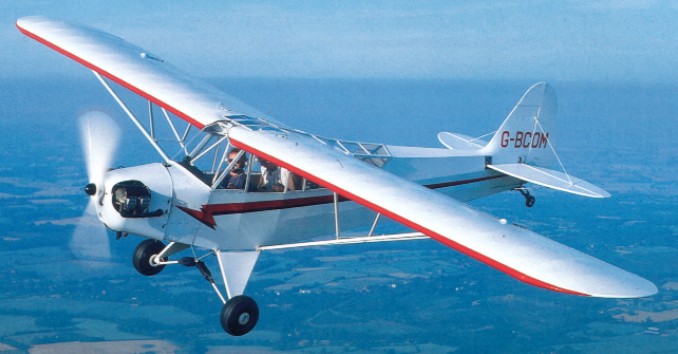
Piper J-3C Spirit of N76 NC88657
All models of the Cub carried large loads for their horsepower and were excellent short field airplanes. With the standard 8:00 x 4 doughnut tires and rugged shock cord damped gear, the plane really didn’t care whether it was on an airport or a pasture. With a stall¬ing speed of 35 mph, any little field would do. It was not unusual in the 1930s and ’40s to see a Cub land in a meadow or on a road near a gas station to refuel on a long cross country. And any cross country was long; speed was not among the airplane’s virtues. The 65 hp J¬3 cruised in the high 70s on a good day.
Sales began to soar, and then in 1941 the US Army selected this aircraft for evaluation in artillery spotting/direction roles. Four were obtained, 42-460 to 42-463, as YO-59, powered by the 65hp Continental C-65/O-170.
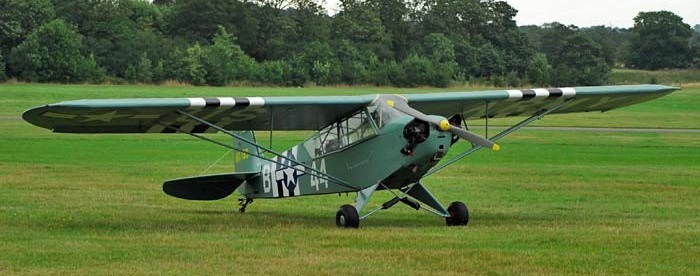
Shortly afterwards ordered 40 similar aircraft, including 42-7813 to 42-7852, under the designation O-59, all redesignated, briefly as L-59, finally L-4. These aircraft were used by the US Army under virtually operational conditions during annual manoeuvres at the end of 1941, and it was very soon discovered that the little Cub had far wider applications than at first anticipated.
One had the distinction of the final WW2 aerial victory in Europe, as the war there was ending, when a rather slow and ungainly dogfight—more of an aerial ballet—between an L-4 and a German Fieseler Fi.156 observation plane took place. USAF Lts Duane Francis and Bill Martin fired their .45 pistols at the German, convincing him to land and surrender.
Six Mutual Defense exports were obtained in 1951; 51-16086 to 51-16091.
This practical experience enabled the US Army to obtain an improved O-59A which, powered by a 48kW Continental O-170-3 flat-four engine, had better accommodation for the pilot and observer with an enhanced all-round view. Orders for O-59As totalled 950 (41-15159 to 41-15329, 42-36325 to 42-36824, 42-38380 to 42-38457, and 43-29048 to 43-29246), but as a result of designation changes they entered service as L-4A aircraft, the earlier YO-59 and O-59 aircraft then being redesignated L-4, and the type later received the name Grasshopper.
Subsequent procurements covered 980 of the L-4B version (43-0491 to 43-1470) with reduced radio equipment.
Civil-Cubs impressed for Army service at the beginning of World War II included eight J-3C-65s and five J-3F-65s which were designated L-4C and L-4D respectively. Two impressed J-3C in 1942 (42-79557 and 42-79558) were designated UC-83A, and later became L-4C.
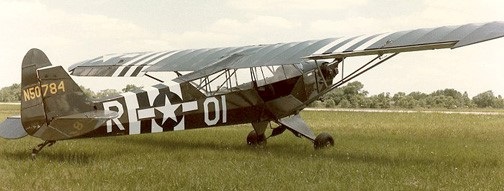
Piper L-4C N50784
Total L-4C impressment was 111, plus 5 more lost in the records somewhere.
The 1943 L-4D were five impressed J-3F.
The 1943 L-4E were one impressed J-4E, plus 1 redesignated from UC-83B, 42-79555.
L-4F were 45 impressed J-5A. plus 42-57505 and five redesignated from UC-83 (42-79551/79554, -107424).
The 41 L-4G were impressed J-5B in 1943.
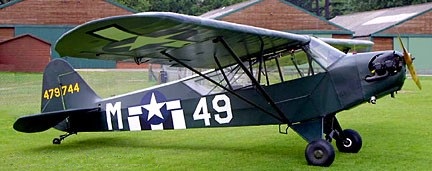
Piper L-4H 44-79744
There were 1,801 of the L-4H variant (43-29247 to 43-30547, and 44-79545 to 44-80044), with only detail changes, and 1,680 of the L-4J (J-3C) model with 65hp Continental which introduced a variable-pitch propeller.
Piper was then requested to develop a training glider from the L-4 design and this, with powerplant removed and the forward fuselage redesigned to accommodate an instructor and two pupils, was built to a total of 250 for the US Army under the designation TG-8. Three of these gliders were acquired for evaluation by the US Navy under the designation XLNP-1.
The US Navy also procured 230 NE-1 aircraft, 26196 to 26425, which, basically similar to the US Army’s L-4s, were used as primary trainers; 20 similar aircraft procured at a later date were designated NE-2, 29669 to 29688. One ship was used for experiments as a potential carry-on by blimps (like a mini-version of the Curtiss Sparrowhawk and USS Akron merger) for long-range sub spotting, but with PBY and PB4Y fitting that role better, the plan was never fully implemented.
When, in 1949, production was switched to the improved Cub J-4 Coupe, Piper had built a total of 14,125 civil and 5,703 military.
Very important to the airplane’s popularity was Pip¬er’s aggressive marketing and pricing. A 1940 brochure lists the 40 hp version of the J 3 for $995, $333 down. And they even threw in a free 12¬month subscription to Air Facts. With a 65 hp Continen¬tal, the price of the J 3 was $1,598.
There were 105 recorded exports to the Turkish AF.
Production increased by leaps and bounds – nearly 600 in 1938, 1100 in 1939, 1800 in 1940. A total of 19,888 were built at Lock Haven and another 150 in Canada. Some were built as L-4 Grasshoppers for the United States military before production ended in 1947.
Certification of the J3C-50 and -65 is under FAA A-691.
The 1944 J-3X was built with a cantilever wing.
Modified lift struts increase the MAUW from 1100 lbs to 1220 lbs.
In 1978 PATTS College of Aeronautics in the Philippines assembled a modified L-4J Piper Cub and flew using 100% alcogas as fuel. In May 1988 a modified version of an L-4J, RPX-25, built by PATTS College of Aeronautics flew.
Piper J-3C-65 Cub Engine: 1 x Continental A65-8, 48kW / 64 hp at 2350 rpm Max take-off weight: 499 kg / 1100 lb Empty weight: 290 kg / 639 lb Fuel cap: 11 USgal Wingspan: 10.73 m / 35 ft 2 in Length: 6.78 m / 22 ft 3 in Height: 2.03 m / 7 ft 8 in Max. speed: 148 km/h / 92 mph Ceiling: 3660 m / 12000 ft Range: 402 km / 250 miles Take-off distance (50ft obstacle): 730 ft / 223 m Landing distance (50ft obstacle): 470 ft / 143 m Climb Rate: 450 ft/min / 2 m/s Crew: 2
J-3F 1938 Engine: 1 x 40, 50, 60, or 65hp Franklin 4AC
J-3L 1938 Engine: 1 x 50, 55, or 65hp Lycoming O-145
J-3P 1938 Engine: 1 x 50hp Lenape Papoose No built: 27
J-3R 1939 Engine: 1 x 65hp Lenape Papoose No built: 1 (NX21806)
J-3X 1944 Engine: 1 x 65hp Continental Speed: 111 mph No built: 1 (NX42111)
NE Engine: 65hp Continental O-170 Wingspan: 35’3″ Length: 22’3″
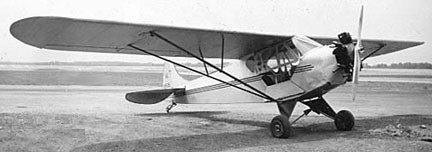
The company was always sensitive to customer desires, and in 1936, Taylor introduced a refined Cub in order to incorporate design improvements as well as suggestions from the field. Walter Jamouneau was given the job of improving the E 2. He rounded off the wingtips and tail, widened the landing gear tread and moved the axles forward a few inches for better ground handling, improved the fuel system, redesigned the ailerons and got to put his initial into the new type designator, J 2. Aerodynamically, the plane remained virtually the same, but Jamouneau believes that directional and roll control were improved in the J 2. It retained the E 2’s tandem, two place seating but added sliding windows on the left and a clamshell arrangement on the right (the window folded up and the door down), actually a late model E 2 improvement that is still used on the Super Cub. The J 2’s engine remained the reliable A 40-3 or -4.
The sale price in 1936 was $1,470 and $1,270 in 1938. 550 were built by the end of 1936. ATC 2-533 was superseded by ATC 595.
Taylor J-2
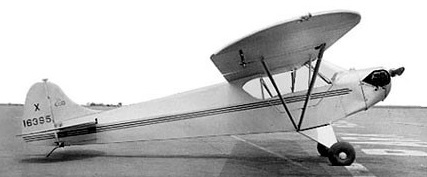
NX16395 J-2S was the prototype with EDO pontoons.
Taylor J-2S minus its floats NX16395
In early 1938, the Ilmavoimat / Maavoimat test team evaluated the Piper J-2. The J-2 had excellent STOL capability, able to take off in less than 300 feet by firewalling the throttle, lifting the tail immediately, pulling full flaps at 45 knots and levering the stick back into the pilots lap. The J-3 was near stallproof, with a stall speed of 34 knots, and short field approaches were easy with full flaps.
Although sales were initially slow, about 1,200 J-2s were produced before a fire in the Piper factory in March 1937. Only 658 Cubs were built that year; total more than 1,200 built by July 1937, at which time production was taken over by Piper Aircraft and the name changed. William Piper relocated his manufacturing operation and several hundred employees to Lock Haven, Pennsylvania, and the Piper Aircraft Corporation was born. By year’s end, it had built 687 Piper airplanes.
Production began in February 1936 and 1207 were built in total until production ended in 1938.
After being an investor in and later treasurer of that Bradford firm the Taylor Broth¬ers Aircraft Company a local oilman named William T. Piper bought the company at a bankruptcy sale for $761. It was 1930, and C. Gilbert Taylor, the former company’s designer and only surviving partner, was given half in¬terest in the new company, which he called the Taylor Aircraft Company.
About the time the J 2 rolled out, so did C.G. Taylor. There had been friction between Taylor and Piper for some time, so Taylor left and Jamouneau took over as chief engineer.
The company was beginning to see some improve¬ment in its always precarious financial situation, and then, in 1937, the plant burned down. By 1937 the company was producing 18 aircraft a week, but fire destroyed the facility on St.Patrick’s Day that year. It was a severe financial blow to the company and to William T. Piper. But instead of being an excuse to quit, the fire only in¬creased Piper’s determination to prove his point. Refi¬nancing was arranged, the name was changed to Piper Aircraft Company, and J 2 production was resumed in a vacant two storey Susquehanna silk mill conveniently located next to the Lock Haven, Pennsylvania airport. That same year, Piper assumed the presidency of the firm, making official a situation that had existed informally since the early 1930s.
In recog¬nition of Walter Jamouneau’s contribution to the E 2, subsequent models were called the J 2 and J 3.
The PA 11 followed next in the Cub line, and the PA 18 Super Cub with essentially the same structural and aerodynamic con¬figuration as the 1932 E 2 continued.
Initial production type was the Cub two-seat high-wing monoplane, of which 10,000 had been completed before the end of 1941.
Piper’s major contribution to the military in World War 2 was not, as often assumed, the Cub liaison and trainer, but steel radar masts.
In 1948 Piper took over the Stinson Division of Consolidated Vultee Aircraft Corporation and acquired the Stinson Voyager production rights, but production of this type was soon halted.
Piper’s first twin was the four-seat Apache, which entered production in 1954. The later four-seat single-engine Comanche first flew in 1956. A whole line of light aircraft has followed the original Cub, from the Pacer/Tri-Pacer/Colt series of high-wing monoplanes to their successors, the Cherokee low-wing series, first of which flew in 1960. Piper produced the specialized Pawnee agricultural monoplane in 1959.
William T. Piper died in 1970.
A series of twins developed from the Apache to Aztec, Twin Comanche, Seneca, and Navajo, plus other aircraft such as single-engined PA-38 Tomahawk. Company became subsidiary of Bangor Punta Corporation, then Lear Siegler Inc (1984), and later Romeo Charlie Inc (1987), finally with only Cheyenne and Malibu Mirage offered, but became insolvent early 1990s, though reduced-rate production continued while a buyer was sought.
The New Piper Aircraft Inc restarted production of Warrior, Archer, Arrow, Dakota, Saratoga and Seneca models at Vero Beach in June 1987 following the sale of the 50 year old aircraft company to Stuart Millar in May.
The 1929 Pioneer Aero Trades School Inc BS-2 was a single-place open cockpit biplane, built as a school project. Registered N446 c/n 2 (II), it was “used for advertising.” The license was cancelled 20 February 1930.





 All Aero