At the time Potez joined the SNCAN group, it was producing the prototypes of the 661 12-passenger four-engine monoplane.
Inter-Wars
Potez 600

Potez 453
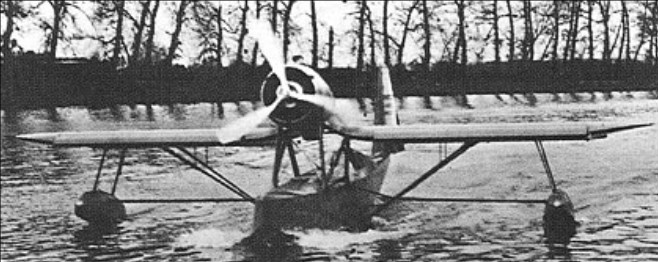
A contender to fulfil the 1933 Marine Nationale requirement for a single-seat float fighter suitable for catapult operation from 10,000-ton cruisers, the Potez 453 was based broadly on the design of the two-seat Potez 452 light observation flying boat. Competing with floatplanes tendered by Bernard (H.52), Loire (210) and Romano (R-90), the Potez 453 flying boat first flew on 24 September 1935. Of mixed construction, it was powered by an 800hp Hispano-Suiza 14Hbs radial engine and was intended to carry an armament of two 7.5mm machine guns. The engine was carried on bracing struts ahead of the wing, the thrust axis passing high above the CG of the flying boat with the result that, in view of the small dimensions of the aircraft, a considerable diving moment was induced at full throttle which could not be easily counteracted. Take-off was, in consequence, difficult and could be effected only by reducing engine power. Further development of the Potez 453 was therefore abandoned.
Max take-off weight: 1937 kg / 4270 lb
Empty weight: 1534 kg / 3382 lb
Wingspan: 11.20 m / 37 ft 9 in
Length: 10.20 m / 33 ft 6 in
Height: 3.45 m / 11 ft 4 in
Wing area: 19.00 sq.m / 204.51 sq ft
Max. speed: 318 km/h / 198 mph
Range: 540 km / 336 miles

Potez 230
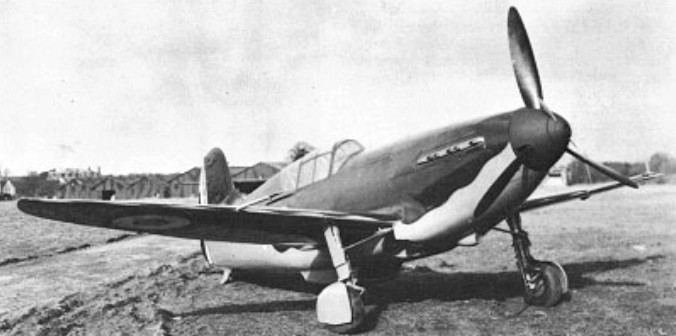
With the absorption of ANF-Mureaux in 1937 as a component of the SNCA du Nord (which also included Potez and retained the appellation for its products), Andre Brunet and his co-designers Lemaitre and Hubert continued the line of lightweight fighter development commenced with the ANF-Mureaux 190. In the autumn of 1938, work on a progressive development, the Potez 230, was begun. While possessing a number of features in common with the earlier fighter (eg, elliptical wings), the new aircraft was of more advanced design. Powered by a 670hp Hispano-Suiza 12Xcrs 12-cylinder liquid-cooled engine and having a proposed armament of one engine-mounted 20mm cannon and four wing-mounted 7.5mm machine guns, the Potez 230 was flown on 30 March 1940. When German forces occupied Villacoublay, the sole prototype of the Potez 230 was seized and transported to Germany for examination of the wing torsion box, which, of integral construction, was the first of its type to have been flown.
Max take-off weight: 1800 kg / 3968 lb
Wingspan: 8.74 m / 29 ft 8 in
Length: 7.57 m / 25 ft 10 in
Height: 2.18 m / 7 ft 2 in
Wing area: 10.97 sq.m / 118.08 sq ft
Max. speed: 560 km/h / 348 mph

Potez CAMS 161
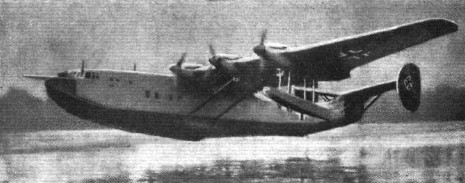
The Potez-CAMS 161 was one of three French large, six-engined flying boats intended as airliners on the North Atlantic route. The others were the Latécoère 631 and the SNCASE SE.200. In the summer of 1938, the 161’s aerodynamics had been investigated and refined with the Potez-CAMS 160, a 5/13 scale flight model.

The 161 was an all-metal monoplane with a high, semi-cantilever wing, braced on each side by a pair of parallel struts between the lower fuselage and the wing near the first outboard engine. The engines were mounted on a constant chord central section but the outer panels were tapered, with ailerons interconnected to Handley Page slots near the wing tips. The trailing edges carried split flaps. The flying boat’s wing stabilizing floats retracted vertically to the outer engine cowlings. The tail unit was of the twin endplate fin type with the tailplane, mounted with marked dihedral, on a fuselage pedestal and externally braced from below. The D-shaped fins were fixed to the tailplane a little below their horizontal mid-lines and were also lightly braced, with struts between them and the upper tailplane surfaces.
The CAMS 161 was powered by six 664 kW (890 hp) Hispano-Suiza 12Ydrs liquid cooled V-12 engines driving three blade propellers. These were cooled via both wing surface and frontal radiators, the latter retracted after take-off. Its two step hull was flat sided forward of the wing but more rounded aft; there were long wing root fillets. Ten square windows on each side lit the passenger cabin, where twenty were provided with seating and sleeping compartments and flown and looked after by six crew.
Very different dates for the first fight appear in the literature: a contemporary report in Flight gives it as within few weeks before 7 December 1939, with “further flying tests” in the first half of 1942, whereas Hartmann has 20 March 1942 as the first flight date. In either case the CAMS machine was the first of the three to fly.
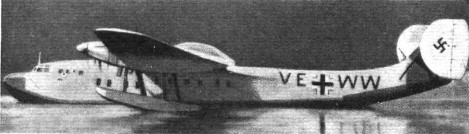
In Hartmann’s account, the March flight was from the Seine, with the aircraft in German markings. Earlier it had been painted in Air France Atlantique trim and at some point it received a French civil registration.
Full flight trials and performance measurements were never done, so the figures remain estimates, but there is clear evidence that the empty weight had increased by about 33% from the 1938 estimates by the time the 161 was flying, with a corresponding 16% increase in gross weight.
It seems to have been destroyed by enemy fire toward the end of World War II, but there is disagreement on exactly when and where: Hartmann locates the event to the Baltic, others to Lake Constance. Cuny states that the SE.200 and the Laté 631 were destroyed on the lake early in 1944, but that the Potez escaped.
Engines: 6 × Hispano-Suiza 12Ydrs, 660 kW (890 hp) each
Propellers: 3-bladed
Wingspan: 46 m (150 ft 11 in)
Wing area: 261 m2 (2,810 sq ft)
Length: 32.11 m (105 ft 4 in)
Height: 8.87 m (29 ft 1 in)
Empty weight: 17,220 kg (37,964 lb) ; Flight (1942) has 22,979 kg (50,660 lb)
Gross weight: 37,000 kg (81,571 lb) ; Flight (1942) has 43,001 kg (94,800 lb)
Fuel capacity: 15,500 kg (34,172 lb) including oil
Maximum speed: 335 km/h (208 mph; 181 kn) at 1,000 m (3,281 ft)
Cruise speed: 300 km/h (186 mph; 162 kn) at 4,000 m (13,123 ft)
Range: 6,000 km (3,728 mi; 3,240 nmi) in a 60 km/h (37 mph) wind, full load, std fuel
Crew: Six
Capacity: Twenty passengers

Potez-CAMS 160
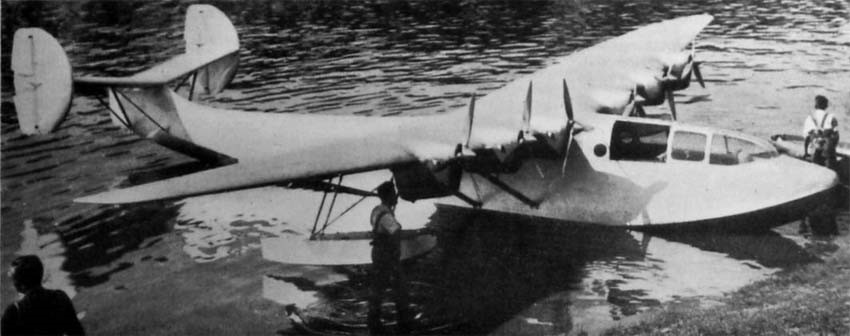
In 1936 the design bureau of Potez-CAMS was beginning the development of the Potez-CAMS 161 six engine, trans-Atlantic passenger flying boat, intended to be a key component of Air France’s Transatlantique fleet. To test the design they built a 5/13 scale flying scale model of it, careful not just to scale dimensions of the flying surfaces and hull, but also to copy the form the nose around the cabin, engine cowlings and retractable float housings. Control surface detail and the flaps of the 161, together with its variable-pitch propellers, were included on the resulting Potez-CAMS 160. It was intended to prove both the aerodynamic and hydrodynamic behaviour of the airliner.

The 160 was a high-wing monoplane. The wing was a semi-cantilever structure, with two parallel bracing struts on each side from the lower fuselage to the wing just inside the central engines, straight-edged in plan with taper on the trailing edge only and rounded tips. It was fitted with interconnected Handley Page slots and ailerons as well as split flaps. It was powered by six four-cylinder inverted inline air-cooled Train 4T engines, each producing 30 kW (40 hp) driving three blade, variable-pitch propellers. The engines were mounted on the wing underside, housed in long, narrow cowlings intended to mimic those around the 664 kW (890 hp) Hispano-Suiza 12Ydrs water-cooled V-12 engines of the full scale aircraft.

The little flying boat had a conventional stepped hull and was stabilized on the water by a pair of floats, attached under the outboard engines and retracting into their cowlings. Its enclosed, tandem seat cockpit was shaped to reproduce the form of the 161’s nose, though the full sized aircraft had proportionally shorter glazing. The 161 had a twin fin empennage with a N-strut braced, parallel chord tailplane mounted on top of the fuselage on a short pillar with marked dihedral. The fins were of the endplate type, with curved leading edges and roughly symmetric above and below the tailplane; on each, the rudder was split into an upper and lower part. All of these features appeared on the final, full size airliner.
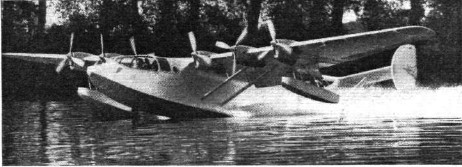
It flew for the first time on 20 June 1938.
The Potez-CAMS 160 appeared, after its first flight, at the 1938 Paris Aero Show.
Engines: 6 × Train 4T, 30 kW (40 hp) each
Propellers: 3-bladed variable pitch
Wingspan: 17.69 m (58 ft 0 in)
Wing area: 38.7 sq.m (417 sq ft)
Length: 12.37 m (40 ft 7 in)
Height: 3.41 m (11 ft 2 in)
Gross weight: 2,275 kg (5,016 lb)
Maximum speed: 222 km/h (138 mph; 120 kn) at 950 m (3,116 ft)
Power/mloadng: 75 W/kg (0.047 hp/lb)
Wing loading: 58.5 kg/sq.m (12.0 lb/sq ft)
Crew: Two, pilot plus observer

Potez (CAMS) 141

The acquisition by Potez in 1933 of Chantiers Aero-Maritimes de la Seine (CAMS) brought increased interest in the development of maritime aircraft, and the Potez (CAMS) 141 was designed to meet an official requirement for a maritime reconnaissance flying-boat. A large-span monoplane wing was carried on a faired superstructure above the hull, to which it was braced on each side by large N-struts. A stabilising float was strut-mounted beneath each wing, and the two-step all-metal hull carried at the rear a twin fin-and-rudder tail unit. Carrying a crew of nine to 12, the 41m span Potez 141 was powered by four 694kW Hispano-Suiza 12Y-26/27 Vee engines in wing-mounted nacelles. First flown on 21 January 1938, successful testing led to large orders, but changing policies and the development of World War II meant that no production aircraft were built.
Max take-off weight: 25900 kg / 57100 lb
Max. speed: 320 km/h / 199 mph
Bomb load: 1500kg
Potez 62 / 621 / 65 / 650
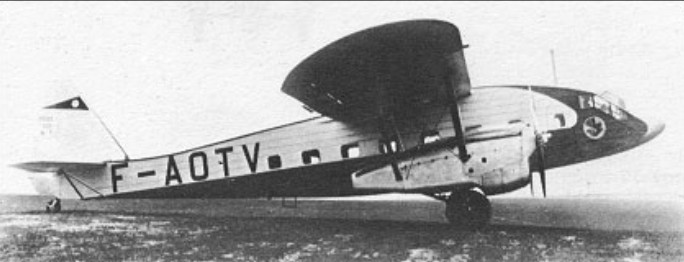
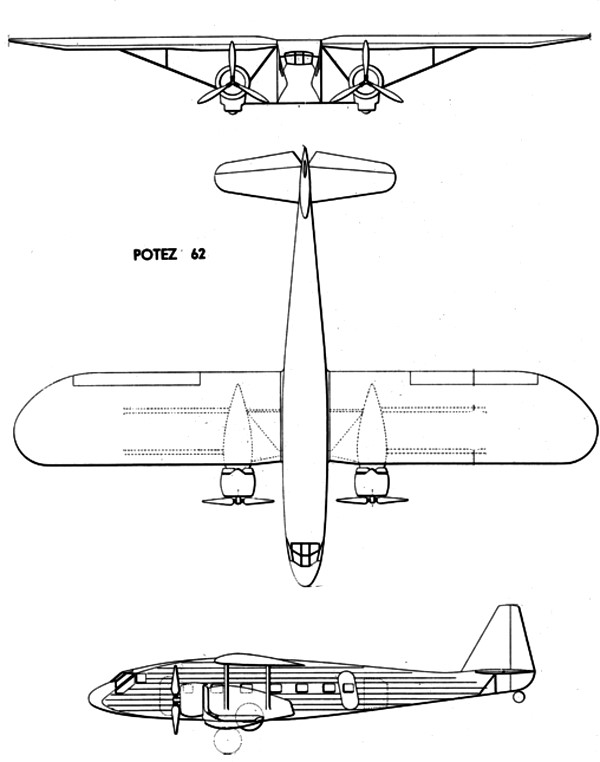
The prototype Potez 62 civil airliner, based on the military Potez 54, made its maiden flight on 28 January 1935. It retained the strut-braced high-set wing of the Potez 54, which was married to a redesigned fuselage. Pilot and co-pilot were seated side-by-side in a control cabin with, to their rear, two cabins accommodating up to 16 passengers. Undercarriage was retracting, but there were no flaps, which the large wing area with thick airfoil made unnecessary, at the expense of speed.
The wooden fuselage had a composite coating, whereas the wings were covered with fabric and the leading edge was made out of metal. The aircraft was propelled by two Gnôme & Rhône radial engines whose 14 cylinders produced some 870 hp. The engines were mounted in two side cradles, fixed to the fuselage and to the wings.
The Potez 621 ordered by Air France, flown later in 1935, introduced 537kW Hispano-Suiza 12Xrs Vee engines and 2 degrees sweepback on the wings. These were used on routes inside South America. By late 1936, many Potez 62s were employed on routes to Europe and the Far East, as the aircraft was robust and reliable, albeit slow. It remained in service until the Second World War, and one was used by the Free French Air Force.
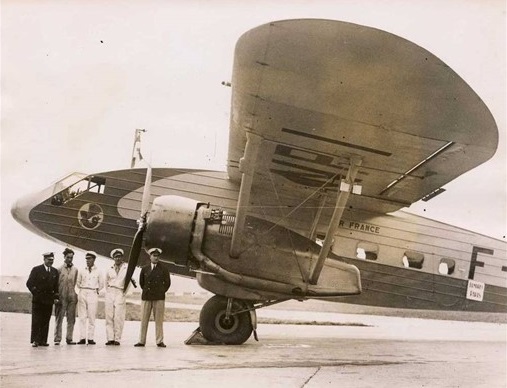
Production totalled 23, four of the 14 machines built as Potez 62s later being converted to Potez 621 standard, and in 1937 nine Potez 62s were re-engined with 671kW Gnome-Rhone 14N16/17 radials.
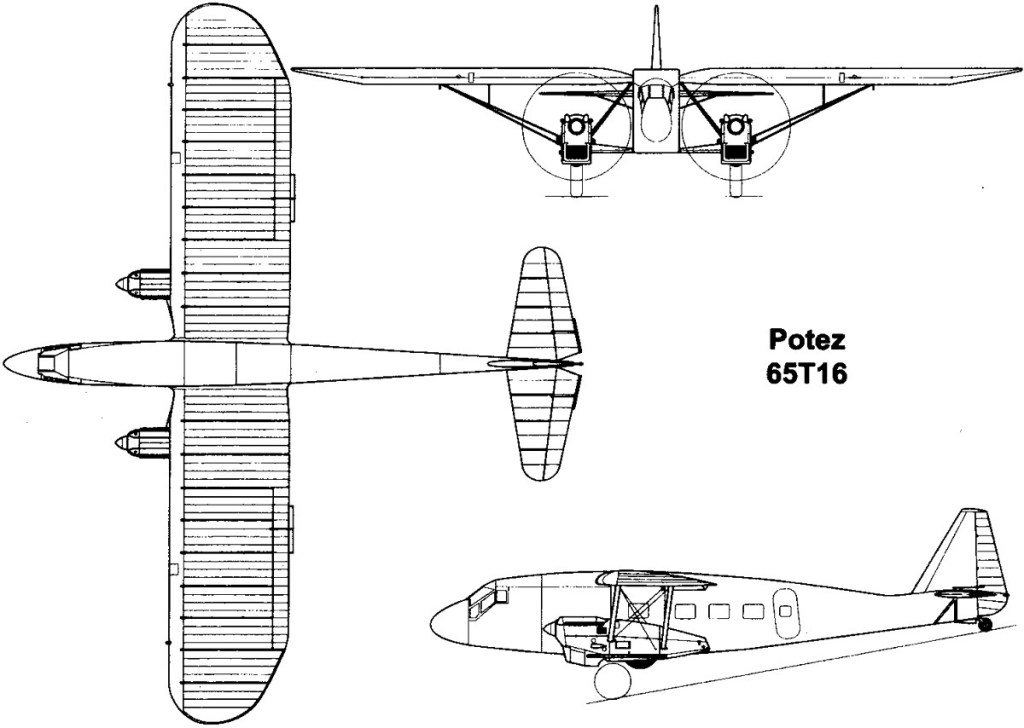
The type interested the Armee de I’Air, which ordered a troop transport version, the Potez 65 or Potez 650 TT, which had accommodation for a crew of three plus 14 fully-equipped troops or, if equipped as an ambulance, with provision for six stretchers, four seated patients and one medical attendant.
The Potez 650 only received relatively minor modifications: Hispano-Suiza 12X liquid-cooled inline engines instead of the Gnome-Rhône 14K radials, a less sophisticated cabin with accommodation for 14 paratroopers and their equipment (one squad) or 10 wounded (for the medevac role), and a larger door system for bulky loading (transport role). The first paradrop from a Potez 650 occurred on May 1937.
Two orders totalling 15 aircraft were received by Potez, the first of them being delivered in late 1935. Powered by 537kW Hispano-Suiza 12 Xirs I or HS 12Xbrs l/grs I engines, and with a maximum take-off weight higher than that of the Potez 62, the military version had maximum speed reduced to 300km/h.
The French military high-command did not have grandiose plans for paratroopers, which did not fit well with its essentially defensive doctrine of the pre-World War II era. Because of this, only two paratrooper companies were formed, and never reached full theoretical strength, and only 15 Potez 650s were manufactured. They were not sufficient in numbers even for such a small number of men, so the big Farman 224 airliner which had just been refused by Air France was pressed into military service.
A combat mission was planned as part of the Allied entry in the Netherlands in the case of a German attack, but the plan was cancelled, and eventually no combat paradrops took place in 1939-1940.
After the armistice, paratrooper units were officially disbanded, although training jumps were performed from time to time in North Africa. The Potez 650s were transferred to a military transport unit. When Free French and British forces attacked the French protectorates of Syria and Lebanon in mid-1941, the Vichy government established an airbridge to resupply its troops in the middle east. Potez 650s took a significant share of the work, alongside converted bombers (Farman 223.3s) and airliners (Dewoitine 338s).
In 1937, the Romanians acquired one civil Potez 62, which was operated until 1944. In late 1936, the Romanian Air Force expressed interest in acquiring foreign military aircraft. The Potez 650 was selected, but Romania required Gnome-Rhône 14K engines to be fitted like originally on the Potez 62, since a license to manufacture these engines had already been acquired by Industria Aeronautică Română. Six examples of this new variant, designated Potez 651 were ordered in 1937, although it seems only four were operationally used. These aircraft were actively involved at the initial stage of the war against the Soviet Union in 1941-1942. Originally ordered as bombers, the Romanian Potez 651s were relegated to transport duties during World War II. Three examples were still in service in May 1944.
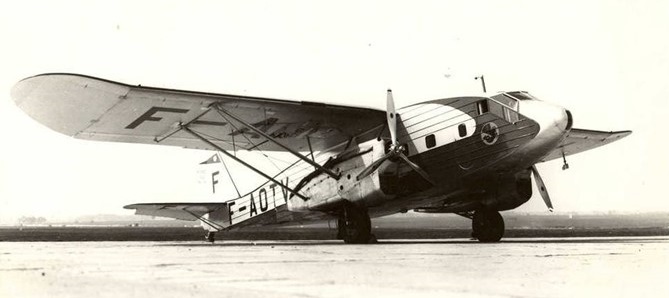
Operators were Air France, the Free French Air Force, and LARES of Romania.
Potez 62
Engines: 2 x Gnome-Rhone 14Kirs Mistral Major, 870 hp / 649kW
Wingspan: 22.45 m / 74 ft 8 in
Wing area: 76.0 sq.m / 818.06 sq ft
Length: 17.32 m / 57 ft 10 in
Height: 3.9 m / 13 ft 10 in
Max take-off weight: 7500 kg / 16535 lb
Empty weight: 4,000 kg (8,800 lb)
Loaded weight: 4895 kg / 10792 lb
Max. speed: 325 km/h / 202 mph
Cruise speed: 280 km/h (151 knots, 174 mph) at 2,000 m (7,500 ft)
Service ceiling: 7500 m / 24600 ft
Range: 1000 km / 621 miles / 540 nmi
Crew: 3
Capacity: 14-16 passengers
Potez 620
Engines: 2 x PD Gnome-Rhone 14Kirs, 820 hp
Wingspan: 22.45 m
Wing area: 76.00 sq.m
Length: 17.32 m
Height: 3.90 m
Empty weight: 4895 kg
Normal takeoff weight: 7500 kg
Maximum speed: 325 km / h
Cruising speed: 280 km / h
Practical range: 1000 km
Service ceiling: 7400 m
Crew: 2
Payload: 16 passengers
Potez 650
Engines: 1 × Hispano-Suiza 12Xgrs1 liquid-cooled V-12 piston engine, 540 kW (720 hp) (right hand rotation)
1 × Hispano-Suiza 12Xhrs1 liquid-cooled V-12 piston engine, 540 kW (720 hp) (left hand rotation)
Wingspan: 22.45 m (73 ft 8 in)
Wing area: 76 sq.m (820 sq ft)
Length: 17.32 m (56 ft 10 in)
Height: 3.9 m (12 ft 10 in)
Max takeoff weight: 7,500 kg (16,535 lb)
Empty weight: 4,632 kg (10,212 lb)
Maximum speed: 300 km/h (186 mph; 162 kn) at 2,000 m (6,600 ft)
Cruising speed: 250 km/h (155 mph; 135 kn) at 2,000 m (6,600 ft)
Range: 1,200 km (746 mi; 648 nmi)
Potez 60 Sauterelle
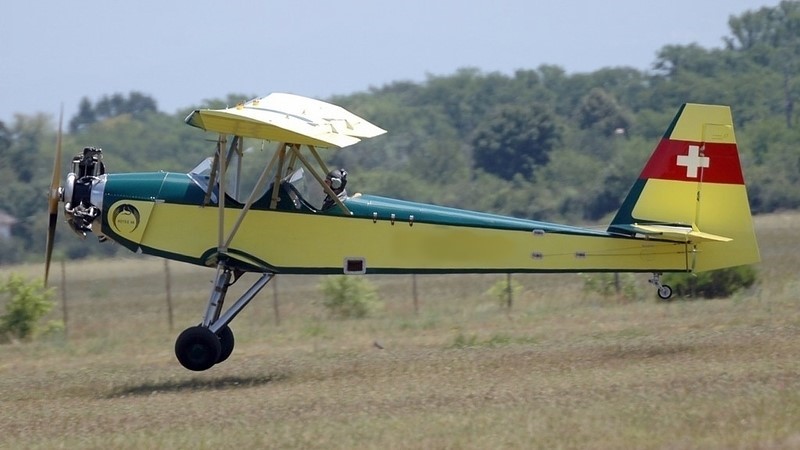
The Potez 60 sometimes named the Sauterelle (“Grasshopper”) is a French 1930s parasol-wing open-cockpit trainer. The Potez 60 is essentially made of wood and covered in linen.
The fuselage is made up of two plywood side panels, assembled on frames. Wooden fins allow the attachment of fairly wide track landing gear, in order to reduce the risk of a “wooden horse” by inexperienced pilots and to facilitate access to the front station.
The construction of the wing is in three panels around two wooden spars, mounted on tubular steel masts. Some Potez 60s had slats mounted on the leading edge. The empennage is wooden too; its size and shape have been slightly modified from the prototype.
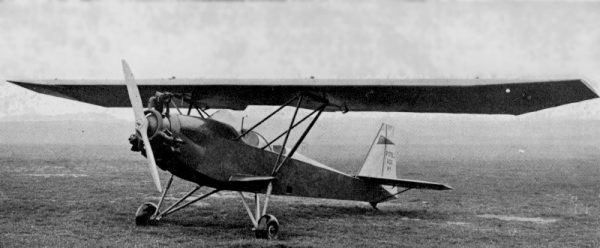
The undercarriage is made of steel tubing with Potez or Messier type rubber dampers or its equivalent. Some aircraft had no brakes, others had cable brakes.
It had a wide-track tailwheel landing gear and is powered by a 45 kW (60 hp) Potez 3B uncowled radial engine.
The Potez 3B engine fitted to the Potez 60 was “one half” of the 6Ba fitted to the Potez 43. As a result, these engines have many parts in common. The 3B engine proved to be reliable, but it requires quite intensive maintenance, especially of the rocker arms, whose lubrication system is quite special.
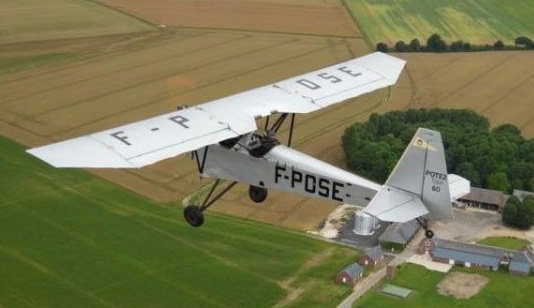
Test pilot René Labouchère took off the Potez 60 for the first time in Méaulte on August 8, 1934. In December, the aircraft was presented in Villacoublay by Georges Detré to the STIAé, the powerful state body mandated to control any French aircraft. Detré gave a brilliant presentation, meant to demonstrate the aircraft’s docility and ease of piloting.
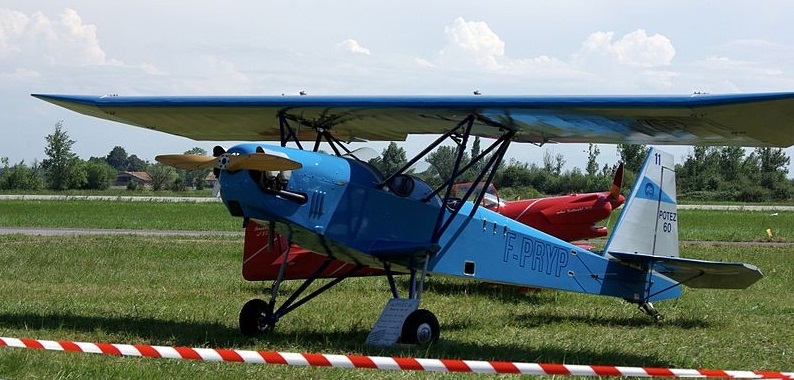
One additional machine was modified in 1948 to take a 75 hp Minie 4DC-30 engine and was referred to as the Potez 60/48.
An order for 250 was placed by the French government, but deliveries stopped after 155 aircraft were produced. On the first models, even the propeller was made by Potez – the Potez 121. Afterwards, several other brands were approved.
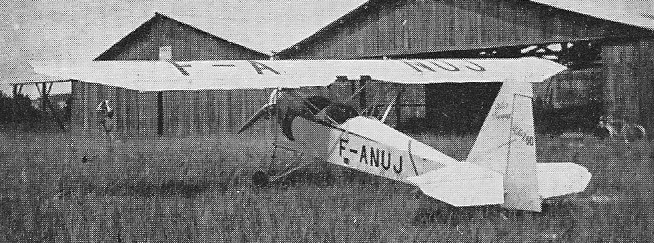
Powerplant: 1 × Potez 3B radial engine, 45 kW (60 hp)
Wingspan: 10 m (32 ft 9.75 in)
Empty weight: 629 lb
Length: 22 ft 10 in
Height: 7 ft 8 in
Loaded weight: 1232 lb
Maximum speed: 145 km/h (90 mph, 78 kn)
Time to 1640 ft: 3 min 45 sec
Ceiling: 3000 m / 9840 ft
Range: 720 km / 404 mi
Crew: 2
Potez 60/48
Engine: 75 hp Minie 4DC-30
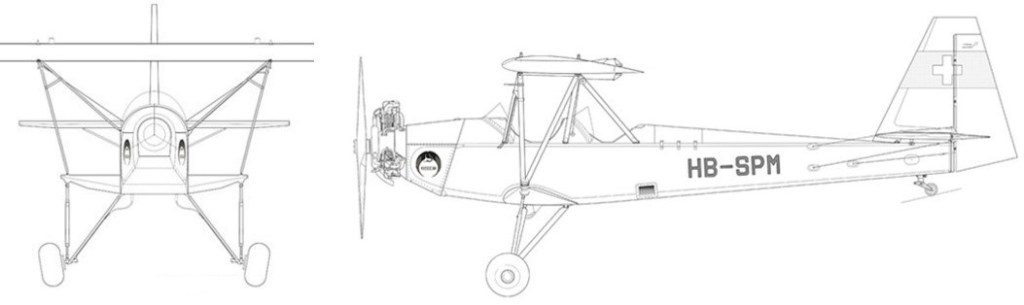
Potez 58 / 580 / 581 / 582 / 583 / 584 / 595
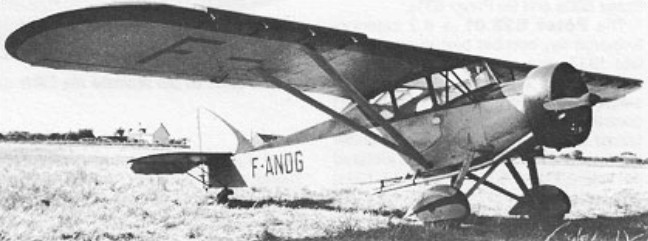
Ultimate development in the series of high-wing monoplane tourers which began with the Potez 36, the Potez 58 prototype first flew in September 1934. Like its immediate predecessor, the Potez 43, it had accommodation for a pilot and two passengers. The wing retained its Vee-strut bracing, leading-edge slats and folding capability, but the wing root was enlarged, the fuselage and tail unit design further refined, and the divided landing gear strengthened and equipped with spatted wheel fairings as standard.
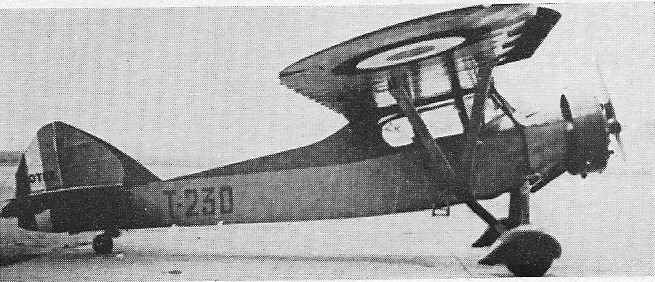
Potez 584
Engine: de Havilland Gipsy Major, 120 hp
Seats: 3
Potez 585
Engine: 1 x Potez 6Ba radial piston engine, 97kW
Max take-off weight: 906 kg / 1997 lb
Loaded weight: 515 kg / 1135 lb
Wingspan: 11.3 m / 37 ft 1 in
Length: 7.44 m / 24 ft 5 in
Height: 2.36 m / 8 ft 9 in
Wing area: 19.0 sq.m / 204.51 sq ft
Max. speed: 190 km/h / 118 mph
Cruise speed: 160 km/h / 99 mph
Range: 750 km / 466 miles
 All Aero