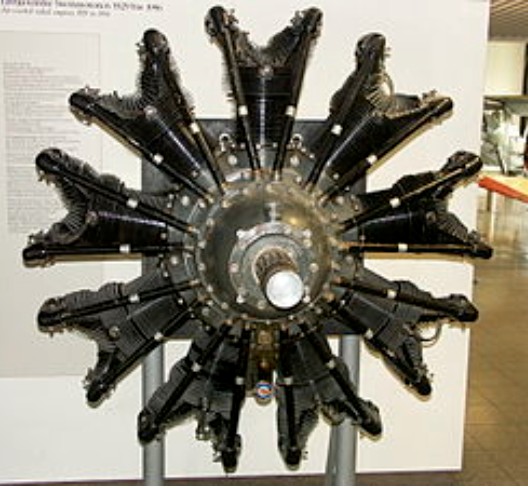
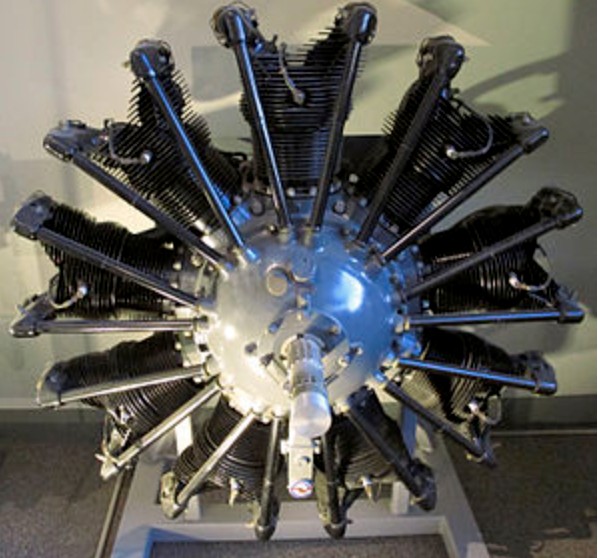
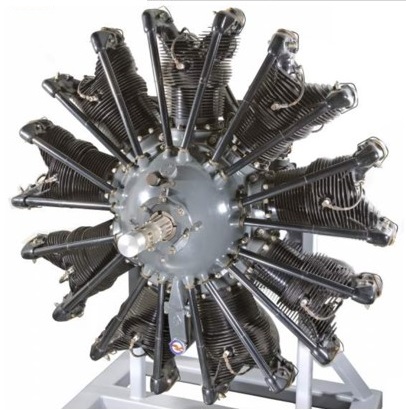
First run in June 1926, the Pratt & Whitney R-1690 Hornet was a widely used aircraft engine. It was a single-row, 9-cylinder air-cooled radial design. Displacement was 1,690 cubic inches (27.7 L).
The master connecting rod has a solid instead of detachable cap big end for higher crank speeds. The single throw two-pice crahkshaft is divided into a forward and rear section. The crankpin is integral with the forward section which transmits power to the propeller hub carried by it. The rear section telescopes into the crankpin and is carried completely through it. The two sections are united by a through bolt and kept in the proper angular relation by splines.
The main crankcase of forged aluminium is divided into two similar sections in the plane of the cylinder and united by nine through bolts between the cylinders as well as by the cylinder flanges.
All valve operating parts are enclosed. The rocker arms are supported by ball bearings and are mounted in the rocker housings which are part of the cylinder head. The push rods are enclosed by telescopic covers held in place by springs.
Every Pratt & Whitney engine is provided with a General Electric rotary induction fan used to provide proper mixture distribution. With suitable gear ratio it is possible for certain specialised purposes to provide a reasonable amount of supercharging without additional weight or complication.
All the accessories are grouped at the rear of the engine protected by the cowling.
On geared engines a 2:1 propeller speed reduction is provided by a geared unit of patented Pratt & Whitney design, weighing 840 lb.
It first flew in 1927. Developed by Pratt & Whitney, 2,944 were produced from 1926 through 1942.
It was built under licence in Italy as the Fiat A.59. In Germany, the BMW 132 was a developed version of this engine.
The R-1860 Hornet B was an enlarged version produced from 1929.
Variants: R-1690-3 525 hp (392 kW), 625 hp (466 kW)
R-1690-5 525 hp (392 kW)
R-1690-B 575 hp (429 kW)
R-1690-11 600 hp (450 kW), 775 hp (578 kW)
R-1690-S5D1G 700 hp (522 kW)
R-1690-52 750 hp (559 kW)
R-1690-SDG
R-1690-S1EG 750 hp (559 kW)
R-1690-S2EG
R-1690-25 850 hp (634 kW)
R-1690-S1C3G 1,050 hp (780 kW)
Fiat A.59 R. Licence built in Italy with reduction gearing.
Fiat A.59 R.C. Licence built in Italy with reduction gearing and supercharger.
BMW Hornet Licence production of the Hornet in Germany, independently developed as the BMW 132.
Applications: Bach Air Yacht Bellanca 31-40 Boeing 80 Boeing Model 95 Boeing 221 Boeing Model 299 Burnelli UB-14 Douglas O-38 Fokker F.32 Junkers Ju-52 Junkers Ju 86 Junkers W 34 Keystone B-3 Lockheed Model 14 Super Electra (L-14H) Lockheed Lodestar (C-56A, C-56B, C-56C, C-56D, C-56E, C-59/Mk 1a) Martin XB-14 Vought O2U Corsair Sikorsky S-42 Sikorsky S-43 Wedell-Williams Model 44
Specifications:
Hornet A-1 Type: 9 cylinder fixed radial, air cooled Military Rating: 525 hp at 1900 rpm Commercial Rating direct: 525 hp at 1900 rpm Commercial Rating geared: 500 hp at 1900 rpm Displacement: 1690 cu.in Compression ratio: 5-1 Bore: 6.125 in Stroke: 6.375 in Length: 44 7/8 in Diameter: 55 7/16 in Weight: 775 lb Fuel consumption: not more than .55 lb/hp/hr Oil consumption: not more than .035 lb/hp/hr Lubrication: Pressure (gear pump) 75-100 lb Ignition: Scintilla, dual Carburation: Stromberg, 2 bbls. Starter: Eclipse Spark plugs: Eclipse Price Series A: $8500 Price Series A.G: $9500
R-1690 SIE-G Type: Nine-cylinder single-row supercharged air-cooled radial engine Bore: 6 1⁄8 in (155.6 mm) Stroke: 6 3⁄8 in (161.9 mm) Displacement: 1,690.5 in³ (27.7 l) Length: 50.98 in (1,295 mm) Diameter: 54.41 in (1,382 mm) Dry weight: 1,014 lb (460 kg) Valvetrain: Pushrod-actuated Supercharger: Single-speed centrifugal type supercharger, 12.0:1 gear ratio Fuel system: Two-barrel Stromberg carburetor Fuel type: 87 octane rating gasoline Cooling system: Air-cooled Reduction gear: Epicyclic gearing, 2:3 Power output: 789 hp (589 kW) at 2,300 rpm for takeoff 740 hp (552 kW) at 2,250 rpm at 7,000 ft (2,135 m) Specific power: 0.47 hp/in³ (21.26 kW/l) Compression ratio: 6.0:1 Specific fuel consumption: 0.6 lb/(hp•h) (362 g/(kW/h)) Oil consumption: 0.42 oz/(hp•h) (16 g/(kW/h)) Power-to-weight ratio: 0.78 hp/lb (1.28 kW/kg)
The Pratt & Whitney R-1535 Twin Wasp Junior was an engine used in American aircraft in the 1930s. The engine was first introduced in 1932 as a 14 cylinder version of the 9-cylinder R-985. It was a two-row, air-cooled radial design. Displacement was 1,535 in³ (25.2 lt); bore and stroke were both 5-3/16 in (131.8 mm).
Variants: R-1535-11 – 750 hp (559 kW) R-1535-13 – 750 hp (559 kW), 825 hp (615 kW) R-1535-44 – 625 hp (466 kW) R-1535-72 – 650 hp (485 kW) R-1535-94 – 825 hp (615 kW) R-1535-96 – 825 hp (615 kW) R-1535-98 – 700 hp (521 kW) R-1535-SB4-G – 825 hp (615 kW)
Applications: Bellanca 28-70 Breguet 695 Curtiss SBC-3 Helldiver Douglas O-46 Fokker D.XXI (Finnish licence-built series 4 and 5) Grumman F2F Hughes H-1 Racer Miles Master Northrop A-17 Northrop BT Vought SBU Corsair Vought SB2U Vindicator
Specifications: R-1535-SB4-G Type: Fourteen-cylinder two-row supercharged air-cooled radial engine Bore: 5 3⁄16 in (131.8 mm) Stroke: 5 3⁄16 in (131.8 mm) Displacement: 1,534.9 in³ (25.153 l) Length: 53.27 in (1,353 mm) Diameter: 44.13 in (1,121 mm) Dry weight: 1,087 lb (493 kg) Valvetrain: Two overhead valves per cylinder Supercharger: Single-speed centrifugal type supercharger, 11:1 reduction Fuel system: Two-barrel Stromberg carburetor Fuel type: 87 octane rating gasoline Cooling system: Air-cooled Reduction gear: Epicyclic gearing, 0.75:1 Power output: 825 hp (615 kW) at 2,625 rpm for takeoff Specific power: 0.54 hp/in³ (24.45 kW/l) Compression ratio: 6.75:1 Specific fuel consumption: 0.49 lb/(hp•h) (295 g/(kW•h)) Oil consumption: 0.39 oz/(hp•h) (15 g/(kW•h)) Power-to-weight ratio: 0.76 hp/lb (1.25 kW/kg)
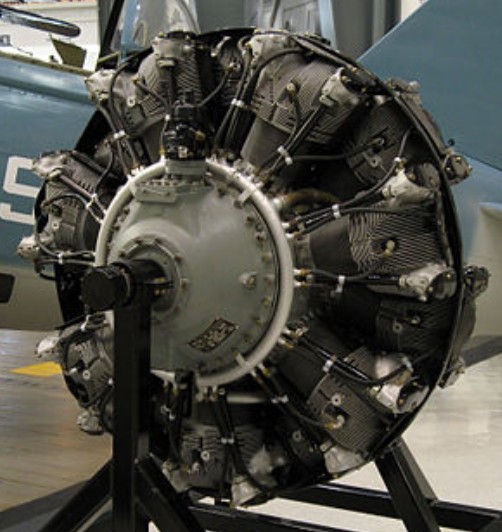
The Pratt & Whitney R-1340 Wasp was a radial aircraft engine that was widely used in American aircraft from the 1920s onward. It was the Pratt & Whitney aircraft companys first engine, and the first of the famed Wasp series. It was a single-row, nine-cylinder, air-cooled, radial design, and displaced 1,344 cubic inches (22 L); bore and stroke were both 5.75 in (146 mm).
The first Wasp was finished on 17 December 1929. Rear-mounted accessories included Scintilla magnetos, Stromberg carburettor, fuel and oil pumps. A started and generator were optional. The prototype never flew and is preserved in the Smithsonian collection. The cost to the Navy was $15,385.92.
Flight tests were conducted in several Navy types, one being Boeing’s Model 69, designated F2B-1.
Within sixty days, fifteen engines a month were being delivered to the Navy’s initial order for 200 engines, at $7,730.00 each.
The Wasp C featured a solid master connecting rod and two piece crankshaft. The master connecting rod has a solid instead of detachable cap big end allowing higher crank speeds. The single throw two-pice crankshaft is divided into a forward and rear section. The crankpin is integral with the forward section which transmits power to the propeller hub carried by it. The rear section telescopes into the crankpin and is carried completely through it. The two sections are united by a through bolt and kept in the proper angular relation by splines.
The main crankcase of forged aluminium is divided into two similar sections in the plane of the cylinder and united by nine through bolts between the cylinders as well as by the cylinder flanges.
All valve operating parts are enclosed. The rocker arms are supported by ball bearings and are mounted in the rocker housings which are part of the cylinder head. The push rods are enclosed by telescopic covers held in place by springs.
Pratt & Whitney Wasp A Serial Number 1, (R-1340), Radial 9 Engine at the National Air and Space Museum.
After taking delivery of the prototype Wright XF3W-1, the Navy installed the Pratt & Whitney Wasp number two. The Wright XF3W-1 was the first airplane to fly with a Pratt & Whitney Wasp engine.
Every Pratt & Whitney engine is provided with a General Electric rotary induction fan used to provide proper mixture distribution. With suitable gear ratio it is possible for certain specialised purposes to provide a reasonable amount of supercharging without additional weight or complication.
All the accessories are grouped at the rear of the engine protected by the cowling.
On geared engines a 2:1 propeller speed reduction is provided by a geared unit of patented Pratt & whiney design, weighing 775 lb.
First run on 29 December 1925, a total of 34,966 engines were produced.
Variants: R-1340-7: 450 hp (336 kW), 600 hp (447 kW) R-1340-8: 425 hp (317 kW) R-1340-9: 450 hp (336 kW), 525 hp (391 kW) R-1340-16: 550 hp (410 kW) R-1340-17: 525 hp (391 kW) R-1340-19: 600 hp (447 kW) R-1340-19F: 600 hp (447 kW) R-1340-21G: 550 hp (410 kW) R-1340-22: 550 hp (410 kW) R-1340-23: 575 hp (429 kW) R-1340-30: 550 hp (410 kW) R-1340-31: 550 hp (410 kW) R-1340-33: 600 hp (447 kW) R-1340-48: 600 hp (447 kW) R-1340-49: 600 hp (447 kW) R-1340-AN1: 550 hp (410 kW), 600 hp (447 kW) R-1340-AN2: 550 hp (410 kW), 3:2 geared prop shaft R-1340-B: 450 hp (336 kW) R-1340-D: 500 hp (373 kW) R-1340-S1H1-G: 550 hp (410 kW), 600 (447 kW) R-1340-S3H1: 600 hp (447 kW)
Applications: Agusta-Bell AB.102 Air Tractor AT-301 Air Tractor AT-401 Ayres Thrush Bach Air Yacht Boeing Model 40A Boeing 247 Boeing F3B Boeing F4B Boeing P-12 Boeing P-26 Peashooter Boeing P-29 CAC Ceres CAC Wirraway Curtiss Falcon Curtiss F7C Seahawk Curtiss O-52 Curtiss P-6S Hawk Curtiss SOC Seagull de Havilland Canada DHC-3 Otter Douglas Dolphin Fairchild FB-3 Fokker F.10 Fokker F.32 Ford Trimotor Gee Bee R-1 Gee Bee R-2 Super Sportster Gee Bee R 1/2 Super Sportster Gee Bee Z Gee Bee QED Grumman Mallard Grumman Ag Cat Howard DGA-6 Junkers W 34 Junkers Ju 52 Knoll Aircraft Company KN-3 Kaman HH-43 Huskie Lockheed Vega Lockheed Model 8 Sirius Lockheed Model 9 Orion Lockheed Model 10-C & 10-E Electra Lockheed XC-35 Loening OL-8 Noorduyn Norseman North American BC-1 North American T-6/SNJ Texan/Harvard Northrop Alpha Northrop C-19 Alpha Scottish Aviation Twin Pioneer Sikorsky H-19 Sikorsky S-38 Thomas-Morse XP-13A Viper Vought O2U Corsair Wedell-Williams Model 45 Westland Whirlwind (helicopter)
Specifications:
Original Wasp Bore: 5.75 in Stroke: 5.75 in Displacement: 1300 cu.in Compression: 5.25-1 Power: 400 hp at 1900 rpm Dry weight: 650 lb
Wasp A Nine-cylinder radial direct-drive Supercharged Air-cooled Displacement: 1,343.8-cubic-inch / 22.021 lt Compression ratio: 5.25:1 Power rating: 410 hp at 1,900 rpm at SL Fuel: 58 octane gasoline Length: 3 ft 6.63 in / 1.083 m Diameter: 4 ft 3.44 in / 1.307 m Weight: 745 lb / 338 kg
Wasp C Type: 9 cylinder fixed radial, air cooled Military Rating: 450 hp at 2100 rpm Commercial Rating Direct: 420 hp at 2000 rpm Commercial Rating Geared: 420 hp at 2100 rpm Displacement: 1344 cu.in Compression ratio: 5.24-1 Bore: 5 3/4 in Stroke: 5 3/4 in Length: 42 9/16 in Diameter: 51 1/2 in Weight: 695 lb Fuel consumption: not more than .55 lb/hp/hr Oil consumption: not more than .035 lb/hp/hr Lubrication: Pressure (gear pump) 75-100 lb Ignition: Scintilla, dual Carburation: Stromberg, 2 bbls Starter: Eclipse Spark plugs: B.G. Price Series C: $7200 Price Series C.G: $8200
R-1340-S1H1-G Type: Nine-cylinder single-row supercharged air-cooled radial engine Bore: 5.75 in (146 mm) Stroke: 5.75 in (146 mm) Displacement: 1,344 in3 (22 L) Diameter: 51.75 in (1.314 m) Dry weight: 930 lb (422 kg) Valvetrain: Two overhead valves per cylinder Supercharger: Single-speed centrifugal type supercharger, 1:10 step-up Fuel system: Two-barrel Stromberg carburetor Fuel type: 91 octane rating gasoline Cooling system: Air-cooled Reduction gear: 3:2 Power output: 600 hp (447 kW) at 2,250 rpm at 6,200 ft (1,890 m) Specific power: 0.45 hp/in³ (20.3 kW/L) Compression ratio: 6:1 Power-to-weight ratio: 0.65 hp/lb (1.05 kW/kg)
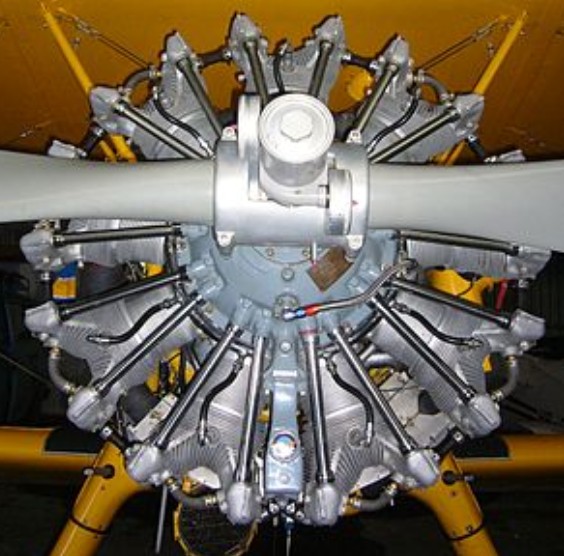
Pratt & Whitney developed the R-985 Wasp Junior as a smaller version of the R-1340 Wasp to compete in the market for medium-sized aircraft engines. Like its larger brother, the Wasp Junior was an air-cooled nine-cylinder radial, with its power boosted by a gear-driven single-speed centrifugal supercharger. Its cylinders were smaller, however, with a bore and stroke of 5 3⁄16 in (132 mm), giving a 27% lesser total displacement. The Wasp Junior used many parts from the Wasp and even had the same mounting dimensions, allowing an aircraft to easily use either the smaller or the larger engine. The first run of the Wasp Junior was in 1929, and sales began in 1930. The initial version, the Wasp Junior A, produced 300 hp (224 kW).
The U.S. military designated the Wasp Junior as the R-985, with various suffixes denoting different military engine models. However, Pratt & Whitney never adopted the R-985 designation scheme for its civil Wasp Juniors, identifying them simply by name and model (e.g. “Wasp Junior A”).
Pratt & Whitney followed the Wasp Junior A with more powerful models in the “A series”. These had higher compression ratios, greater RPM limits, and more effective supercharging, and they led to the “B series”. The first B series model was the Wasp Junior TB, which could maintain 420 hp (313 kW) at sea level and could reach 440 hp (328 kW) for takeoff. The TB was tuned for best performance at sea level; it was soon joined by the Wasp Junior SB, which was tuned for best performance at altitude and could sustain 400 hp (298 kW) at altitudes up to 5,000 ft (1,500 m), with 450 hp (336 kW) available for takeoff. A still later model, the Wasp Junior T1B2, had improved performance at low level, being able to sustain 450 hp (336 kW) up to 1,500 ft (460 m) while still matching the SB’s power at high altitudes. The SB and T1B2, and later versions of these with similar performance, were the most popular Wasp Junior models. One later development of the T1B2, the Wasp Junior B4, was especially designed for vertical mounting in helicopters.
During the mid-1930s, Pratt & Whitney developed a still greater improvement of the Wasp Junior, the “C series”, with an even higher compression ratio and RPM limit. The only type produced in this series, the Wasp Junior SC-G, could sustain 525 hp (391 kW) at an altitude of 9,500 ft (2,900 m) and could produce 600 hp (447 kW) for takeoff. It also included reduction gearing to allow the high-revving engine to drive a propeller at suitable speeds, hence the “-G” suffix. Aviator Jacqueline Cochran flew a special Model D-17W Beechcraft Staggerwing with this engine in 1937, setting a speed and altitude record and placing third in the Bendix transcontinental race. However, the SC-G never got past the experimental stage.
Early versions of the Wasp Junior were used in various small civil and military utility aircraft, but only in limited numbers. The type became more popular later in the 1930s. It was selected for the Lockheed Model 10A Electra twin-engined airliner, as well as for other small twin-engined civil transports like the Lockheed Model 12A Electra Junior, the Beechcraft Model 18, and the Grumman Goose amphibian. It was also used in single-engined civil utility aircraft like the Beechcraft Staggerwing, the Howard DGA-15, and the Spartan Executive.
As World War II arrived, the U.S. military chose the Wasp Junior for the Vultee BT-13 Valiant and North American BT-14 basic training aircraft and for the Vought OS2U Kingfisher observation floatplane. Military versions of existing Wasp-Junior-powered civil aircraft were also produced, such as the military derivatives of the Beech 18, Beech Staggerwing, Grumman Goose, and Howard DGA-15. The Wasp Junior also powered some versions of the British Avro Anson and Airspeed Oxford twin-engine trainers. The demands of World War II led to the production of many thousands of Wasp Juniors.
Up until the end of the war, the Wasp Junior’s closest competitor was Wright Aeronautical’s R-975 Whirlwind. However, during the war, the Wasp Junior was far more widely used in aircraft than the R-975, and Wright ceased production of the R-975 in 1945.
After World War II, many military-surplus aircraft with Wasp Junior engines entered the civil market. Production of the Beech 18 with the Wasp Junior engine continued until 1970. New designs based on the Wasp Junior were also introduced, such as the Sikorsky H-5 helicopter, the de Havilland Beaver and Max Holste Broussard bush airplanes, and agricultural aircraft like the Snow S-2B and S-2C, Grumman Ag Cat, and Weatherley 201.
Pratt & Whitney ceased production of the Wasp Junior in 1953, having built 39,037 engines.
Pratt & Whitney 450 hp DHC-2 Beaver Starting one entails pulling the prop through nine blades to make sure no engine oil had seeped past the rings of the lower cylinders: if you didn’t take this precaution, a hydraulic effect in the cylinders could result, bending the conrods. You then primed the engine with a few pumps on a pump just inside the cockpit door. Then you pumped the engine ‘wobbly pump’ to get the fuel up to the carburettor, flicked on the master switch, adjusted the mixture lever to full rich, pumped the throttle two or three times and adjust it to a point just above the stop, flicked another switch to crank the engine over (which produces a loud whine), and after five blade rotations, switched on both magnetos. The engine would then commence backfiring loudly. By then, you were watching to ensure the oil pressure was coming up. With luck, pressure was in the green zone on the gauges by the time the detonations from the engine had smoothed. The oil was to warm up to atleast 40 degreess C.
Applications: Air Tractor AT-300 Avro Anson (Mk V) Barkley-Grow T8P-1 Beechcraft Model 18 and military derivatives Beechcraft Staggerwing D17S, D17W, G17S Bell XV-3 Bellanca 300-W Berliner-Joyce OJ Boeing-Stearman Model 75 (in aftermarket conversions) Bratukhin G-3 CAC Winjeel de Havilland Canada DHC-2 Beaver and L-20/U-6 military versions Douglas C-26 Dolphin Fleetwings BT-12 Grumman G-164 Ag Cat (some models) Grumman G-21 Goose Howard DGA-11 Howard DGA-15P Koolhoven F.K.51 (some models) Lockheed Model 10-A Electra Lockheed Model 12-A Electra Junior Max Holste MH.1521 Broussard McDonnell XHJH Whirlaway North American BT-14 PWS-24bis Seversky BT-8 Sikorsky H-5 helicopter (and S-51 civil version) Sikorsky S-39 amphibian Snow S-2B and S-2C Spartan Executive 7W Stinson Reliant SR-9F and SR-10F Vought OS2U Kingfisher Vultee BT-13 Valiant Waco S3HD Waco SRE Aristocrat Weatherly 201 series Weatherly 620
Specifications:
Wasp Jr. A R-985-1 U.S. military version First production version. Power, continuous: 300 hp (224 kW) at 2,000 RPM sea level Power, takeoff: 300 hp (224 kW) at 2,000 RPM Compression ratio: 5.0:1 Supercharger gear ratio: 7:1 Octane rating: 68 Dry weight: 565 lb (256 kg)
Wasp Jr. TB, TB2 R-985-9, -11, -11A, -21, -46 U.S. military versions Early B-series versions rated for sea-level performance. Power, continuous: 420 hp (313 kW) at 2,200 RPM sea level Power, takeoff: 440 hp (328 kW) at 2,300 RPM Compression ratio: 6.0:1 Supercharger gear ratio: 8:1 Octane rating: 80 Dry weight: 640 lb (290 kg)
Wasp Jr. SB, SB2, SB3 R-985-13, -17, -23, -33, -48, -50; R-985-AN-2, -4, -6, -6B, -8, -10, -12, -12B, -14B U.S. military versions Common B-series versions rated for performance at altitude. Type: 9-cylinder supercharged air-cooled radial piston engine Power, continuous: 400 hp (298 kW) at 2,200 RPM 5,000 ft (1,500 m) Power, takeoff: 450 hp (336 kW) at 2,300 RPM Bore: 5 3⁄16 in (132 mm) Stroke: 5 3⁄16 in (132 mm) Displacement: 985 cu in (16.14 L) Length: 41.59 in (1,056 mm) Diameter: 45.75 in (1,162 mm) Compression ratio: 6.0:1 Supercharger: Single-speed gear-driven General Electric centrifugal supercharger, with impeller driven at 10 times crankshaft speed Octane rating: 80/87 aviation gasoline Dry weight: 640 lb (290 kg) ComponentsValvetrain: Two overhead valves per cylinder, pushrod-actuated Reduction gear: Direct drive Specific power: 0.406 hp/cu.in (18.5 kW/lt) Power-to-weight ratio: 0.625 hp/lb (1.03 kW/kg)
Wasp Jr. T1B2, T1B3 R-985-25, -27, -39, -39A; R-985-AN-1, -1A, -3, -3A U.S. military versions Common B-series versions with improved sea-level performance. Power, continuous: 450 hp (336 kW) at 2,300 RPM 1,500 ft (460 m) Power, takeoff: 450 hp (336 kW) at 2,300 RPM Compression ratio: 6.0:1 Supercharger gear ratio: 10:1 Octane rating: 80/87 Dry weight: 653 lb (296 kg)
Wasp Jr. B4 R-985-AN-5, -7 U.S. military versions Vertically mounted development of T1B3, for helicopters. Power, continuous: 450 hp (336 kW) at 2,300 RPM 2,300 ft (700 m) Power, takeoff: 450 hp (336 kW) at 2,300 RPM Compression ratio: 6.0:1 Supercharger gear ratio: 10:1 Octane rating: 80/87 Dry weight: 684 lb (310 kg)
Wasp Jr. SC-G Experimental high-powered version with propeller reduction gearing. Power, continuous: 525 hp (391 kW) at 2,700 RPM 9,500 ft (2,900 m) Power, takeoff: 600 hp (447 kW) at 2,850 RPM Compression ratio: 6.7:1 Supercharger gear ratio: 10:1 Octane rating: 100 Dry weight: 864 lb (392 kg)
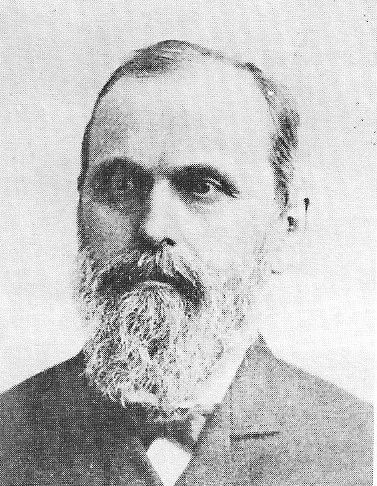
In 1925, Frederick Rentschler established the Pratt & Whitney Aircraft Company in Hartford, and Connecticut. Former president of the Wright Aeronautical Corporation of New Jersey, Rentschler was an astute businessman and visionary. Rentschler believed that the future of aviation lay in aircraft capable of carrying a large number of passengers’ great distances at ever-faster speeds. To do so required a more reliable, more powerful aircraft engine than was currently available, and this was where Rentschler focused his energies.
Pratt
Whitney
Within a year, Rentschler and his team had designed the air-cooled, radial Wasp engine, which together with its successor, the Hornet, provided increased power and reliability at a low relative weight. Both engines proved extremely successful. By 1929, Pratt & Whitney Aircraft had outgrown its Capitol Avenue plant in Hartford, and Rentschler moved the company to new headquarters on a 1,100-acre site in East Hartford, which included room for further expansion and an airfield to flight test his engines. Pratt & Whitney Aircraft was on its way to becoming one of the state’s largest employers.
Air power played a significant role in the Allied victory during World War II, and Pratt & Whitney Aircraft supplied much of that power. By the end of the war, Pratt & Whitney Aircraft had produced more than 350,000 engines for military use – more in number than any other American manufacturer and, in total horsepower, one half that of America’s combat air forces. In the meantime, Pratt & Whitney Aircraft became a division of the United Aircraft Corporation, which also manufactured the latest in aviation technology, the helicopter, invented by Igor Sikorsky in 1939.
During the post-war decades, Pratt & Whitney Aircraft continued to manufacture aircraft engines for commercial use and was also involved in the development of jet engines. During the 1950s, when government optimism in the peaceful uses of nuclear power was at its peak, Pratt & Whitney even investigated the possibility of using nuclear power in commercial aircraft at its Connecticut Aircraft Nuclear Engine Laboratory in Middletown.
The Praga D was a four-cylinder, air-cooled, horizontally opposed aircraft engine first produced in Czechoslovakia in 1936 but which enjoyed its greatest success after World War II due to the explosion in popularity of sports flying. A version for helicopters was produced post WWII as the Praga DH.
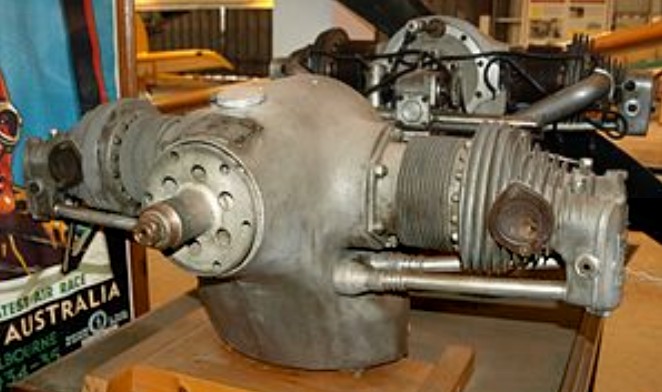
The Praga B2 was a low powered air-cooled flat twin aero engine suitable for very light aircraft. Dating from the mid-1930s, it was manufactured by Praga, Ceskomoravska-Kolben-Danek Co., Czechoslovakia.
The Praga B2 was a dual ignition, air-cooled horizontal twin producing 40 horsepower (30 kW) aimed at lightweight aircraft. It was a higher compression version (6.7:1 from the earlier 5.72:1) of the original and otherwise very similar Praga B, which provided 36 hp (27 kW). Its cylinders were machined from alloy steel forgings and had aluminium alloy heads. The pistons were of aluminium alloy, with three compression rings and one scraper ring. The connecting rods were of nitrided steel, with divided big ends and bronze bushes at the little ends. The one piece crankshaft was also formed from nitrided steel and had two main roller bearings and a single ball thrust bearing. The single piece crankcase was cast from an aluminium alloy.
135 units in all, including B and B2 variants were built. Jowett Cars Ltd. of Idle, Bradford in the UK obtained a licence in 1936 to build the Praga B engine, for installation into the licence built Hillson Praga. Immediately after the end of World War II the Praga B2 was on display at the 1946 Paris Air Show.
Specifications: B2 Type: 2-cylinder horizontally opposed Bore: 105 mm (4.13 in) Stroke: 110 mm (4.49 in) Displacement: 1.906 L (116 cu in ) Length: 610 mm (24.0 in) Width: 854 mm (33.6 in) Height: 515 mm (20.3 in) Dry weight: 48 kg (106 lb) (with airscrew hub) Valvetrain: Two alloy steel valves per cylinder at 50°, aluminium-nickel-bronze valve seats. Two ball bearings to each rocker arm, grease gun lubricated in oil tight rocker-box. Push-rods and tappets in aluminium sleeves. Fuel system: Zenith 42M, mixture passing through sump in pipe to avoid condensation. Two BTH magnetos supplying two plugs/cylinder. Oil system: Integral with 4.5 L (7.9 pt) sump. Pressure and scavenge pumps, filtered; pressure feed to big and little ends. Cooling system: Air-cooled, finned cylinders Reduction gear: Direct, right hand tractor. Power output: 31.1 kW (41.7 hp) at 2,440 rpm Specific power: 16.3 kW/L (0.36 hp/cu in) Compression ratio: 6.7:1 Fuel consumption: at 2,440 rpm 9.38 kg/h (20.68 1b/h) Specific fuel consumption: 0.225 kg/hp/h (0.495 lb/hp/h) Oil consumption: 0.2-0.3 kg/hp/h (0.44-0.66 lb/hp/h) Power-to-weight ratio: 0.65 kW/kg (0.4 hp/lb)
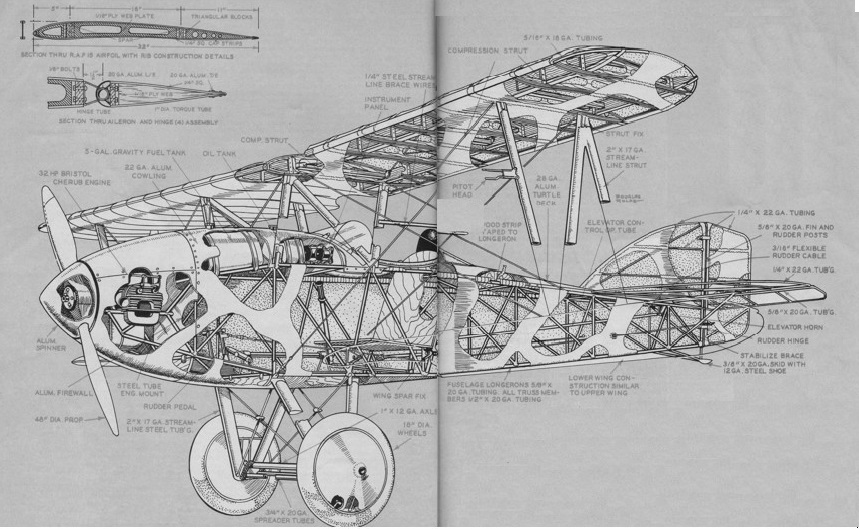
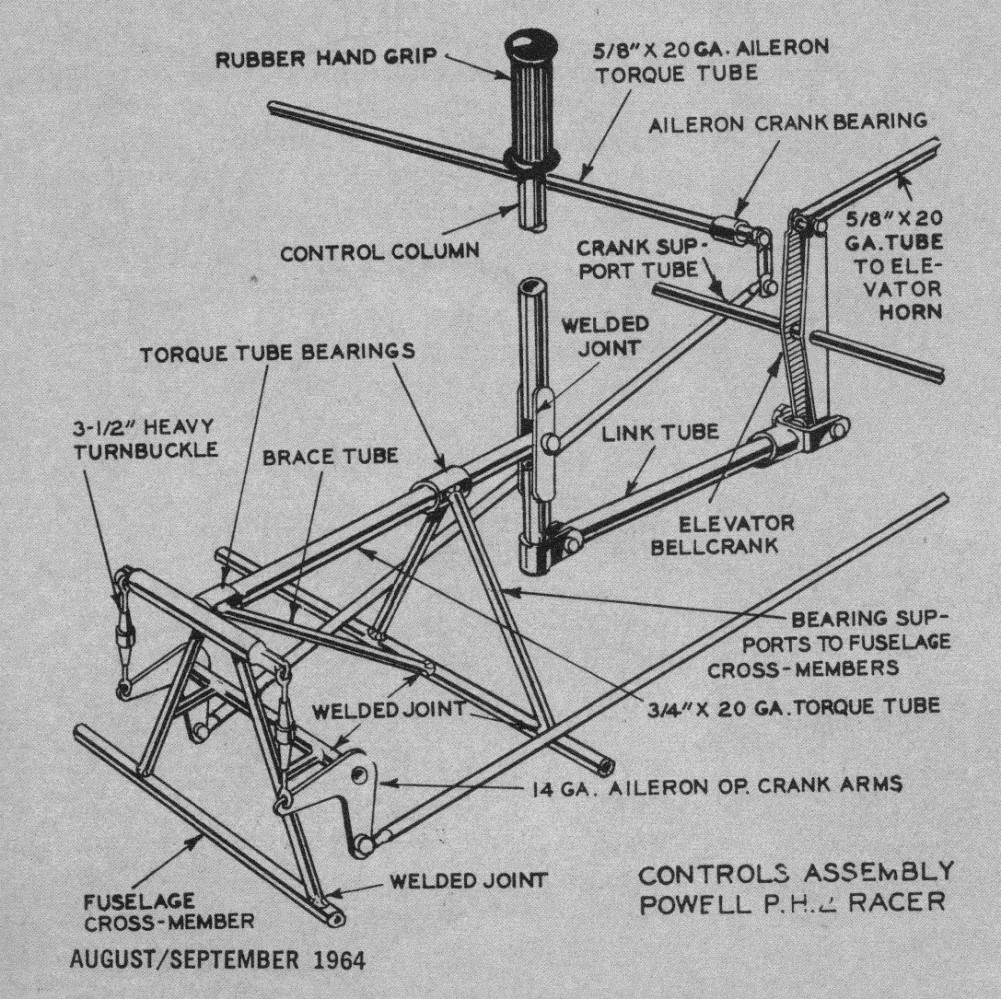
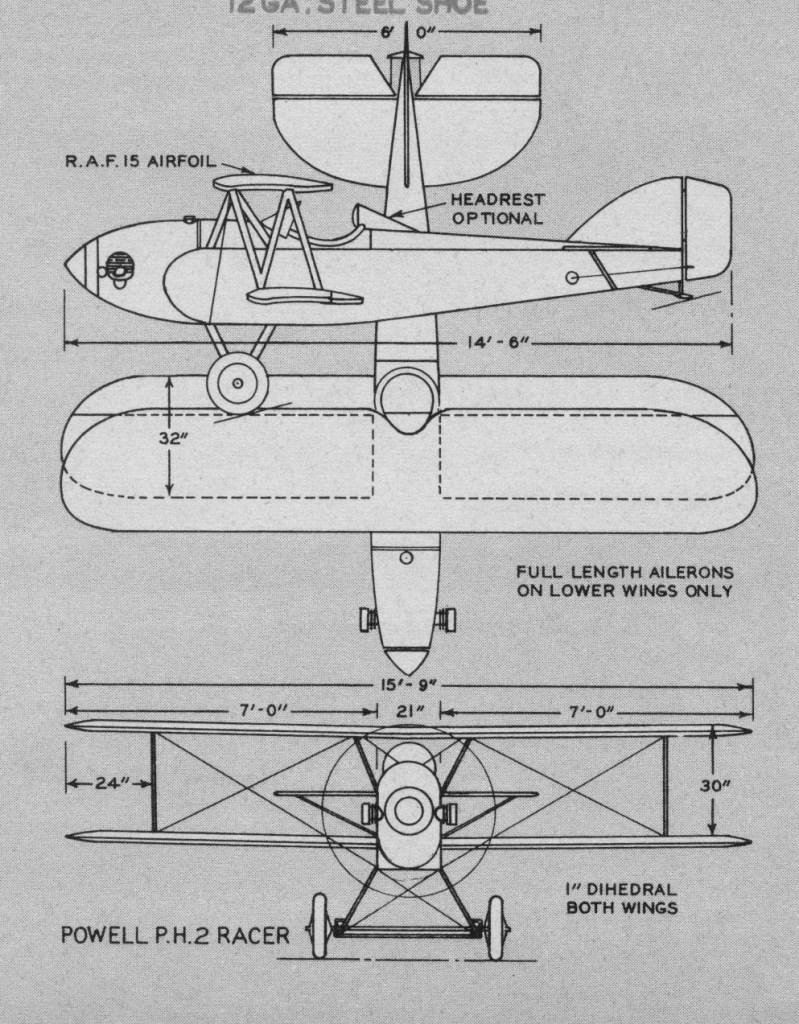
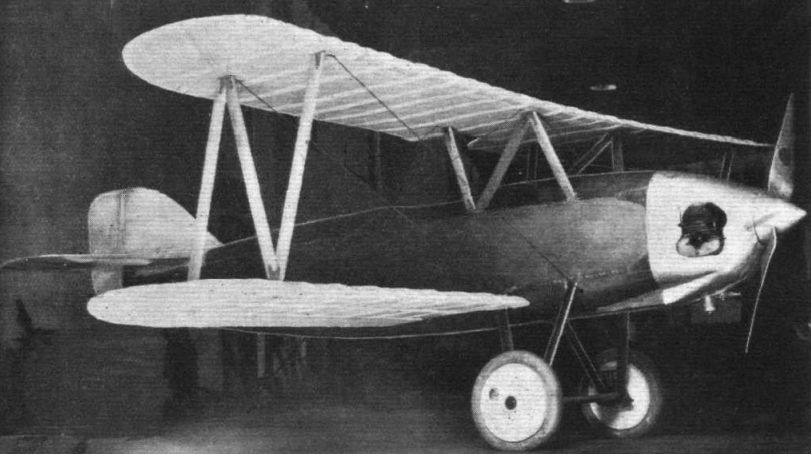
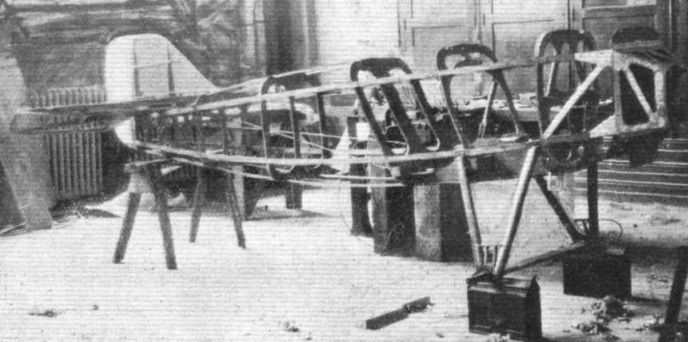
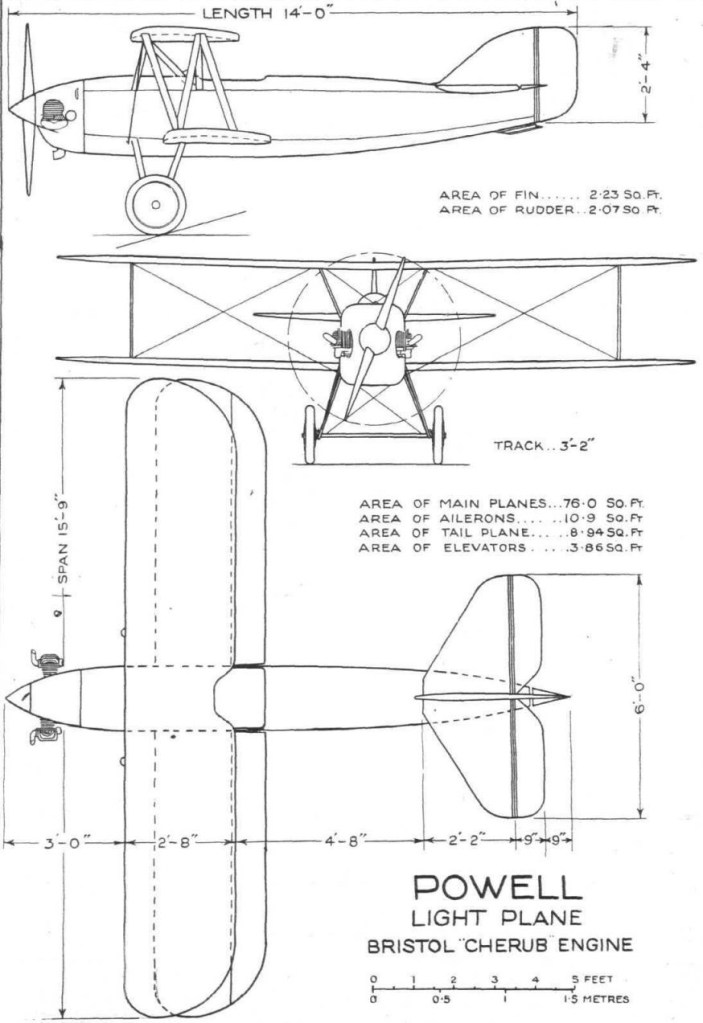
Designed by Professor C.H. Powell, teacher at the Aeronautics Department of the University of Detroit, the PH.2 was an equal span biplane with welded steel tube fuselage and tail surfaces, appearing in 1923.
The wings have routed spruce beams with 1/16in ply ribs and 1/4in square cap strips. Streamline steel tubing was employed fir the interplane struts and the landing gear struts. Wing and landing bracing was 1/4in streamline steel wire. The engine was a Bristol Cherub.
Possibly only two were built although detailed plans were available.
Engine: Bristol Cherub, 32 hp Wingspan: 15 ft 9 in Length: 14 ft 6 in Height: 5 ft 3 in Stagger: 9.5 in Chord: 32 in Incidence: 0 deg Max speed: 85 mph Cruise: 75 mph Landing speed: 32 mph
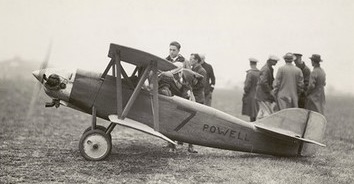
The Powell PH Racer was designed by Professor C.H. Powell, teacher at the Aeronautics Department of the University of Detroit.
The biplane racer used an all wood fuselage with birch paneling. The wing spars were also wood with fabric covering. Uniquely, the aileron hinges were made of leather.
The Powell PH Racer was a 1920s air racer which holds the distinction of having won all of the races it entered.
Race Winnings: 1925 National Air Races piloted by Jerry V. Dack of Dayton, Ohio Aero Digest Trophy (Dack) The Dayton Daily News Trophy The Scientific American Trophy
The Powell Racer was returned to the University of Detroit where it was destroyed in static load tests.
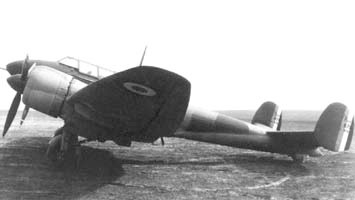
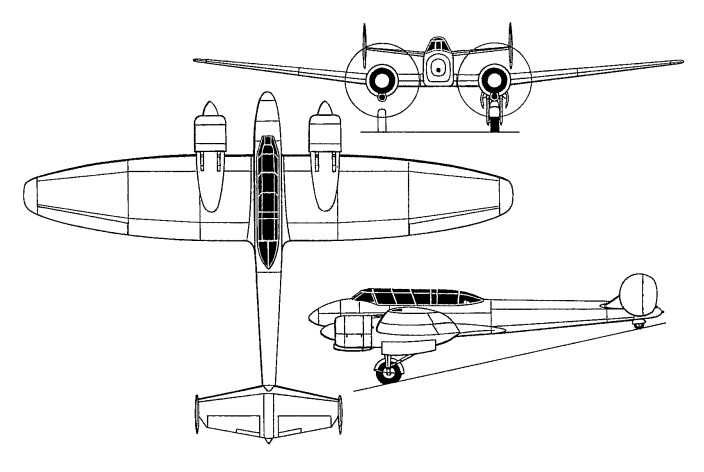
Designed to meet a requirement for a three-seat fighter with an endurance of three hours at 90% max speed, the Potez 670 was configurationally similar to the Potez 630 and 631. Flown for the first time on 30 March 1939, the Potez 670 had meanwhile been modified as a two-seat long-range escort fighter and bomber destroyer.
Potez 670
Initially powered by two 700hp Gnome- Rhone 14M radials, it was re-engined after initial flight trials with two 800hp Hispano-Suiza 14AB 12/13 radials, with which it resumed flight tests in July 1939 as the Potez 671.
Potez 671
Several production variants were proposed, but flight trials were incomplete at the time of the French collapse and the sole prototype was destroyed during the German onslaught. At the time, work had begun on an initial batch of 40 Potez 671 C2 fighters.
Potez 670 Engines: 2 x Gnome & Rhone 14M-3, 700 hp Wingspan: 15.10 m Wing area: 32.50 sq.m Length: 10.80 m Height: 3.27 m Empty weight: 3120 kg Maximum take-off weight: 4680 kg Maximum speed: 460 km / h Cruising speed: 412 km / h Practical range: 1800 km Service ceiling: 10,000 m Crew: 2 Armament: 2 x 20-mm cannon Hispano-Suiza HS-404 front, 2 x 7.5-mm machine guns MAC 1934, 1 x 20-mm cannon Hispano-Suiza HS-404 rear-firing turret
Potez 671 Engines: 2 x Hispano-Suiza 14AC, 800 hp Wingspan: 15.10 m / 50 ft 6 in Wing area: 32.50 sq.m / 349.83 sq ft Length: 10.80 m / 35 ft 5 in Height: 3.27 m / 11 ft 9 in Max take-off weight: 4726 kg / 10419 lb Empty weight: 3186 kg / 7024 lb Max. speed: 500 km/h / 311 mph Cruising speed: 445 km / h Maximum rate of climb: 876 m / min Service ceiling: 10,500 m Range: 2000 km / 1243 miles Crew: 2 Armament: 2 x 20-mm cannon Hispano-Suiza HS-404 front, 2 x 7.5-mm machine guns MAC 1934, 1 x 20-mm cannon Hispano-Suiza HS-404 rear-firing turret



 All Aero