c.1925
(Clarence O) Prest Airplane Supply
Arlington CA
USA
1929:
Prest Airplane & Motor Co.
c.1925
(Clarence O) Prest Airplane Supply
Arlington CA
USA
1929:
Prest Airplane & Motor Co.
Predappio sa, a division of the Caproni Group, produced two trainers in the late 1930s, the Ca.602 two-seat biplane and a single-seat aerobatic version, the Ca.603, both powered by Alfa-Romeo in-line engines.
Italy
Predappio sa, a division of the Caproni Group, produced two trainers in the late 1930s, the Ca.602 two-seat biplane and a single-seat aerobatic version, the Ca.603, both powered by Alfa-Romeo in-line engines.
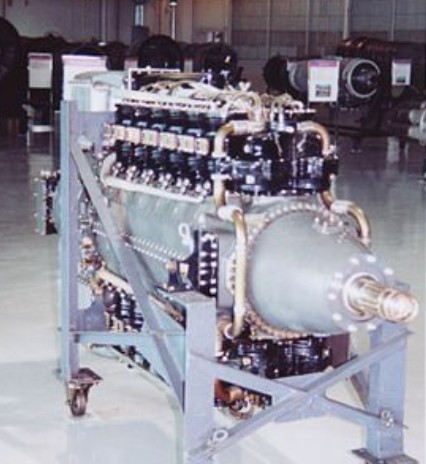
The Pratt & Whitney X-1800 (later enlarged as the XH-2600) was an H-block aircraft engine project developed between 1938 and 1940, which was cancelled with only one example being built.
The X-1800 was a watercooled 24-cylinder H-block of 2,240 cu.in displacement; this was later expanded to 2,600 cu.in displacement. It was intended to be used in the Vultee XP-54, Curtiss-Wright XP-55 Ascender, Northrop XP-56, and Lockheed XP-49. Projected performance was to be 1,800 to 2,200 hp (1350-1640 kW), with a turbocharger to secure high-altitude performance. The designation came from the intended power rating rather than the more usual cubic inch engine displacement figure.
The target date for series production was 1942. In 1940, however, performance on the test bench did not continue to improve, demonstrating a need for considerable additional development effort. Pratt & Whitney subsequently ended development of the X-1800 in October 1940, with only one built, to concentrate on radial engines.
Specifications:
X-1800
Type: 24 cylinder H-engine
Bore: 5.25in (133.35mm)
Stroke: 5.00in (127mm)
Displacement: 2,597.7 cu in (42.57L)
Length: 107in (2.71m)
Dry weight: 2,400lb (1,089kg)
Valvetrain: Sleeve valves
Power output: 1,800 – 2,000 hp
The Pratt & Whitney XH-3130 (sometimes called the XL-3130) was an H-block aircraft engine project developed for the United States Navy in the late 1930s. The design was later enlarged as the XH-3730), but the project was canceled in 1940 in favor of Pratt & Whitney developing the R-4360 Wasp Major air-cooled radial engine.
Type: 24 cylinder H-engine
Bore: 6.00in (152.4mm)
Stroke: 5.50in (139.7mm)
Displacement: 3,732.2 cu in (61.16L)
Valvetrain: Sleeve valves
Power output: 2,900 hp
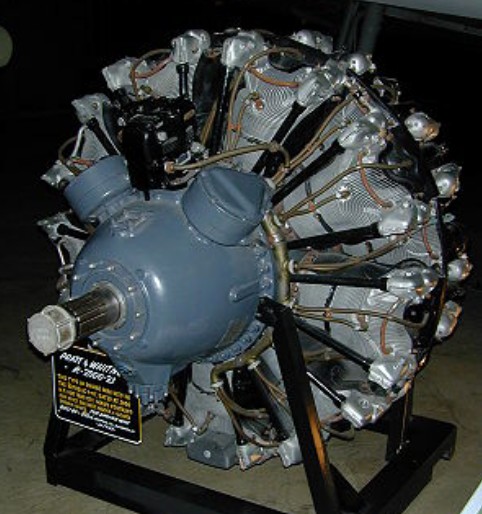
First run in 1937, the R-2800 was America’s first 18-cylinder radial engine design. The Double Wasp was more powerful than the world’s only other modern eighteen, the Gnome-Rhône 18L; which itself was even larger than the contemporary American Wright Duplex-Cyclone radial of 3,347 cu.in (54.86 lt) then under development, but the Double Wasp was much smaller in displacement than either of the other 18-cylinder designs, and heat dissipation was a greater problem. To enable more efficient cooling, the usual practice of casting or forging the cylinder head cooling fins that had been effective enough for other engine designs was discarded, and instead, much thinner and closer-pitched cooling fins were machined from the solid metal of the head forging. The fins were all cut at the same time by a gang of milling saws, automatically guided as it fed across the head in such a way that the bottom of the grooves rose and fell to make the roots of the fins follow the contour of the head, with the elaborate process substantially increasing the surface area of the fins. Cylinder cooling was effected by aluminum cooling muffs that were shrunk onto the steel alloy forged barrels. In addition to requiring a new cylinder head design, the Double Wasp was probably the most difficult to effectively direct a flow of cooling air around.
Pratt & Whitney R-2800 Double Wasp Article
The twin ignition magnetos on the Double Wasp were prominently mounted on the upper surface of the forward gear reduction housing and almost always prominently visible within a cowling, with the driveshafts for the magnetos emerging from the gear reduction case either directly forward or directly behind the magneto’s cases, or on the later C-series R-2800s with the two-piece gear reduction housings, on the “outboard” sides of the magneto casings.
When the R-2800 was introduced in 1939 it was capable of producing 2,000 hp (1,500 kW), for a specific power value of 0.71 hp/cu.in (32.6 kW/L). In 1941 the power output of production models increased to 2,100 hp (1,600 kW), and to 2,400 hp (1,800 kW) late in the war. However, even more was coaxed from experimental models, with fan-cooled subtypes producing 2,800 hp (2,100 kW), but in general the R-2800 was a rather highly developed powerplant right from the beginning.
The R-2800 was used to power several types of fighters and medium bombers during the war, notably the US Navy’s Vought F4U Corsair, with the XF4U-1 first prototype Corsair becoming the first-ever airframe to fly with the Double Wasp on May 29, 1940, and the first single-engine US fighter plane to exceed 400 mph (640 km/h) in level flight during October 1940. The R-2800 also powered the Corsair’s naval rival, the Grumman F6F Hellcat, the US Army Air Forces’ Republic P-47 Thunderbolt, the twin-engined Martin B-26 Marauder and Douglas A-26 Invader, as well as the first purpose-built twin-engined radar-equipped night fighter, the Northrop P-61 Black Widow.
When the US entered the war in December 1941, some major changes in American military aviation engine design and manufacturing philosophy rapidly emerged, with such long-established engines as the Wright Cyclone and Double Wasp being re-rated on fuel of much higher octane rating (anti-knock value) to give considerably more power. By 1944, versions of the R-2800 powering late-model P-47s (and other aircraft) had a rating (experimental) of 2,800 hp on 115-grade fuel with water injection.
After World War II, the engine was used in the Korean War, and surplus World War II aircraft powered by the Double Wasp served with other countries well past the Korean War, some being retired as late as the latter part of the 1960s when the aircraft were replaced.
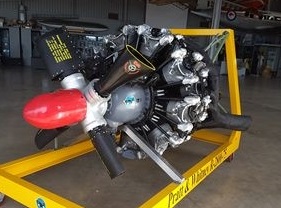
A major war demands the utmost performance from engines fitted to aircraft whose life in front-line service was unlikely to exceed 50 hours’ flying, over a period of only a month or two. In peacetime however, the call was for reliability over a period of perhaps a dozen years, and the R-2800’s reliability commended its use for long-range patrol aircraft and for the Douglas DC-6, Martin 4-0-4, and Convair transports. This last application is noteworthy, since these were twin-engined aircraft of size, passenger capacity, and high wing loading comparable with the DC-4 and the first Constellations.
A total of 125,334 R-2800 engines were produced between 1939 and 1960.
Variants:
Power ratings quoted are usually maximum “military” power that the engine could generate on takeoff and at altitude: 100 Octane fuel was used, unless otherwise noted.
The R-2800 was developed and modified into a basic sequence of subtypes, “A” through “E” series, each of which indicated major internal and external modifications and improvements, such that the “E” series engines had very few parts in common with the “A”.
Note: Suffixes such as -S14A-G denote engines developed for export to other countries.
The dash number for each military type (e.g.: -21) was allocated to identify the complete engine model in accordance with the specification under which the engine was manufactured, thus it did not necessarily indicate the sequence in which the engines were manufactured; for example: the -18W was a “C” series engine, built from 1945, whereas the -21 was a “B” series engine, built from 1943.
Until 1940 the armed forces adhered strictly to the convention that engines built for the Army Air Force used odd dash numbers (e.g.: -5), while those built for the US Navy used even (e.g.: -8). After 1940, however, in the interests of standardization, engines were sometimes built to a joint Army-Navy contract, in which case the engines used a common dash number (e.g.: the -10 was used by both Army and Naval aircraft.)
The suffix W e.g.: -10W denotes a sub-series modified to use A.D.I Anti-Detonant Injection or water injection equipment, using various mixes of water and methyl alcohol (CH3OH) injected into the carburetor to increase power for short periods: several models of R-2800s were fitted as standard with A.D.I and did not use the W suffix. Few commercial aircraft used water injection.
“A” Series:
R-2800-1
1,500 hp (1,118 kW) at 2,400 rpm at 7,500 ft (2,286 m). Production prototype of “A” series engines with the first flight test July 29, 1939. Single-speed two-stage supercharger. Production = 2 (P&W). Tested in Vultee YA-19B.
R-2800-5
1,850 hp (1,379 kW) at 2,600 rpm at 2,700 ft (823 m). Main production “A” series engine used in Douglas B-23 Dragon, Martin B-26A, early B series and XB-26D and Curtiss C-55/XC-46. Production = 1,429 (P&W 475, Ford 954.)
“B” Series:
The A and B series can be most readily identified by their smooth, single piece nose casings.
R-2800-8
2,000 hp (1,491 kW) at 2,700 rpm at 1,000 ft (305 m); 1,800 (1,342 kW) at 2,700 rpm at 15,500 ft (4,724 m). First series production “B” Series engine using a two-stage, two-speed supercharger and with internal engineering changes resulting in increased power and reliability. Updraft Bendix-Stromberg PT-13D-4 pressure carburetor. First production engines delivered to U.S.N November 11, 1941. Used in Brewster F3A-1, Goodyear FG-1, Vought F4U-1 and F4U-2. Production = 3,903 (P&W 2,194; Nash 1,709.)
R-2800-8W
2,250 hp (1,677 kW) WEP with water injection. First production engine using ADI equipment, major production version of -8 and used in same versions of F4U Corsair. Production = 8,668 (P&W 5,574; Nash 3,094.)
R-2800-10 and R-2800-10W
2,000 hp (1,491 kW) at 2,700 rpm at 1,000 ft (305 m); 1,800 (1,342 kW) at 2,700 rpm at 15,500 ft (4,724 m); up to 2,250 hp (1,677 kW) WEP with water injection. Similar to -8 series apart from downdraft PT-13G2-10 and PT-13G6-10 (-10W) carburetor. Used in Curtiss XP-60E, Grumman F6F-3 (-10; late production -10W) and F6F-5 (-10W) series and Northrop XP-61, YP-61, and P-61A-1. Production = 4,621 -10 (P&W 2,931; Nash 1,690) and 12,940 -10W (P&W 3,040; Nash 9,900); Total = 17,561.
R-2800-21
2,000 hp (1,491 kW) at 2,700 rpm at 2,500 ft (762 m); 2,000 hp (1,491 kW) at 2,700 rpm at 25,000 ft (7,620 m). First production variant fed by a General Electric C-1 turbosupercharger. Designed for use in the Republic P-47B, C, D, G and XP-47F and K. Production = 5,720 (P&W 1,049; Ford 4,671.)
R-2800-59
2,000 hp (1,491 kW) at 2,700 rpm at 2,500 ft (762 m); 2,000 hp (1,491 kW) at 2,500 rpm at 25,000 ft (7,620 m); 2,300 hp (1,700 kW) WEP with water injection. Main production variant used in P-47 series, fed by an improved C-23 turbosupercharger. Differed from -21 in being fitted with A.D.I and a General Electric ignition system with a simplified, tubular ignition harness developed by the Scinitilla company in partnership with Bendix. Used in P-47C and D, XP-47L. Production = 11,391 (P&W 592; Ford 10,799).
“C” Series
R-2800-18W
2,100 hp (1,566 kW) at 2,800 rpm at 1,000 ft (305 m); 1,800 hp (1,342 kW) at 2,800 rpm at 25,500 ft (7,772 m). First series production variant of the “C” Series, which was a complete redesign of the R-2800. Some of the main changes were forged, rather than cast cylinders, allowing an increased compression ratio (from 6.65:1 to 6.75:1), a redesigned crankshaft, a single piece, rather than split crankcase center section, and a two section nose casing, incorporating hydraulically operated torque-monitoring equipment and an automatic, vacuum operated spark-advance unit. The supercharger used fluid coupling for the second stage. Updraft Bendix-Stromberg PT-13G2-10 carburetor. Used in Vought F4U-4 and -4 variants. Production = 3,257 (P&W).
R-2800-22W – 2,400 hp (1,789 kW)
R-2800-27 – 2,000 hp (1,491 kW)
R-2800-30W – 2,250 hp (1,677 kW)
R-2800-31 – 2,000 hp (1,491 kW)
R-2800-32(E) – 2,450 hp (1,827 kW), 2,850 hp (2,125 kW) with water-methanol injection
R-2800-34 – 2,100 hp (1,567 kW)
R-2800-34W – 2,400 hp (1,789 kW)
R-2800-39 – 2,000 hp (1,491 kW)
R-2800-41 – 2,000 hp (1,491 kW)
R-2800-43 – 2,000 hp (1,491 kW)
R-2800-44 – 2,300 hp (1,700 kW)
R-2800-44W – 2,400 hp (1,789 kW)
R-2800-48 – 2,500 hp (1,890 kW)
R-2800-48W – 2,400 hp (1,789 kW)
R-2800-51 – 2,000 hp (1,491 kW)
R-2800-54 – 2,100 hp (1,567 kW)
R-2800-57 – 2,800 hp (2,090 kW)
R-2800-57C – 2,800 hp (2,090 kW)
R-2800-59W – 2,500 hp (1,890 kW)
R-2800-65 – 2,000 hp (1,491 kW)
R-2800-65W – 2,250 hp (1,677 kW)
R-2800-71 – 2,000 hp (1,491 kW)
R-2800-73 – 2,800 hp (2,090 kW)
R-2800-75 – 2,200 hp (1,640 kW)
R-2800-77 – 2,800 hp (2,090 kW)
R-2800-79 – 2,000 hp (,1491 kW)
R-2800-83 – 2,100 hp (1,567 kW)
R-2800-83AM – 2,100 hp (1,567 kW)
R-2800-99W – 2,300 hp (1,700 kW)
R-2800-103W – 2,500 hp (1,890 kW)
R-2800-2SB-G – 1,850 hp (1,379 kW)
R-2800-CB16 – 2,400 hp (1,789 kW), 2,500 hp (1,890 kW)
R-2800-CB17 – 2,500 hp (1,890 kW)
R-2800-S1A4-G – 1,850 hp (1,379 kW)
R-2800-S1C3-G – 2,100 hp (1,567 kW)
Applications:
Brewster XA-32
Breguet Deux-Ponts
Canadair CL-215
Canadair C-5 North Star
Consolidated TBY Sea Wolf
Convair 240, 340, and 440
Curtiss P-60
Curtiss XF15C
Curtiss C-46 Commando
Douglas A-26 Invader
Douglas DC-6
Fairchild C-82 Packet
Fairchild C-123 Provider
Grumman AF Guardian
Grumman F6F Hellcat
Grumman F7F Tigercat
Grumman F8F Bearcat
Howard 500
Lockheed Ventura/B-34 Lexington/PV-1 Ventura/PV-2 Harpoon
Lockheed XC-69E Constellation
Martin B-26 Marauder
Martin 2-0-2
Martin 4-0-4
North American AJ Savage
North American XB-28
Northrop XP-56 Black Bullet
Northrop P-61 Black Widow
Northrop F-15 Reporter
Republic P-47 Thunderbolt
Sikorsky CH-37 Mojave
Sikorsky S-60
Vickers Warwick
Vought F4U Corsair
Vultee YA-19B
Specifications:
R-2800-54
Type: 18-cylinder air-cooled twin-row radial engine with water injection
Bore: 5.75 in (146.05 mm)
Stroke: 6 in (152.4 mm)
Displacement: 2,804.5 cu.in (45.96 L)
Diameter: 52.8 in (1,342 mm)
Dry weight: 2,360 lb (1,073 kg)
Valvetrain: Poppet, two valves per cylinder
Supercharger: Variable-speed (in F8F-2, unified with throttle via AEC automatic engine control), single-stage single-speed centrifugal type supercharger
Fuel system: One Stromberg injection carburetor
Fuel type: 100/130 octane gasoline
Cooling system: Air-cooled
Power output: 2,100 hp (1,567 kW) @ 2,700 rpm
Specific power: 0.75 hp/cu.in (34.1 kW/L)
Power-to-weight ratio: 0.89 hp/lb (1.46 kW/kg)
Pratt & Whitney R-2180 was the designations for two closely related radial engines developed in the United States by Pratt & Whitney. They had two rows of seven cylinders each.
Pratt & Whitney R-2180-A Twin Hornet – first run in 1936
Pratt & Whitney R-2180-E Twin Wasp E – first run in 1945
The Pratt & Whitney R-2060 Yellow Jacket was a liquid-cooled aircraft engine project developed for the United States Army in the early 1930s. First run in 1932, the engine had five banks of four in-line cylinders, and displaced 2,060 cubic inches. Designed to produce 1,000 hp, the engine produced 1,116 hp on its final run after 35 hours of testing. The engine was cancelled in favor of continuing development of Pratt & Whitney’s air-cooled R-1830 Twin Wasp radial engine.
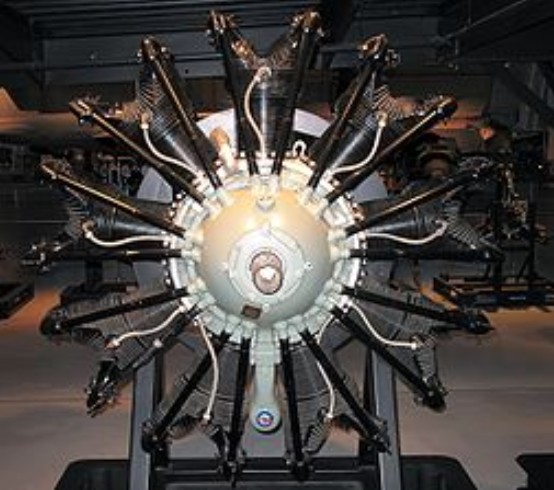
The Pratt & Whitney R-1860 Hornet B was a relatively uncommon aircraft engine, first run in 1929. It was a development of Pratt & Whitney’s earlier R-1690 Hornet and was basically similar, but enlarged in capacity from 1,690 to 1,860 cubic inches (30.5 L). Bore was increased by 1/8″ and the stroke by 3/8″. Both engines were air-cooled radial engines, with a single row of nine cylinders.
The master connecting rod has a solid instead of detachable cap big end for higher crank speeds. The single throw two-pice crahkshaft is divided into a forward and rear section. The crankpin is integral with the forward section which transmits power to the propeller hub carried by it. The rear section telescopes into the crankpin and is carried completely through it. The two sections are united by a through bolt and kept in the proper angular relation by splines.
The main crankcase of forged aluminium is divided into two similar sections in the plane of the cylinder and united by nine through bolts between the cylinders as well as by the cylinder flanges.
The cylinder and valve design was with two large valves driven by pushrods. All valve operating parts are enclosed. The rocker arms are supported by ball bearings and are mounted in the rocker housings which are part of the cylinder head. The push rods are enclosed by telescopic covers held in place by springs.
Every Pratt & Whitney engine is provided with a General Electric rotary induction fan used to provide proper mixture distribution. With suitable gear ratio it is possible for certain specialised purposes to provide a reasonable amount of supercharging without additional weight or complication.
All the accessories are grouped at the rear of the engine protected by the cowling.
On geared engines a 3:1 propeller speed reduction is provided by a geared unit of patented Pratt & whiney design, weighing 885 lb.
The enlarged engine was designed by George Willgoos and was first available in 1929.

The fourteen-cylinder Twin Wasp was more complex and costly than the nine-cylinder, single-row Hornet B. The Twin Wasp was by far the more powerful engine though, even in its early versions it produced 800 hp to the Hornet B’s 575 bhp. A further advantage was the reduced diameter of the Wasp: 48 inches compared to 57. This reduced drag, and the very large diameter of the Hornet would also have been a serious drawback for visibility if used in a small single-engined aircraft.
Although a technically competent design, the enlarged Hornet B engine was not a commercial success. Customers preferred to buy the R-1830 Twin Wasp instead, which in time became the most numerous aircraft engine ever produced.
Applications:
Bellanca C-27 Airbus
Boeing Monomail
Boeing YB-9
Consolidated Commodore
Consolidated Fleetster
Fokker F-32
Keystone B-4A
Keystone LB-8 (prototype only)
Keystone XLB-12 (engine evaluation testbed only)
Martin XT6M (prototype only)
Sikorsky S-40
Sikorsky S-41
Specifications:
Type: Nine-cylinder single-row supercharged air-cooled radial engine
Rating – direct: 575 hp / 429 kW at 1950 rpm
Rating – geared: 550 hp at 1950 rpm
Displacement: 1860 cu.in (30.54 L)
Compression ratio: 5-1
Bore: 6.25 in (158.8 mm)
Stroke: 6.75 in (171.4 mm)
Length: 44 9/16 in / 113.7 cm
Diameter: 56 3/4 in / 144.6 cm
Weight: 810 lb
Dry weight: 376.4 kg (830 lb)
Fuel consumption: not more than .55 lb/hp/hr
Oil consumption: not more than .035 lb/hp/hr
Lubrication: Pressue (gear pump) 75-100 lb
Ignition: Scintilla dual
Carburation: Stromberg, 2 bbls
Supercharger: Single-speed centrifugal type supercharger
Valvetrain: Pushrod-actuated, two valves per cylinder
Starter: Eclipse
Spark plugs: B.G.
Price Series B: $8500
Price Series B G: $9500
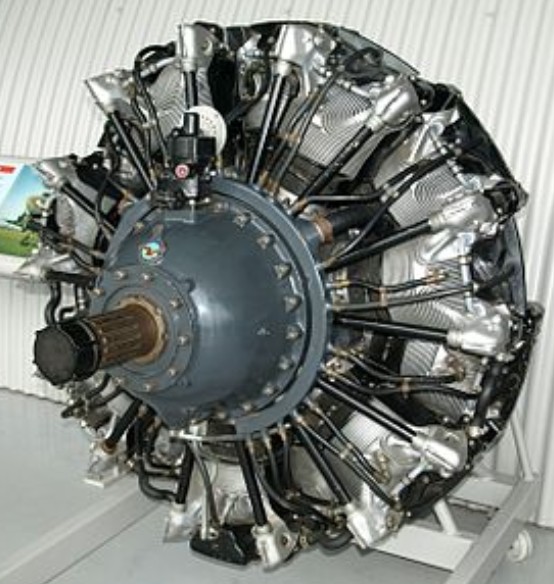
First run in 1932, the Pratt & Whitney R-1830 Twin Wasp was an American aircraft engine widely used in the 1930s and 1940s. Produced by Pratt & Whitney, it was a two-row, 14-cylinder, air-cooled radial design. It displaced 1,830 cu in (30.0 L) and its bore and stroke were both 5.5 in (140 mm). A total of 173,618 R-1830 engines was built, and from their use in two of the most-produced aircraft ever built, the B-24 bomber and DC-3 transport, more Twin Wasps may have been built than any other aviation piston engine in history. An enlarged version with a slightly higher power rating was produced as the R-2000.
Variants:
R-1830-1: 800 hp (597 kW)
R-1830-9: 850 hp (634 kW), 950 hp (708 kW)
R-1830-11: 800 hp (597 kW)
R-1830-13: 600 hp (447 kW), 900 hp (671 kW), 950 hp (708 kW), 1,050 hp (783 kW)
R-1830-17: 1,200 hp (895 kW)
R-1830-21: 1,200 hp (895 kW)
R-1830-25: 1,100 hp (820 kW)
R-1830-33: 1,200 hp (895 kW)
R-1830-35: 1,200 hp (895 kW) Fitted with GE B-2 turbosupercharger
R-1830-41: 1,200 hp (895 kW) Fitted with GE B-2 turbosupercharger
R-1830-43: 1,200 hp (895 kW)
R-1830-45: 1,050 hp (783 kW)
R-1830-49: 1,200 hp (895 kW)
R-1830-64: 850 hp (634 kW), 900 hp (671 kW)
R-1830-65: 1,200 hp (895 kW)
R-1830-66: 1,000 hp (746 kW), 1,050 hp (783 kW), 1,200 hp (895 kW)
R-1830-72: 1,050 hp (783 kW)
R-1830-76: 1,200 hp (895 kW)
R-1830-82: 1,200 hp (895 kW)
R-1830-86: 1,200 hp (895 kW)
R-1830-88: 1,200 hp (895 kW)
R-1830-90: 1,200 hp (895 kW)
R-1830-90-B: 1,200 hp (895 kW)
R-1830-92: 1,200 hp (895 kW)
R-1830-94: 1,350 hp (1,007 kW)
R-1830-S1C3-G: 1,050 hp (783 kW), 1,200 hp (895 kW)
R-1830-S3C4: 1,200 hp (895 kW)
R-1830-S3C4-G: 1,200 hp (895 kW)
R-1830-S6C3-G: 1,100 hp (820 kW)
R-1830-SC-G: 900 hp (671 kW)
R-1830-SC2-G: 900 hp (671 kW), 1,050 hp (783 kW)
R-1830-SC3-G: 1,065 hp (749 kW) Swedish unit built under license by SFA company for Finnish VL Myrsky II
Applications:
Bristol Beaufort (Australian-built production)
Bloch MB.176
Burnelli CBY-3
CAC Boomerang
CAC Woomera
Consolidated B-24 Liberator
Consolidated PBY Catalina
Consolidated PB2Y Coronado
Consolidated PB4Y Privateer
Curtiss P-36 Hawk
Douglas C-47 Skytrain
Douglas DC-3
Douglas DB-7 (early variants only)
Douglas TBD Devastator
FFVS J 22
Fokker D.XXI-4
Grumman F4F Wildcat
Lioré et Olivier LeO 453
Lisunov Li-3 – A Yugoslav version of the Soviet Lisunov Li-2
Martin Maryland
Republic P-43 Lancer
Saab 17
Saab 18
Short Sunderland V
Seversky P-35
Vickers Wellington IV
VL Myrsky
Vultee P-66 Vanguard
Specifications:
Type: Fourteen-cylinder two-row supercharged air-cooled radial engine
Bore: 5.5 in (139.7 mm)
Stroke: 5.5 in (139.7 mm)
Displacement: 1,829.4 in³ (30 l)
Length: 59.06 in (1,500 mm)
Diameter: 48.03 in (1,220 mm)
Dry weight: 1,250 lb (567 kg)
Valvetrain: Two overhead valves per cylinder
Supercharger: Single-speed General Electric centrifugal type supercharger, 1:7.15 speed increase
Fuel system: Two-barrel Stromberg carburetor
Fuel type: 95-100 octane rating gasoline
Cooling system: Air-cooled
Reduction gear: Epicyclic gearing, 2:3
Power output:
1,200 hp (895 kW) at 2,700 rpm for takeoff
700 hp (522 kW) at 2,325 rpm cruise power at 13,120 ft (4,000 m)
Specific power: 0.66 hp/in³ (29.83 kW/l)
Compression ratio: 6.7:1
Specific fuel consumption: 0.49 lb/(hp•h) (295 g/(kW•h))
Power-to-weight ratio: 0.96 hp/lb (1.58 kW/kg)
 All Aero