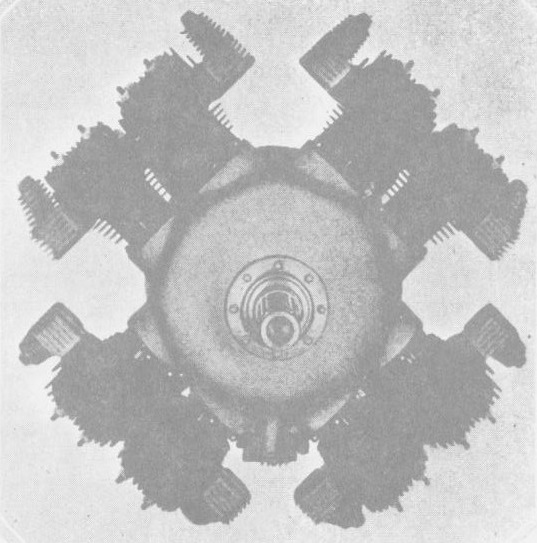
Bakewell Wing-Foot

The Bakewell Wing-Foot was a new design, constructed to be inherently balanced, permitting higher motor speeds. Gear ratios could be furnished as required.

The motor is equipped with ball bearings throughout except the connecting rod crank pin bearing which is roller, and the wrist pin connecting rod bearing is bronze.

It was found that his motor does not have a vibration point up to 4700 rpm.

The crankshafts are of three piece construction. Cylinder barrels are nitralloy steel with the bore hardened. Rocker arms being enclosed in the crankcase are continually lubricated.

Valves are operated with a single cam for each cylinder, each cam shaft being mounted on two ball bearings. Each crankshaft is mounted on three ball bearings and the propeller shaft, being straight through the motor, is mounted also on three ball bearings.

All oil lines are cast integral with the gear case sections and the oiling system is operated with two hardened gear pumps; one pump removing the oil from the sump and replacing it in the supply tank, the second taking its supply from the tank and forcing it into the propeller shaft where the oil is distributed from this point by a force fed splash systm.

The motor was covered by “Patents applied for” on many features.

Accessories available at extra cost were starter ($250), exhaust stacks ($80), and exhaust manifold (250).

Type: Geared V, radial
Commercial Rating: 160 hp at 2800 rpm motor speed, 1800 rpm prop.
Displacement: 456 cu.in
Compression ratio: 6-1
Bore: 4 in
Stroke: 4 1/2 in
Length: 32 in
Diameter: 34 in
Weight: approx. 400 lb
Fuel consumption: not more than .55 lb/hp/hr
Oil consumption: not more than .020 lb/hp/hr
Lubrication: Force feed with splash distribution
Ignition: Scintilla
Carburation: Stromberg dual
Spark plugs: 2 per cylinder
Price: $3500 less hub and starter
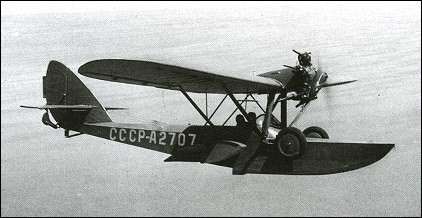
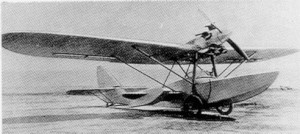
Shavrov SH-1 / SH-2

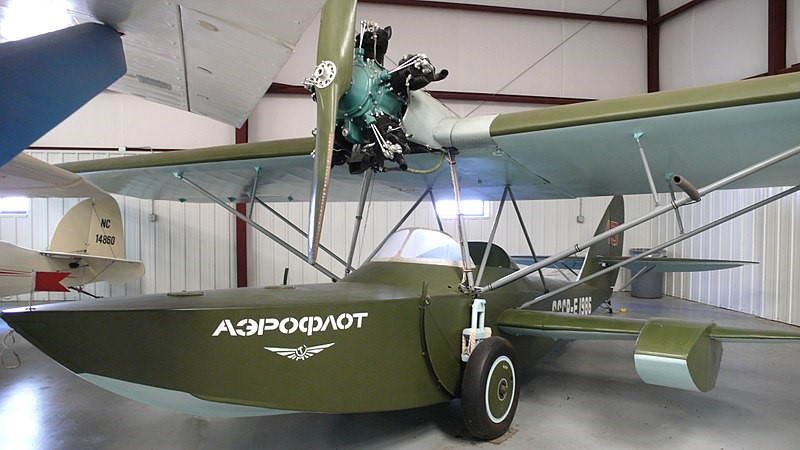
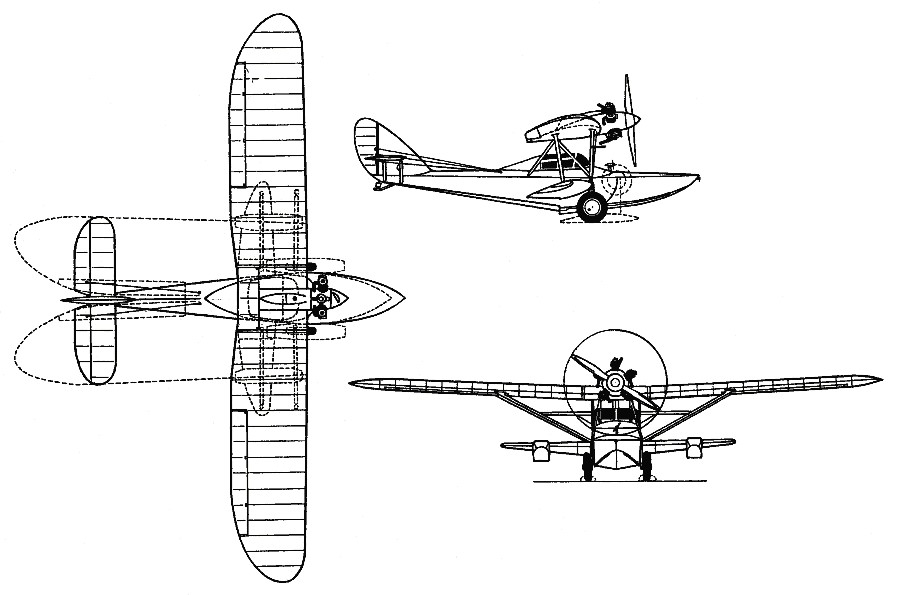
The Shavrov Sh-2 was developed from the small amphibian Sh-1 prototype design and performed its first flight on November 11, 1930, made from land. The Sh-1 remained a prototype.

The first Soviet mass-produced flying boat, the small, wooden Shavrov Sh-2 was a development of the Sh-1, with a more powerful engine and increased size.

The Sh-2 could carry two crew members as well as one passenger and during wintertime, the aircraft could be equipped with skis. The small lower wing served as attachment for the stabilizing floats. It was a light, simple and reliable design.

The Sh-2 passed State Acceptance trials for operation from water and land on June 12–17, 1934, without problems. Series productions was initiated on 1 April 1934, and ended two years later. However, due to its successful design and the popularity among its pilots, production was restarted in 1939. Total production was up to at least 700 aircraft, several hundred of those being built after 1939, possibly up to 1950.

The Sh-2 served throughout the Soviet Union as a utility transport, for liaison, and as a trainer, and for many years was used on fishery protection duties and frontier patrol work. They supported Arctic operations.

Sixteen were built under the designation Sh-2S as air ambulances carrying one or two stretcher patients.

In 1939 Aeroflot built additional Sh-2s from available spares and later the type was reinstated in production. As well as use for the civil roles indicated, the Sh-2 was flown by the V-VS as a general-purpose aircraft.

A number of later machines had a glazed crew cabin and other refinements, becoming redesignated Sh-2bis most had improved M-11L engines.

The aircraft was in service until 1964 and set a number of records among flying boats and seaplanes.

On 28 August 1942, the Finns captured two Sh-2s and pressed them into service in the liaison role, as well as carrying the Commander of the Finnish Air Force, until 1944.

One plane was constructed by cadets of Egorevsky aviation school of civil aircraft in the USSR, under the direction of teachers, during 1984-86. The plane was sold and delivered to the USA in the 1990s.

Shavrov Sh-2, at the Historic Aircraft Restoration Museum, Maryland Heights, Missouri, USA.

Shavrov SH-2
Engine: 1 × Shvetsov M-11A, 75 kW (100 hp)
Propeller: 2-bladed fixed-pitch
Wingspan upper: 13.0 m / 42 ft 8 in
Wingspan lower: 5.4 m / 17 ft 9 in
Wing area: 24.75 m² / 266 ft²
Length: 8.20 m (26 ft 11 in)
Height: 2.80 m (9 ft 2 in)
Empty weight: 680 kg (1,500 lb)
Max. takeoff weight: 937 kg / 2,065 lb Payload: 257 kg (567 lb)
Maximum speed: 140 km/h (87 mph, 76 kn)
Range: 400 km (250 mi, 220 nmi)
Service ceiling: 3,500 m (11,500 ft)
Crew: 1 pilot
Capacity 2 passengers / 257 kg / 567 lb

Sharapov-Verzilov Piervieniets

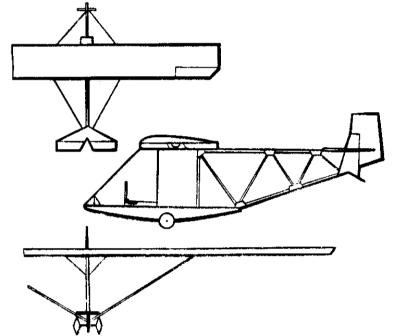
The Sharapov-Verzilov “Piervieniets” (First) (Russian: Шарапов-Верзилов “Первенец”) was designed as a single-seater training glider.

Conceptually the “Piervienets” was designed as a high wing glider braced by four uprights. The wing had a rectangular shape in the plane with ailerons in the outer area.

The fuselage was in the form of a low-sided “bathtub” to which a flat, uncoated wooden structure was attached, ending in the conventional tail.

The landing gear consisted of two wheels located on the sides and a tail skid.

The pilot sat in a fully exposed seat. The cabin space was so wide that flights were carried out with a passenger behind the pilot.

Built in Simferopol in 1927 by AN Sharapov and VN Verzilov and flying that fall, the “Piervieniets” glider was entered in the IV edition of the national glider competitions. During competitions it was the most popular glider, flying 274 training flights.

Piervieniets
Wingspan: 12 m
Wing area: 18 m²
Aspect ratio: 8
Length: 6.5 m
Empty weight: 125 kg
Wing loading: 11 kg / m²
Aileron surface: 2.6 m²
Accommodation: 1

Sharapov-Verzilov Buyán

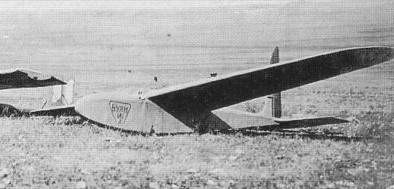
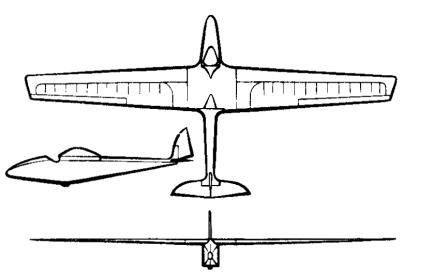
The Sharapov-Verzilov ”Buyán” (Russian: Шарапов-Верзилов “Буян”) was designed as a single-seater racing glider. The “Buyán” was a cantilever-wing monoplane. This wing, with a trapezoidal shape in the plane and slanted straight ends, was located high in the fuselage.

The fuselage had a fusiform shape with straight gunwales. At the top and inside it had a curved shape. At the front was the open cockpit.

The shape of the tail surfaces was reminiscent of the fins of a dolphin. The landing gear featured a wheel partially inserted into the centerline of the fuselage.

Built in 1928 in Simferopol by AN Sharapov and VN Verzilo, it was a participant in the 5th round of national gliding competitions after first flying in the fall of 1928.

Shapley Kittiwake

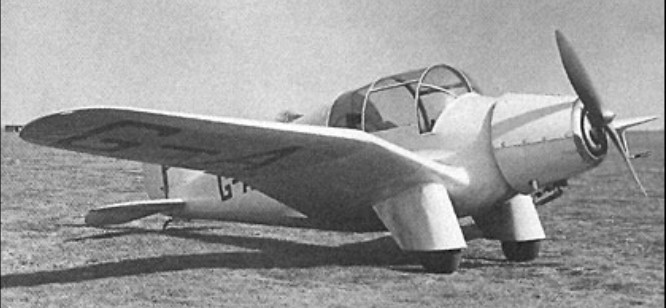
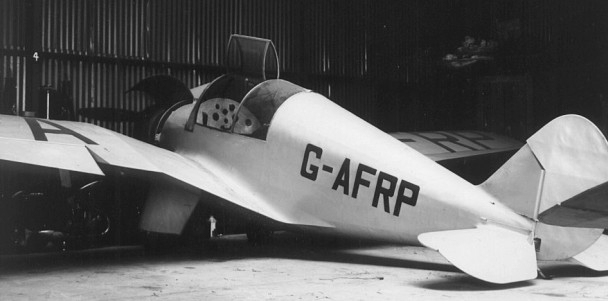
Designed and built by Errol Spencer Shapley at Torquay, Devon, the Kittiwake was a two-seat monoplane with a gull wing and a fixed landing gear. The first aircraft, a Mark 1 registered G-AEZN (c/n ESS.1), with an open cockpit was powered by a 50 hp (37 kW) Continental A50 piston engine and first flown at Roborough in 1937. A Captain F Symodson was the test pilot. The second aircraft, a Mark 2 registered G-AFRP (c/n ESS.2), was a cabin monoplane powered by a 90 hp (67 kW) Pobjoy Niagara III engine and first flown at Roborough in 1938.

The Mark 1 aircraft was dismantled before the Second World War. The Mark 2 was stored during the war only to crash on Dartmoor in December 1946.

Kittiwake Mark 2
Engine: 1 × Pobjoy Niagara III, 90 hp (67 kW)
Wingspan: 32 ft 0 in (9.76 m)
Length: 20 ft 10 in (6.35 m)
Empty weight: 901 lb (409 kg)
Gross weight: 1600 lb (726 kg)
Cruise speed: 110 mph (176 km/h)
Crew: 1
Capacity: 1

Seversky SEV-1XP / SEV-S-1

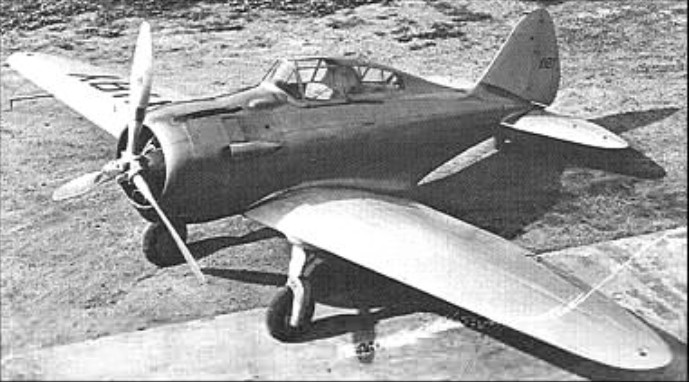
The SEV-2XP with an 800hp Wright XR-1670 engine, was damaged enroute to Wright Field and hurriedly converted into the single-place SEV-1XP with an 850hp Wright R-1820-G4 Cyclone engine

First flying as the NX18Y c/n 2 still, in August 1935 piloted by de Seversky, the SEV-1XP initially retained the R-1670 engine. By now featuring a semi-retractable undercarriage, the prototype was reengined with an ungeared nine-cylinder Wright R-1820 Cyclone. This engine failed to produce its rated power, however, the predicted 483km/h maximum speed proving unobtainable in consequence.

The USAAC Materiel Division’s decision to defer fighter choice pending further evaluation to be held in March 1936 enabled the SEV-1XP to be re-engined once more, this time with an 850hp 14-cylinder Pratt & Whitney R-1830-9 Twin Wasp. This was succeeded, in turn, by a geared R-1820-G5 offering 950hp for take-off, but the Twin Wasp was subsequently re-installed.

With this last engine and an armament of one 7.62mm and one 12.7mm gun, the SEV-1XP was selected on 16 June 1936, approval being given for production of 77 fighters against a contract confirmed early in 1937, with the designation P-35.

Repowered with a P&W R-1830B as the SEV-S1, and with a new tail and cowling, NX18Y raced at the 1935 Nationals, piloted by Frank Sinclair) to fourth place.

It was scrapped in 1937.

Sev-1XP
Engine: 850hp Wright R-1820-G4 Cyclone
Wingspan: 10.97 m / 36 ft 0 in
Length: 7.59 m / 25 ft 11 in
Height: 2.69 m / 9 ft 10 in
Wing area: 20.44 sq.m / 220.01 sq ft
Max take-off weight: 2274 kg / 5013 lb
Empty weight: 1681 kg / 3706 lb
Max. speed: 465 km/h / 289 mph
Range: 1918 km / 1192 miles
Seats: 1

Sev-1XP
Engine: P&W R-1830B