Pasadena CA.
USA
Built the S-1 monoplane in 1929.
Pasadena CA.
USA
Built the S-1 monoplane in 1929.
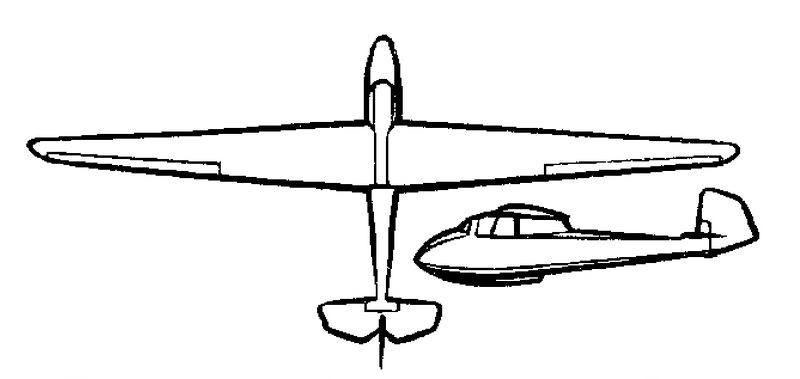
The “Pavel Golovin” glider, also known as PAI-2, was designed and built by a group of enthusiasts consisting of BN Sheremetiev, Yu. I. Koltunov, BL Sirken and AI Pietsuj. The main objective in the construction of this glider was the study of the flight methodology for a training glider with a view to using it for the calculation of record-keeping flights.
The Sheremetiev / Koltunov / Sirken / Pietsuj “Pavel Golovin” glider (Russian: Шереметев, Колтунов, Сиркен, Пьецух – Павел Головин) was designed as a cantilever monoplane with high wing in parasol. The wing construction was characterized by a single spar.
The fuselage was constructed of wood and featured a hexagonal cross section.
In order to provide the pilot with the highest level of comfort, a large cockpit was designed, equipped with all the necessary instruments: altimeter, speedometer, barometer, thermometer, compass, reversal indicator. The cabin was closed using an angled cover, which opened to the side and could be released from the inside in case of emergencies.
The tests carried out in July 1937 with the pilot II Shelest at the controls, showed good stability in the air and response to the controls, as well as excellent manoeuvrability. At speeds of 80 – 160 km / h it was possible to make high school piloting figures.
The negative aspects were the long take-off run and the large wing loading. The landing, on the other hand, was quite short.
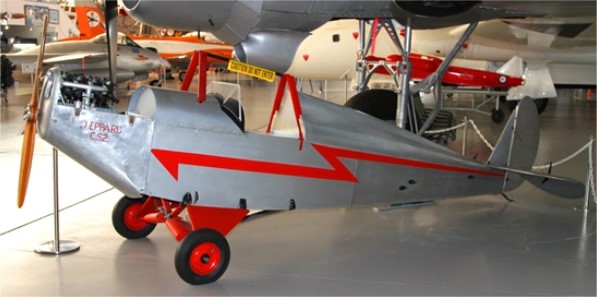
After building the CS1 glider in the early 1930s, Clem Reginald Sheppard of Adelaide, Australia, designed the single seat Sheppard CS2 aircraft in the 1930s. The plans for this aircraft were first drawn in chalk on his parents’ lounge room floor at Kensington Park. The aircraft was later built in the backyard and garage. The fabric to cover the aircraft was sewn by his mother.
By 1938, after Clem had spent all his spare time and money, the aircraft was ready to fly. The CS2 had fold-back wings so it could be towed behind a car to Virginia, where it was flown on a number of occasions by Bill Maddocks. Bill was a Royal Aero Club of SA instructor.
On Clem Sheppard’s death, the aircraft was taken into store by the Royal Aero Club of SA. It went to the South Australia Aviation Museum in November 1987. The wings were to be refitted following restoration.
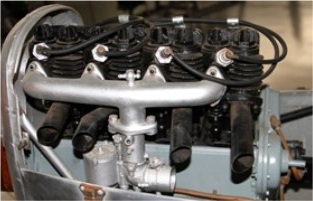
Engine: 4-cylinder Henderson Ace Motorcycle engine rated at 8 hp
Wingspan: 7.62 m
Length: 5 m
Height: 1.68 m
Maximum take-off weight: 174 kg
Capacity: 1 pilot
Clem Reginald Sheppard of Adelaide, Australia, in the early 1930s designed and built a glider – the CS1.
Clem Reginald Sheppard was born in October 1914. When he left school he joined the family business, Sheppards Jewellers of Adelaide, and trained as a watchmaker. As a young man he developed a keen interest in aviation. In the early 1930s he designed and built a glider (the CS1). He then designed and built a single seat aircraft, the CS2.
Built in 1938, the Shepard-Krum SC-1 Sportcraft was a two-place, open-cockpit, low wing monoplane, powered by a 65hp Velie M-5 engine and registered N19953.
Fred J Shepard & Thomas C Krum
Beaverton OR.
USA
Built the Shepard-Krum SC-1 Sportcraft in 1938.
Riverbank CA.
USA
Circa 1928, F R Shepard built an aircraft of some type, registered N3278 and powered by a 40hp Lawrance engine.
In 1933 W J Sheehan of S Walpole MA., USA, built a single-place, open-cockpit, low wing monoplane. Powered by a Heath-Henderson, later replaced by Anzani, the sole example built was registered N911V c/n 4. Featuring V-strut-braced wings, the registration was cancelled in 1935.
S Walpole MA.
USA
Built a homebuilt aircraft in 1933.

