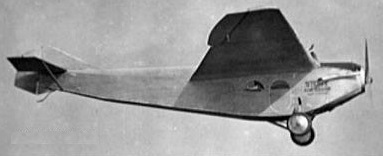
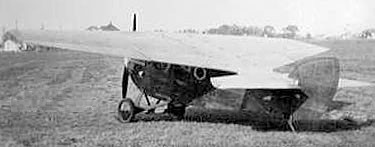
Sullivan Goblin

The 1931 Sullivan Goblin N10694 c/n SC-1 was a two-place open cockpit monoplane powered by a 38hp Continental.

Sold and resold many times around the Bay Area and Santa Rosa. Officers in the Sullivan company were J W Robb and J J Schmidt, who also show up later as principals in the Ful-Vue Fixtures Co Ltd, one of the plane’s buyers (24 June 1932).

Universal Engine & Propeller Co, Berkeley (SF Bay Airdrome, Alameda 1937), acquired it on 29 January 1934 and installed their 50hp Universal Indian with variable-pitch prop.

After several more changes of owners, and a 60hp LeBlond in 1937, the reg was cancelled on 15 April 1940 Its registration expired in 1940 and was cancelled.

Sud-Ouest / Ouest Aviation

France
Formed 1935 at Bordeaux-Merignac by the Potez group when it took over the Societe Aerienne Bordelaise. Was intended as a decentralized production source for Potez and Bloch aircraft. A prime responsibility was development and production of Bloch types, especially single-seat fighters derived from MB.150 of 1936. Redesign facilitated production and improved performance, resulting in MB.151 and 152. By June 1940 production totaled about 600, involving five plants. MB.175 twin-engined bomber was in production and was revived after Second World War as torpedo aircraft. Several other prototypes built, including four-engined bomber.

In France, the Socialist Government of the so called Popular Front brought all the companies building military aircraft, aero engines and ar¬mament under its control in 1936. The im¬mediate result was the socialized oblivion of such established companies as Marcel Bloch, Bleriot, Nieuport, Potex, Dewoitine, Hanriot and Farman within half a dozen nationalized groups or Societies Nationales, named ac¬cording to their geographical location (Nord, Ouest, Centre, Midi and so on).

Incorporated in SNCASO 1936, incorporating the factories of Marcel Bloch, Bleriot and Liore et Olivier, subsequently merging with SNCASO and changing name to Ouest Aviation in 1956.

In 1942 completed forerunner of Bretagne twin-engined transport, though not flown until 1945; then used commercially and experimentally. Numerous and varied post-Second World War types included distinctly unusual forms of rotary-wing aircraft. Aeriel (1948) and Djinn (1953) with tip jets, and Farfadet convertiplane (1953).

Aerocentre went into liquidation during 1949, its plants and work being shared by SNCAN (Nord), SNCASO (Sud-Ouest) and engine form SNECMA.

Original designs included S.O.94R twin-engined trainer; S.O.95 Corse, and S.O.30 Bretagne military transports; S.O.4050 Vautour twin-jet bomber; and the S.O.9000 Trident. The S.O.1221 Djinn two-seat helicopter was produced, and Vertol H-21 helicopters were manufactured under license for the French Army. Ouest became part of Aerospatiale.

After World War II, although four of the nationalized groups continued operating un¬der state control, private companies were al¬lowed to resume the design and manufacture of both civil and military aircraft. Some of the pioneering names of French aviation, such as Breguet and Morane Saulnier, returned to prominence, and by 1950 a new one had been added Avions Marcel Dassault.

Loire-Nieuport joined SNCASO in 1942.

SNCASO and SNCASE joined to form Sud-Aviation in 1958.
Sud-Est

Societe Nationale de Constructions Aeronautiques du Sud-Est
SNCASE

In France, the Socialist Government of the so called Popular Front brought all the companies building military aircraft, aero engines and ar¬mament under its control in 1936. The im¬mediate result was the socialized oblivion of such established companies as Marcel Bloch, Bleriot, Nieuport, Potex, Dewoitine, Hanriot and Farman within half a dozen nationalized groups or Societies Nationales, named ac¬cording to their geographical location (Nord, Ouest, Centre, Midi and so on). Liore-et-Olivier, Potez, Romano, and SPCA formed SNCASE in 1936. Sud-Est was a nationalised company that had taken over manufacture from Bloch.

Company thus became responsible for development and production of LeO.45 twin-engined bomber, first flown January 1937, outstanding in many points of design and much used and adapted during and after Second World War. Built also Romano trainers and LeO.43 catapult floatplane, of type first flown December 1934.

In 1941 the company absorbed SNCAM. Early post-Second World War products included Languedoc four-engined airliner, developed from Bloch 161 of 1939, which entered service between Paris and Algiers in 1946, and was ordered additionally for military use.

Dewoitine joined SNCASE in 1942.

After World War II, although four of the nationalized groups continued operating un¬der state control, private companies were al¬lowed to resume the design and manufacture of both civil and military aircraft. Some of the pioneering names of French aviation, such as Breguet and Morane Saulnier, returned to prominence, and by 1950 a new one had been added Avions Marcel Dassault.

Military types in development included Grognard twin-jet attack aircraft of 1950; the unique trolley-launched skid-landing Baroudeur strike aircraft of 1953; and Mistral and Aquilon developments of the British de Havilland Vampire and Sea Venom. Especially notable original developments were the Alouette helicopter series first flown in 1951, and the rear-engined twin-jet Caravelle in 1955.

Until 1 September 1956 known as Societe Nationale de Constructions Aeronautiques du Sud-Est (SNCASE). On the 1st September 1956 the S.N.C.A. du Sud-Est was merged with the S.N.C.A. du Sud-Oest into Sud-Aviation.

Stout 1-AS Air Sedan / TT

Stout Air Sedan

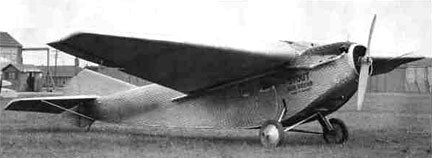
Designed by William Stout and George Prudden, the 1923 1-AS Air Sedan was all-metal construction with corrugated skin. First all-metal commercial airplane in the US and basis for the 2-AT.

Test-flown by Eddie Stinson, it was powered by a 90hp Curtiss OX-5, replaced by a 150hp Hisso when it was apparent only 3 passengers could be carried with the OX-5. With the Hisso engine. Five could be carried.

One 1-AS Air Sedan was built, plus another as 1925 model TT single-place for evaluation by USPO as a “flying mail truck”.