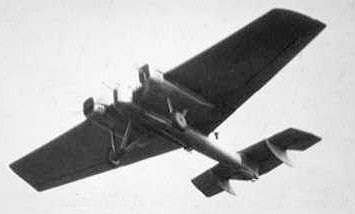
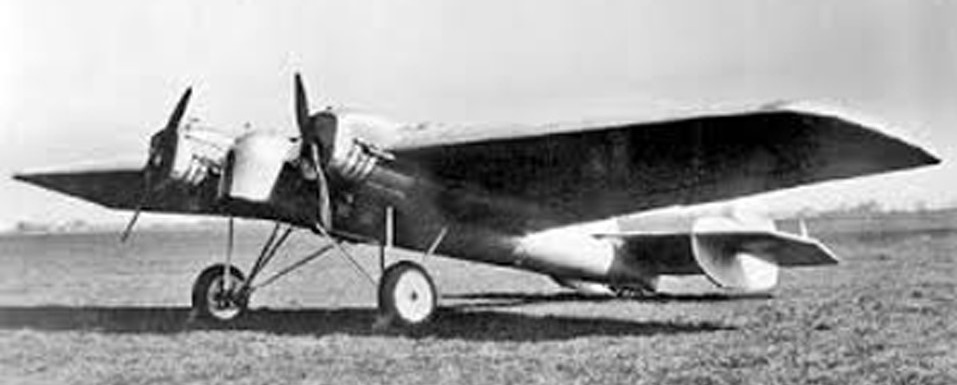
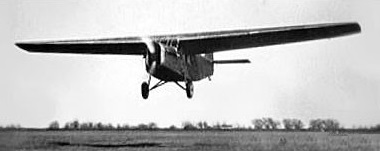
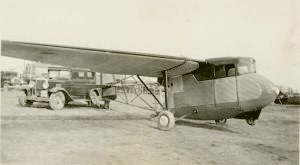
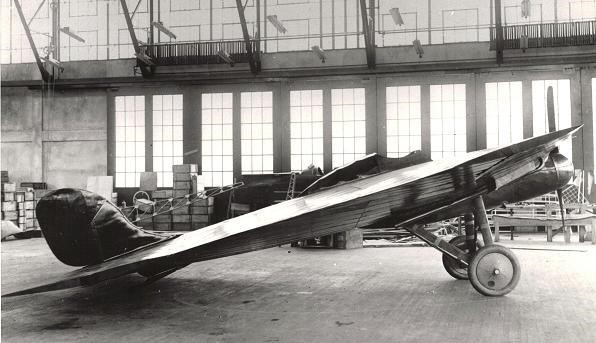
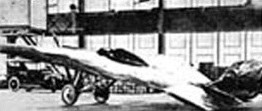
The Stout ST-1 of 1922 was a two-place, open cockpit all-metal monoplane prototype of a projected USN torpedo-bomber; the first all-metal USN plane.
The US Navy Bureau of Aeronautics had a requirement to review several types of torpedo-carrying aircraft. Prototypes of the Curtiss CT, Stout ST, Fokker FT and Blackburn Swift F were evaluated at the Anacostia Naval Yard. William Bushnell Stout approached the Navy with his all-metal torpedo bomber design. He estimated the aircraft would cost $50,000 each to produce. The aircraft was built in Detroit, Michigan over a two-year period. Navy officials visited the facility frequently to inspect the new metal-forming and construction methods.
The aircraft was a twin engine conventional geared mid-winged monoplane. Its primary feature was its corrugated metal construction, a new technique and different from the tube-and-fabric airplanes of the time. In addition, the internally supported cantilever wing developed for the Stout Batwing was employed. The aircraft was test flown successfully, however, the airplane showed signs of inadequate longitudinal stability.
Three were ordered, A5899 to A5901.
The first flight of the prototype, designated ST-1, was at Selfridge Field on 25 April 1922 with Edward Stinson at the controls. The flight was witnessed by William A. Moffett, chief of Navy Aeronautics. Stinson suggested changes to the aircraft, but none were made.
When the $162,000 prototype A6072 crashed after 14 flights, a contract for 2 more, A5902 and 5904, was cancelled.
Engines: two 400hp Packard V-1237 Wingspan: 60’0″ Length: 37’0″ Max speed: 120 mph Cruise: 110 mph Stall: 40 mph Range: 385 mi Crew: 2
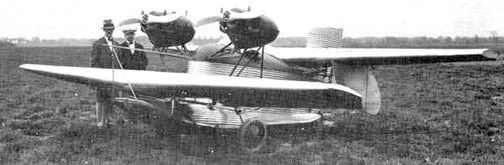
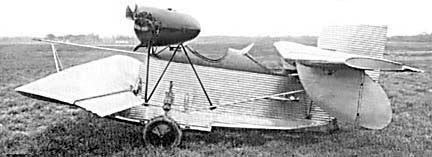
The 1927 Stout Dragonfly was a short-coupled canard design with two tandem wings, one tail-mounted and the other on the nose, triple tails, and truss-mounted motors.
The only all-metal corrugated experimental built was badly damaged in hitting a bump during high-speed taxi tests and was scrapped.
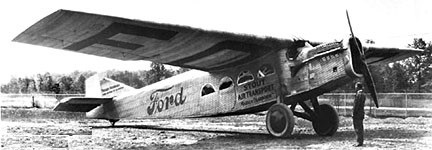
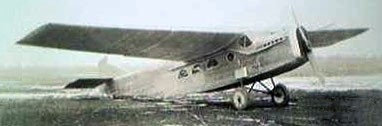
The Stout 2-AT (aka Air Pullman) passenger transport, was produced under the Ford aegis and wearing that company’s logo, but built at Stout’s Detroit plant and so named Maiden Detroit. First flying on 23 April 1924, it became the first plane for Ford Air Transport Service in 1925.
The next four planes were built at his new Detroit plant on Ford Airport and all named Maiden Dearbon, with appended numbers for each model (sometimes as Roman numerals), and the balance after Ford acquired Stout Metal Aircraft Co in Aug 1925.
Selling for $22,500, eleven were built. The first one to USPO and refitted with 500hp Packard, 5 to Ford’s Air Transport Service, 4 to Florida Airways, 1 to retailer John Wanamaker.
Revised rudder, gear, stacks;
A crash on 18 May 1926, of 2-AT-2 was the first fatal accident for a commercial US aircraft on the new CAM air mail routes (the pilot was killed; there were no passengers). It was determined the cause was weather.
The first use of the nickname, “Tin Goose,” was found in a 30 December 1925, newspaper article. They were the predecessor of the historic Ford Tri-Motors.
Engine: 400hp Liberty 12 Max speed: 120 mph Cruise speed: 100 mph Seats: 9 passengers
William Bushnell Stout was a designer of road vehicles and aircraft, including the Ford Trimotor series. He was founder of the Stout Metal Airplane Division of the Ford Motor Company and in 1931 designed the Skycar which was specified for easy handling and provided with automobile-style comfort. Single examples of four variations on the basic design were produced between 1931 and 1944.
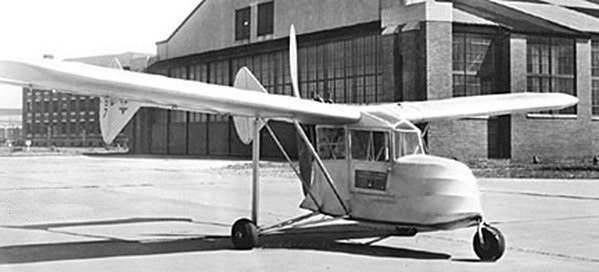
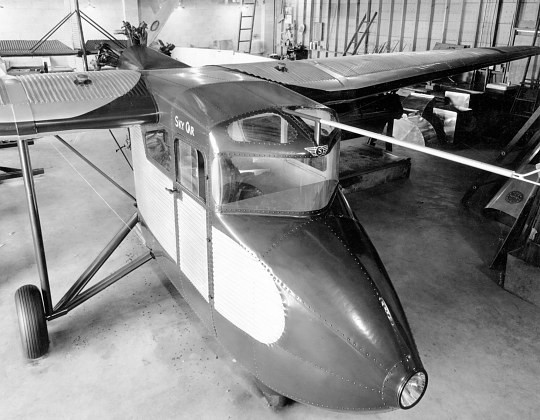
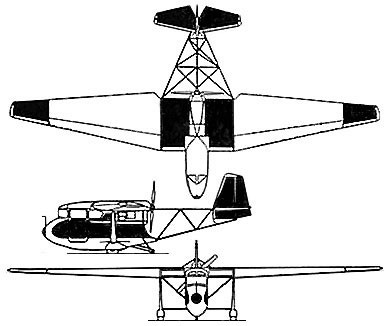
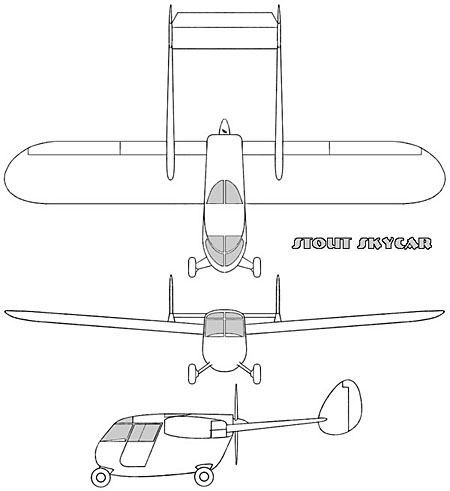
The Skycar I was first displayed at the spring 1931 Detroit Show and first flown in 1931. The aircraft was a two-seat high-wing monoplane, accommodating the occupants in tandem layout. It had an all-metal steel-tube frame covered with corrugated metal skin. Centre-line nose and tail-wheels plus a standard landing gear were fitted. The rear fuselage was constructed from an open framework carrying a single fin and rudder, inside which was located the rear pusher engine. The Sky Car was displayed with a Moorhouse engine (Alfred Moorhouse of Detroit, assignor to Packard Motor Car Company). Fuel was carried in two tanks in the leading portion of the central section of the engine housing, from where it was fed by gravity to the engine. At a later date the aircraft was fitted with twin booms carrying the single fin and rudder (see photo of preserved aircraft). The aircraft featured balanced pivoting outboard wingtips rather than ailerons. Stout attempted to design a simple aircraft that would have controls similar to early model Fords including the ignition switch and the starter button. Stout planned to build the Sky Car (i.e. its original name was “Sky Car” but various newspaper and magazine articles spelled it “Skycar”) and sell it at the price of a moderately priced car (approximately $2000) if mass-produced in numbers.
The Skycar I, NX10899, sometimes referred to as the Model 11-W. Its original wingtips were ailerons, replaced by trailing-edge ailerons somewhere in its path of modifications. It was flown as a personal aircraft by Stout for several years and was later donated to the Smithsonian Institution. It is on display in the National Air and Space Museum at Dulles Airport Virginia.
The National Air Museum initiated acquisition of the aircraft from the University of Detroit in the late 1940s and found that the entire fuselage, wing center section, and landing gear were missing. While available parts were shipped to the Museum’s storage facility in Park Ridge, Illinois, Stout funded the building of replica parts by the General Metalcraft Company of Phoenix, Arizona. This restoration, completed in 1951, represents the Skycar in a later development phase.
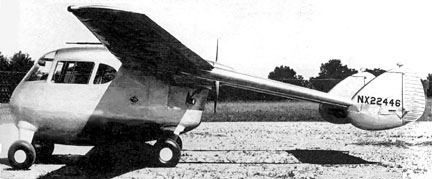
The Skycar II NX22446 of 1941 was a higher-powered version utilising stainless steel construction and twin tail booms. The four-wheel landing gear was intended to facilitate a later rebuild to roadability which never occurred. It was built with support from Fred Fisher of General Motors.
stout-skycar2
The Skycar II was evaluated by the United States Army Air Forces (USAAF) as the XC-65 42-7772 light transport. It was destroyed in a hangar fire circa 1942.
The Skycar III of 1943 had a higher-powered Lycoming engine to enable operation at higher gross weight, but was otherwise simailar to the Skycar II.
The Skycar III was tested by the USAAF as the XC-107.
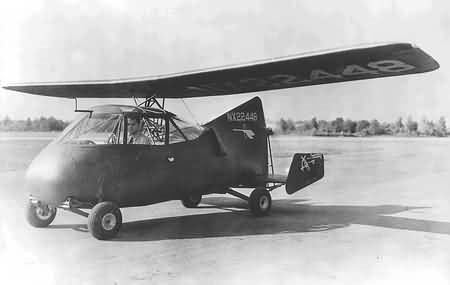
William Bushnell Stout’s formula for successful aircraft design was ‘simplicate and add more lightness’. To ‘simplicate’ his Skycar IV he called upon George Spratt, inventor of an articulated wing which could tilt in any direction to command movement in pitch, roll or yaw. Because the Spratt Wing eliminated all other control surfaces, Stout was able to design a stubby, compact fuselage/car body which looked like a giant beetle. The Skycar IV of 1944 was also known as the Spratt-Stout Model 8 and the Convair 103. It was similar to the Skycar III with twin tail-booms, but fitted with twin fins and rudders.
The Skycar was reportedly very easy to fly, and took less than five minutes to pre¬pare for road use. It was evaluated in 1946 by Consolidated Vultee (later Convair).
Skycar I / Model II-W Engine: 75 hp (56 kW) Michigan Rover R-267 pusher engine later 90 hp (67 kW) Warner Junior. Length: 24 ft 0 in Wingspan: 43 ft 0 in Gross weight 1550 lb Useful lift: 480 lb Maximum speed: 95 mph Cruise speed: 80 mph Stall speed: 35 mph Range: 320 miles Crew: 1 Capacity: 1 passenger
Wing span: 12.2 m (40 ft.) Length: 7.32 m (24 ft.) Height: 2.13 m (6 ft.) Weight, Empty: 430.9 kg (950 lbs.) Weight, Gross: 647 kg (1,425 lbs.)
Skycar II / XC-65 Engine: 90 hp (67 kW) Franklin O-200 pusher engine. s. (1 built) Wingspan: 35’0″ Length: 20’5″ Max speed: 110 mph Stall: 45 mph Gross wt: 1550 lb Seats: 2
Skycar III / XC-107 Engine: 125 hp (93 kW) Lycoming O-290 pusher Wingspan: 43’0″ Length: 24’0″ Gross weight 1825 lb Max speed: 118 mph Seats: 2
Skycar IV / Spratt-Stout Model 8 / Convair 103 Engine: 90 hp (67 kW) Franklin 4ACG pusher engine, later 125 hp (93 kW) Lycoming O-290C
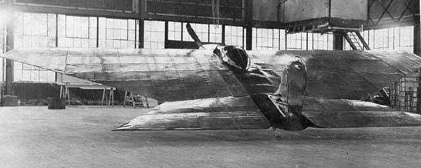
During World War II, William Bushnell Stout was employed by Packard in 1917 when he was appointed as a technical advisor to the War production board. The board gave Stout a contract to develop a blended wing body aircraft. Funded by the Motor Products Corporation, Stout developed the “batwing” aircraft with the intent to market the aircraft to the United States Army. Stout first experimented with an all-wood flying wing design with a glider design, the “Batwing Glider”, tested at Ford Airport in 1926. Stouts design was nicknamed “Bushnell’s Turtle”. (a reference to the unrelated David Bushnell’s Turtle submarine’s shape). The blended-wing batwing was designed to have all surfaces of an aircraft used to provide lift, eliminating the added drag of a conventional fuselage. This concept is applied to all flying wind aircraft. The batwing differed slightly with the addition of a set of horizontal stabilizers at the rear of the aircraft for stability. The aircraft was an early example of wood-veneer aircraft construction. The wings were covered with a 3 ply wood veneer only 1/20th of an inch thick. The internal bracing consisted of hundreds of spruce struts. Nine spars tested to 1 ton of load each.
To reduce drag, the aircraft employed a cantilever wing without support wires or struts. This required a “thick” wing to build a spar strong enough to support the aircraft. To maintain the shape of the wing, the chord also had to be longer as the wing became thicker. In the case of the batwing, the chord was the entire length of the aircraft. Since the spar did not need to be as thick toward the tips to support the load, the chord decreased further out along the wing, forming a oval shaped wing. As ideal as this was, it caused significant engineering challenges maintaining the center of pressure on the aircraft. Further aerodynamic drag reductions came from having the water cooled engine embedded into the wing with retractable radiators. The pilot sat in an open cockpit placed at the top of the aircraft. Visibility was restricted downward by the placement. The batwing was the first example of a cantilevered wing and veneer skin in the United States.
The mockup of his first thick winged aircraft design was built at the Widman woodworking plant in Detroit, Michigan. The 150 hp engine was acquired from Charles Warren Nash who had a budding interest in the project. The first flight was in Dayton, Ohio in November 1918. The pump shaft on the engine was broken, but the plane was flown anyway. Although the flight was successful, the test pilot Jimmie Johnson commented that the aircraft was too dangerous to fly because of the limited visibility. Stout later called the visibility “abominable”. The test aircraft was put into storage. Soon afterward, Stout submitted British patent #149,708, with a batwing aircraft with the corners squared off rather than the oval design of the prototype. The updated aircraft was never produced. Stout went on to focus on more conventional aircraft featuring the advancement of all-metal construction, but continued to maintain the plane of the future will look like the batwing
Stout drew plans for a scaled up version of the Batwing, with a 100 foot wingspan. The larger aircraft would have solved the visibility issues, but did not get past planning stages.
Stout also used the term “batwing” in the name of future aircraft that used cantilever wings.
Stout Batwing Engine: 1 × Hispano -Suiza, 150 hp (110 kW) Wingspan: 20 ft (6.1 m) Wing area: 480 sq ft (45 sq.m) Empty weight: 1,542 lb (699 kg)
In 1919 W. B. Stout (former aeronautical writer and engineer) formed Stout Engineering Laboratories Inc. at Detroit, Michigan. Built Batwing cantilever monoplane, hoping for U.S. Navy and civil orders. In 1920/1922 built and flew large twin-engined coast-defense torpedo-carrier monoplane for Navy.
1922: Stout Metal Airplane Co, Dearborn MI. USA
Stout, facing bankruptcy, solicited financial support, which came from a group of Detroit area businessmen, among them auto manufacturers Roy Chapin (Hudson), Walter Chrysler, Barney Everitt (Rickenbacker), Fred Fisher (Fisher Body), Henry Ford (via Edsel Ford), Charles F Kettering (GMC), Alvin McCauley (Packard), and Ransom E Olds (Reo).
In 1922 established Stout Metal Airplane Company with himself as chief designer and Edsel Ford as a director. Specialized in metal construction. Seven-passenger Stout Air Pullman of 1924 had corrugated metal skin.
In August 1925 the company was bought by Henry Ford and joint publicity was gained when Stout Mail Plane marked “Ford” operated on Detroit-Cleveland route.
AT- 4 of 1926 established famous Tri-Motor line, associated with name Ford. In 1931 Stout Engineering Laboratories exhibited Sky Car two-seat monoplane at Detroit.
In August 1925 Henry Ford bought the Stout Metal Airplane Company from founder William Bushnell Stout. The new division of the Ford Motor Company produced three versions of the Tri-Motor monoplane.
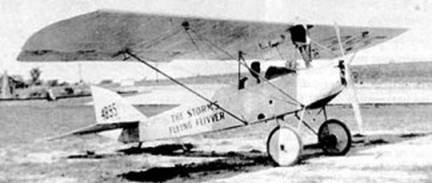
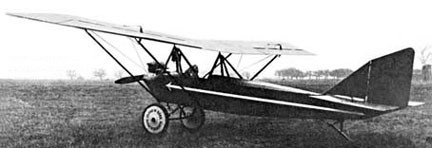
The 1928 Storms Aircraft Co Flying Flivver was a kit plane advertised in kit form, less motor, for $1135. Power was normally a 36hp Ford T engine, or optional 60hp Ford A. A parasol wing was $985.
Storms Flying Flivver
About seven were registered in the USA including; N4895, which a newspaper report had as crash-landing in 1928, piloted by A J Storm. N11917, appears in Texas registers as (Wyley J) Wood-Storms N882Y shows as Lee-Storms N627W N882Y N10212
One was constructed at Wesport, New Zealand in the 1930s. The aircraft kitset imported from the USA by Jack Kilkenny and partners was a Storms WhizBang. In April 1933 following assembly it was inspected by a member of the NZPAF and found to be built from substandard material. Nevertheless the group were not deterred and it was taken to Carters beach with intentions to fly it. However although one of the group had previously had two hours dual instruction, he and Kilkenny’s brother-in-law were unable to get it of the ground. A week or two later John Spencer Allan after additional dual flying tuition successfully flew the aircraft on several occasions however it crashed with Spencer Allan at the controls following engine failure and was badly damaged. Plans to rebuild the aircraft were shelved following a second visit from the PAF inspector who advised them of the consequences should they fly it again. In June 1970 John Spencer Allan was killed near Taupo in the crash of AESL Airtourer ZK-CXS. His passenger survived. By all accounts the WhizBang kit was a real “Heath Robinson” affair. The PAF inspector noted that the timber supplied for wings and fuselage was Sugar Pine, the aileron hinges were cheap cupboard hinges and the elevator and rudder hinges were fashioned from leather shoe tongues and tacked to the spars. The Westport aircraft was kit #7 and another kit is believed to have been imported by Mr Hildred, Te Aroha, New Zealand, but it seems probable construction of this aircraft was not completed
Eddie Campbell of Prineville, USA, had, in 1930, got hold of the plans for a homebuilt design called “The Storms Flying Flivver,” a tiny high-wing monoplane powered by a Ford Model A engine. The Model A engine was roughly the same size and weight as the Model T, but made twice as much power. And Eddie worked at a Ford dealership’s repair facility, so he had access to the equipment necessary to soup it up a bit. Ted was out of town for a week when Eddie finished his project, and not expected back for another four days. Eddie, already a fairly experienced glider pilot, grew impatient. Plus, it was his plane; he wanted to be the first to fly it. So, he pulled it out and fired it up and pointed it down the field. It would not take off. He tried it several times; at the proper speed, it simply would not leave the ground. Eddie looked it over, scratched his head, and decided the problem was that it was “nose heavy.” Getting his tools out, he took the wing loose and moved it a little bit forward. Then he climbed back in to try again. This time, the plane came off the ground, all right. It went straight into a steep climb, completely ignoring Eddie’s attempts to control it; stood on its tail, trying to hang from the prop, about 100 feet in the air; then stalled and pitched forward and slammed down into the ground, nose first, ending up in a tangled heap.
Flying Flivver Engine: 36hp Ford T Wingspan: 31’0″ Length: 20’6″ Useful load: 350 lb Max speed: 65 mph Cruise: 45 mph Stall: 20 mph Range: 135 mi Seats: 1
Flying Flivver Engine: 60hp Ford A Wingspan: 31’0″ Length: 20’6″ Max speed: 70 mph Cruise: 50 mph Stall: 20 mph Seats: 1