1982: Big Boy Toys Ltd t/a Sheffield Micro Light Aircraft, 52 Crescent Road, Nether Edge, Sheffield S7 1HN, Great Britain.
Trike builder
1982: Big Boy Toys Ltd t/a Sheffield Micro Light Aircraft, 52 Crescent Road, Nether Edge, Sheffield S7 1HN, Great Britain.
Trike builder
The Skeeter is a lightweight sporting plane featuring a single seat and a single strut-braced wing mounted in parasol fashion. The wing is constructed from wood spars and fabric covering with the exception of the leading edge that is metal-covered. The fuselage is constructed from a steel-tube frame that is paneled with either wood or metal in the cockpit area only. Aft of the cockpit section the airframe is left uncovered. Power is supplied by Volkswagen engines rated from 50 to 72 hp.
Engine: 72hp VW
Wingspan: 22’0″
Length: 13’6″
Gross Wt. 730 lb
Empty Wt. 500 lb
Fuel capacity 5½ USG
Useful load: 280 lb
Max speed: 85 mph
Cruise speed: 75 mph
Stall: 42 mph
Climb rate 600 fpm
Takeoff run 600 ft
Landing 600 ft
Range: 160 mi
Sears: 1
1980: Sheffield Aircraft, 4750 S. Mead, Littleton, CO 80123, USA.
UL builder
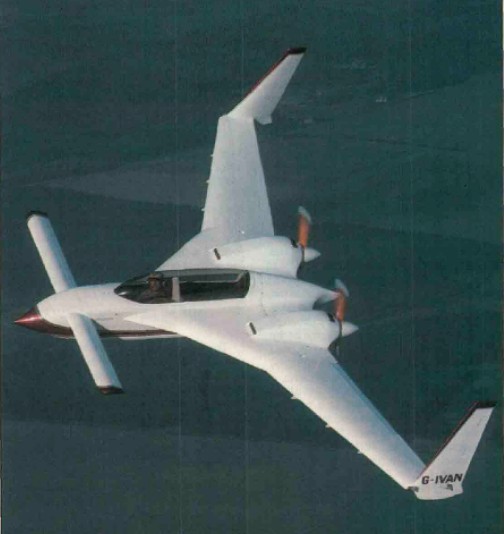
Built by Ivan Shaw, Barnsley, South Yorkshire, England. G-IVAN began in 1980 as a VariEze and completed in 1981, was later converted to a Long-EZ, and then to a twin engined pusher (first flight 29 June 1989). The main undercarriage gear retracts into the fuselage where the O-200 used to fit.
The Twin-EZ was developed and built by Mr. Ivan Shaw, a British science school teacher. The Twin-EZ started life as a homebuilt Rutan VariEze certified in 1978. When Shaw considered transforming his aircraft into a twin-pusher (initially referred to as the Twin Speed) in 1981, he planned to use two 50 hp Lotus rotary engines. According to him, twin pusher engines and a retractable undercarriage should boost the Long-EZ’s cruise speed to 200 m.p.h. and increase range to 2,000 n.m., offering 50 m.p.g. fuel economy. Shaw, a self-confessed “eyeball engineer” who aimed to fly his home-built late in 1985 when a pair of Lotus microlight engines would become available.
Shaw claimed a pair of 50 h.p. Lotus engines weighed 701 lb. less than either of the other units and burned 20 per cent less fuel. He built a bracket which allowed the pair to be attached to the standard engine mount on the rear fuselage, each engine sitting just 31 in. from the fuselage centre line. Electrical systems could be run from either engine, offering “complete redundancy”.
Shaw’s other modification was to fit a fully retractable undercarriage. This carried a 301 lb. weight penalty over the fixed undercarriage, but reduced drag and so offered the prospect of the major speed increase Shaw was predicting. Empty weight was predicted to be 800 lb. and the first flight was to be made within six weeks of engine delivery.
However, development of the Lotus engine type was stopped, and therefore none was ever installed on the Twin-EZ. For Shaw, who had worked with Lotus and Rutan on the Microlight aircraft, Colin Chapman’s untimely death also signified the end of all aviation activity for Lotus, engines included. As a result Shaw decided to modify the aircraft with larger Long-EZ wings to accommodate two 77 hp Hewland HAE75 three-cylinder two-stroke reciprocating engines, installed in a pusher configuration. In this form, the Twin-EZ was first flown on June 29, 1989, and was demonstrated days later at the UK Popular Flying Association’s annual rally at Cranfield Airport.
The Twin-EZ was soon used as test-bed for the Norton-Wankle NR642 rotary engines, each unit being mounted pusher-style at the wing trailing edge. The Norton rotary engine had already been tested in 1987 in an Aviation Composites Mercury, a local derivative of the Microlight developed at Scaled Composites. The advantages of the rotary Norton over the Hewland engine were said to be a lengthy overhaul interval and increased power. The Norton engine developed 90 h.p. compared with the Hewland’s 75 h.p., and was claimed to be extremely light for its power output owing to constructional simplicity.
At Gamston in the 1980’s Ivan Shaw was air testing the twin conversion and it was damaged whilst stored there.
Ownership later changed to Anthony Malcolm Aldridge of Crostwight, North Walsham, and the aircraft was stored.
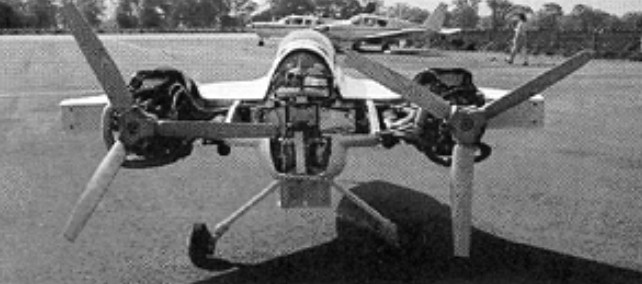
Type: twin-pusher two-seat sportsplane
Engines: 2 x Hewland HAE75, 77 hp
2 x 90 hp Norton rotary
MTOW: 499kg
Cruise speed: 280 mph
Vmca: 57 kt
Serial No: c/n 39; s/n PFA 074-10502
Crew/passengers: 2
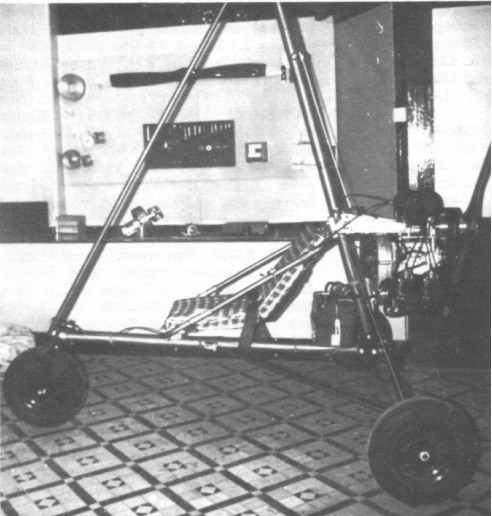
Single seat single engined flex wing aircraft with weight shift control. Rogallo wing with keel pocket. Pilot suspended below wing in trike unit, using bar to control pitch and yaw/roll by altering relative positions of trike unit and wing. Wing braced from above by kingpost and cables, from below by cables; floating cross tube construction with 70% double surface. Undercarriage has three wheels in tricycle formation; no suspension on any wheels. Push right go left nosewheel steering independent from yaw control. No brakes. Aluminium tube trike unit, with optional pod. Engine mounted below wing driving pusher propeller.
By 1982 four Tartan trike units have been made; three with 330 cc Robin engines and one with a 250.
The Tartan, so named because of its distinctive seat covering, is most commonly flown with an Airwave Nimrod wing and was largely inspired by the Ultrasports Tripacer. It is a beefier structure using heavier gauge tube, a cast engine bearer and solid plastic tubing inserts, to prevent bolts crushing the tubing.
While the Tartan is a thoroughly conventional trike unit, a high proportion is made in house not just the tubework but also the engine bearers, propeller, silencer and reduction drive.
Engine: Robin EC34PM
Propeller diameter and pitch 54×30 inch, 1.37×0.76m
Toothed belt reduction, ratio 2.3/1
Fuel capacity 2.4 US gal, 2.0 Imp gal, 9.1 litre
Length overall 11.8ft, 3.60m
Wing span 32.8ft, 10.0m
Nose angle 120 deg
Total wing area 165 sq.ft, 15.3 sq.m
Wing aspect ratio 6.5/1
Nosewheel diameter overall 16 inch, 41 cm
Main wheels diameter overall 16 inch, 41 cm
Max climb rate at sea level 650 ft/min, 13 m/s
Engine: Robin EC25PS
Propeller diameter and pitch 54×27 inch, 1.37×0.69m
Toothed belt reduction, ratio 2.3/1
Fuel capacity 2.4 US gal, 2.0 Imp gal, 9.1 litre
Length overall 11.8ft, 3.60m
Wing span 32.8ft, 10.0m
Nose angle 120 deg
Total wing area 165 sq.ft, 15.3 sq.m
Wing aspect ratio 6.5/1
Nosewheel diameter overall 16 inch, 41 cm
Main wheels diameter overall 16 inch, 41 cm
By the spring of 1983, Sharp & Sons was widely known as the maker of probably the best engineered reduction drives in the UK, as well as a source of props, engine bearers and any other awkward part that no one else is willing to cast or machine.
1982: Sharp & Sons, 104 6 Green Road, Colne, Lancashire BB8 8AJ, Great Britain.

The Nemesis originated as an attempt by Jon Sharp to build a Shoestring racer, with composite skins over a steel frame. Along the way, Dan Bond convinced him to use an airfoil with extensive laminar flow and finally, Steve Ericson helped Jon design a sleeker, all composite airframe. All that remains of the original “plastic Shoestring” is the horizontal tail. The steel space frame was sold to Dan Gilbert and became the guts of his Shadow Formula One air racer. Although Shadow looks much like Nemesis it is fabricated differently and has a completely different wing.
The Formula One racing Sharp DR 90 Nemesis was built at the Mojave Airport by the Nemesis Air Racing Team. The aircraft is powered by a modified Continental O-200 piston engine.
Between 1991 and 1999, the plane won 45 of the 48 race events in which it was entered, including nine consecutive Reno Gold National Championships. During each of the race seasons from 1994 through 1999, Nemesis finished as the International Formula One points champion. Nemesis was awarded the George Owl Trophy for its design in 1991, three Louis Blèriot Medals from the Fédération Aéronautique Internationale (1993, 1996 and 1998), and four Pulitzer Trophies (1993, 1994, 1995 and 1999). The aircraft set 16 world speed records, and in one of those records, Nemesis was clocked at over 290 mph (467 km/h). Because of its successes, the National Air and Space Museum has described the plane as “the most successful aircraft in air racing history”.

After the end of the 1999 racing season, Jon Sharp donated the aircraft to the National Air and Space Museum and it is now on display at the NASM’s Steven F. Udvar-Hazy Center.
The success of the aircraft led Jon Sharp to design a follow-on type, the Nemesis NXT.
Variant: Rolls-Royce ACCEL
Engine: 1 × Continental O-200, 100 hp
Wingspan: 20 ft 6 in (6.25 m)
Wing area: 66 ft2 (6.13 m2)
Length: 18 ft 6 in (5.64 m)
Height: 3 ft 4 in (1.02 m)
Empty weight: 520 lb (236 kg)
Loaded weight: 770 lb (350 kg)
Fuel capacity: 5 US gal (18.9 liters)
Maximum speed: 292 mph (470km/h)
Stall speed: 90 Kias (167 km/h)
Crew: 1
G-Loading limits: +6, -4
Cabin height: 35 in (89 cm)

An indigenous Chinese airliner. It first flew in 1980, but was not put into production.
China
Assembled and then manufactured 35 McDonnell Douglas (now Boeing) MD-80 series airliners, the first flying in July 1987 and entering commercial service that same month. Delivery of the first of 20 follow-on MD-90-30 Trunkliners began 1998.
China
First flew in December 1974 a Chinese derivative of the Antonov An-12B freighter, as the Y8, of which some 60 have gone into military and civil use. Maritime surveillance prototype also flown with Litton radar.

