Aero Dovron Straton D-8

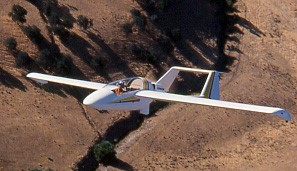
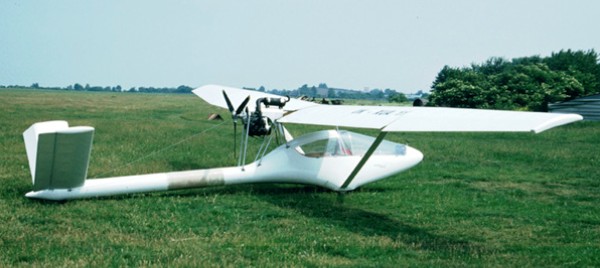
The motorised ultralight sailplane Straton D8 Moby Dick was original driven for a Trabant or Rotax 227-engine. The wood construction V tail design has fibreglass wingtips and weights only 180kg. Like the D7 Mini Straton, the D8 was developed as a homebuilt motorised sail plane in the Czech Republic. It was available in partial kits or factory assembled leading edges, wing spars and ribs. Due to the low cost price, the Straton D8 was an attractive model for the homebuilder. The D8 is not only built in Europe, but also in the U.S.A.
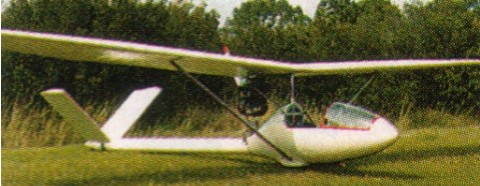
Engine: Trabant, 24 hp
Hp range: 20-32
Max speed: 80 mph
Cruise: 60 mph
Stall: 20 mph
Range: 240 sm
ROC: 550 fpm
TO dist: 250 ft
Ldg dist: 280 ft
Glide ratio: 18-1
Fuel cap: 5 USG
Empty wt: 250 lb
Mtow: 470 lb
Height: 5.5 ft
Length: 20.7 ft
Wingspan: 38 ft
Wing area: 107 sq.ft
Seats: 1
Undercarriage: single wheel.
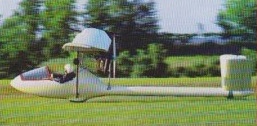
Aero Dovron Mini Straton D-7 / Toresi Straton D7

Toresi Straton D7

This motorglider was designed in the Czech Republic in the late 1980’s. It has been certified by the Czech governing body. It has a glide ratio of 17:1, one man field assembly and takeoff. Engine choices are Trabant or Rotax 277. Available as a kit, for approximately US$6995.

The Toresi Straton D7 has a composite fuselage and fabric covered wooden wings.

Engine: Trabant, 24 hp
HP range: 18-35
Speed max: 80 mph
Cruise: 55 mph
Range: 200 sm
Stall: 25 mph
ROC: 550 fpm
Take-off dist: 150 ft
Landing dist: 180 ft
Fuel cap: 5 USG
Weight empty: 250 lb
Gross: 470 lb
Height: 5.5 ft
Length: 19.68 ft
Wing span: 36 ft
Wing area: 105.5 sq.ft
Seats: 1
Landing gear: single wheel

Toresi Straton D7
Engine: Hirth 263, 30 hp
Wing span: 10.80 m
Wing area: 9.98 sq.m
MAUW: 250 kg
Empty weight: 100 kg
Fuel capacity: 20 lt
Max speed: 125 kph
Cruise speed: 85 kph
Minimum speed: 45 kph
Climb rate: 5 m/s
Certification: VZ
Seats: 1
Fuel consumption: 5.5 lt/hr
Kit price (1998): 55 000 Fttc

Aerodis America G-802 Orion

Orion four-seat composites monoplane, with pusher propeller aft of tail, produced by Jean Grinvalds in 1982. Plans and access to moulds later made available from Club Orion.
The Orion was once scheduled to be manufactured in Texas.
The Orion G-802 is the first four-place, all-composite kit plane to be introduced in the United States. The clean surfaces, complemented by its pusher design, enables the Orion to compile impressive performance stats. Time to completion runs between 600 and 800 hours. The G-802 model of the Orion first flew in November 1983.
Advanced Technology in Aviation (ATA) purchased fuselages and reworked them, mainly strengthening the fuselages with carbon fibre and designing a new wing.
Club Orion in France co-ordinates all activity relating to the Orion.

Engine: Lycoming 180 hp
Hp range: 160-200 hp
Gross weight: 2310 lb
Empty weight: 1340 lb
Fuel capacity: 58.2 USgal
Optional fuel capacity: 106.0 USgal
Wingspan: 29 ft 6 in
Length: 22 ft 5.5 in
Top speed 180 hp: 205 mph
Cruise: 186 mph @ 75 % @ SL
Stall: 56 mph
Climb rate: 985 fpm
Ceiling: 14,850 ft
Takeoff roll (50 ft): 1600ft
Landing roll: 650ft
Range std: 932 sm
Optional range: 1864 sm
Max range: 2283 sm

Aerodis America AA200 Orion

First flown on 2 June 1981, Grinvalds Orion, one of the earliest composite kit- and homebuilt aircraft, was built in France and the USA

A four-seat composites lightplane with tail-mounted propeller

The first one ever built, serial # 001, was the project of Peter L. Rodriguez.

serial # 001                                        Courtesy Peter L. Rodriguez

Aerodis America

Established 1982 to develop AA200 Orion four-seat composites lightplane with tail-mounted propeller, AA300 Rigel tandem two-seat jet trainer, and AA330 Theta single-seat light tactical jet.
The assets of Aerodis were acquired by P.T. Cipta Restu Sarana Svaha of Indonesia in 1991.

Aero Design & Development Hummingbird

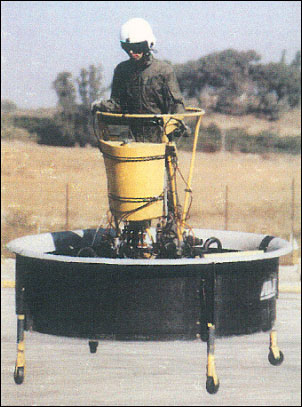
Launched as private venture, reviving concept explored by US Hiller VZ-1 in the 1950s but incorporating new features. The first (tethered) hovering flight was made on 28 August 1997; and the first free (untethered) flight (4X-BEB) 4 October 1998. Availability in kit form was originally planned for 2000.
A naturally stable VTOL platform which can be flown by persons with limited piloting experience. The Hummingbird has full engine redundancy, and can continue flying safely throughout full flight envelope after a single engine failure (initial hovering flights used approximately half of total available power). Air duct has outwards-curved lip on upper surface and diameter to length ratio of approximately 2.75:1.
Vertical speed (rise/descent) is controlled by pilot increasing or reducing rotor rpm via a twist-grip throttle with the left hand. Lateral (sideways) and longitudinal (fore/aft) motion is achieved simply by the pilot tilting his body slightly in desired direction. Maximum allowable speed is attained when pilot’s body reaches limit imposed by circular railing at waist height. The ‘Nose’ of vehicle can be turned by a small lever at pilot’s right hand.
The engines are mounted on four sides of a square gearbox which also serves as pedestal supporting the occupant. Rotors extend from the lower end of gearbox. The engines and propellers are off-the-shelf ultralight components and the circular outer duct is of graphite/epoxy construction.
Four non-retractable, free-castoring single wheels, each with shock-absorbing oleo that can withstand vertical impacts of up to 3.7m/s serve as landing gear.
Four 16.4kW Hirth F33-15A single-cylinder piston engines, each with dual ignition, own carburettor and own fuel line are coupled through torsional dampers and one-way clutches. These drive, via an AD & D gearbox equipped with a chip detector, two three-blade contrarotating propellers/rotors which are synchronised to obtain practically zero yawing moment at all throttle settings.
The Hummingbird accomodates a pilot only, standing inside tubular metal frame.

AD & D Hummingbird
Engines: 4 x Hirth F33-15A, 16.4kW
Diameter: 2.2m
Height overall: 1.9m
Empty weight: 145kg
Max T-O weight: 260kg
never-exceed speed: 74km/h
Hovering ceiling, IGE: 2440m
Hovering ceiling, OGE: 1525m
Range, standard fuel: 31km
Endurance, standard fuel: 30min
Standard fuel capacity: 19 litre

Aero Designs Inc Condor

pilot Dave Morss

The Condor built by ADI in 1981 was a two place, powered sailplane made out of composite materials and powered by a Revmaster 2100 cc VW engine.

The Condor wing has foam ribbing, fibreglass covered, with a single aluminium spar.

While taking off at night, the engine stopped and the aircraft glided into a hill. The aircraft was totally destroyed.

Engine: Revmaster 2100 cc VW, 65 hp
Prop: Fahlin 34 x 58
Span: 32 ft
Length: 17 ft 11 in
Wing area: 130 sq.ft.
MAUW: 1100 lb
Useful load: 520 lb
Max speed: 95 mph est
Stall: 46 mph
Climb rate: 700 fpm

Aero Designs Inc SuperCruiser / KIS TR-4 Cruiser

First flown in 1994, the SuperCruiser is a 4-place aircraft with a cruise speed of 190 mph and a stall speed of 59 mph. The aircraft has a length of 25.46 ft. and wing span of 29 ft. It has a gross weight of 2500 lbs. and a useful load of 1100 lbs. The prototype was powered by a Cont. IO-360ES. Lycoming engines from 160-200 HP are recommended and build time is 1200-1500 hours. Aircraft Spruce is a prime supplier for materials used in Super Cruiser kits.

Pulsar Aircraft Corp SuperCruiser
Engine: Continental IO-360, 210 hp
HP range: 80-210
Cruise speed: 175 mph
Stall: 55 mph
Range: 810 sm
ROC: 1400 fpm
Take-off dist: 900 ft
Landing dist: 1350 ft
Fuel cap: 52 USG
Weight empty: 1300 lb
Gross weight: 2400 lb
Length: 23.5 ft
Wing span: 29 ft
Wing area: 135 sq.ft
Seats: 4
Landing gear: nose

KIS TR-4 SuperCruiser
Engine: Lycoming O-360, 180 hp
Speed max: 195 mph
Cruise: 180 mph
Range: 925 sm
Stall: 50 mph
ROC: 1200 fpm
Take-off dist: 1200 ft
Landing dist: 1500 ft
Service ceiling: 17,000 ft
HP range: 160-200
Fuel cap: 200-400 lt
Weight empty: 1200 lb
Gross: 2400 lb
Height: 7.2 ft
Length: 25 ft
Wing span: 29 ft
Wing area: 135 sq.ft
Seats: 4
Landing gear: nose wheel

KIS TR-4 SuperCruiser
Engine: Continental IO-360ES
MTOW: 2500 lb
Cruise: 145 kt

KIS TR-4 SuperCruiser
Engine: Continental IO-300ES
Cruise: 165 kt
Seats: 4