Airbus Industries A320

Essentially an all-new design the A320 was first launched on 23 March 1984, and developed around a digital fly-by-wire flight control system with sidestick controllers, and a gust alleviation function for a smoother ride and greater fatigue life. The roll out of the A320 took place on 14 February 1987 and the aircraft made its first flight on 22 February 1987 from Toulouse with CFM56 engines. European certification followed 12 months later and Air France took the first delivery on 28 March 1988 and began service in April 1988. The A320 has seating for 150 to 179 passengers and the ability to take standard baggage containers. The type was certificated in 1989 for operations with the IAE V2500 high technology engine.

Airbus Industries A320 Article

The A320 was ordered by launch customer, British Caledonian, in 1984, and entered the British Airways fleet after the takeover of British Caledonian in April 1988.
Ten were in British Airways service, five of the initial A320-100 and five A320-200.

Initially the A320-100 was completed as a low gross weight aircraft, but Airbus introduced the A320-200 aircraft, with wing tip fences, a wing centre section fuel tank, and a higher MTOW. This boosted maximum range to 2,865 nm and in the end only 21 A320-100s were built. In June 1993 Airbus also decided to move the A320 family production line from Toulouse, France, to Hamburg, Germany.

In 2001, in his association with the directorship of RMI Titanium Co, Neil Armstrong flew an A320 at Airbus’s headquarters in Toulouse, France.

The 3000th A320 family – delivered 18 Jan 2007.

Gallery

A320
Engines: 2 x CFM56-5-A1 turbofans, 111.2kN
Take-off weight: 73500-77000 kg / 162041 – 169757 lb
Empty weight: 41900 kg / 92374 lb
Payload: 19100kg / 42109 lb
Wingspan: 34.1 m / 111 ft 11 in
Length: 37.6 m / 123 ft 4 in
Wing area: 122 sq.m / 1313.20 sq ft
Cruise speed: 850 km/h / 528 mph
Range: 4800-5500 km / 2983 – 3418 miles
Crew: 2
Passengers: 150-180

A320
Engines: 2 x International Aero Engines V2500
Wing span: 33.91m
Wing area: 122.4 sq.m
Pax cap: 185

A320-231
Engines: IAE V2500-A1

A320-232
Engines: 2 x IAE V2527-A5, 26,500 lb
Cruise: M0.79
Range: 2900nm

A320-200
Range: 2865 nm
Pax cap: 185
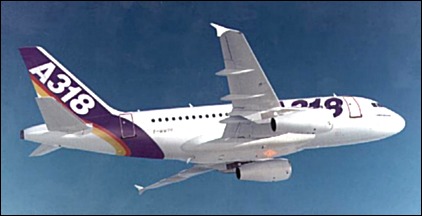
Airbus Industries A318

The 100-seat A318 is 6.12 m shorter than the A320 and was launched on 26 April 1999. The type first flew from Finkenwerder Airfield at Hamburg, on 15 January 2002, piloted by Bernd Schaefer.

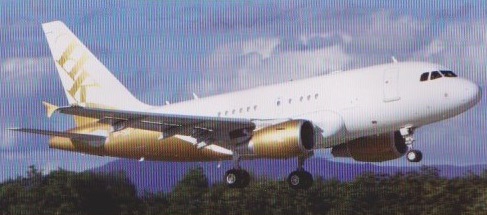
Airbus A318-112 Elite VP-CKH

The A318 Elite, based on the smallest model in the A320 family, was available in two standard interior configurations. For 14 or 18 passengers, it has a range of up to 4000 nm / 7410 km carrying 8 passengers. The first Elite flew in October 2006 and was delivered to Comlux.

Gallery

A318
Engines: 2 x Pratt-Whitney PW6000, 98-107kN
Wingspan: 34.1 m / 111 ft 11 in
Length: 31.4 m / 103 ft 0 in
Height: 12.6 m / 41 ft 4 in
Wing area: 122 sq.m / 1313.20 sq ft
Take-off weight: 59000-61500 kg / 130073 – 135585 lb
Empty weight: 38900 kg / 85760 lb
Payload: 14000kg / 30865 lb
Max. speed: 0.82M
Cruise speed: 0.78M
Range w/max.payload: 2750-3700 km / 1709 – 2299 miles
Crew: 2
Passengers: 107-129

Engines: CFM56-5
Pax cap: 107

Airbus Industries A310

Realising the A300B2 was larger than required, Lufthansa pressed Airbus for a 200 passenger wide-body. Lufthansa insisted on the use of new technology, and made considerable contribution to the newbA310, incorporating a two-crew digital flight deck and extensive use of composite materials.

Airbus Industries A310 Article

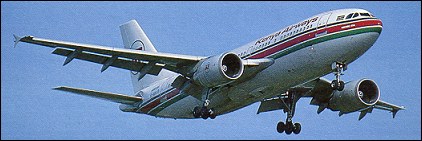
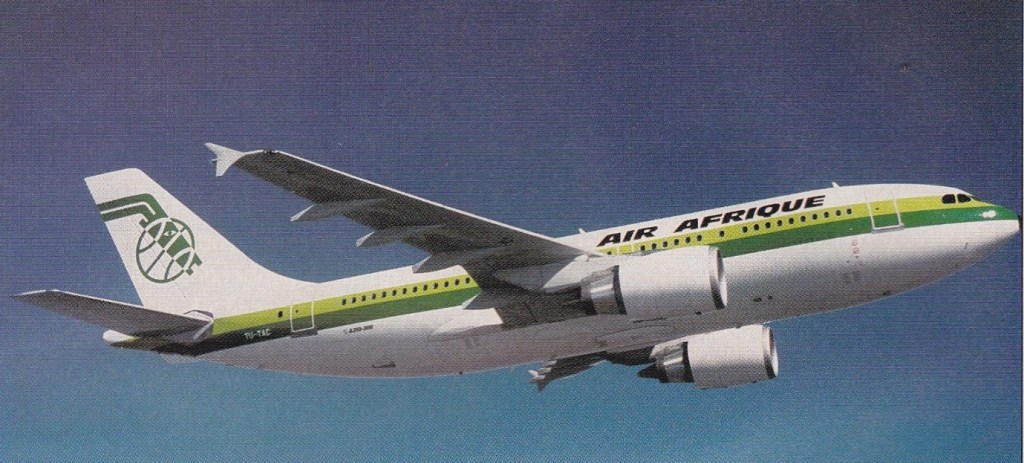
While the A300 was under development, Airbus looked at a smaller capacity variant. The A310 was officially launched in July 1978, offering a capacity between 210 to 250 passengers in mixed-class layouts. The second aircraft of Airbus, the A310-200 has a shorter fuselage than the A300 and first flew on 3 April 1982 as a 191-280 short/medium-range wide-body airliner. French and West German certification was received on 11 March 1983 and in April 1983 the launch customers Lufthansa and Swissair began services.

Lufthansa, jointly with Swissair, became the launch customer of the A310-200, ordering 25. Plus 25 options in a US$1.5 billion deal. The A310-300 began transatlantic service with Lufthansa in March 1990.
The fuselage was essentially the same as that of the A300, except shorter, allowing the development and manufacturing costs to be kept down. The wing and horizontal tail surfaces were new, including a high technology wing from BAe of much reduced area and span. The cockpit was a forward-facing two-man area, with advanced digital avionics.
Since May 1986 the basic production version, the A310-200, have been delivered with drag-reducing wingtip fences. The A310-200C and A310-200F are convertible and all-cargo versions respectively. The first major variant was the A310-300 with extended range. First flying on 8 July 1985, this variant has wingtip fences as standard, additional fuel in the tailplane and an optional central tank fitted in part of the cargo hold. Swissair was the first customer.

A310-300

Biman Banglades Airlines ordered two A310-300s from Airbus on 31 January 1995. The 221 passenger aircraft were delivered on 13 June and 19 August 1996.
The first A310 to be converted to an in-flight refuelling role was revealed at Dresden, Germany in 2004. The A310MRTT has pods added to the outer ends of its wings and four auxiliary tank/containers installed in the lower cargo hold. The aircraft can also be used as an airborne hospital with up to six intensive care units and 56 stretchers or, as a combined cargo and troop transport version, can carry 12 pallets and 54 troops.
Airbus indicates additional fuel cells with the abbreviation ACT (Additional Centre Tank), first used on the A300 600 and A310 300. This tank is installed in the forward part of the rear hold, aft of the main landing gear bay, and displaces two LD3 containers. (An additional tank may also be installed at the expense of more baggage/cargo space.)

A310
Engines: 2 x Pratt & Whitney PW4152 turbofans, 220kN
Take-off weight: 157000 kg / 346128 lb
Empty weight: 70275 kg / 154931 lb
Wingspan: 43.89 m / 143 ft 12 in
Length: 46.66 m / 153 ft 1 in
Wing area: 219 sq.m / 2357.29 sq ft
Max. speed: 1038 km/h / 645 mph
Cruise speed: 850 km/h / 528 mph
Range: 9175 km / 5701 miles
Crew: 2
Passengers: 210-250

A310-300
Engines: 2 x Pratt & Whitney PW4152 turbofan, 52,000lbs thrust OR General Electric CF6-80C2A2 turbofan, 52,000lbs of thrust.
Length: 153.08ft (46.66m)
Width: 144.03ft (43.90m)
Height: 51.84ft (15.80m)
Empty Weight: 178,111lbs (80,790kg)
Maximum Take-Off Weight: 361,556lbs (163,999kg)
Maximum Speed: 560mph / 902kmh / 487kt
Maximum Range: 5,965miles (9,600km)
Service Ceiling: 42,651ft (13,000m)
Accommodation: 8 + 220

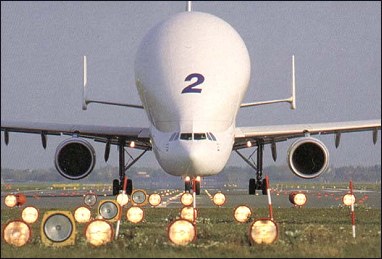
Airbus Industries A300-600ST Beluga

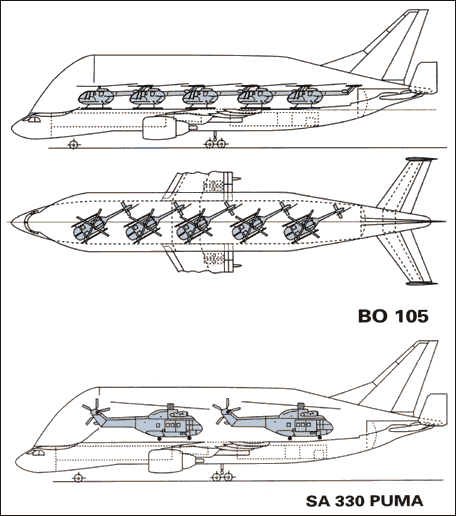
Special Aircraft Transport International Company GIE, formed October 1991 as joint venture between Aerospatiale of France and Daimler-Benz Aerospace Airbus of Germany to develop a successor to the Super Guppy outsized freighter used to carry large Airbus airliner assemblies between factories in Europe.

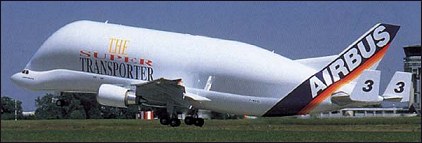
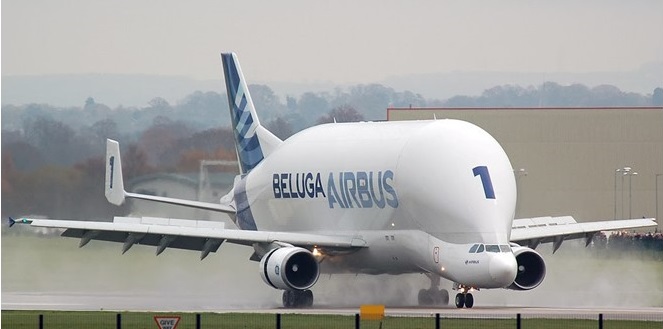
Resulting A300-600ST Super Transporter, known also as Beluga, based on A300-600R but with many important modifications including a completely new upper fuselage section to provide a freight hold of 24 ft 3 in (7.4 m) cross-section, with access via the largest door ever installed on an aircraft (upward-opening); cockpit moved forward and below cargo deck; new tailplane with endfins.

Airbus Beluga F-GXLH

The first A300-600ST Super Transporter flew on September 13, 1994, and after 335 test hours, was certified in October 1995. This aircraft went into service in January 1996. The second Beluga first flew on March 26, 1996 and the third on April 21, 1997 (last of five ordered for delivery in 2001). The Belugas took over the complete ferrying operations for Airbus major assemblies in October 1996.

The cockpit has been lowered to get a platform for easier loading, and the A300-600 is equipped with a 100% digital control system (fly-by-wire). With its internal diameter of 7.62m, the Beluga can of carry a set of A340 wings or two pairs of wings for the A320.

Airbus A300-600ST “Beluga” F-GSTA

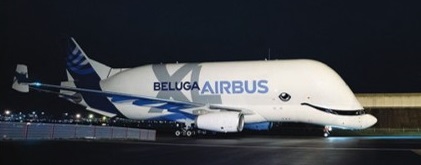
As Airbus Industries grew, its fleet of Belugas became no longer sufficient and as a result the XL model was developed with a 35% bigger capacity. The fuselage is almost 7m longer than the earlier version and wider than than of an A380. As soon as certified the Beluga XL flew from Bremen to Chester, UK, where Airbus wings are built. The XL is able to transport two A350 wings.

Beluga XL

Gallery

Airbus / SATIC A 300-600 ST Beluga
Engine : 2 x General Electric CF6-80C2A8, 257463 N
Length: 184.245 ft / 56.158 m
Height: 56.562 ft / 17.24 m
Wingspan : 147.1 ft / 44.836 m
Max take off weight : 330750.0 lb / 150000.0 kg
Max. payload weight : 100327.5 lb / 45500.0 kg
Max. speed : 420 kts / 778 km/h
Range : 900 nm / 1666 km
Hold cap: 49,440 cu.ft

Airbus Industries

Airbus Industries was first established on 29 May 1969, after the signing of a Franco-German agreement to go ahead with the Airbus 300. In December 1970, Airbus Industries was registered under French law as a GIE ( Groupement d’Intérêt Economique ) under the leadership of the ‘Airbus Founding Fathers’ – Franz-Josef Strauss, Henri Ziegler, Robert Bateille and Felix Kracht.

The first delivery of a production A300 was made in My 1974 to Air France.

The A300 programme, launched in May 1969, was initially a Franco-German venture, with the British aircraft industry participating on a private basis. Airbus Industrie, the organisation which was responsible for the management, marketing, sales and product support of the programme, was created in December 1970 as an equal partnership between Aerospatiale of France and Deutsche Airbus GmbH of Germany. The organisation was based at Toulouse, in the South of France, where it remains. Casa of Spain joined in 1971and in 1979 British Aerospace joined as a full partner. The consortium was owned by Aerospatiale of France (37.9 percent), DaimlerChrysler of Germany (37.9 percent), British Aerospace (20 percent) and CASA of Spain (4.2 percent), which are also the main industrial participants in design, development, and manufacture. Associate members of the consortium are Belairbus of Belgium and Fokker Aviation of the Netherlands.
Airbus Industrie was restructured into a limited-liability company in 1999, divisions included Airbus Industrie Asia, formed with Alenia of Italy to develop a new airliner in partnership with AVIC of China and ST Aero of Singapore; Airbus Military Company to develop the FLA military freighter (taking over from former Euroflag; and Large Aircraft, founded in 1996 to progress work on the ultra-large A3XX airliner.
On 11 July 2001, EADS and BAE Systems completed the final procedures to make the new integrated Airbus company a formal legal entity.

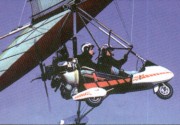
Airborne Windsports Blitz

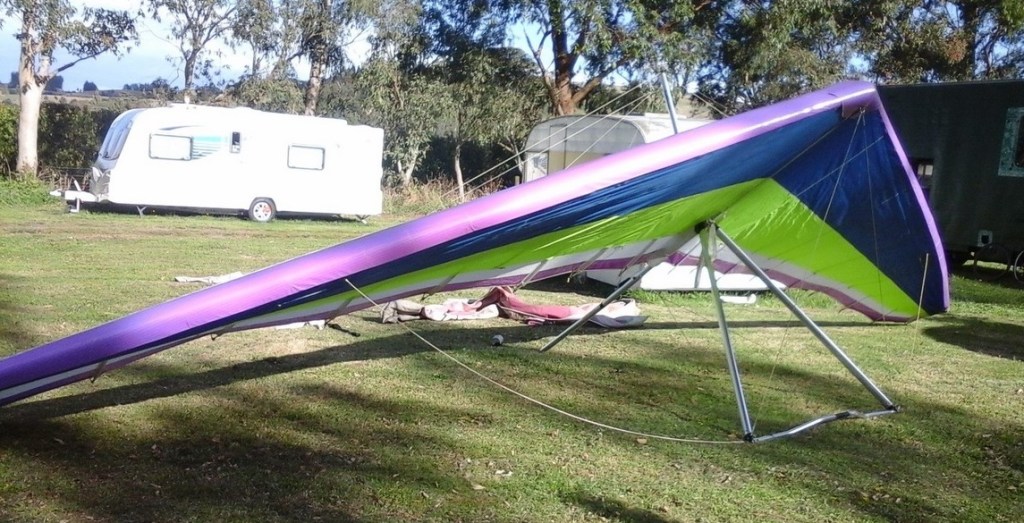
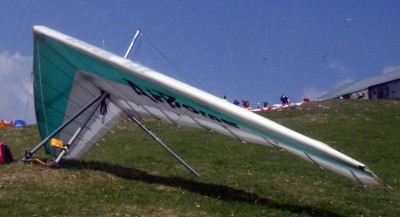
Airbourne Blitz 137

A 1992 hang glider for intermediate pilots, the Blitz is described as a very good wing. The glider handles nice and easy, good on towing (no yaws). Just one thing is not so pleasant, it’s when you approach landing don’t take too much speed (unless you VG is pulled enough) because glider starts to yaw, if you do so pull your VG (polispast) more. But the glider is very good.

Blitz 137
Wing area: 12.76 m²
Wing span: 9.36 m
Aspect ratio: 6.9
Hang glider weight: 29 kg
Minimum pilot weight: 45 kg
Maximum pilot weight: 65 kg
Packed length: 5.3 m
Packed length short: 3.8 m
Number of battens: 27
Nose angle: 127°

Blitz 146
Wing area: 13.6 m²
Wing span: 9.75 m
Aspect ratio: 6.9
Hang glider weight: 31 kg
Minimum pilot weight: 55 kg
Maximum pilot weight: 80 kg
Packed length: 5.6 m
Packed length short: 4.1 m
Number of battens: 29
Nose angle: 127°

Blitz 155
Wing area: 14.37 m²
Wing span: 10.1 m
Aspect ratio: 7.1
Hang glider weight: 33 kg
Minimum pilot weight: 60 kg
Maximum pilot weight: 95kg
Packed length: 5.7 m
Packed length short: 4.3 m
Number of battens: 29
Nose angle: 127°

Airborne Windsports Edge

Edge XT

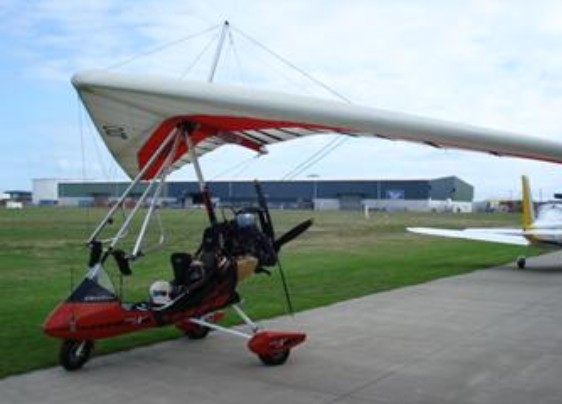
The Edge trike unit was offered circa 1998 with a wing of the same name; a double surface design.

Edge / Edge

The Airborne Windsports Edge XT-912 microlight is manufactured in Australia and designed to British Civil Airworthiness Requirements Section S – Small Light Aeroplanes (BCAR-S).
The microlight type was issued with a Type Certificate, Number VA513, by the Australian Civil Aviation Safety Authority on 16 December 2004.

Edge X

Gallery

Edge 582E / Executive
Engine: Rotax 582, 54 hp
Speed max: 82 mph
Cruise: 57 mph
Range: 200 sm
Stall: 32 mph
ROC: 1500 fpm
Take-off dist: 75 ft
Landing dist: 100 ft
Service ceiling: 18,000 ft
Fuel cap: 10 USG
Weight empty: 400 lb
Wing span: 33.46 ft
Wing area: 167 sq.ft
Seats: 2
Landing gear: nose wheel

Edge X
Engine: Rotax 503, 46 hp
Speed max: 62 mph
Cruise: 45 mph
Range: 200 sm
Stall: 32 mph
ROC: 1500 fpm
Take-off dist: 75 ft
Landing dist: 75 ft
Service ceiling: 18,000 ft
Fuel cap: 12.7 USG
Weight empty: 407 lb
MTOW: 882 lb
Wing span: 33.3 ft
Wing area: 164 sq.ft
Seats: 2
Landing gear: nose wheel

Edge X 582

Edge / Edge
Empty weight: 171 kg
Wing span: 10.14 m
Wing area: 15.2 sq.m
Fuel capacity: 46 lt
Certification: Aust.
Engine: Rotax 582 DCDI, 64 hp
MAUW: 401 kg
Seats: 2
Max speed: 120 kph
Cruise speed: 93 kph
Minimum speed: 55 kph
Climb rate: 3.8 m/s
Fuel consumption: 12 lt/hr
Price (1998): Aust$19,272

Airborne Windsports Explorer II

The Explorer trike was available as a single seat ultralight or a two seat trainer. The 2-place version has also been used to air tow hang gliders via a unique towing bridle. The Explorer can be dismantled for roof top tranporting or can easily fit into the back of the family station wagon.

Engine: Fuji Robin 280 or 440
Wing: Moyes Delta glider 220
Weight: 85kg / l10kgs
Econ cruise speed: 20 kts
Stall: l0kts