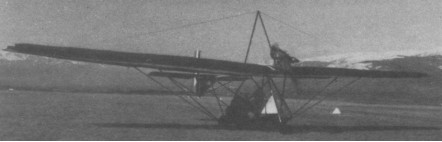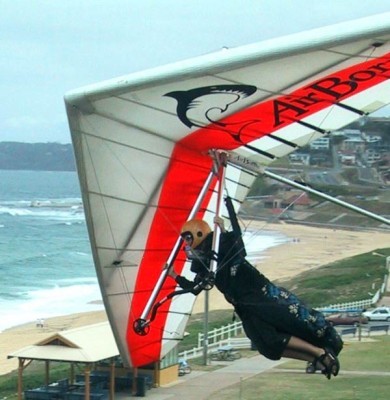
Airborne Windsports Shark

The Shark first appeared in 1996. A kingpostless design the Shark’s speed and handling improved without compromising proven strength and dive recovery.

The Shark (rated Int/Adv) gives solid stability at speed, tight wires (in all VG settings) for safer launching, light to pull VG, sprung battens for a clean trailing edge, a 7 minute rigging (both flat or up), a 7075 airframe with 7075 battens, USHGMA certification and optional folding speedbar.

VB is cam type so the wing wires always remain tight which is fantastic for ground handling and confident take offs. This glider is easy in turns and to land. Both responsive and stable in bumpy air, it makes it a good glider for aero towing or difficult/small conditions.

The Shark 156 wing was large but remained very manageable and the performance was there. Very stable in turbulent conditions. It’s a well made glider and lovely to fly. It can be thermalled even with the VB fully pulled on, so not the tightest highest performing sail, but the compromise is inspirational.

The Airborne’s shark is not being produced anymore.
Shark 132
Wing area: 12.3 m²
Wing span: 9.36 m
Aspect ratio: 7.2
Hang glider weight: 28 kg
Minimum pilot weight: 50 kg
Maximum pilot weight: 85 kg
Minimum speed: 30 km/h
Maximum speed: 85 km/h
Packed length: 5.3 m
Packed length short: 3.7 m
Number of battens: 29
Nose angle: 127°

Shark 144
Wing area: 13.4 m²
Wing span: 9.71 m
Aspect ratio: 7.2
Hang glider weight: 32 kg
Minimum pilot weight: 65 kg
Maximum pilot weight: 105 kg
Minimum speed: 30 km/h
Maximum speed: 85 km/h
Packed length: 5.5 m
Packed length short: 3.9 m
Number of battens: 29
Nose angle: 127°

Shark 156
Wing area: 14.6 m²
Wing span: 10.36 m
Aspect ratio: 7.3
Hang glider weight: 35 kg
Minimum pilot weight: 80 kg
Maximum pilot weight: 125 kg
Minimum speed: 30 km/h
Maximum speed: 85 km/h
Packed length: 5.9 m
Packed length short: 4.2 m
Number of battens: 31
Nose angle: 127°
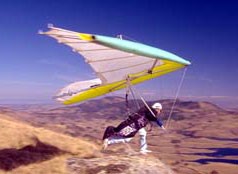
Airborne Windsports Buzz

Hang glider circa 1998. Described as easy to fly, but there have been issues of unintentional slipping 360’s.

Buzz 140
Wing area: 13.03 sq.m
Pilot weight: 50-75 kg
Wing span: 8.0 m
Nose angle: 118 deg
Aspect ratio: 5.3
Price (1998) AUS$2705

Buzz 154
Wing area: 14.33 sq.m
Pilot weight: 60-95 kg
Wing span: 8. 2 m
Nose angle: 118 deg
Aspect ratio: 5.6
Price (1998) AUS$2705

Airborne Windsports Pty.

Airborne started trading as a company in 1983 and operated out of Redhead near Newcastle Australia. Airborne directly employs 30 people and exported to more than 30 countries in 2009. Founders Shane, Ricky and Russell Duncan were the sons of keen water skier and hang glider pilots Anne and Kevin Duncan. Anne and Kev taught the boys to ski and then to fly in the earlydays of tow kites. At the time the boys were as young as 12 years. Kevin was into flying competition. He flew a 1000 foot per minute sink rate tow kite. The aim was to complete as many 360 degree turns before touching down on the water.
Glider design was improving rapidly and before long true foot launch hang gliders were developed and the boys were soon launching off coastal dunes and then cliffs.
The Duncan brothers regularly competed in overseas hang gliding comps. To supplement their income they started to teach hang gliding under the name of Airborne Windsports Pty Ltd. Another partner and friend Chris Brandon was also part of the company.
Airborne imported a microlight (trike) from the UK in the early 80’s. It was to be used as a means to launch hang gliders. The Duncans with their mechanical backgrounds soon designed a purpose built two seater microlight which could be used for taking passengers and training.
1985: Airborne Windsports Pty Ltd,. 39 Grif¬fith St, Charlestown, NSW 2290. Australia.
In 1987 the government Horscotts inquiry into ultralight accidents changed the way manufacturers developed and sold ultralights. Airborne were already load testing wings and had never had problems with structural failure. This came out in the inquiry along with other evidence and subsequently the rules changed. Manufacturers were then required to certify to a standard.
Certification of the Edge model microlight proceeded. Paul Mollison engineer and keen hang glider pilot joined the company. Paul became the technical director and was responsible for writing the standard, which became CASA document called CAO 95.32.
Around the same time Rob Hibberd who was also flying hang gliders joined Airborne as a Director. The now six partners continued to re-design the Edge microlight so that it would comply with the new standard. Meanwhile all were still flying hang gliding comps and supplementing their income through sponsorships and teaching hang gliding and microlight flying. Airborne was still yet to produce a hang glider.
A 3 car garage was where Airborne’s serious manufacturing started, then became too small and the company moved to a “real” factory. Airborne then ventured into glider design and produced an intermediate glider called the Breeze.
Airborne certifies designs to Australian Civil Aviation and UK Civil Aviation standards. Airborne holds production approvals from the Australian Civil Aviation Safety Authority (CASA).
A crop spraying system has been developed to use on Airborne microlights for a low cost option for aerial spraying of crops.
1998: 12/30 Kalaroo Rd, NSW 2290 Redhead, Australia.

Air-Am Aviation Hornet

The Hornet is a tailless flying wing of composite construction and powered by a Konig driven ducted fan mounted behind the enclosed cockpit. The aircraft sits on a reverse tricycle undercarriage to enhance its rough strip capabilities. The large wing folds back either side of the fuselage to facilitate storage and trailering.

Engine: Konig 3-cyl
Prop: ducted fan
Wing span: 7.9 m
Wing area: 10 sq m
Length: 3m
Weight: 114kg
Cruise speed: 85 kt
Stall: 30 kt

AILE PX-2000

Single seat single engined high wing monoplane with conventional three axis control. Wing has swept back leading and trailing edges, and constant chord; cruciform tail. Pitch control by elevator on tail; yaw control by fin mounted rudder; roll control by fullspan ailerons; control inputs through stick for pitch/roll and pedals for yaw. Wing braced from above by kingpost and cables, from below by cables and struts; wing profile Clark Y; double surface. Undercarriage has three wheels in tricycle formation with additional tailskid; rubber suspension on nosewheel and steel spring suspension on main wheels. Push-right go right nosewheel steering connected to yaw control. Optional brakes on main wheels. Aluminium tube framework, partially enclosed. Engine mounted above wing driving tractor propeller.
The PX2000 design studies began in December 1982 following an idea of Patrick Lemonnier. The construction of the prototype was begun in February 1983 and it made its first flight on the 3 April. Its test programme included as much static testing as flight testing, static tests being entrusted to Ingenerie Technique Atlantique (ITA), a specialist aeronautical and marine laboratory.
By 1982 the single seater had already largely confirmed the calculated performance figures. The figures quoted below correspond to the prototype which is fitted with a Fuji Robin EC44 2PM, hand started and developing 43 hp. It was tested without the glass fibre pod with polycarbonate windscreen, and the three wheel fairings which will be fitted to the production models.

Engine: Robin EC442PM, 53 hp at 6750 rpm
Prop¬eller diameter 65 inch, 1.64m
Toothed belt reduction, ratio 2.5/1
Max static thrust 309 lb, 140 kg
Power per unit, area 0.39hp/sq.ft, 4.2 hp/sq.m
Fuel capacity 1.8 US gal, 6.6 Imp gal, 30.0 litre
Length overall 17.5 ft, 5. 30 m
Height overall 7.9ft, 2.40m
Wing span 29.9ft, 9.10m
Chord at root 4.3ft, 1.29 m
Chord at tip 2.7ft, 0.82m
Dihedral 2 deg
Sweepback 5 deg
Tailplane span 8.7 ft, 2.61 m
Fin height 3.9 ft, 1.20 m
Total wing area 136 sq.ft, 12.6 sq.m
Total aileron area 31.5 sq.ft, 2.92 sq.m
Fin area 9.1 sq.ft, 0.85 sq.m
Rudder area 7.5 sq.ft, 0.70 sq.m
Tail¬plane area 12.7sq.ft, 1.18 sq.m
Total elevator area 10.3 sq.ft, 0.96 sq.m
Wing aspect ratio 6.59/1
Wheel track 4.7 ft, 1.40 m
Wheelbase 4.7 ft, 1.40 m
Nosewheel diameter overall 10 inch, 25 cm
Main wheels diameter overall 12 inch, 30cm
Empty weight 3091b, 140kg
Max take off weight 574 lb, 260kg
Payload 265 lb, 120kg
Max wing loading 4.24 lb/sq.ft, 20.7 kg/sq.m
Max power loading 10.83 lb/hp, 4.9kg/hp
Load factors; +6.0, 4.0 ultimate
Max level speed 87mph, 140kph
Never exceed speed 106mph, 170kph
Max cruising speed 81mph, 130kph
Economic cruising speed 65mph, 105kph
Stalling speed 22mph, 35kph
Max climb rate at sea level 1000ft/min, 5.1m/s
Min sink rate 400fpm at 34 mph, 2.0 m/s at 55 kph
Best glide ratio with power off 10/1 at 37mph, 60kph
Take off distance 115 ft, 35 m
Landing distance 131 ft, 40 m
Service ceiling 10,000 ft, 3050 m
Range at average cruising speed 218 mile, 350km

AILE Patrilor 3

Side by side two seat single engined high¬wing monoplane with conventional three axis control. Wing has swept back leading edge, swept forward trailing edge and tapering chord; cruciform tail. Pitch control by elevator on tail; yaw control by fully flying rudder; roll control by ailerons; control inputs through stick for pitch/roll and pedals for yaw. Wing braced from above by kingpost and cables, from below by struts; wing profile double surface. Undercarriage has three wheels in tricycle formation; no suspension on any wheels. Push right go right nosewheel steering connected to yaw control. No brakes. Aluminium tube framework, with optional pod. Engine mounted above wing driving tractor propeller.
A Patrick Lemonnier design, the Patrilor 3 two seater was assembled without any prior engineering drawings, in his automotive repair and panel beating shop.
Prototype 01 made its first flight at the end of May 1982 and was shown at the end of July at the Brienne amateur constructors’ convention. Number 02 then appeared but prematurely terminated its career with a dicey landing and was followed by a number 03, which successfully completed the first London to Paris in the hands of Jacques Toulorge.
Production models have been on sale since November 1982 and have met with exception¬al success. The company, in April 1983, added to this strut braced machine a kingpost and landing wires, which give increased structural integrity and which have the secondary effect of improving aileron efficiency by stiffening the wing. This machine is therefore now one of those rare aircraft which use two struts in a V to support each wing plus wires stiffening it from above.
In standard form the Patrilor 3 is delivered built and tested by the manufacturer. It is deriggable by one person in 20 min and trailer transportable. The folded dimensions are 21.8 x 6.2 x 8. 0 ft (6.60 x 1. 88 x 2.45 m). Options include a fairing for the forward part of the framework (made of transparent polycarbonate), dual controls, carburettor heat kit, plus an instrument panel with basic instruments. Additionally, the standard Hirth engine can be replaced by the Robin EC44 2PM of 53 hp. Planned is a second model, the Patrilor 3bis with flaps, and a crop spraying version named Agrilor. For North America, Patrilors are delivered as kits and the 40 h building time is the responsibility of the dealer.

Engine: Hirth 2701R, 43 hp at 6750 rprn
Propeller diameter 56 inch, 1.42 m
Toothed belt reduction, ratio 2.5/1
Max static thrust 254 lb, 115 kg
Power per unit area 0.18hp/sq.ft, 2.0hp/sq.m
Fuel capacity 8.5 US gal, 7.0 Imp gal, 32.0 litre
Length overall 19.4 ft, 5.90 m
Height overall 8.0ft, 2.45m
Wing span 38.7ft, 11.75m
Chord at root 5.5ft, 1.64m
Chord at tip 3.5ft, 1.05m
Dihedral 3 deg
Sweepback 8deg
Tailplane span 11.1 ft, 3.38 m
Total wing area 233 sq.ft, 21.6 sq.m
Total aileron area 17.2 sq.ft, 1.60 sq.m
Rudder area 8.2 sq.ft, 0.76 sq.m
Tail¬plane area 17.2 sq.ft, 1.60sq.m
Total elevator area 11.8sq.ft, 1.10 sq.m
Wing aspect ratio 6.4/1
Wheel track 5.6ft, 1.72m
Wheelbase 6.2ft, 1.88m
Tailwheel diameter overall 10 inch, 25 cm
Main wheels diameter overall 16 inch, 40 cm
Empty weight 320 lb, 145 kg
Max take off weight 707 lb, 320 kg
Payload 387 lb, 175 kg
Max wing loading 3.03 lb/sq.ft, 14.8 kg/sq.m
Max power loading 16.4 lb/hp, 7.4 kg/hp
Load factors; +4.5, 3.8 ultimate
Max level speed 56 mph, 90 kph
Never exceed speed 68 mph, 110 kph
Max cruising speed 50 mph, 80 kph
Economic cruising speed 43mph, 70kph
Stalling speed 22 mph, 35 kph
Max climb rate at sea level 500 ft/min, 2.5 m/s
Min sink rate 600 fpm @ 24 mph, 3.0 m/s @ 40 kph
Best glide ratio with power off 8/1 at 37 mph, 60 kph
Take off distance 115 ft, 35 m
Land¬ing distance 115 ft, 35 m
Service ceiling 10,000ft, 3050 m
Range at average cruising speed 125 mile, 200 km

Aiera Tension

Paraglider circa 1998.

Tension M
Wing area: 29.7 sq.m
Certification: DHV 2-3/Afnor
Pilot weight: 75/90 kg
No. of cells: 57
Wing span: 13.2 m
Aspect ratio: 5.8
Max speed: 50kph
Price (1998) 2,499 Pounds

Tension S
Wing area: 26 sq.m
Certification: DHV 2-3GH/Afnor
Pilot weight: 55/80 kg
No. of cells: 57
Wing span: 12.3 m
Aspect ratio: 5.8
Max speed: 50kph
Price (1998) 2,499 Pounds

Tension L
Wing area: 32.5 sq.m
Certification: DHV 2-3/Afnor
Pilot weight: 85/115 kg
No. of cells: 57
Wing span: 13.7 m
Aspect ratio: 5.8
Max speed: 50kph
Price (1998) 2,499 Pounds