First introduced in 1991.
Hilite 36
Hilite II
Hilite III circa 1997
First introduced in 1991.
Hilite 36
Hilite II
Hilite III circa 1997

A 7 or 9 cell paraglider produced in 1986. The first paraglider produced by Apco.
APCO has been involved in the paragliding industry from the very beginning. Anatoly Cohn, the company’s owner and founder, started in hang gliding, designing and building gliders from 1976 with Agur Gliders until 1982 when he founded APCO. He quickly realized that paragliding was the direction for sport flying and concentrated on developing quality gliders at a competitive price. Since that time the company has steadily grown, employing 60 people in 1996 and producing thousands of paragliders, harnesses and parachute reserve systems every year.
PO Box 2124
Holon 58121
Israel
The first paraglider produced by APCO was the 7 or 9 cell System K, staring in 1986. By 1996, a mere ten years later, APCO was producing an average of 3 new models a year and had already picked up 6 world records on its wings. A trend which was to continue into the next decade. By the beginning of 2006 APCO had brought out more than 40 models of paragliders and now has 11 world records set on APCO wings.
Apco produced over 2000 wings in 1997.
1998: Chalamish St .7, Industrial Park, ISR-389000 Caesarea, Israel.
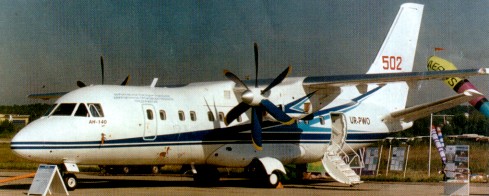
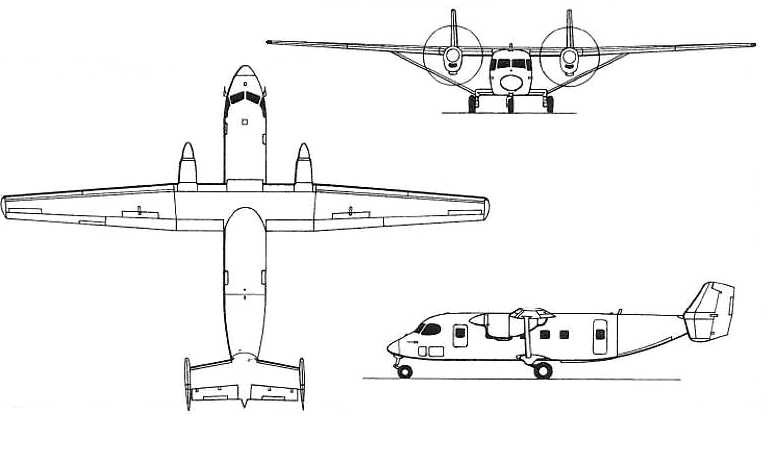
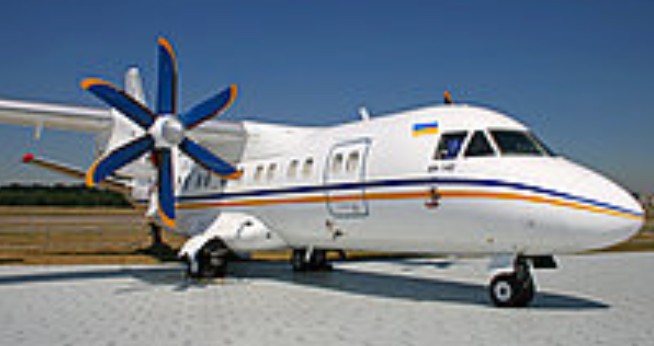
The An-140 (first flown September 1997) short-haul regional airliner was planned to supersede the An-24.
An agreement for licence production by Iranian Aviation called ‘Iran-140’ was signed in 1993. The first aircraft, supplied as a kit, flew on 7 February 2001.
Seats: 46-52.
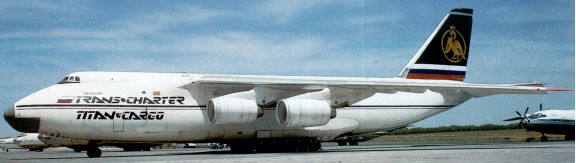
The An-124 strategic airlifter, Nato code name Condor, first flew on December 26, 1982 with Vladimir Terski at the controls, and at least nine had been built by June 1987. At the time of its first flight, the An-124 was the largest aircraft in the world.
The An-124 is powered by four 230kN-thrust Lotarev D-18T high-bypass turbofans, and is claimed to carry its 150-tonne maximum payload over 4,500km. Designed for simultaneous nose and tail loading, with a visor-type lifting nose and integral forward-folding ramp, the pressurised cargo hold is 36m long, 6.4m wide, and 4.4m high. A pressurised upper deck can accommodate 88 passengers.
The An-124 has a six-man crew (two pilots, two engineers, a navigator and a radio operator), dual weather and ground mapping raders, quadruplex inertial navigation, and anologue fly-by-wire controls with mechanical backup operating hydraulic control servos.
Two overhead travelling cranes, which have a lifting capacity of 30 tonnes, and two winches allow heavy cargo to be self-loaded without the use of special airport loading equipment.
To enable the carriage of extremely heavy cargo, HeavyLift-Volga-Dnepr have developed special loading systems allowing individual items of up to 100 tonnes to be loaded. In addition, two double-deck car-racking systems have been built allowing up to 50 cars to be carried in one flight.
Approximately 5,500kg of composite materials are used in doors, fairings, and panels, including 3,000kg of carbonfibre, giving a 1,800kg overall weight saving.
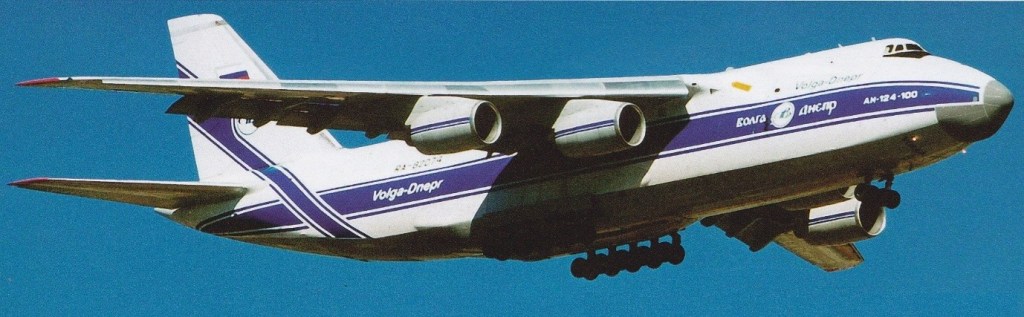
The second aircraft, named Ruslan, appeared at the 1985 Paris Air Salon. The aircraft entered service with Aeroflot in early 1986, and now serves principally on the Siberian run, carrying outsize items to the oil and mineral exploitation industries. In 1987 the An-124 began service with the air force. Production is reportedly eight to ten aircraft per year, and by 1989 over 25 had been completed. The An-124 was assigned the NATO reporting name ‘Condor’.
The An-124-100 is a civil varient, certified in Russia. They are built one at a time and take about three and a half years to construct. Its 24-wheel undercarriage allow it to go into semi-prepared strips and the two nose-wheel units can be retracted on the ground allowing the aircraft to ‘kneel’ to assist loading. The large undercarriage system, the full-span, leading-edge slats and flaps give the An-124 very good short field performance.
Full-span leading-edge slats and large flaps give the An-124 short field capability, while its 20 main wheels allow the type to use rough fields..
Civil examples were with Antonov Air Foyle, HeavyLift Volga Dnepr and the Russian-Australian joint venture, Antonov Airlines.
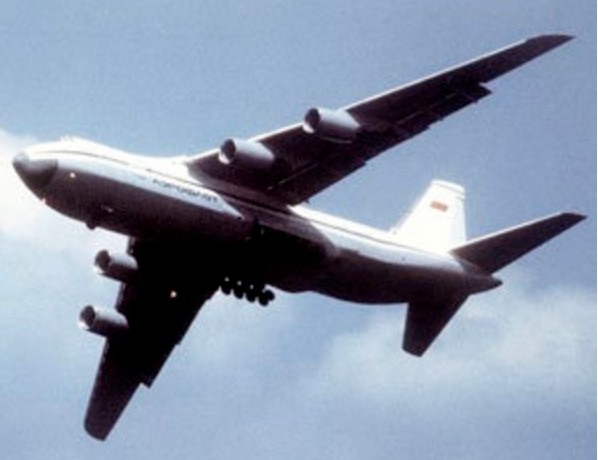
An-124
Engine: 4 x Lotarev D-18T Turbofan, 229.9 kN. / 51,590 lb
Installed thrust: 920 kW.
Wingspan: 73.0 m / 239 ft 6 in
Length: 69.1 m / 226 ft 5 in
Height: 68.18ft / 20.78m
Wing area: 6759.792 sq.ft. / 628.0 sq.m
Wing load : 132.23 lb/sq.ft / 645.00 kg/sq.m
Height: 22.0 m / 72 ft 2 in
Max take off weight : 893025.0 lb / 405000.0 kg
Weight empty : 429975.0 lb / 195000.0 kg
Max. weight carried : 463050.0 lb / 210000.0 kg
Max. speed : 466 kt / 863 km/h / 537mph
Landing speed : 132 kt / 245 km/h
Cruising speed : 445 kt / 825 km/h
Service ceiling : 39370 ft / 12000 m
Range w/max.fuel: 16500 km / 10253 miles
Range w/max.payload: 4500 km / 2796 miles
T/O run: 1200 m.
Ldg run: 800 m.
Crew: 6
Capacity: 88 pax.
Air refuel: No.
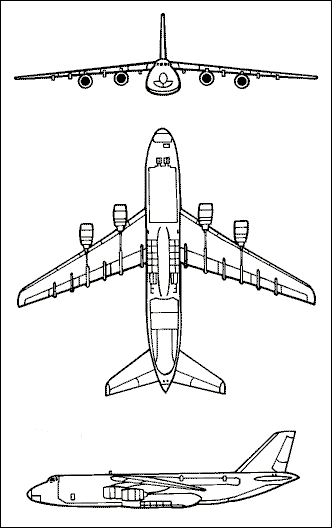
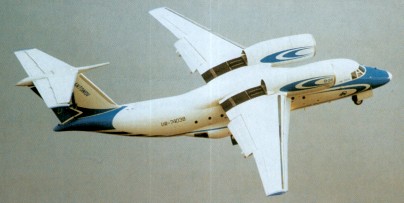
Flight testing of an An-74 develop¬ment of the An-72 Coaler twin-turbofan Stol transport was announced early in February 1984. The An-74 has been developed specifically for use in the Arctic and Antarctic, and may be equipped with an interchangeable landing gear, with skis available for operations from ice and snow. Principal differences apparent in the An-74 are a longer fuselage with a nose-mounted radar, and a redesigned wing.
First flown in 1977, the An-72, and the related An-74, only received its airworthiness certificate when the An-74TK was certified by Aeronautical Register on 2 August 1991. The An-74 was also produced at Kharkov from December 1989.
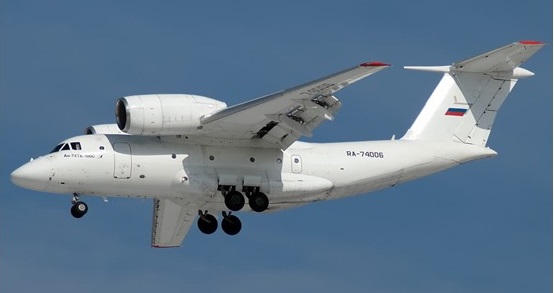
Production of An-74 also started by Polyot Industrial Association at Omsk, Russia, in 1993 (assisted by Progress at Arsenyev); first Polyot aircraft (RA-74050) was flown 25 December 1993.
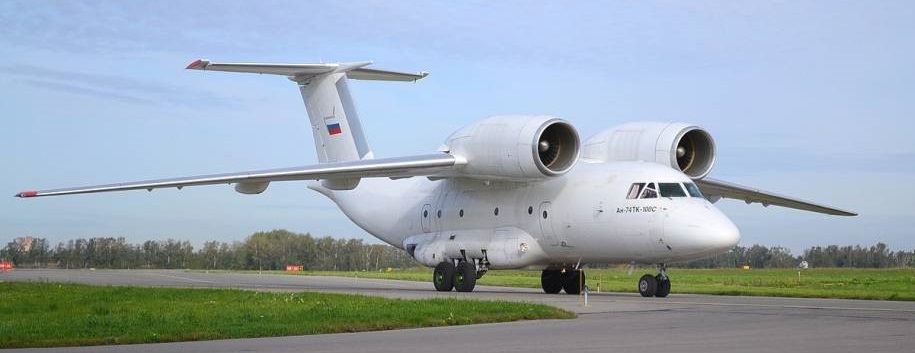
An An-72P maritime patrol version was demonstrated 1992 and development of the An-74-200 and An-74TK-200 by Antonov started 1995. The An-74TK-300 is basically an An-74TK-200 with underslung engines.
The An-88 is a tactical battlefield surveillance aircraft based on An-72 (also known as An-72R).
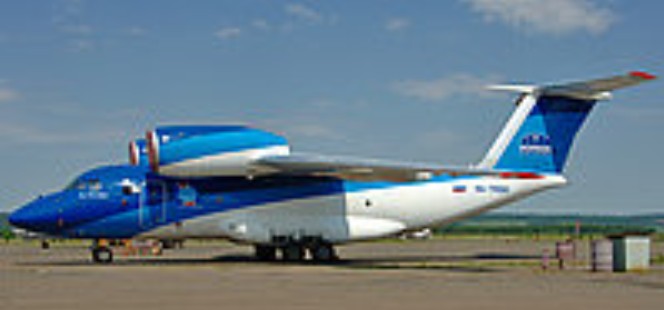
An-74 Coaler
Engine: 2 x Lotarev D-36 turbofan.
Installed thrust: 127.4 kN.
Span: 31.9 m.
Length: 28.7 m.
MTOW: 34,500 kg.
Payload: 10,000 kg.
Cruise speed: 550 kph.
Ceiling: 10,500 m.
T/O run: 470 m.
Range/payload: 3300 km with 5000 kg.
An-74TK-300
Engines: 2 x Lotarev D-436.
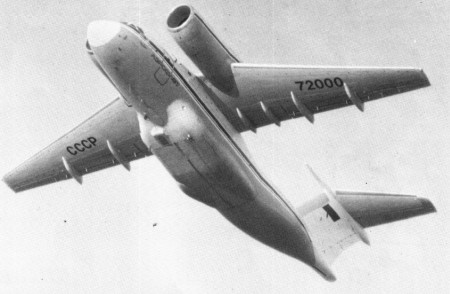
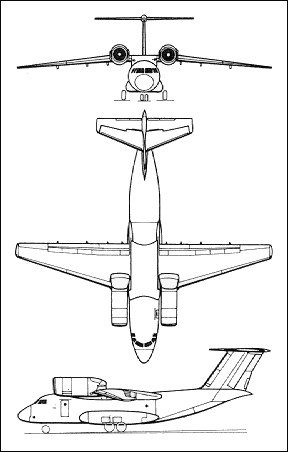
Originating as private venture military transport based on stillborn An-60 64-73 seat civil airliner designed to meet 1967 specification, the revised design, following issue of military requirement in 1968, included relocation of engines above wings.
Two static test airframes, and two prototype An-72 were built at Kiev. The first (SSSR-197744) flew on 31 August 1977.
Intended to replace the turboprop powered An 26 in Aeroflot service, its high lift devices and multi wheel landing gear make it suitable for operation from unprepared airfields with snow or ice covering and accommodate about 52 passengers. Overwing engines exhaust over the wing and trailing edge devices, to increase lift at low airspeeds. The NATO named Coaler is designed for rough-field operations and has a rear cargo door/ramp.
A production order was placed in December 1980 for an improved An-72A version, when manufacture was transferred to Kharkov, Ukraine, where first production An-72 flew 22 December 1985.
The An-72, and the related An-74, only received its airworthiness certificate in 1991. By mid-1992, about 50 were in industrial service, although none with Aeroflot.
The An-72 platform went on to spawn other variants that included maritime surveillance An-72P model, the An-71 “Madcap” AEW model and the An-74 “improved Coaler” upgraded engines and a conventional engine mounting. The An-72P armed surveillance and maritime patrol aircraft was developed in conjunction with Israeli Aircraft Industries and featured revised cockpit glass design, specialized Elta radar, electronic warfare systems and long range day/night observation equipment and systems.
The An-74 is a civil development of the An-72.
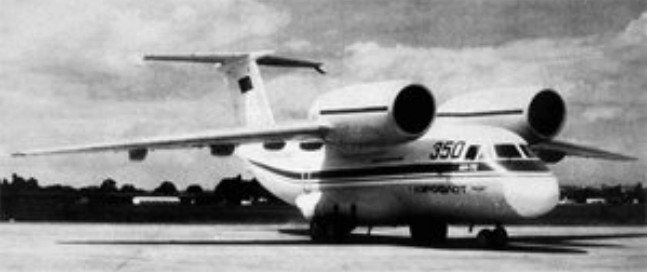
Engine: 2 x turbo-jet Lotarev D-30, 62.8kN
Length: 26.6 m / 87 ft 3 in
Height: 8.2 m / 26 ft 11 in
Take-off weight: 26500-30500 kg / 58423 – 67241 lb
MTOW increased: 72,751 lb (33 000 kg)
Max useful load: 22,046 lb (10 000 kg) Wingspan: 25.8 m / 84 ft 8 in
Cruise speed: 720 km/h / 447 mph
Ceiling: 11000 m / 36100 ft
Range w/max.fuel: 3200 km / 1988 miles
Range w/max.payload: 1000 km / 621 miles
Range 16,534 lb (7500 kg) useful load: 1,243 mls (2000 km)
Crew: 2-3
Passengers: 32
An-72 (Coaler-C)
Engines: 2 x Lotarev D-36 turbofan, 14,330lbs thrust
Length: 94.16ft (28.7m)
Wingspan: 104.66ft (31.90m)
Height: 28.38ft (8.65m)
Empty Weight:41,998lbs (19,050kg)
Maximum Take-Off Weight:76,059lbs (34,500kg)
Maximum Speed: 438mph (705kmh; 381kts)
Maximum Range: 497miles (800km)
Service Ceiling: 125,246ft (38,175m)
An-72P
Armament: 1 x 23mm gun pod,
2 x UB-23M rocket launcher system
4 x 220lb internally-held bombs
Accommodation: 3
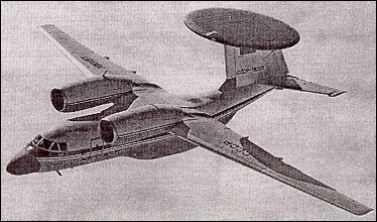
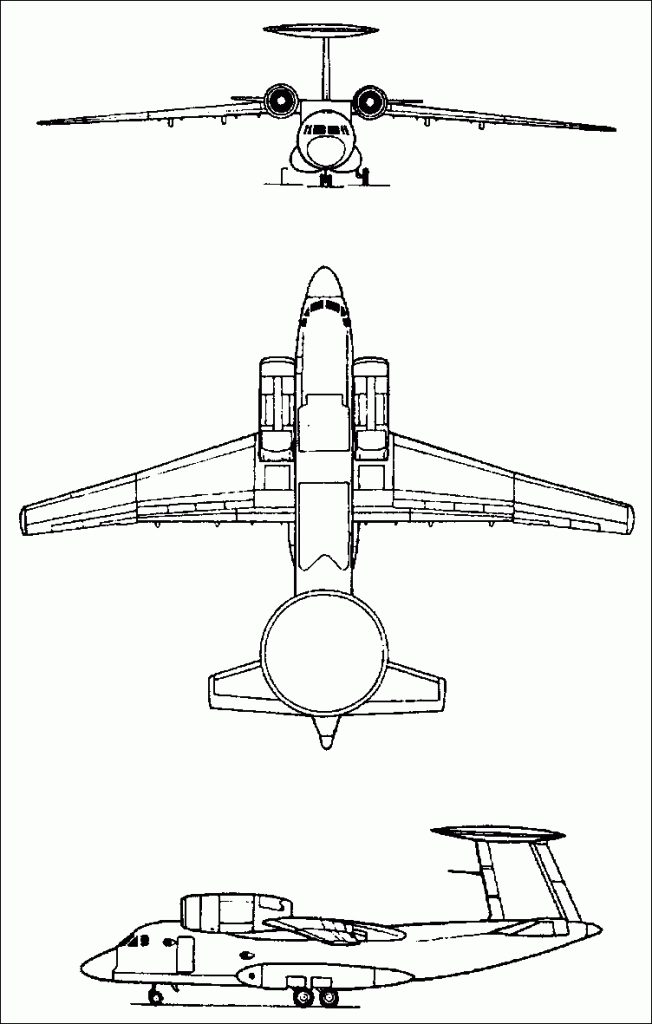
An AEW plane based on An-72 transport plane, the first prototype flew on July 12, 1985. A small tactical airborne early warning and control aircraft with rotating radome above tailfin, the program was canceled with no production orders. NATO reporting name ‘Madcap’.
An-71
Engine: 2 x D-436K turbofans, 7500kg + 1 x RD-38A, 2900kg
Wingspan: 31.89 m / 104 ft 8 in
Length: 23.50 m / 77 ft 1 in
Height: 9.20 m / 30 ft 2 in
Max. Speed: 650 km/h / 404 mph
Cruise Speed: 530 km/h / 329 mph
Ceiling: 10800 m / 35450 ft
Crew: 6
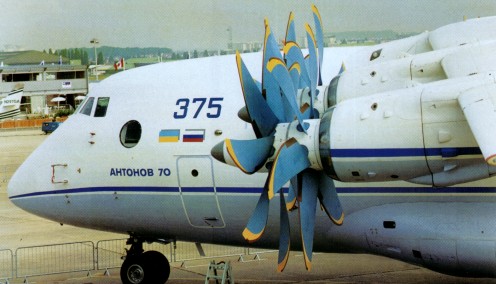
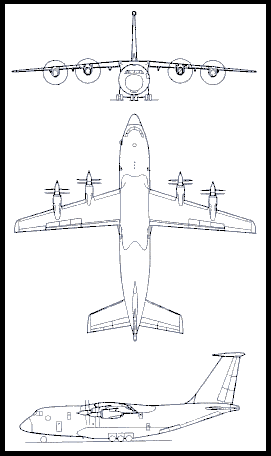
The development of the An-70 program began in 1975 but the collapse of the Soviet Union effectively stopped the funding of most major new programs. The An-70 has the high wing and tail loading ramp for a tactical freight aircraft and uses contra-rotating propfans. Each propfan has contra-rotating propellers; the front has eight composite blades, the rear just six.
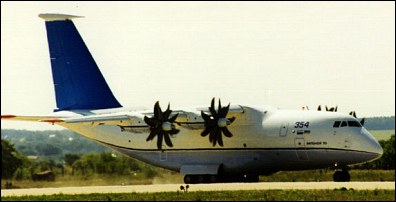
A new propfan medium-size wide-body short take-off and landing transport aircraft intended to replace An-12, the first flight was achieved on December 16, 1994 but the first prototype crashed on 10 February 1995 after colliding with its An-72 chase plane.
Construction of a second prototype was completed, which began flight testing at Gostomel airport in Ukraine on April 24, 1997.
Engine: 4 x D-27 propfans, 10300kW
Take-off weight: 130000 kg / 286602 lb
Wingspan: 44.06 m / 144 ft 7 in
Length: 40.25 m / 132 ft 1 in
Height: 16.1 m / 52 ft 10 in
Cruise speed: 750-800 km/h / 466 – 497 mph
Ceiling: 12000 m / 39350 ft
Range: 7250 km / 4505 miles
Range w/max.payload: 1350 km / 839 miles
Maximum payload: 47 tons.
Crew: 3-5
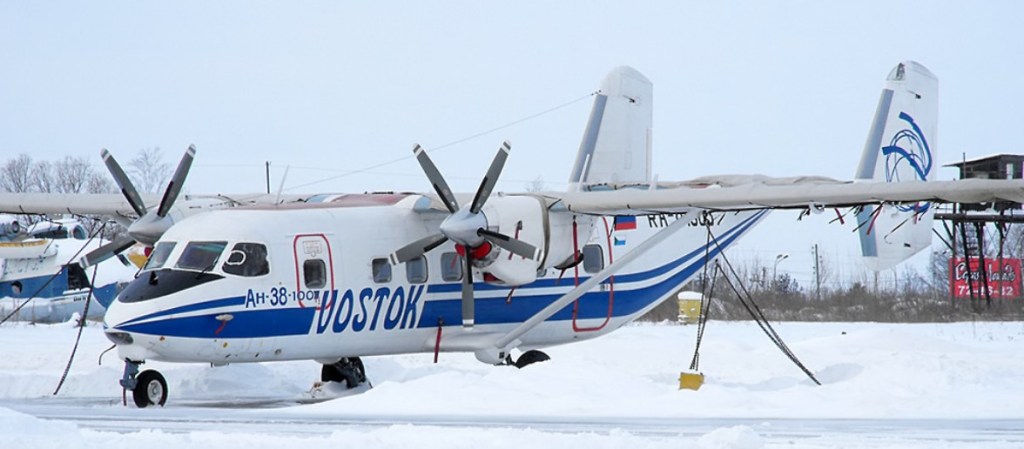
The Antonov An-38 is a stretched and upgraded version of Antonov’s earlier An-28. It is a twin-engined turboprop transport aircraft, designed by the Antonov Design Bureau in Kyiv, Ukraine. Production is in Novosibirsk, Russia, but some crucial parts are also made in Ukraine and Belarus. It first flew in 1994, and received international flight certification in April 2000. A total of 11 were built and 2 remain in airline service as of August 2019.
Impetus for a stretch of the Antonov An-28 design began with a 1989 sales tour in India, where it became clear that a significant market existed for an aircraft similar to the An-28, but with seating in the 25–30 seat range. The design was approved a year later, and was displayed at the 1991 Paris Air Show as a model.
The An-38 is of a similar design to the older An-28, featuring the same wings and tail; but it has a longer fuselage and includes several enhancements, such as higher fuel efficiency, increased comfort (cabin and cockpit), and decreased internal noise, coupled with better sound insulation. Other improvements include an increase in passengers to 27, thanks to an increase in maximum payload to 2,500 kg (5,500 lbs), as well as a maximum speed of 405 km/h (250 mph). Its design also enables it to operate in adverse conditions—it is equipped with weather radar, sophisticated navigational systems, and low pressure tires that allow it to operate from primitive, unpaved and icy airfields. Furthermore, the aircraft is more resistant to stalling at high angles of attack and is stable and maneuverable with ice on the wing and tail assembly.
As of August 2019, 2 Antonov An-38 aircraft remain in airline service with ALROSA. Recent reviews suggest only one remains in service in 2021.
An-38-100
Powerplant: 2 × Honeywell TPE331-14GR-801E turboprop, 1,118 kW (1,499 hp) each
Propellers: 5-bladed Hartzell Propeller HC-B5MA, 2.85 m (9 ft 4 in) diameter constant-speed fully-feathering reversible-pitch propellers
(or 2x 1,029 kW (1,380 shp) Omsk MKB Mars TVD-20 turboprop engines driving AV-36 propellers)
Wingspan: 22.06 m (72 ft 5 in)
Length: 15.67 m (51 ft 5 in)
Height: 4.6 m (15 ft 1 in)
Airfoil: TsAGI R-II-14 (14%)
Empty weight: 5,300 kg (11,684 lb)
Max takeoff weight: 8,800 kg (19,401 lb)
Fuel capacity: 2,210 kg (4,872 lb)
Maximum speed: 405 km/h (252 mph, 219 kn)
Cruise speed: 380 km/h (240 mph, 210 kn) at 4,200 m (13,800 ft)
Range: 1,650 km (1,030 mi, 890 nmi) with 9 passengers + 45 minutes reserve
1,450 km (900 mi; 780 nmi) with 17 passengers + 45 minutes reserve
600 km (370 mi; 320 nmi) with 27 passengers + 45 minutes reserve
Take-off run: 350 m (1,150 ft)
Landing run: 270 m (890 ft)
Balanced field length: 900 m (3,000 ft)
Crew: 2
Capacity: 26-27 passengers / 2,500 kg (5,512 lb) max payload