A tandem two-seat STOL general-purpose lightplane (first flown September 1988, designed by the Nanjing University of Aeronautics and Astronautics). Features of AD-200 include rear-mounted wings with winglet fins, nose canard and pusher piston engine in the rear of the fuselage pod.
Produces the AD-200 Blue Eagle tandem two-seat STOL general-purpose lightplane (first flown September 1988, designed by the Nanjing University of Aeronautics and Astronautics). Features of AD-200 include rear-mounted wings with winglet fins, nose canard and pusher piston engine in the rear of the fuselage pod.
Designed by Glen Beets, the G/B is a single-seat, open-cockpit sporting plane featuring a high parasol-braced wing and conventional tailwheel type landing gear. While the fuselage is a fabric-covered steel tube structure, the wing is built with spruce spars and ribs, also fabric covered. All plans, kits, and components are sold through the Stolp Starduster Corp.
The engine uses a 2.5:1 gear reduction unit designed and built by Beets and Fred Nelson.
Engine 70-hp Volkswagen, 1641cc. Gross Wt. 925 lbs. Empty Wt. 603 lbs. Wingspan 25 ft Length 16 ft 4in Top speed 156 mph. Cruise 120 mph. Stall 35 mph. Climb rate 2000 fpm. Takeoff run 200 ft. Landing roll 300 ft. Range: 600 sm.
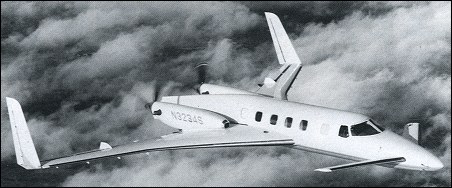
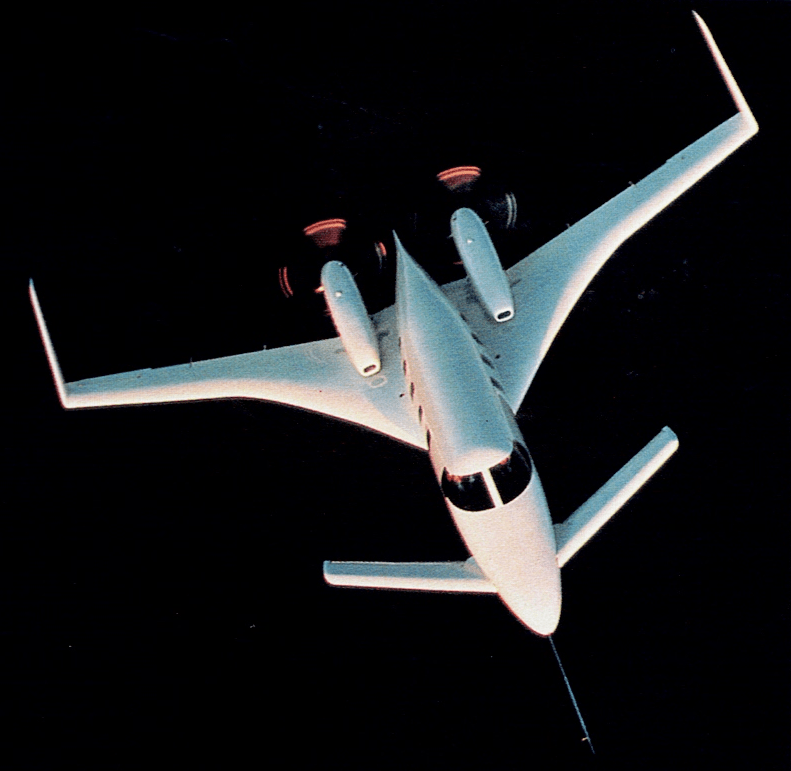
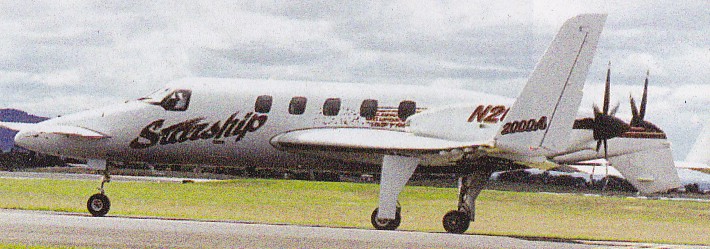
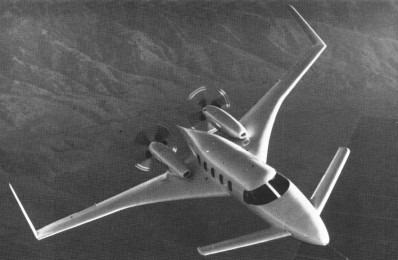
Success in testing the SCAT 1 led to the construction of the Model 2000 Starship 1. The Starship design has compound taper main wings, which mount the two pusher engines. Large endplate fins, known as tipsails, provide longitudinal stability, augmented by two small fins on the wing trailing edge. Additional keel area is provided by a ventral fin under the extreme rear of the slender fuselage. The large canard foreplanes of variable-geometry, sweeping forward by 4 degrees for low-speed flight and 30 degrees back in the cruise.
The Starship is built entirely of composites such as carbon graphite, Kevlar and E-glass, which make for an exceptionally strong and light aircraft that isn’t subject to the same inherent long-term weaknesses found in aluminum airframes. The composite makeup of the airframe doesn’t transmit noise or vibration from its twin 1,200 shp Pratt & Whitney engines, thus keeping interior cabin sound levels extremely low. Because of its canard configuration, the design is virtually impossible to stall. Virtually the entire structure is made of Nomex honeycomb and graphite/epoxy composites, with titanium used in high-stress areas.
The prototype composite construction Starship rolled out at Wichita to begin its certification in 1985. The first of three flying pre-production Starship 1s flew on 15 February 1986. Another three airframes were produced for static, damage tolerance and pressure testing. Basic FAA certification followed on 14 June 1988, and the first production machine flew on 25 April 1989. This has been used for customer demonstration flights, resulting in 40 orders by June of that year.
The tandem wing, twin pusher corporate aircraft is capable of a maximum cruise of 352 knots and a 41,000 foot ceiling. The Starship is the first all-composite, pressurised aircraft to receive FAA type certification. Starship is constructed of layers of graphite fibre surrounding a core of honeycombed nomex, bonded with adhesive resin. The unique Starship entered production in 1988 following first flight of a full-scale prototype on 15 February 1986. Seating eight passengers in a pressurised cabin, the aircraft is powered by two 1,200 shp (895 kW) P & W Canada PT6A-67A turboprops in “pusher” configuration giving a max cruising speed of 335 kts (621 km/h). Composites form a major portion of the Starship’s construction and among its aerodynamic features are variable-geometry foreplanes and large wingtip stabilisers called “tipsails”. Production ceased approximately 10 years after its introduction.
Beech 2000 Starship 1 Engines: 2 x Pratt & Whitney Canada PT6A-67A turboprops, 1,200 shp / 895kW Max take off weight : 14001.8 lb / 6350.0 kg Weight empty : 8917.0 lb / 4044.0 kg Max. weight carried : 5084.7 lb / 2306.0 kg Fuel capacity: 534 US gal Wingspan: 16.6 m / 54 ft 6 in Length: 14.05 m / 46 ft 1 in Height: 3.96 m / 12 ft 12 in Wing area: 26.09 sq.m / 280.83 sq ft Wing load : 49.82 lb/sq.ft / 243.0 kg/sq.m Max. speed : 352 kt / 652 km/h Landing speed : 84 kt / 156 km/h Cruise speed: 621 km/h / 386 mph Initial climb rate : 3346.46 ft/min / 17.0 m/s Service ceiling: 12495 m / 41000 ft Range: 3132 km / 1946 miles Payload : 8-11pax Takeoff distance, 50 ft.: 4,093 ft Landing distance, 50 ft.: 2,630 ft.
To provide a new generation of corporate transports, Beech looked to Burt Rutan’s Scaled Composites Inc. to design and produce the SCAT 1, an 85% scale technology demonstrator of a canard-configured aircraft. Success in testing led to the construction of the Model 2000 Starship 1.
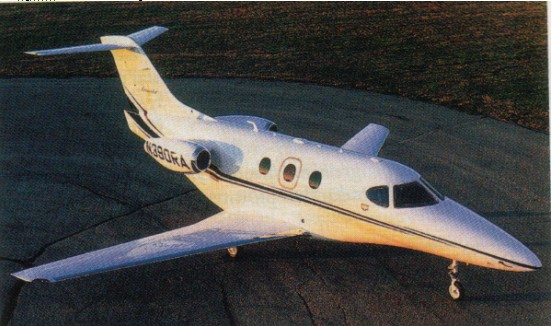
Raytheon developed the composite Premier I entry-level jet with a composite fuselage, empennage and control surfaces built of graphite and epoxy laminates with honeycomb construction, totaling more than a million miles of carbon-fiber filaments. The wings are aluminum.
Premier 1 Engines: two 2,300 lb Williams FJ44-2A Seats: 2+6 Gross weight: 12,500 lb Empty weight: 8,470 lb Fuel capacity: 548 USgals Max cruise: 451 kts Range: 826-1,502 nm Ceiling: 41,000 nm Takeoff distance: 3,792 ft. Landing distance: 3,170 ft.
Premier 1A Engines: (2) Williams FJ44-2A Max Cruise Speed: 451 kt @FL330 Max Range: 1460 nm Max Certified Altitude: 41,000 ft Takeoff Distance: 3792 ft New Price 2009: US$6.4 million
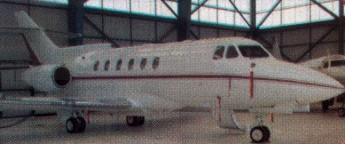
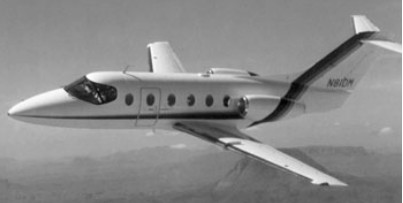
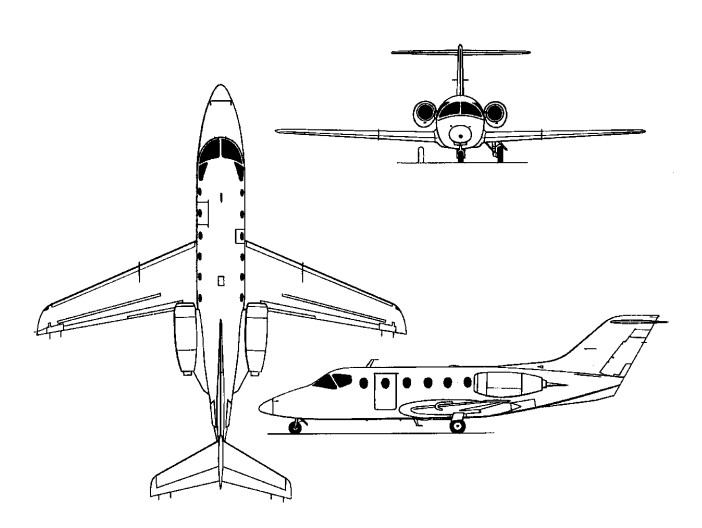
In 1977 Mitsubishi designed and built two prototypes of a twin-turbofan business aircraft designated the MU-300, the first flying on 29 August 1978; a one hour flight. A cantilever low-wing monoplane with a pressurised fuselage and retractable tricycle landing gear, the MU-300 was powered by two JT15D-4 turbofan engines, pod-mounted one on each side of the rear fuselage. Its twin turbofans are rated at 2,500 lbs. s.t. for takeoff and 2,375 lbs. s.t. for maximum continuous operation. Standard accommodation was provided for a crew of two and seven passengers. At the end of the development programme the prototypes were dismantled and shipped to the USA, where they were reassembled by the company’s US subsidiary Mitsubishi Aircraft International Inc. The two Diamond I prototypes underwent 350 hours of test flying in Japan before their arrival in the United States for FAA certification. Redesignated the Diamond I, the two aircraft were used in the US certification programme, which was granted on 6 November 1981. Initial customer deliveries began in July 1982 and 62 were built. The Diamond I wing design, with its advanced flight control system of full-span flaps, wing spoilers, and T-tail empennage, is built for optimum performance.
Mitsubishi developed an improved Model MU300-10 Diamond II, which was approved under FAA type certificate A14SW. Eleven examples were produced before the program was taken over by Beech and the aircraft re-certificated as the Beech Model 400 under new FAA type certificate A16SW. All the MU300-10 were subsequently converted to the Model 400 under Beech Service Bulletin Number 2140.
An improved version, the Diamond IA, fitted with uprated JT15D-4D engines giving overall performance increases, an EFIS cockpit and with maximum take-off weight increased to 7361kg, was announced in 1983 and the first of 27 built, distinguished by the extra port side window, was delivered in 1984. With an MTOW reduced to 7157kg, but with extra fuel, and more powerful JT15D-5 engines, a further eight aircraft were produced as the Diamond II. Model 400 comprised serial numbers RJ-12 through RJ-65.
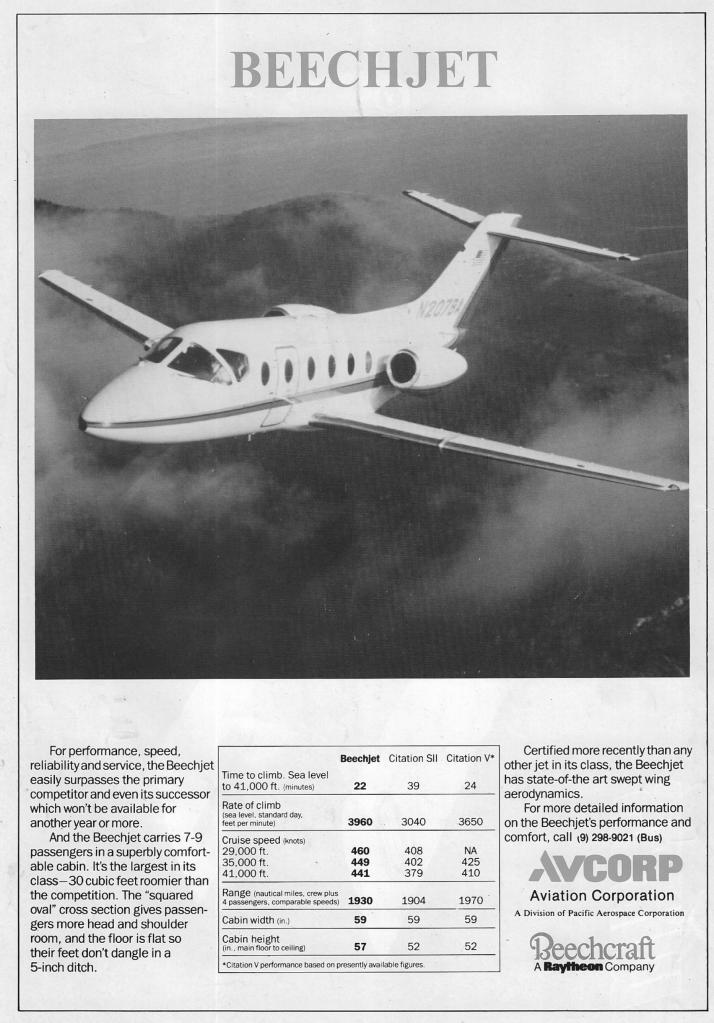
However, in December 1985, Mitsubishi sold the Diamond II design rights to Beech, together with components for 64 aircraft. These were assembled at Wichita and marketed as the Beechjet 400. Beech then initiated full manufacture of the type in 1989. The first Beech-assembled aircraft was rolled out on 19 May 1986 and deliveries began in June. By the beginning of 1989 46 Beechjets had been delivered. Beech is also providing support for previous Mitsubishi products, including the MU-2 and earlier Diamond versions.
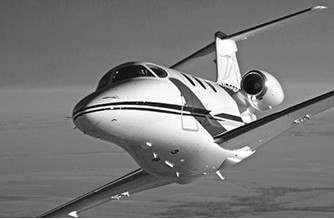
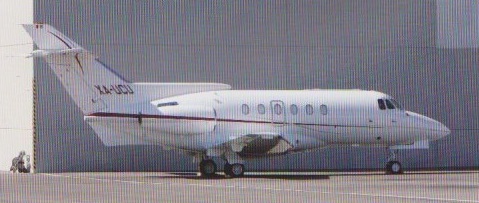
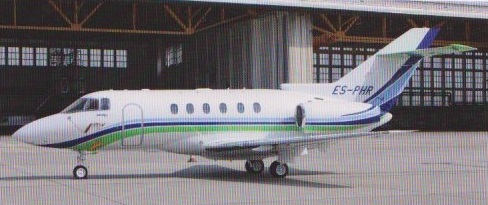
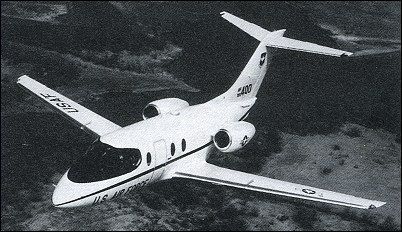
The Beechjet 400A first flew on 22 September 1989. The commercial Model 400A Beechjet was certificated on 20 June 1990, featuring increases in payload and ceiling, greater cabin volume, a rear lavatory and improved soundproofing. A Collins Pro Line 4 EFIS is fitted as standard. Deliveries of this version began in early 1990. By the beginning of 1991 beech had received orders for 113 slightly modified Model 400As In February 1990 the US Air Force chose the type as the airframe element of the Tanker/Transport Training System under the designation Beech 400T T-1A Jayhawk. Powerplants are 2,900 lb st (12.9 kN) P&W Canada JT15D-5 turbofans. The USAF requirement was for 211 aircraft and the first of these was delivered in July 1991 and entered service in March 1992, training KC-135, C-5, KC-10 and C-17 crews. In 2003 its name changed once again to the Hawker 400XP (for ‘extended performance’) for a better fit into the Raytheon family of bizjets.
The Model 400A, serial number RK-1 and on, was a further development. The primary change was the introduction of the Rockwell Collins Proline IV EFIS system, plus other improvements including greater cabin volume, increased max takeoff weight and higher operating ceiling. (From 2003 and serial number RK-354 the aircraft was marketed as the Hawker 400XP.) Production ceased in 2010 with serial number RK-604.
Variation: Nextant 400
Specifications:
MU-300 Diamond I First built: 1981. Engines: 2 x P&W JT15D-4, 2,500 lbs thrust. Seats: 11. Length: 48.3 ft. Height: 13.8 ft. Wingspan: 43.4 ft. Wing area: 241 sq.ft. Wing aspect ratio: 7.5. Maximum ramp weight: 14,200 lbs. Maximum takeoff weight: 14,100 lbs. Standard empty weight: 8600 lbs. Maximum useful load: 5200 lbs. Zero-fuel weight: 10,800 lbs. Maximum landing weight: 13,200 lbs. Wing loading: 58.4 lbs/sq.ft. Power loading: 2.8 lbs/lb. Maximum usable fuel: 4200 lbs. Best rate of climb: 3000 fpm. Certificated ceiling: 41,000 ft. Max pressurisation differential: 9 psi. 8000 ft cabin alt @: 41,000 ft. Maximum single-engine rate of climb: 810 fpm. Single-engine ceiling: 26,500 ft. Maximum speed: 434 kts. Normal cruise @ 37,000ft: 424 kts. Fuel flow @ normal cruise: 1098 pph. Stalling speed clean: 104 kts. Stalling speed gear/flaps down: 91 kts. Turbulent-air penetration speed: 208 kts.
Beechjet 400A Engines: 2 x Pratt & Whitney Canada JT15D-5 turbofans, 1315kg / 2,900 lb st (s/n RK-1 through RK-507) / Pratt & Whitney Canada JT15D-5R (s/n RK-508 and after) MCTOW: 16,100 lb / 16,300 lb. (serial number RK-347 and after, and aircraft with Kit 128-5202-0001 Increased Gross Takeoff Weight.) Weight empty: 10116.5 lbs / 4588.0 kg Wingspan: 13.25 m / 43 ft 6 in Length: 14.75 m / 48 ft 5 in Height: 4.19 m / 13 ft 9 in Wing area: 22.43 sq.m / 241.43 sq ft Wing load: 65.60 lbs/sq.ft / 320.0 kg/sq.m Max. speed: 854 km/h / 531 mph Cruise speed: 828 km/h / 515 mph Landing speed: 87 kts / 161 km/h Ceiling: 13715 m / 45000 ft Service ceiling: 41011 ft / 12500 m Initial climb rate: 4330.71 ft/min / 22.0 m/s Range: 5375 km / 3340 miles Noise Standard: FAR Part 36 Amendment 36-17 Max. No. of Seats: 11
Hawker 400XP Engines two 2,965-lb. Pratt & Whitney JT15D-5 turbofans. Seats 7-9. Gross wt. 16,500 lb. Empty wt. 10,550 lb Fuel capacity 733 US gal. Max cruise 450 kts. Long range cruise 414 kts. Range 874-1,687 nm. Ceiling 45,000 ft Takeoff distance 3,906 ft Landing distance 3,514 ft