1998:
Anderslebener Straβe 107-109
D-39387 Oschersleben
Germany
LSA builder as Delta Dart Flugzeugbau
1998:
Anderslebener Straβe 107-109
D-39387 Oschersleben
Germany
LSA builder as Delta Dart Flugzeugbau
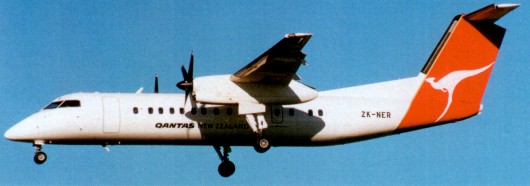
The Dash 8, of high wing monoplane configuration powered with two P&W 120s, was announced by de Havilland Canada in 1979 as a complement to the larger four engined STOL capable Dash 7. The company’s first transport not optimised for short take-off and landing. The go-ahead to cut metal was announced in September 1980 and the prototype Dash 8 series 100 rolled out in Downsview, Ontario, in April 1983.
de Havilland Canada DHC-8 Article
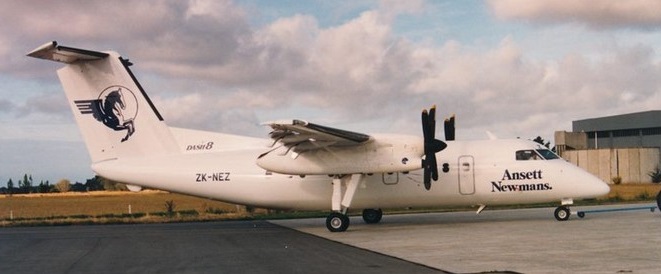
The fuselage cargo-loading door is standard, and other features include a retractable tricycle landing gear with twin-wheel units, large-span T-tail, and a high-mounted wing carrying two fuel-efficient Pratt & Whitney PW120 advanced turboprop engines driving large-diameter slow-turning four-bladed propellers (originally the PT7A) ensuring very low noise levels. These engines also have safety features which ensure that if one fails the other automatically increases its output to 1492kW.
The prototype of the 36-seat Series 100 flew for the first time on 20 June 1983. Canadian certification followed on 28 September 1984. The first customer was to be norOntair of Canada on 23 October 1984.
Orders for the initial 100 series production version had reached 230 by 1990.
The -100A series followed in 1990. The -100A model had a revised interior with more headroom and enhanced PWI20A engines and in 1992 was offered with the more powerful PW121 engines.
In 1992 the production switched to the Dash 8-200 and the first deliveries began in April 1995. The Dash 8-200 has PW123C engines, which gave the -200 series an increase in top speed of 30 knots over the 100 series. The -200B series has the PW123Bs for better ‘hot and high” performance. From April 1996 all Dash 8 aircraft delivered were fitted with a computer-controlled noise and vibration suppression system (NVS). To reflect this the name was changed to Dash 8Q (for “quiet”). In 1998 this was changed again to Dash 8-Q200 when the new interior was introduced. The Dash 8-Q200 holds 37 passengers.
Boeing, within a month of purchasing DHC, signalled their commitment to the enterprise by announcing mid-1985 the development of a stretched 50/56 passenger Dash 8 Series 300 for a first flight on 15 May 1987 (modified Series 100 prototype). This became the -300 series and the first aircraft was an earlier prototype Dash 8 converted to the new length of 25.68 metres. It first flew on 15 May 1987. Canadian certification followed on 15 February 1989 and the first deliveries were to Time Air later on 27 February 1989, FAA type approval on 8 Tune 1989.
The stretch for the series -300 was effected with a “plug,” forward and aft of the wing. of 3.43 metres. The wings also have a greater span of 27.43 metres over 25.91 metres. Other smaller changes were a larger toilet, a repositioned galley and a new galley door, an additional wardrobe, dual air conditioning packs and the option for an APU. Orders for the Srs 300 were in excess of 100 by 1990, deliveries starting in February 1989. The Dash 8-300 provides a very good single engine performance, being able to climb to 14,000 feet at maximum all up weight or descend to 16,000 feet on one engine.
Further variants of the 300 series were offered with the first, the -300A, being in 1990 with increased higher gross weights, interior improvements and the standard PW123A engines. The -300B was introduced in 1992 with PW123B engines as standard. All Dash 8-300 aircraft built since April 1996 have also been fitted with NVS and throughout the ’90s Boeing Canada worked on variants for both military and civil applications. Two transport versions are in service with the Canadian Department of National Defence as CC 142s and four navigation trainers are on order as CT-142. The USAF has two on inventory as E¬9As for range control on the Gulf Missile Test range.
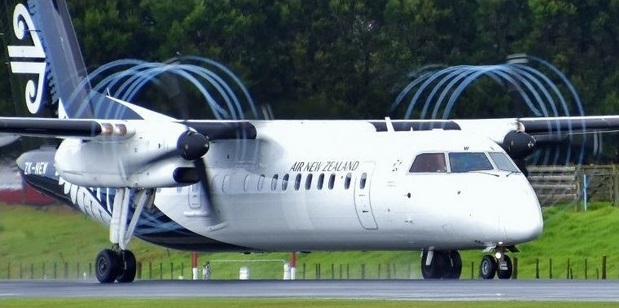
In 1986 de Havilland Canada, by then part of Bombardier, started development of a larger 50-seat regional airliner. 1998 the aircraft where renamed Dash 8Q-300s when the new interior was introduced.
Six twin-turboprop Dash 8s ordered by the Canadian Armed Forces have long-range fuel tanks, rough-field landing gear, strengthened floors, and other equipment changes. Designated Dash 8Ms by DHC, four will be used as navigation trainers, while the other two will be allocated to transport duties in Europe, replacing Dash 7s.
The 1987 commercial variant was the stretched 50-56-seat Series 300. The 37-seat Dash 8 Series 200 and 50-seat Series 300 turboprops were being produced at the rate of two per month in 1998.
Launched in June 1995 as stretch of Series 300, the -Q400, can hold 70 passengers, equipped with a computer-controlled noise and vibration suppression system, indicated by the “Q” (standing for quiet) before the model/number designator. First flown on 31 January 1998, FAA FAR Pt 25 approval was received on 8 February 2000. First delivery was to SAS Commuter 20 January 2000, followed by service entry 7 February on the Copenhagen, Denmark, to Poznan, Poland route.
The low-noise Dash 8 Q became the standard version from 1996
By January 1991 the Dash 8 order book stood at 361 aircraft, comprising 251 Series 100s and 110 Series 300s, with around 230 delivered. A Q300 delivered to Air Nippon on 6 March 2001 was the 600th Dash 8.
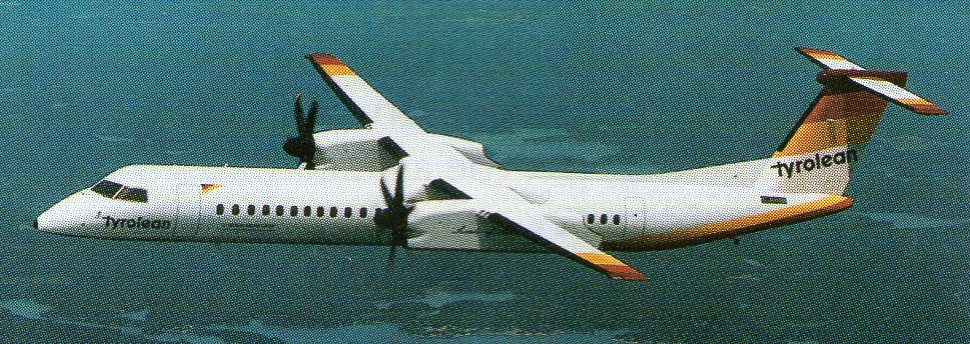
In June 2009 Bombardier sold the Q400 aircraft program to Longview, the company that owns Viking Air. A separate company called DeHavilland Aircraft of Canada was created to build and support the Q400.

In 2025 a used Q400 plane can be purchased for about $5 million and can be retrofitted for firefighting for an additional $5 million.
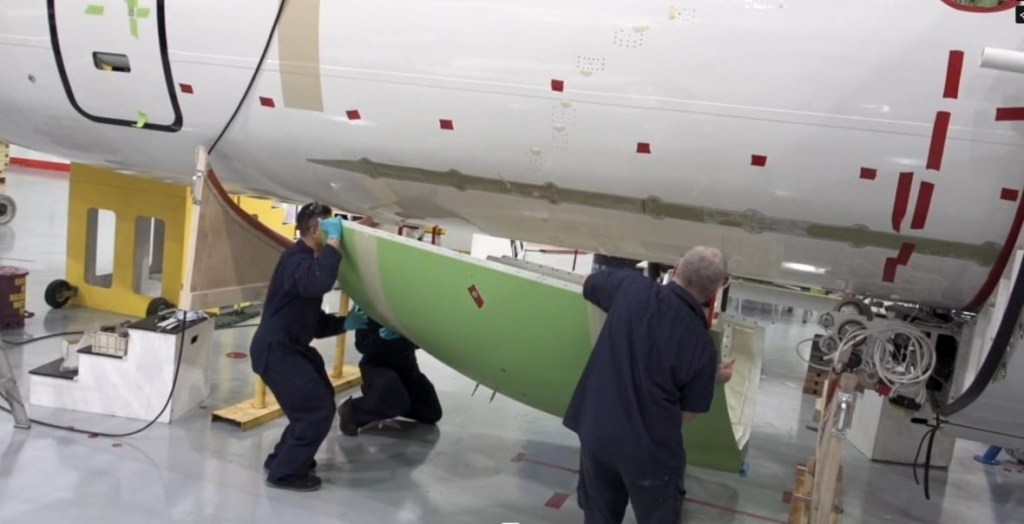
Variants:
CC-142: designation of two Series 100s bought by the Canadian. Department of National Defence but operated since March 1987 by the Canadian Forces at Lahr, Germany. Used as passenger/cargo transports, the aircraft are equipped with long-range fuel tanks, rough field landing gear,, high strength floors and a special-mission-related avionics fit.
CT-142: designation of four Series 100s, acquired by the Canadian DND, and operated as specially configured navigation trainers by the Canadian Forces. Otherwise equipped similarly to the CC-142, the trainers are distinguished by their extended noses.
Dash 8M-100: two specially-equipped Series 100s used by the Canadian Department of Transport to calibrate ILS, VOR and MLS systems at Canadian airports.
Dash 8M-300ASW Triton: designation of a proposed maritime patrol or anti-submarine warfare version of the Series 300 equipped with Harpoon or Exocet-type anti-shipping missiles mounted on lower side fuselage sponson hardpoints, and four underwing pylons, outboard of the engines, capable of carrying missiles, torpedoes, mines, sonobuoys or searchlights. With a full range of ASW sensors including FLIR, MAD and search radar operated by a six-man crew, maximum endurance is over 11 hours.
E-9A: designation of two standard Series 100 aircraft acquired by the US Air Force in 1985 as airborne platforms to perform telemetry and data link duties in connection with drone and missile testing at Tyndall AFB, Florida. Modified by the Sierra Research division of LTV, the E-9A carries a large fuselage fairing containing a steerable phased-array antenna, underfuselage search radar and special avionics. Both aircraft were delivered in 1988.
Specifications:
Dash 8 Series 100
Engines: 2 x Pratt & Whitney Canada PW120A turboprops, 1491kW
Take-off weight: 15650 kg / 34503 lb
Empty weight: 9979 kg / 22000 lb
Wingspan: 25.91 m / 85 ft 0 in
Length: 22.25 m / 73 ft 0 in
Height: 7.49 m / 25 ft 7 in
Wing area: 54.35 sq.m / 585.02 sq ft
Cruise speed: 497 km/h / 309 mph
Ceiling: 7620 m / 25000 ft
Range w/max.payload: 2010 km / 1249 miles
Dash 8 Series 200
Engines: 2 x Pratt & Whitney Canada PW120A turboprops, 1491kW
Take-off weight: 15650 kg / 34503 lb
Empty weight: 9979 kg / 22000 lb
Wingspan: 25.91 m / 85 ft 0 in
Length: 22.25 m / 73 ft 0 in
Height: 7.49 m / 25 ft 7 in
Wing area: 54.35 sq.m / 585.02 sq ft
Cruise speed: 497 km/h / 309 mph
Ceiling: 7620 m / 25000 ft
Range w/max.payload: 2010 km / 1249 miles
Dash 8 Series Q200
Engines: 2 x Pratt & Whitney Canada PW120A turboprops, 1491kW
Take-off weight: 15650 kg / 34503 lb
Empty weight: 9979 kg / 22000 lb
Wingspan: 25.91 m / 85 ft 0 in
Length: 22.25 m / 73 ft 0 in
Height: 7.49 m / 25 ft 7 in
Wing area: 54.35 sq.m / 585.02 sq ft
Cruise speed: 497 km/h / 309 mph
Ceiling: 7620 m / 25000 ft
Range w/max.payload: 2010 km / 1249 miles
DHC 8 Dash 8-300
Length: 84.318 ft / 25.7 m
Height: 24.606 ft / 7.5 m
Wingspan: 89.895 ft / 27.4 m
Wing area: 604.937 sqft / 56.2 sq.m
Max take off weight: 41101.2 lb / 18640.0 kg
Weight empty: 24696.0 lb / 11200.0 kg
Max. weight carried: 16405.2 lb / 7440.0 kg
Max. speed: 286 kts / 530 km/h
Landing speed: 76 kts / 141 km/h
Cruising speed: 270 kts / 500 km/h
Initial climb rate: 1771.65 ft/min / 9.00 m/s
Service ceiling: 25098 ft / 7650 m
Wing load: 68.06 lb/sq.ft / 332.00 kg/sq.m
Range: 891 nm / 1650 km
Engine: 2 x Pratt & Whitney 123, 1751 shp
Crew: 2
Payload: 50-56pax
Dash 8-300A
Payload: 6272kg
Dash 8-311
Engines: 2 x Pratt & Whitney of Canada PW123 turboprops, 2,380-shp.
Props: four bladed Hamilton Standard 14SF-23.
Max cruise: 287 kts.
Initial ROC: 1800 ft/ min.
Empty wt: 11.657 kg.
MTOW: 19,505 kg.
Cruise 92%: 276 kts.
Fuel flow @ 92%: 360 kg/hr each.
Seats: 56.


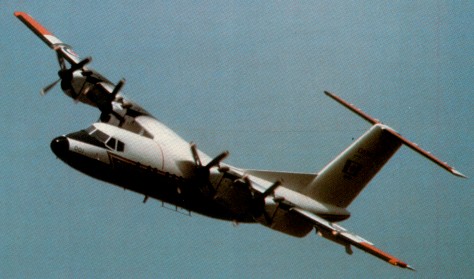
de Havilland Canada, in response to a market survey, estimated interest in a large STOL aircraft with advanced STOL capability, so that higher standards of comfort, comparable with much larger aircraft, would be available to those airlines which operate from runways about 915m in length.
de Havilland Canada DHC-7 Article
With backing from the Canadian government the, construction of two pre-production de Havilland Canada DHC-7 aircraft began in late 1972, and the first was flown on 27 March 1975 (C-GNBX X) at Downsview, Ontario. Certification was gained in 1977 and the Dash 7 proved not only to be very quiet, but could take off with full load in only 2,260 ft (689 m) and land in 1,950 ft (594 m).

The DHC-7 has four large-diameter propellers turning slowly (and therefore quietly) in front of double-slotted trailing-edge flaps, and a T-tail keeps the tailplane well clear of the propeller wash. There are four spoilers in the upper surface of each wing. The inboard pair serve as spoilers or lift dumpers, the outboard pair as air spoilers which can also be operated differentially in conjunction with the ailerons to augment lateral control.
The fuselage is of fail-safe construction to permit pressurisation, and the landing gear is of the retractable tricycle type, with twin wheels on each unit,
Powered by four Pratt & Whitney Aircraft of Canada PT6A-50 turboprop engines, to reduce noise levels to a minimum, each drives a large-diameter 3.42m, Hamilton constant-speed full-feathering reversible-pitch four-blade propeller made from fiberglass. The props are slow-turning to reduce noise levels, so that the landing approach noise level on a three-degree glideslope is 92.4 EPNdB.
Accommodation is provided for 50 passengers, with access to the main cabin via a single door, incorporating air-stairs, at the rear of the cabin on the port side. There are provisions for optional mixed passenger/cargo or all-cargo operations, and a large freight door can be installed at the forward end of the cabin on the port side. Up to five standard pallets can be carried by the Dash 7 in an all-cargo configuration. The flight crew of two is accommodated on a separate flight deck, and advanced avionics to enhance their efficiency include an autopilot/flight director system which incorporates flight and air data computers, and weather radar.
The first operator to receive the Dash 7 was Rocky Mountain Airways, on 3 February 1978.
The company offered a coastal reconnaissance model as the Dash 7R Ranger with Litton LASR-2 radar with its antenna in an underfuselage radome for 360x surveillance coverage, but in fact the only military sales have been three aircraft each to Canada and Venezuela. Two of the Canadian aircraft were designated CC-132 and used for communications from the base at Lahr in West Germany by No.412 Squadron, while the third is designated Dash 71R and used for ice reconnaissance by the Canadian Coast Guard in the Gulf of St Lawrence. The Venezuelan aircraft are transports with a secondary coastal reconnaissance.
When production finished in December 1988 113 had been delivered to 35 customers in 22 countries. Military use of the Dash 7 was restricted to two used as VIP/transports (designated CC-132) by the Canadian Armed Forces in Germany from August 1979 to April 1987, and a single aircraft delivered to the Venezuelan Navy in May 1982 used in the patrol and transport roles.
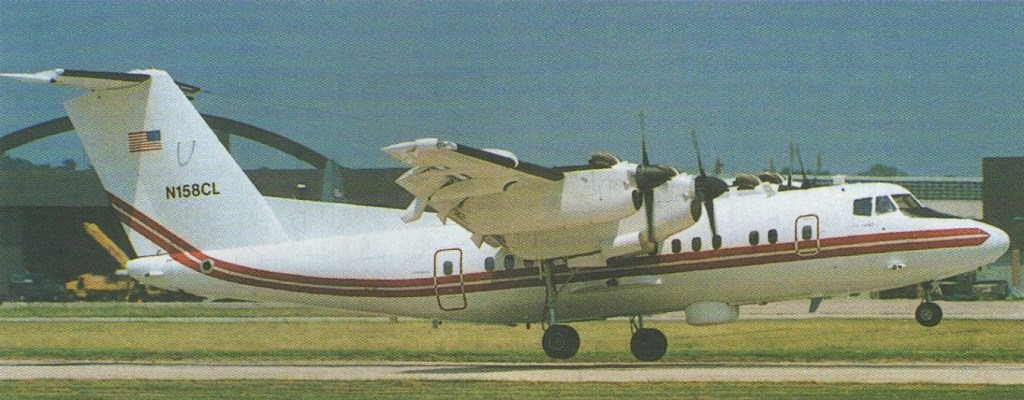
Variants:
Dash 7 Series 100: standard passenger version seating 50 passengers.
Dash 7 Series 101: all-cargo version of Series 100 able to accommodate five standard pallets.
Dash 7 Series 150: developed passenger version introduced in 1978 with higher gross weight, increased fuel capacity and improved passenger amenities.
Dash 7 Series 151: all-cargo version of Series 150.
Dash 7 IR: single special ice reconnaissance version of the Series 150 built for the Canadian government. Equipped with SLAR and computers to track ice formations and flow patterns, the aircraft was delivered in May 1986 and is operated by Bradley Air Services for the Department of Environment.
DHC-7 Series 100
Engines: 4 x P & W Aircraft Canada PT6A-50 turboprop, 835kW
Max take-off weight: 19958 kg / 44000 lb
Empty weight: 12542 kg / 27651 lb
Wingspan: 28.35 m / 93 ft 0 in
Length: 24.58 m / 81 ft 8 in
Height: 7.98 m / 26 ft 2 in
Wing area: 79.89 sq.m / 859.93 sq ft
Cruise speed: 436 km/h / 271 mph
Ceiling: 6400 m / 21000 ft
Range w/max.payload: 1279 km / 795 miles
Crew: 2
Passengers: 48
DHC 7-102/103
Engines: 4 x P&W PT6A-50, 1120 shp.
Props: Hamilton 4-blade, 135-in.
Seats: 50.
Length: 80.5 ft.
Height: 26.2 ft.
Wingspan: 93 ft.
Wing area: 860 sq.ft.
Wing aspect ratio: 10.
Maximum ramp weight: 44,100 lbs.
Maximum takeoff weight: 44,000 lbs.
Standard empty weight: 27,044 lbs.
Maximum useful load: 17,056 lbs.
Zero-fuel weight: 39,000 lbs.
Maximum landing weight: 42,000 lbs.
Wing loading: 51.2 lbs/sq.ft.
Power loading: 9.8 lbs/hp.
Maximum usable fuel: 9925 lbs.
Best rate of climb: 1200.
Service ceiling: 22,800 ft.
Max pressurisation differential: 4.7 psi.
8000 ft cabin alt @: 22,000 ft.
Maximum engine out rate of climb: 700 fpm @ 124 kts.
Engine out climb gradient: 338 ft/nm.
Engine out ceiling: 14,800 ft.
Maximum speed: 231 kts.
Normal cruise @ 16,000ft: 225 kts.
Fuel flow @ normal cruise: 1639 pph.
Endurance at normal cruise: 5.5 hrs:
Stalling speed clean: 100 kts.
Stalling speed gear/flaps down: 66 kts.
Turbulent-air penetration speed: 171 kts.
CC-132
Engines: four 1,120-shp (835-kW) Pratt & Whitney Canada PT6A-50 turboprops.
Maximum speed 266 mph (428 km/h) at 8,000 ft (2,440 m)
Service ceiling 21,000 ft (6,400 m)
Range 1,347 miles (2,168 km) with a 6,500-lb (2,948-kg) payload.
Empty weight: 27,650 lb (12,542 kg)
Maximum take-off 44,000 lb (19,958 kg).
Wing span 93 ft 0 in (29.35 m)
Length 80 ft 7.75 in (24.58 m)
Height 26 ft 2 in (7.98 m)
Wing area 860.0 sq ft (79.89 sq.m)
Payload: 50 passengers or 11,310 lb (5,130 kg) of freight.
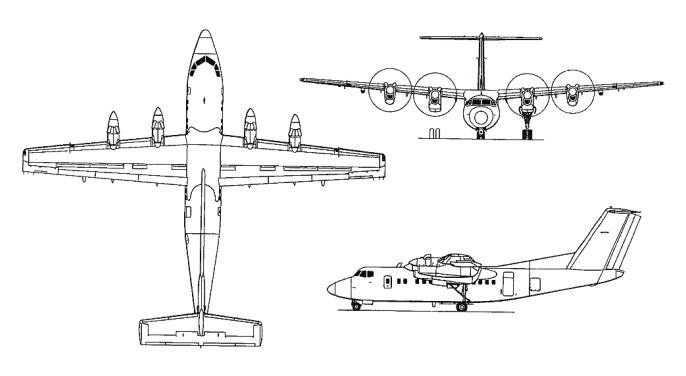
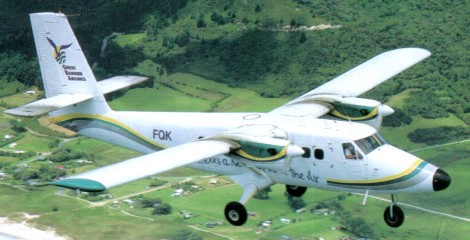
In 1964 de Havilland Canada announced that it was developing a twin-turboprop high-wing monoplane with STOL capability to provide accommodation for 13 to 18 passengers as the de Havilland Canada DHC-6 Twin Otter. Design of the aircraft’s wing includes double-slotted trailing-edge flaps and ailerons which can be drooped simultaneously with the flaps to enhance STOL performance. Fixed tricycle landing gear can have optional float or ski installations, as well as the standard wheels.
Jointly funded by the Canadian Department of Defence and de Havilland Canada, the first of an initial batch of five made its maiden flight on 19 May 1965. The first three aircraft were powered by two 432kW Pratt & Whitney Aircraft of Canada PT6A engines, but the fourth and subsequent examples of this first Twin Otter Series 100 production version had PT6A-20 engines of similar output.
de Havilland DHC-6 Twin Otter Article
Its design philosophy is directed towards operation from short semi-prepared runways for services in localities where air connections have not previously been practical, and its emphasis is on engineering simplicity and operational versatility. This is reflected by such features as urethane blocks as shock absorbers in the main undercarriage shoulders. Another selling point is the quickly convertible 384 cu.ft cabin from passengers to a maximum freight load of 4250 lb carried over 100 nm stage lengths with reserves.
The principal impact of the Twin Otter, and a feature which has already resulted in sales and options for about 30 aircraft, is probably its STOL performance to and from 50 ft of about 1000 ft. The CAR 3 distances are still only 1700 ft for take-off and 2160 ft for landing. At the start of its European tour at the Hanover Air Show, the Twin Otter demonstrator was able to join the Do27s and Porters ferrying passengers across the town to the small airstrip of the main industrial fair, and it was also able to get in and out of Heligoland’s 190m strip off the German coast.
The Twin Otter has full-span double-slotted flaps, with the outer sections also operating as ailerons, but has no exotic high lift devices. Its tricycle undercarriage has an electrically-driven hydraulic pump providing power for steering, toe brakes and flaps, with a nosewheel – tiller on the port control wheel. The Twin Otter cockpit has entry doors each side so that the crew can get in and out when the cabin is packed to capacity with freight.
The Twin Otter has roof-mounted engine controls, which increase available cockpit space and the PT6s can be left in the flight idle gate for taxying except for occasional aft movement into the Beta range, to prevent excess speed building up on the ground. Further aft movement of the power levers through the idle gate selects reverse pitch, which enables the Twin Otter to back out of restricted parking spaces.
There are two main power references-torque, in lb/sq.in, and turbine gas temperature, with respective limits of 42.5 and 750 deg C.
During take-off, it would be easy to over boost the engines by opening the power levers to their full extent, so if the outside air temperature is on the low side, the torque-meters have to be watched to avoid exceeding the limit. In hot weather the limiting factor becomes exhaust temperature.
After raising flap, the Twin Otter climbs at 110 kt on 41 lb/sq.in torque, with the airscrew rpm pulled back to 90 per cent and climbed at nearly 2 000 ft/min. Levelling out with power reduced to 33 lb/sq.in torque and 78 percent rpm (330 shp per engine) gives an indicated 140-145 kt., which trued out to 155-160 kt. for a fuel flow of 225 lb per hour per engine.
One of the most useful aspects of Twin Otter performance is the’large usable speed range between Vno Of 160 kt. and a flapdown stall with power of well below 40 kt. IAS, including a manoeuvre speed for bush flying of around 55 kt. with about 25 per cent power and full flap.
To eliminate large changes of trim with flap movement, the Twin Otter retains the same trim tab interconnection that was introduced in its single-engine predecessor. This ensures a comfortable limit to, the nose-up pitch accompanying flap retraction during an overshoot. Clean and power off, slight aileron snatch precedes pre-stall buffet, with some lateral hunting at 65 kt. which continues after the mild break-away at about 60 kt. IAS. With the full 40 degrees of flap extended, a gentle and straight stall break occurs at about 42 kt. IAS, power oft. Aerodynamic buffet gives about 8 kt. stall warning in all configurations
With 30 degrees (take-off) of flap extended, Vmc is 64 kt., and single-engine flight is completely uncomplicated. Feathering the port (critical) propeller from a 92 kt. climb resulted in light rudder loads, even before wind milling stopped, although the Twin Otter runs out of rudder trim at just below 85 kt, a long way before Vmc. There was no difficulty in showing a single engine en route climb of more than 300 ft/min.
Before landing, the nosewheel tiller has to be checked for centering, and then a spectacularly steep approach is achieved with full flap and just a trickle of power at only 65 kt. With restricted reverse pitch a 250 ft ground run is achieved.
The price, in basic form, in 1966 was (Canadian) $275000 approx. The PT6A-20 starts operational life with an overhaul period of 1200 hours.
Some 30 Twin Otters were due for completion by the end of 1966, and production was to continue at the rate of about six per month.
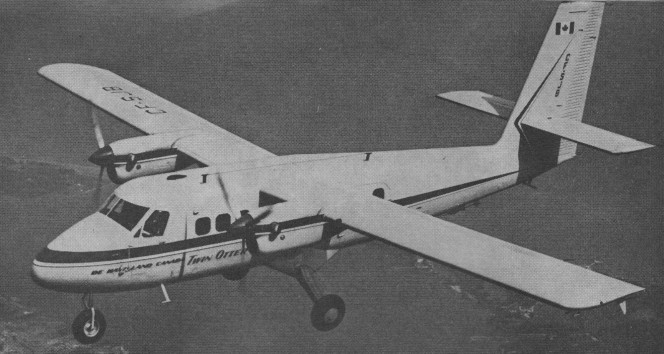
Delivered in July 1966, the first Twin Otter Series 100 entered service in 1966, and, following manufacture of 115 of that version, production switched to the Twin Otter Series 200. It differed by having increased baggage capacity in a lengthened fuselage nose and was certificated for operation at a higher gross weight. After 115 had been built the production Twin Otter Series 300 was introduced, this having more powerful 652 shp PT6A-27 engines which make possible an increase of almost 454kg in maximum take-off weight. Later production aircraft had a 20-seat commuter interior as standard and all floatplane versions, irrespective of series, retain the shorter fuselage nose of the original Series 100. Specialised equipment that has been developed to enhance the capabilities of these popular aircraft includes a ventral pod to carry 272kg of freight and an expendable fabric membrane tank holding 1818 litres of water for water-bombing fire-fighting operations.
The 300S model features several improvements: high-capacity brakes, an antiskid system, wing spoilers, refined electrical and hydraulic systems, propeller automatic feather, and improved fire protection. In addition, six 300S enhanced STOL performance DHC-6-300s were built in the mid 1970s. Earlier models, the series 100 and 200, were fitted with 570 shp engines. Access to the two man cockpit is through a car-like door on each side or through the cabin. The standard “Commuter” version will accommodate 20 passengers, but optional arrangements are available.
In 1982 DH Canada offered two specialised military versions designated Twin Otter Series 300M basic military transport (15 troops, 20 passengers or 2,270kg of cargo) or COIN version armed with cabin-mounted machine-guns and four underwing hardpoints, and the 300MR maritime reconnaissance version equipped with undernose Litton AN/APS-504 360 degree scan search radar, comprehensive avionics, an infrared linescanner, and a wing-mounted searchlight. Although a prototype 300MR was flown, the only buyer as Senegal with a single aircraft.
The Twin Otter has seen wide use with air forces and government agencies. Military operators include Argentina, Canada, Chile, Ecuador, Ethiopia, France, Haiti, Jamaica, Nepal, Norway, Panama, Paraguay, Peru, the USA and Venezuela.
When the last Twin Otter was delivered in December 1988 production had reached 844.
Field Aviation Co of Mississauga, Ontario, developed an update package for the aircraft which has prompted a first contract by Wideroe Flyveselskap to modernise that airline’s fleet of nine aircraft. Principal differences are the four-bladed propellers on the two Pratt & Whitney Canada PT6A-27 turboprops and a brand new interior.
Viking announced the re-launch of the type and in 2010 ten Twin Otter 400s were in various stages of assembly at Calgary with production ramping up to build one-and-a-half aircraft every four weeks.
Viking Air completed a ten-minute maiden flight of the first new-build DHC-6 Series 400 Twin Otter on February 16, 2010. The aircraft (c/n 845) flew from the company’s assembly facility at Calgary in Alberta. It has been assigned the registration C-FMJO and is configured with a commuter cabin and was to be delivered to launch customer Zimex Aviation of Switzerland for use on oil and gas industry contracts throughout North Africa.
By 2016 the Twin Otter series 400 was in series production by Viking Air and a number were in service, including two operated by Loganair, Glasgow, Scotland.
Variants:
Twin Otter 300S: designation of six aircraft fitted with 11 seats, an improved high-capacity anti-skid braking system and wing spoilers, built for the 1973 experimental Air Transit service linking downtown STOL airports in Montreal and Ottawa.
Twin Otter Series 400: proposed development to meet US FAR 36 noise regulations. Not built.
UV-18A: two standard Series 300s delivered October 1976 onwards to the US Army Alaska National Guard, followed by four more in 1979 and 1982. Operating on wheels, floats or skis they are used for command, personnel or logistic flights within Alaska.
UV-18B: two standard Series 300s delivered to the US Air Force Academy in 1977 and used for sporting parachuting activities.
Specifications:
De Havilland Canada DHC 6 Twin Otter
Engine: 2 x Pratt&Whitney Canada PT6A 20, 643 shp
Wingspan: 65 ft (19.81 m)
Length: 49.5 ft (15.1 m)
Height: 18.6 ft (5.67 m)
Wing area: 420 sq.ft (39.02 sq.m)
Max take off weight: 11,000 lb (4990 kg)
Weight empty: 5850 lb (2653 kg)
Max. fuel: 2488 1b (1128 kg)
Max. payload: 4250 lb (1928 kg)
Max. speed: 239 kt / 442 km/h
Max. cruise at 10,000 ft (3050 m): 158 kt (293 kph)
Service ceiling: 25,500 ft (8354 m)
Single-engine ceiling: 8500 ft (2590 m)
Initial climb: 1550 ft/min (7.87 m/sec)
Single-engine climb: 315 ft/min (1.59 m/sec)
Cruising altitude: 10007 ft / 3050 m
Wing loading: 25.01 lb/sq.ft / 122.0 kg/sq.m
Range full fuel / 2420 lb (1105 kg) payload: 710 nm (1320 km)
Range with max. payload: 100 nm (185 km)
STO to 50 ft (15 m): 1090 ft (332 m)
Short landing from 50 ft (15 m): 980 ft (298 m)
CAR 3 distance take-off: 1700 ft (518 m)
CAR 3 distance landing, 2 160 ft (658 m)
Crew: 2+20
DHC-6 Twin Otter
Engine: 2 x PT6A-27, 620 hp.
Seats: 22.
Wing loading: 29.8 lb/sq.ft.
Pwr loading: 10.08 lb/hp.
Gross wt: 12,500 lb.
Empty wt: 7387 lb.
Equipped useful load: 4944 lb.
Payload max fuel: 1754 lb.
Range max fuel/cruise: 763nm/4.1hr.
Range max fuel / range: 895nm/6.1hr.
Ceiling: 26,700 ft.
Max cruise: 182 kt.
Max range cruise: 148 kt.
Vmc: 68 kt.
Stall: 58-74 kt.
1.3 Vso: 75 kt.
ROC: 1600 fpm.
SE ROC: 340 fpm @ 80 kt.
SE ceiling: 11,600 ft.
Min field length: 1500 ft.
Fuel cap: 2583/3190 lb.
DHC-6 Twin Otter
Engines: 2 x Pratt & Whitney (UACL) PT6A 27 turboprop, 652 shp.
Prop: 8 ft 6 in (2.59 m) dia 3 blade.
Wing span: 65 ft 0 in (19.81m).
Length: 51 ft 9 in (15.77 m).
Wing area: 420 sq ft (39.02 sq.m).
Gross weight: 12,500 lb (5,670 kg).
Max cruising speed: 210 mph (338 kph) at 10,000 ft (3,050 m).
Range: 745 miles (1,198 km) with 3250 lb (1474 kg) payload.
Crew: 1 or 2
Accommodation: 20 passengers or equivalent freight load.
DHC 6-300
Engines: 2 x P&W PT6A-27, 620 shp / 486kW.
Props: Hartzell 3-blade, 102-in.
Seats: 20.
Wingspan: 19.81 m / 65 ft 0 in
Length: 15.77 m / 52 ft 9 in
Height: 5.94 m / 20 ft 6 in
Wing area: 39.02 sq.m / 420.01 sq ft
Wing aspect ratio: 10.1.
Maximum ramp weight: 12,508 lbs.
Maximum takeoff weight: 5670 kg / 12,500 lbs.
Standard empty weight: 6873 lbs.
Maximum useful load: 5635 lbs.
Zero-fuel weight: 12,300 lbs.
Maximum landing weight: 12,300 lbs.
Wing loading: 29.8 lbs/sq.ft.
Power loading: 10.1 lbs/hp.
Maximum usable fuel: 3190 lbs.
Best rate of climb: 1600.
Service ceiling: 8140 m / 26,700 ft.
Maximum single-engine rate of climb: 340 fpm @ 79 kts.
Single-engine climb gradient: 258 ft/nm.
Single-engine ceiling: 11,600 ft.
Maximum speed: 182 kts.
Normal cruise @ 10,000ft: 182 kts.
Fuel flow @ normal cruise: 664 pph.
Endurance at normal cruise: 4.3 hrs:
Stalling speed clean: 74 kts.
Stalling speed gear/flaps down: 58 kts.
Turbulent-air penetration speed: 136 kts.

Formed in 1928 at Downsview, Toronto, as a constructional and service facility. Built 1,553 Tiger Moths (1938- 1945), erected about 40 D.H.60M Moths, a Giant Moth, some 25 Puss Moths, and 200 Tigers (from U.K.-built parts). Developed ski and float installations for DH products. Built 1,134 Mosquitoes (1942-1945) and 54 Fox Moths (postwar). Undertook design and construction of the Tiger Moth replacement, the DHC-1 Chipmunk, built in Canada, Britain, and Portugal. Further Canadian designs have concentrated on STOL capability: the DHC-2 Beaver transport, DHC-3 Otter transport, DHC-4 Caribou pistonengined freighter (company’s first
twin), DHC-5 Buffalo twin-turboprop freighter (first flown 1964), DHC-6 Twin Otter twin turboprop transport (first flown 1965), DHC-7 Dash 7 quiet STOL four-engined airliner (first flown 1975), and DHC-8 Dash 8Q short-range twin-turboprop regional airliner (first flown June 1983 and remaining in major production, with latest Series 400 for up to 78 passengers first flown January 1998). Special variants of its aircraft have included maritime surveillance, navigation training and airborne over-the-horizon telemetry relay models of the Dash 8. The company became part of the Hawker Siddeley Group in 1960, but retained the name de Havilland. From 1974 owned by Canadian Government, then Boeing (as Boeing Canada) from 1986.
In 1992 Bombardier purchased 51 percent of de Havilland Canada. In January 1997, they purchased the remaining 49 percent of DHC from the Province of Ontario, as part of Bombardier Aerospace Group in 1992 and since known as de Havilland Inc.
By 2007 Viking Air owned the rights to all early de Havilland Canada products from the Chipmunk through to Beaver, Otter, Caribou, Twin Otter and Dash 7.
Formed 1927 at Melbourne, the first overseas holding by DH, as service agent, assembling imported Moths. Moved to Sydney in 1929. Between 1939 and 1942 built 1,085 Tiger Moths and 87 Dragons; 212 Mosquitoes (1942-1947); 120 Vampires (1948-1961). Local designs were the DHA G2 troop-carrying glider and the post-war DHA 3 Drover three-engined transport. Acquired CAC Lidcombe (1959); Bristol Aeroplane Company (Australia) Pty. Ltd. (1962); Fairey Aviation Company of Australia Pty. Ltd. (1963). In 1960 became Australian Hawker Siddeley Company, the name changing in 1963 to Hawker de Havilland Australia Pty. Ltd.
Produces aerostructures for Airbus and Boeing, supports RAAF F-111 and P-3 improvement programs, and is a team member under Raytheon Systems Company proposing the Airbus A310 for the RAAF’s AEW&C requirement. Previously, in 1980s, having bought Australian Aircraft Consortium and formed it into the Trainer Aircraft Division of HDH, continued development for short time of A10B turboprop-powered two-seat basic trainer.
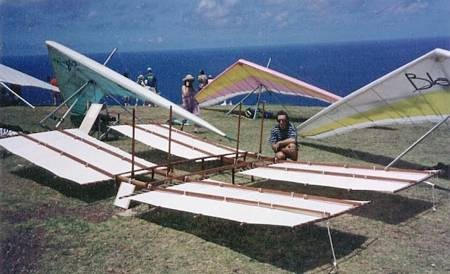
A replica of the Hargrave Tandem Monoplane Glider of 1894 built by Rob De Groot, photographed at the Hang Gliding World Championships of 1994 – the 100th anniversary of the glider designed and built by the Australian pioneer Lawrence Hargrave. As the originals only flight was unsuccessful, Hargrave shied away in his career from monoplanes, adopting instead the idea of biplanes (box-kite designs). The tandem wing monoplane however, became a concept Langley later saw fit to continue with his Aerodrome in 1903.

Explorer amphibian design from Dean Wilson, to provide full living accommodation for five people and carry a vehicle or bulk freight loaded via a swing-open tail. First flown 1991.
France
Hubert de Chevigny commissioned the Explorer amphibian design from Dean Wilson, to provide full living accommodation for five people and carry a vehicle or bulk freight loaded via a swing-open tail. First flown 1991.
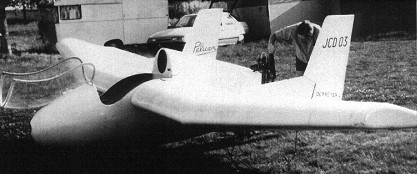
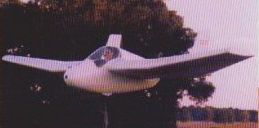
The “Pélican” flying wing was designed by Jean-Claude Debreyer based on the AV-36. Unlike that machine, however, it is not designed for soaring but only for inexpensive powered flight. The designer’s goal was to produce a machine that was easy to build, ultra-light and low in cost, which explains the choice of the flying wing configuration, the low aspect ratio of the wing and the tandem landing gear. The prototype was built of wood with a few laminated parts; the wing section was the same as that of the AV-36 (Fauvel F4 17%). The two-stroke engine, mounted at the rear of the short fuselage, between the two fins, drives a two-bladed propeller directly. The Air Est Services, based in eastern France, offers a kit version, built of composite materials, named JCD-03. It can be equipped with a 12 hp Solo engine or a 24 hp Koenig which gives a considerable improvement over the original performance figures.
The Pelican is transformed into the Eagle by substituting a 24 hp direct drive Konig for the Solo.
Wing span: 7.92 m
Length: 3.10 m
Wing area: 12.0 sq.m
Airfoil: Fauvel F4 17%
Empty weight: 85 kg
Max. weight: 175 kg
Engine: Solo 15 ch
Propeller diameter: 75 cm
Takeoff run: 150 / 200 m
Stall speed: 45 km/h
Cruise speed: 75 km/h
Endurance: 3 hours
Air Est JCD-03 Eagle
Empty weight: 90 kg
Wing span: 7.2 m
Wing area: 12 sq.m
Fuel capacity: 20 lt
Engine: Konig SC 430, 24 hp
MAUW: 200 kg
Seats: 1
Max speed: 130 kph
Cruise speed: 90 kph
Minimum speed: 40 kph
Climb rate: 3 m/s
Fuel consumption: 8 lt/hr
Kit price (1998): 45 000 F sm

